

Talent assessment is the systematic process of measuring a candidate’s or employee’s job-relevant skills, competencies, and behaviors using standardized tools to predict on-the-job performance. Unlike resume screening or gut-feel interviews, talent assessment uses objective criteria to improve hiring accuracy, reduce bias, and support data-driven workforce decisions. The industry term you’ll encounter most often is pre-employment assessment or structured evaluation, though talent assessment covers the full employee lifecycle. Tools like iMocha, Workhuman, and MetaView have made these processes faster and more defensible. Whether you’re screening software engineers in Mexico City or evaluating leadership candidates in São Paulo, the method matters as much as the outcome.
What is talent assessment and why does it matter?
Talent assessment is defined as a structured evaluation process that measures knowledge, skills, abilities, and other characteristics (KSAOs) against the specific requirements of a role. It replaces the two most common hiring errors: over-reliance on polished resumes and over-reliance on interviewer intuition. Both of those inputs are notoriously unreliable predictors of actual job performance.
The benefits of talent assessment are concrete and measurable. Organizations that use objective, role-specific criteria report higher quality of hires, shorter time-to-fill, and greater hiring fairness. That last point matters legally as well as ethically. When your selection criteria are documented and tied to job requirements, you have a defensible record if a hiring decision is ever challenged.

The importance of talent assessment also extends beyond the hiring decision itself. Assessment tools applied across the lifecycle including cognitive tests, personality profiles, and job simulations give HR teams a clearer picture of employee potential, not just current skill levels. That data becomes the foundation for onboarding plans, development programs, and succession pipelines.
Planning a hire?
Talk through the best hiring option
This article usually leads to one practical question: should you use staffing or salary guide? We can help you choose quickly.
Simple next step
Start with staffing and we will help you pick the best hiring setup.
Three named frameworks anchor most modern assessment programs: the Uniform Guidelines on Employee Selection Procedures (UGESP), which set the legal standard in the U.S.; the KSAO model, which defines what to measure; and competency-based scorecards, which define how to score it. Understanding all three is non-negotiable for any HR professional building or auditing an assessment process.
What are the main types of talent assessment methods?
Assessment tools cluster into four broad categories, each measuring a different dimension of candidate fit. Knowing which category to use for which role is the first practical decision you’ll make when designing an assessment program.
Cognitive assessments measure how quickly and accurately a candidate processes information, solves novel problems, and learns new material. For technical roles in FinTech or SaaS, cognitive ability is often the strongest single predictor of ramp time.
Personality assessments evaluate behavioral tendencies rather than fixed traits. Tools in this category help you understand whether a candidate’s natural working style aligns with the team’s operating rhythm. They work best when paired with a structured interview, not used in isolation.
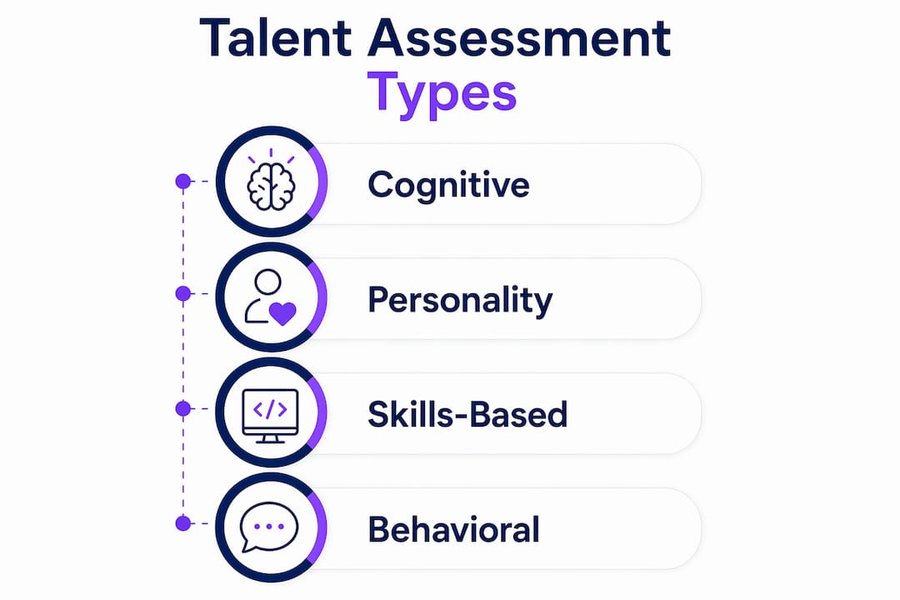
Skills-based assessments are the most direct method. A coding challenge, a financial modeling exercise, or a written sales pitch tests exactly what the job requires. Platforms like iMocha specialize in technical skills testing across hundreds of programming languages and frameworks.
Behavioral assessments, including situational judgment tests and structured interviews with scored rubrics, capture how candidates have responded to real challenges in the past. Behavior-based, role-relevant questions anchored to a weighted scorecard produce more consistent evaluations than open-ended conversation.
Pro Tip: Don’t default to a single assessment type. The most predictive hiring processes combine at least two methods, such as a skills test paired with a structured behavioral interview, to capture both what a candidate can do and how they do it.
How to design a legally defensible assessment process
Building an assessment process that holds up under legal scrutiny requires more than choosing a reputable vendor. The UGESP framework requires that every selection procedure be job-related and consistent with business necessity. That standard applies whether you’re using a cognitive test, a coding challenge, or a structured interview.
Here is a practical sequence for building a defensible process:
- Conduct a job analysis. Document the KSAOs required for the role before selecting any assessment tool. This step is the legal and practical foundation of everything that follows.
- Define your scoring rubric. A simple, weighted scorecard anchored to the competencies identified in your job analysis produces consistent results across interviewers and candidates.
- Select validated tools. Vendor claims of validation are not sufficient on their own. Good test validity typically correlates between 0.2 and 0.4, and that validity must be demonstrated for your specific job, scoring approach, and applicant pool.
- Monitor for adverse impact. The four-fifths rule, defined in UGESP, flags when a selection rate for any protected group falls below 80% of the highest-scoring group. Track this data from day one.
- Document everything. Documentation of KSAOs and validation studies tied to your specific applicant population is what separates a defensible program from a legally risky one.
- Review and update regularly. Validity is context-specific. Changing the job, the scoring rules, or the candidate pool can materially affect both predictive validity and adverse impact profiles.
Pro Tip: When a vendor tells you their assessment is “fully validated,” ask for the criterion-related validity study specific to your industry, job level, and scoring method. Generic validation reports do not satisfy UGESP requirements.
How talent assessments support the employee lifecycle beyond hiring
Most HR teams deploy assessments at the point of hire and then stop. That’s a significant missed opportunity. Organizations that use assessment tools across multiple lifecycle stages including onboarding, development, and succession planning get compounding returns on the initial investment in assessment design.
The applications beyond hiring include:
- Onboarding calibration. Assessment data collected during hiring gives managers a baseline for new employee strengths and gaps, allowing onboarding plans to address real deficiencies rather than generic training modules.
- High-potential identification. Cognitive and personality data, combined with early performance metrics, helps HR teams identify employees who are ready for accelerated development before a manager nominates them informally.
- Personalized development plans. Skills-based assessments administered six to twelve months post-hire reveal whether an employee has grown into the role or plateaued, giving L&D teams specific targets rather than broad curricula.
- Internal mobility decisions. When a new role opens, existing assessment data on current employees reduces the time and cost of internal screening. It also makes internal mobility more equitable by applying the same criteria used for external candidates.
- Succession planning and leadership pipelines. Behavioral and cognitive data on senior individual contributors helps HR teams build leadership pipelines grounded in evidence rather than visibility or tenure.
The practical implication is that your assessment architecture should be designed from the start to generate reusable data. A skills test administered at hiring that cannot be referenced during a promotion decision is a wasted asset.
How technology platforms enhance assessment effectiveness
Assessment technology has moved well beyond basic multiple-choice tests. Modern platforms integrate cognitive testing, behavior analysis, and structured interview guides into a single workflow that produces evidence-based candidate profiles and reduces the administrative burden on hiring teams.
The most significant benefits of assessment technology fall into four areas. Speed: automated scoring eliminates the lag between test completion and hiring team review. Consistency: every candidate takes the same test under the same conditions, removing the variability that plagues unstructured processes. Bias reduction: structured scoring rubrics and blind review features reduce the influence of demographic signals on evaluation outcomes. Compliance support: platforms that log test conditions, scoring criteria, and results create the documentation trail that UGESP requires.
Platforms worth knowing include iMocha for technical skills testing across software, data, and cloud roles; MetaView for AI-assisted interview analysis and structured scoring; and Workhuman for performance and recognition data that feeds into development and succession decisions. For teams building or auditing their recruitment assessment tools, the key selection criteria are validity evidence, adverse impact reporting, and integration with your existing ATS.
Assessment instruments paired with structured interviews and background checks create a multi-signal evaluation architecture that outperforms any single method. The combination matters because no single assessment type captures the full picture of candidate fit. Technical skills tests tell you what someone can do today. Cognitive assessments tell you how fast they’ll grow. Behavioral interviews tell you how they’ll operate under pressure. Used together, they give you a defensible, predictive hiring decision. You can also explore how HR tech transforms recruitment workflows for global teams to understand how these platforms fit into a broader hiring architecture.
Key takeaways
Talent assessment works when it combines job analysis, validated tools, structured scoring, and continuous monitoring across the full employee lifecycle.
Why most assessment programs fail before they start
The most common failure I see in talent assessment programs is not a bad tool choice. It’s a missing job analysis. Teams select a cognitive test or a personality profile because a vendor demo looked impressive, then spend months trying to justify why the results don’t correlate with actual job performance. The tool isn’t the problem. The foundation is.
Misalignment between assessment scenarios and scorecard competencies is the second most common failure. I’ve reviewed interview scorecards where the behavioral questions tested conflict resolution but the scorecard measured strategic thinking. Interviewers scored candidates on criteria the questions never actually probed. The fix is straightforward: anchor every question to a specific competency on the scorecard, and keep the rubric simple enough that two interviewers independently reach the same score 80% of the time.
The third failure is treating assessment as a one-time setup. Validity is not permanent. When you change the role, the team, or the candidate pool, the predictive power of your existing tools can shift materially. The organizations that get the most from assessment programs treat validation as an ongoing practice, not a checkbox completed at launch.
My honest recommendation: start with a single, well-validated skills test tied to a documented job analysis, add one structured behavioral interview with a scored rubric, and build from there. Complexity added before the foundation is solid creates noise, not signal.
— Eugene
How Gentyrecruitment integrates assessment into every hire
Gentyrecruitment builds structured talent assessment into every stage of its recruitment process for U.S. and European tech companies hiring from Latin America. Every candidate in the Gentyrecruitment pool has been evaluated against role-specific technical and behavioral criteria before they reach your hiring team, which means you’re reviewing pre-vetted profiles rather than raw applications.
For companies hiring software engineers, data professionals, or sales talent across Argentina, Brazil, Mexico, and Colombia, Gentyrecruitment’s IT recruitment process combines skills-based screening, structured interviews, and English proficiency evaluation to deliver candidates who are ready to contribute from day one. If you want to hire pre-vetted LATAM talent faster and with greater confidence in candidate quality, Gentyrecruitment’s assessment-informed approach is built for exactly that outcome.
FAQ
What is talent assessment in simple terms?
Talent assessment is a structured process that uses standardized tests, interviews, and simulations to measure whether a candidate has the skills and behaviors a specific role requires. It replaces resume screening and unstructured interviews with objective, scored criteria.
What are the most common talent assessment methods?
The four primary methods are cognitive assessments, personality assessments, skills-based tests, and behavioral interviews. Most high-performing hiring processes combine at least two of these to capture both technical ability and behavioral fit.
How do talent assessments reduce hiring bias?
Structured scoring rubrics anchored to documented competencies reduce the influence of interviewer intuition and demographic signals on hiring decisions. Platforms like iMocha and MetaView add blind review features and standardized test conditions that further limit subjective variation.
Are talent assessments legally required in the U.S.?
They are not legally required, but any assessment used in hiring must comply with UGESP, which requires selection procedures to be job-related, consistent with business necessity, and monitored for adverse impact against protected groups.
How often should talent assessment tools be revalidated?
Revalidation is recommended whenever the role, scoring criteria, or candidate pool changes materially. Validity is context-specific, meaning a tool validated for one job level or applicant population may not perform the same way in a different context.