

Standardized hiring workflows look efficient on paper, but the moment you apply them to cross-border, remote recruitment in Latin America, small friction points stack up quickly into expensive, trust-eroding delays. A scheduling system built for on-site interviews in New York will not account for a candidate in Bogotá navigating a different time zone, a different legal framework, and a different communication culture. The result is slower pipelines, weaker candidate experiences, and lower offer acceptance rates. This article breaks down exactly where customization drives real value, which stages to prioritize, and how to implement changes without overcomplicating a process that already has enough moving parts.
Table of Contents
- The hidden costs of generic hiring processes
- What should be customized and what should not?
- Customizing AI, assessments, and selection for real outcomes
- LATAM-specific operational and legal requirements
- How to implement smart customization for remote recruitment
- Why ‘customization’ is often misunderstood in hiring and what actually drives results
- Ready to deploy tailored hiring solutions in LATAM?
- Frequently asked questions
Key Takeaways
The hidden costs of generic hiring processes
Most hiring managers assume that their time-to-hire problem comes from one big bottleneck, perhaps a slow background check vendor or an overloaded engineering team. In reality, hiring metrics reflect delays across multiple stages, and the damage from a generic workflow accumulates at every single step. A two-day delay in scheduling plus a three-day delay in feedback plus a one-day lag in offer generation adds up to a week lost before you even notice a problem.
Generic processes hurt you in three distinct ways. First, they fail to address the specific friction points of your hiring context. Second, outdated or poorly designed selection methods undermine the defensibility of your hiring decisions, meaning you cannot explain or justify why one candidate was chosen over another. Third, they create a poor candidate experience, which directly affects whether top-tier engineers in Medellín or São Paulo even accept your offer.
For US and European tech companies hiring in Latin America, the stakes are even higher. Consider a few realities:
What do you need?
Choose the hiring path that fits
After reading "Why customize hiring solutions for remote LATAM talent?", most teams compare these options before deciding how to hire.
- Timezone gaps between, say, Berlin and Buenos Aires can create a 4 to 6-hour window of overlap, and a generic scheduling tool will not optimize for that.
- Legal structures differ dramatically. Hiring a full-time employee in Brazil requires understanding CLT labor laws, while Mexico has its own social security and profit-sharing obligations.
- Communication norms vary too. What feels like a direct and efficient email in the US may come across as abrupt or underspecified in Colombia, affecting how candidates perceive your employer brand.
“The best hiring processes are not the most elaborate ones. They are the ones precisely calibrated to the actual barriers your team and your candidates face.”
Building faster tech hiring frameworks requires acknowledging that LATAM recruitment does not respond to cut-and-paste workflows. It rewards specificity, local awareness, and deliberate design.
What should be customized and what should not?

Now that you know customization matters, let’s break down where it drives the biggest difference. Not every process step needs a bespoke solution. In fact, over-engineering the wrong stages wastes resources and creates confusion for interviewers, coordinators, and candidates alike.
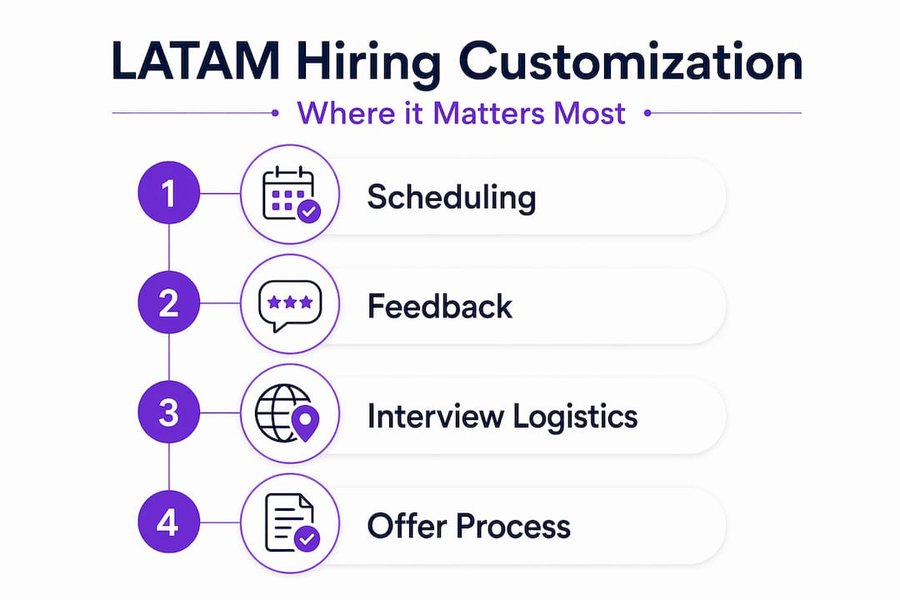
Customization should focus on stages creating measurable delays, such as scheduling, feedback turnaround, and interviewer availability, rather than trying to redesign every element simultaneously. Here is a practical comparison to guide your priorities:
This table makes clear that the biggest customization opportunities cluster around scheduling, feedback, and offer logistics. These are exactly the stages where cross-border complexity introduces the most friction. The core structure of your hiring pipeline, meaning your job intake process, your ATS configuration, and your core competency rubrics, can and should stay consistent.
Pro Tip: Before you redesign anything, pull your stage-by-stage time data from your ATS. If a stage consistently takes more than twice the median for that role type, that is your first customization target. Everything else can wait.
Here is a practical sequence to get started:
- Audit your current funnel by mapping every stage and its average time-to-completion across your last 20 to 30 LATAM hires.
- Identify the three stages with the highest delay variance, not just the highest average time.
- Customize those stages first, implementing targeted changes such as timezone-smart scheduling or a 24-hour feedback SLA.
- Leave stable stages alone until you have measured the impact of your initial changes.
- Document your process so that each customization is repeatable and not dependent on one team member’s memory.
Understanding how recruitment tech transformations can accelerate this audit process is critical, especially for fast-scaling teams that do not have a dedicated recruiting operations function.
Customizing AI, assessments, and selection for real outcomes
Once workflow priorities are clear, the next big customization frontier is AI ranking and candidate evaluation. AI-powered candidate ranking tools are now standard in most modern ATS platforms, but their default configurations are built for a generic user base, not for a FinTech company in Amsterdam hiring a senior back-end engineer in Mexico City.
Generic candidate-ranking logic can reward wrong signals. If your AI model weights years of experience at large enterprises, it will systematically downrank strong engineers from LATAM who built impressive products at smaller, high-growth companies. Custom rubrics, scoring thresholds, and governance controls align the model’s output with what your team actually values.
Here is a look at the controls modern AI hiring platforms typically offer, and how to apply them for LATAM recruitment:
The second major risk with AI in this context is auditability. Lack of governance can erode trust and create compliance risk, especially when you are making hiring decisions that affect workers in multiple jurisdictions. Adding human checkpoints at the screening and shortlist stages is not optional. It is how you protect both your company and your candidates.
Pro Tip: When deploying custom AI hiring logic, run a parallel test for the first 30 days. Score candidates manually alongside your AI tool, then compare outputs. This calibration step catches misconfigured rubrics before they influence live hiring decisions.
Assessment customization follows the same logic. A generic coding test built for a US audience may reference infrastructure or tooling assumptions that do not match how senior engineers in Argentina or Brazil structure their work. Calibrating assessment difficulty, format, and scenario relevance to the specific LATAM talent pool you are targeting will improve both candidate experience and the predictive validity of your results.
LATAM-specific operational and legal requirements
The real test of customization comes in cross-border, remote-first hiring for LATAM, where the details matter most. Latin America is not a monolithic region. Brazil, Mexico, Colombia, Argentina, and Chile each have distinct labor laws, tax structures, public holiday schedules, and employment norms that directly affect how you hire and retain talent.
Customization is driven by time-zone overlap, communication norms, and legal mechanics, including the critical decision between Employer of Record (EOR) and direct entity models, which vary by country and company size. A US startup hiring its first two engineers in Colombia may find that an EOR model is the fastest and most compliant path forward, while a European scale-up with 15 existing hires in Brazil may benefit more from establishing a local entity.
Key factors that hiring managers and founders frequently underestimate include:
- Mandatory benefits: Brazil’s CLT framework includes a 13th-month salary, profit sharing (PLR), and mandatory vacation provisions that must be reflected in offer letters and contracts.
- Currency volatility: Argentina’s persistent inflation and currency controls affect how compensation packages are structured and how frequently they need to be reviewed.
- Notice periods: In Mexico, notice period conventions differ significantly from US at-will employment, affecting offboarding planning and contractor-to-employee conversions.
- Cultural interview norms: In several LATAM countries, candidates expect more interpersonal warmth and context-setting in early-stage interviews. A purely transactional screening call can reduce offer acceptance rates.
- Public holidays: A standardized interview schedule that ignores Carnival week in Brazil or Día de Muertos in Mexico will generate friction and signal a lack of cultural awareness.
For tailoring tech recruitment in LATAM, the most effective approach treats each country as its own hiring market with its own operating playbook rather than a geographic extension of your existing process.
Statistic to note: Teams that align their hiring process to local market norms in LATAM report significantly shorter time-to-acceptance windows and higher first-year retention rates compared to teams that apply a generic global framework.
How to implement smart customization for remote recruitment
You have seen why and where customization matters. Here is a proven implementation path that avoids overwhelm while driving real results. The key is sequencing: do not try to overhaul your entire pipeline at once.
Adapting funnel steps, rather than copying onsite assumptions, is crucial to remote hiring success. Here is a structured rollout sequence:
- Audit your current remote hiring funnel. Map every stage, its owner, its average duration, and its most common failure mode. Flag steps that were designed for in-person hiring and have not been adapted for async or remote contexts.
- Rank customization opportunities by impact and effort. A simple two-by-two matrix (high impact vs. low effort first) will help you sequence changes without overwhelming your recruiting team.
- Pilot one or two targeted customizations. For example, implement timezone-aware scheduling for LATAM candidates and a mandatory 48-hour feedback SLA for hiring managers. Run the pilot for 30 days.
- Measure stage-specific metrics before and after. Track time-to-schedule, time-to-feedback, and candidate drop-off rate at each stage. These numbers will tell you whether your customization is working.
- Document and standardize successful changes. Once a customization proves effective, encode it into your process documentation and ATS configuration so it is not lost when team members change.
- Review quarterly. The LATAM talent market evolves quickly, and what works in 2026 may need adjustment as new countries open up or labor regulations shift.
Building a scalable hiring pipeline means designing for growth from the start, not retrofitting customizations after a hiring crisis. Pairing this approach with recruitment automation strategies creates a compounding advantage: each automated, customized step reduces recruiter workload while improving candidate experience.
Pro Tip: Assign a single owner to each customization pilot. Without clear ownership, changes stall in review cycles, and the process reverts to its default state within weeks.
Why ‘customization’ is often misunderstood in hiring and what actually drives results
Here is a perspective that most hiring guides will not give you: the biggest risk in customization is not doing too little. It is doing too much in the wrong places. We see this pattern repeatedly with fast-growing tech companies that have read about process optimization and decide to redesign their entire hiring funnel at once. They emerge three months later with a beautifully documented process that nobody follows because it is too complex to execute consistently.
Highly customizable process tooling adds complexity, and complexity is the enemy of consistency. If a process step rarely causes delays or derails offers, leave it alone. Standardization is your friend in those areas. Spend your customization budget, whether that is time, money, or attention, on the stages where data shows actual bottlenecks.
The most effective hiring leaders we work with follow a simple rule: if a metric is not broken, do not touch it. They start with time-to-hire data segmented by stage and country, identify the two or three stages with the highest delay variance, and focus every customization effort there. Everything else stays standard. This discipline produces faster results and avoids the “shiny object” trap of adopting every new hiring trend without evidence that it addresses a real problem in your specific pipeline.
Ready to deploy tailored hiring solutions in LATAM?
Effective customization is tough to execute alone, especially when you are navigating country-specific labor laws, timezone logistics, and AI tool configurations simultaneously. That is where specialized expertise accelerates everything.
Genty Recruitment builds precisely customized hiring solutions for US and European tech companies sourcing remote talent across Latin America. Whether you need IT recruitment in LATAM with pre-screened technical candidates, access to a curated pipeline of pre-vetted tech talent ready to integrate into your global team, or end-to-end staffing and EOR solutions that handle compliance across Brazil, Mexico, Colombia, and Argentina, we have the regional expertise and structured assessment process to deliver results faster than a generic recruiting approach ever could.
Frequently asked questions
Why do remote hiring processes need more customization than on-site hiring?
Remote hiring introduces greater delay points, compliance differences, and communication gaps that a generic workflow cannot address. Adapting funnel steps to remote-first dynamics, rather than copying on-site assumptions, is essential for consistent results.
How does customizing AI tools improve hiring results?
Custom AI candidate ranking aligns scoring with your actual business needs and reduces compliance risk. Configurable rubrics and governance controls ensure the model rewards the competencies your team actually values rather than generic proxies.
Which hiring workflow steps create the biggest delays?
Scheduling, interview evaluation, and feedback loops are the most consistent delay sources in tech hiring funnels. Automated scheduling is 26% faster than manual scheduling, making it one of the highest-ROI customizations you can implement immediately.
What is the difference between EOR and direct entity hiring in LATAM?
EOR lets you hire without setting up a legal entity in a new country, while direct entity hiring means your company manages local compliance, payroll, and benefits administration directly. The right choice depends on your headcount, growth plans, and risk tolerance in each specific LATAM market.
Can over-customization hurt the hiring process?
Yes. Excessive customization adds operational complexity and reduces consistency across your recruiting team. Focus customization only on stages where data shows real delays or compliance risks, and leave everything else standardized.