

Fast hiring is defined as moving decisively through the recruitment process to secure qualified candidates before competitors do. In tech, where top talent exits the market within 10–14 days, slow processes are not just inefficient. They are expensive. The industry term for this discipline is recruitment velocity, and it directly determines whether your team grows or stalls. The average time-to-hire sits at 36 days, while top-performing companies close roles in 14. That 22-day gap costs offer acceptance rates, team productivity, and in competitive LATAM markets, it costs you candidates in Argentina, Brazil, and Colombia who have three other offers on the table. GENTY recruitment delivers curated shortlists within 7 days precisely because that window is where the real competition happens.
Why fast hiring is important: the core business case
Fast hiring produces measurable business outcomes, not just a smoother candidate experience. Candidates who receive a response within 24 hours are 3 times more likely to continue in the hiring process. That single data point reframes the entire recruitment funnel. Speed is not a courtesy. It is a conversion lever.
The benefits of quick hiring compound across the organization:
- Higher offer acceptance rates. Every extra week in the process cuts offer acceptance by 10–15%. A 4-week delay can reduce your acceptance probability by nearly half.
- Reduced time-to-productivity. A new engineer who starts in week 3 instead of week 7 contributes a full month of output. For a senior DevOps role, that difference is measurable in deployment cycles.
- Stronger employer brand. Hiring speed signals organizational health to candidates. A fast process tells engineers that your company makes decisions, respects their time, and operates with clarity.
- Lower team burnout risk. Extended vacancies force existing engineers to absorb extra workload. That pressure compounds quickly in sprint-based environments.
LATAM timezone alignment amplifies these benefits. Engineering teams in Mexico City, Bogotá, and Buenos Aires overlap with US EST and PST hours, which means feedback loops between hiring managers and candidates happen in real time, not across a 12-hour gap.
Before you start hiring
Check location, salary, and hiring fit
If you are moving from research to action, start with the market basics so your hiring plan is clearer.
Pro Tip: Set a 24-hour internal SLA for candidate feedback at every stage. Teams that enforce this rule consistently close roles faster without changing their evaluation criteria.
How does fast hiring impact quality of hire and long-term retention?
Speed and quality are not opposites. The concern that moving fast forces poor decisions is real, but it applies to unstructured speed, not to well-designed rapid processes.

Structured interviews combined with AI-driven summaries improve both hiring speed and decision quality by cutting redundant steps without losing candidate insight. A four-round interview process that takes six weeks does not produce better hires than a two-round process completed in ten days. It produces exhausted candidates and inflated dropout rates.
The common pitfalls of rushed hiring are specific and avoidable:
- Skipping a technical assessment because the hiring manager is impatient
- Failing to align stakeholders on the role definition before sourcing begins
- Confusing urgency with pressure, which pushes candidates toward counteroffers
Long-term retention improves when the hiring process itself is a positive experience. Candidates who feel respected during recruitment carry that perception into their first 90 days. In LATAM markets, where referral networks in cities like São Paulo and Medellín are tight, a poor candidate experience spreads quickly.
GENTY recruitment’s skill-first process addresses this directly. Pre-vetted shortlists from Argentina, Brazil, Mexico, and Colombia arrive with technical assessments already completed. Hiring managers evaluate fit, not raw volume, which compresses the decision timeline without cutting corners.
Pro Tip: Define your non-negotiable technical requirements before the search begins. Changing the role definition mid-process is the single most common cause of avoidable delays.
What practical strategies can tech companies use to speed up hiring?
Recruitment velocity improves through process design, not just urgency. Recruitment agility, defined as the ability to forecast and adjust hiring rapidly, is a fundamental competitive advantage for tech companies. The following steps build that agility systematically.
- Forecast roles before they open. Use sprint velocity data and product roadmaps to predict hiring needs 60–90 days out. Reactive hiring always takes longer than planned hiring.
- Write the role definition as a team. Engineering lead, hiring manager, and HR must align on must-have skills before sourcing starts. Misalignment discovered mid-process adds weeks.
- Set candidate communication SLAs. Delays of even 5–10 minutes reduce hiring likelihood significantly, based on analysis of 11.66 million transactions. Build same-day response into your process as a rule, not a goal.
- Use structured, time-boxed interviews. Two rounds with clear scorecards beat five rounds with vague impressions. Assign a decision owner before the first interview.
- Partner with specialists for LATAM sourcing. Timezone overlap between US hubs and LATAM markets like Mexico, Colombia, and Argentina reduces communication delays and accelerates the hiring cycle significantly.
The table below compares typical hiring timelines across two approaches:
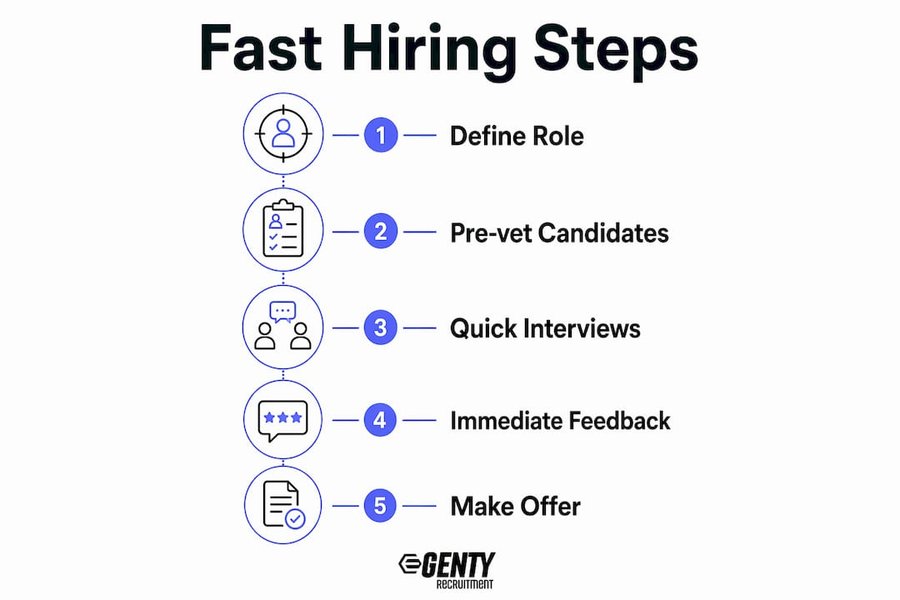
Pro Tip: Assign one internal hiring coordinator per open role. Distributed ownership is the most common reason feedback stalls between interview rounds.
What are the hidden costs of slow hiring in tech?
Slow hiring carries costs that rarely appear on a recruiter’s dashboard. A 30-day delay for a $100,000 role costs over $8,000 in lost productivity, excluding team disruption. For a senior engineer at $150,000, that number scales proportionally.
The operational damage goes further than lost output:
“Extended vacancies cause ‘team drag’, increasing workload on current employees and potentially leading to burnout and turnover. Hidden costs exceed recruiter fees.” — The 90-Day Hiring Lag
49% of employees report feeling overwhelmed due to unfilled roles on their team. That figure represents a direct pipeline from vacancy to attrition. When your best engineers carry two jobs for three months, they start looking.
The competitive cost is equally concrete. A tech company that fills a critical AI engineering role in 20 days gains a full product sprint over a competitor that takes 90 days. In FinTech and SaaS, where release cycles determine market position, that gap is not recoverable. Companies using data-driven recruitment and structured communication gain strategic leads through faster workforce reconfiguration.
LATAM hiring reduces these risks structurally. Salary benchmarks for senior engineers in Colombia and Argentina run 30–40% below US equivalents for comparable skill levels. That cost difference means you can fill roles faster, at lower risk, without sacrificing technical depth. GENTY recruitment’s fixed-fee pricing and 3-month replacement guarantee remove the financial exposure that typically makes hiring leaders hesitate.
Key takeaways
Rapid recruitment is a competitive discipline. Tech companies that close roles in 14–21 days consistently outperform those stuck in 60-day cycles on offer acceptance, team stability, and product velocity.
Speed without discipline is just haste
The most common mistake I see tech hiring leaders make is treating urgency as a strategy. They feel the pressure of an open role, skip the role-definition step, and start sourcing before the team agrees on what they actually need. The result is a fast process that produces the wrong hire, followed by a slow termination and an even slower restart.
The companies that hire well and fast share one habit: they do the slow work upfront. They write clear job definitions. They align stakeholders before the first resume arrives. They build feedback SLAs into their calendar, not their intentions. When those foundations are in place, speed becomes a natural output of the process, not a risk to it.
What I find consistently true in LATAM hiring is that the timezone advantage is real but underused. A hiring manager in San Francisco who sends feedback at 5 PM PST reaches a candidate in Buenos Aires at 9 AM the next morning. That is not a delay. That is a same-day response in the candidate’s working day. Teams that understand this rhythm close LATAM roles faster than they close domestic ones, once they stop treating the timezone as a barrier.
The other pattern worth naming: candidates read your process as a preview of your culture. A disorganized, slow, feedback-free hiring experience tells engineers exactly what working at your company will feel like. The best LATAM engineers in FinTech, AI, and SaaS have options. They choose companies that communicate clearly and move with purpose.
— Eugene
GENTY recruitment: pre-vetted LATAM talent, delivered in 7 days
Tech companies that need to fill engineering, DevOps, or sales roles without a 60-day wait have a direct path through GENTY recruitment’s IT recruitment in LATAM service. GENTY recruitment sources pre-vetted talent from Argentina, Brazil, Mexico, Colombia, and Chile, with curated shortlists delivered within 7 days of role confirmation.
The model is built for hiring managers who need speed without sacrificing technical depth. Fixed-fee pricing by seniority level, no upfront payments, and a 3-month replacement guarantee remove the risk from moving fast. Clients save up to 40% compared to US or European hiring rates while gaining engineers who work in overlapping EST and PST hours. For FinTech, SaaS, and AI teams that cannot afford a 90-day vacancy, GENTY recruitment is the fastest path to a qualified hire. Reach out to GENTY recruitment to get your first shortlist within a week.
FAQ
Why does fast hiring matter in tech specifically?
Tech roles require rare skill combinations, and top candidates exit the market within 10–14 days. A slow process does not just delay a hire. It eliminates the best candidates from your pool entirely.
Does hiring fast reduce the quality of new hires?
Not when the process is structured. Structured interviews with defined scorecards and pre-vetted shortlists maintain quality while cutting unnecessary steps. The risk comes from unstructured speed, not from moving quickly through a well-designed process.
What is a realistic time-to-hire for senior tech roles?
Top-performing companies achieve a 14-day time-to-hire for tech roles. The industry average is 36 days, and senior roles often exceed 60 days without a specialized recruitment process.
How does LATAM hiring reduce time-to-fill?
Timezone overlap between US EST/PST and LATAM markets in Mexico, Colombia, Argentina, and Brazil enables same-day communication cycles. That alignment compresses feedback loops and shortens the overall hiring timeline compared to offshore alternatives.
What is the cost of a 30-day hiring delay?
A 30-day delay on a $100,000 role costs over $8,000 in lost productivity, not counting team disruption or the burnout risk from redistributed workload.