
The usual advice for hiring analysts starts with a checklist of SQL, Excel, Python, and dashboard tools. That's the wrong starting point. Data analyst recruiters need a defined business output, an appropriate pay band, and a scored assessment before they need software keywords. For a Series A–C company, the useful shortlist is the one that separates someone who can maintain reporting from someone who can design experiments or own predictive models. Those aren't interchangeable jobs, and they shouldn't share an undifferentiated salary benchmark.
Match the Analyst Brief to the Right Pay Band
A recruiter can't price or scope a search from the title alone. The following occupational benchmarks, including the 2025 US median wages, are reported in the South Dakota Mines data analytics jobs guide.
Treat these as occupational reference points, not ready-made offers. They aren't startup-specific salary bands, and they don't establish European compensation. Use them to identify the work family before adjusting for seniority, location, employment structure, and accountability.
Translate the title into a deliverable
Say your VP Sales needs a reliable weekly pipeline review. The analyst must reconcile CRM records, define conversion stages, and explain why the dashboard changed. That brief sits nearer the reporting end of the table, even if the candidate uses Python to automate extraction.
Before you start hiring
Check location, salary, and hiring fit
If you are moving from research to action, start with the market basics so your hiring plan is clearer.
A product team asking whether an onboarding change improved activation needs different evidence. The analyst must define exposure, consider selection effects, explain uncertainty, and recommend whether to ship. Forecasting and decision-support responsibilities warrant a different search from routine dashboard maintenance.
Someone owning churn prediction needs to explain training data, leakage, evaluation choices, and model limitations. Don't recruit that person under a reporting brief because the company calls everyone an analyst.
Separate benchmarking from offer setting
For broader role comparisons, Mojolin's compensation reference for technology hiring provides another resource to consult while defining the role. For a regional search, use Data, AI & ML salary benchmarking to investigate the relevant talent market rather than treating a US median as a universal rate.
Write down who owns the warehouse, instrumentation, and production deployment, too. Otherwise, the recruiter may search for an analyst while the hiring manager expects an analytics engineer.
Briefing rule: Specify recurring reporting, experimentation, forecasting, or model ownership before choosing a benchmark, seniority label, or keyword filter.
Write the Scorecard and Brief the Recruiter
Start with observable evidence. A scorecard should tell the recruiter what qualifies someone for an interview and tell your reviewers why a candidate passed.
Define the evidence before sourcing
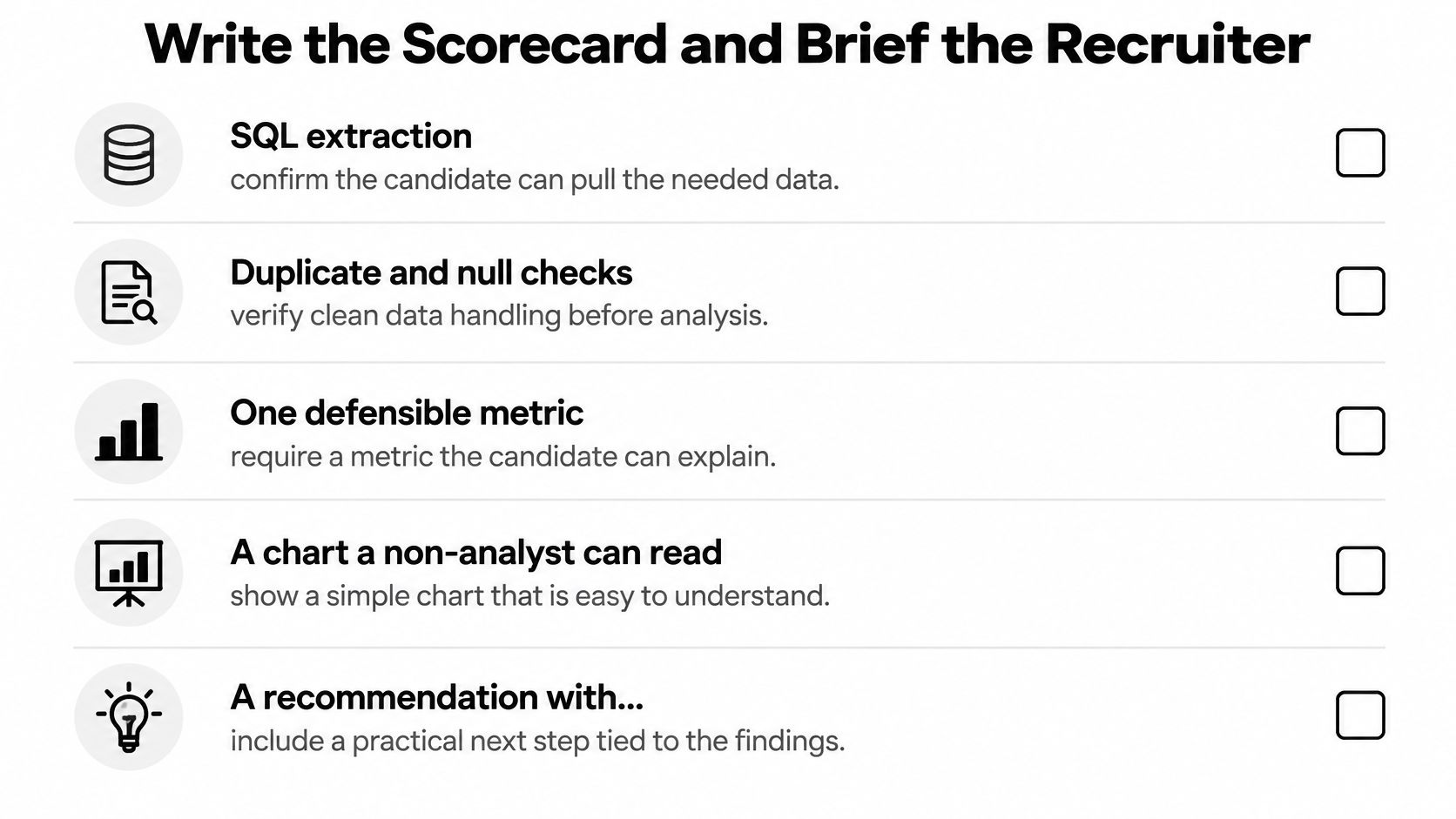
Use these assessment lines, with domain judgment separate from tool execution:
SQL extraction. Can the candidate identify the right grain, join tables without inflating results, and explain the query?
Duplicate and null checks. Require a method for finding unreliable records and explaining their treatment.
One defensible metric. Ask for the numerator, denominator, population, and exclusions. A conversion rate without an eligible population isn't sufficiently defined.
A chart a non-analyst can read. Look for appropriate scales, meaningful labels, and a visible answer to the business question.
A recommendation with stated assumptions. The candidate should distinguish what the analysis supports from what still needs investigation.
Domain judgment. Test whether the candidate understands the operating decision, not merely the dataset.</li>
Domain knowledge deserves explicit assessment: an Interview Query analysis of 1,355 US Glassdoor postings found 69.3% sought domain expertise, compared with 30.7% seeking generalist profiles; Excel appeared in 41.3%, Tableau in 28.1%, and Power BI in 24.7%.
For a fintech role, ask how the candidate would distinguish suspicious spending from legitimate changes in customer behavior. A candidate who identifies false-positive costs, customer segments, and investigation limits may be stronger than someone listing more visualization products.
Decide which gaps you can train
Set a practical onboarding assumption: learning a second BI product can be a 30-day training objective, provided the candidate already demonstrates sound reporting fundamentals. That's a planning choice, not a promise about every hire.
An inability to define a funnel or reason through pricing impact is different. If the role requires independent business analysis immediately, don't classify missing analytical judgment as a minor onboarding task.
Treat a degree as optional unless the seat needs a specialist credential. Verify joins, cleaning, and business implications directly, and don't use years of experience or keyword counts as pass-fail gates.
Attach a 1–5 scale to each line, with written descriptions of weak, acceptable, and strong evidence. Have two reviewers practice against the same example before interviewing candidates; the structured hiring guide for startups can help organize the handoffs.
Send a complete search packet
Give the recruiter these items together:
Output statement. Name the deliverable, its business owner, and the decision it supports.
Scorecard. Include the assessment lines, anchors, and required qualifications.
Work-sample specification. Define the exercise, permitted tools, scoring method, and candidate instructions.
Offer band. State the range and what additional responsibility would justify moving within it.</li>
Ask the recruiter to restate the packet before submitting anyone. Refuse an unscoped résumé dump, even if the profiles look impressive.
At GENTY recruitment, we check technical depth, English, and availability before an offer is made. Our Recruitment plan provides fixed-fee hiring for tech, sales, and operations across LATAM, starting from $2,999, including Data, AI & ML searches for data scientists and ML engineers. This week, freeze the scorecard, choose a search model, and brief a dedicated technical search with the completed packet.
Choose and Vet Data Analyst Recruiters
The model should match the workload and scarcity of the hire, not the agency's preferred package. An established internal recruiter may be the best choice when your technical team can assess candidates consistently. External support becomes more useful when you need domain access, sourcing capacity, or someone accountable for running the search.
Retained search doesn't remove your responsibility to define fit. Contingency doesn't automatically mean weak assessment, either. The useful distinction is whether the recruiter agrees to produce evidence against your requirements.
Ask for role-specific proof
Use these questions when evaluating external data analyst recruiters:
Placement mix. How many analysts placed in the last 12 months owned dashboards, experimentation, or modeling? Ask for separate categories, not a blended analytics count.
Screening discipline. Will the recruiter use your scorecard exclusively, or introduce undocumented filters?
Technical ownership. Who performs the first technical read, and what can that person evaluate independently?
Submission evidence. Will each name arrive with competency notes, demonstrated outputs, unresolved gaps, and availability?
Automation disclosure. How are candidates told about automated screening, and who reviews contested or ambiguous results?
Guarantee terms. What happens if the hire leaves within the guarantee window? Identify exclusions, replacement obligations, and your own responsibilities.</li>
For a broader commercial review, use these questions to ask a recruitment agency alongside the technical checks. Have procurement examine payment triggers and contractual commitments rather than assuming every agency uses the same terms.
Set a refusal threshold
A recruiter who leads with a SQL-plus-Tableau Boolean search hasn't yet demonstrated that they understand your role. Ask them to explain why an adjacent-domain candidate could qualify and what evidence would disqualify a familiar-industry candidate.
If they can't restate your outputs and work through your domain example, they aren't ready to source.
Don't proceed on the promise that the hiring manager will sort it out during interviews. That arrangement transfers the screening work back to your team while leaving the agency's submission standard undefined.
Score the Shortlist With One Work Sample
Use a bounded exercise to establish what candidates can do, then use the interview to investigate their choices. Comparative selection evidence summarized in the International Journal of Human Resource Management lists predictive-validity coefficients of .54 for work samples, .51 for structured interviews, and .18 for years of job experience.
Those coefficients aren't probabilities that a hire will succeed. They support using job-relevant evidence rather than treating tenure as proof of capability.
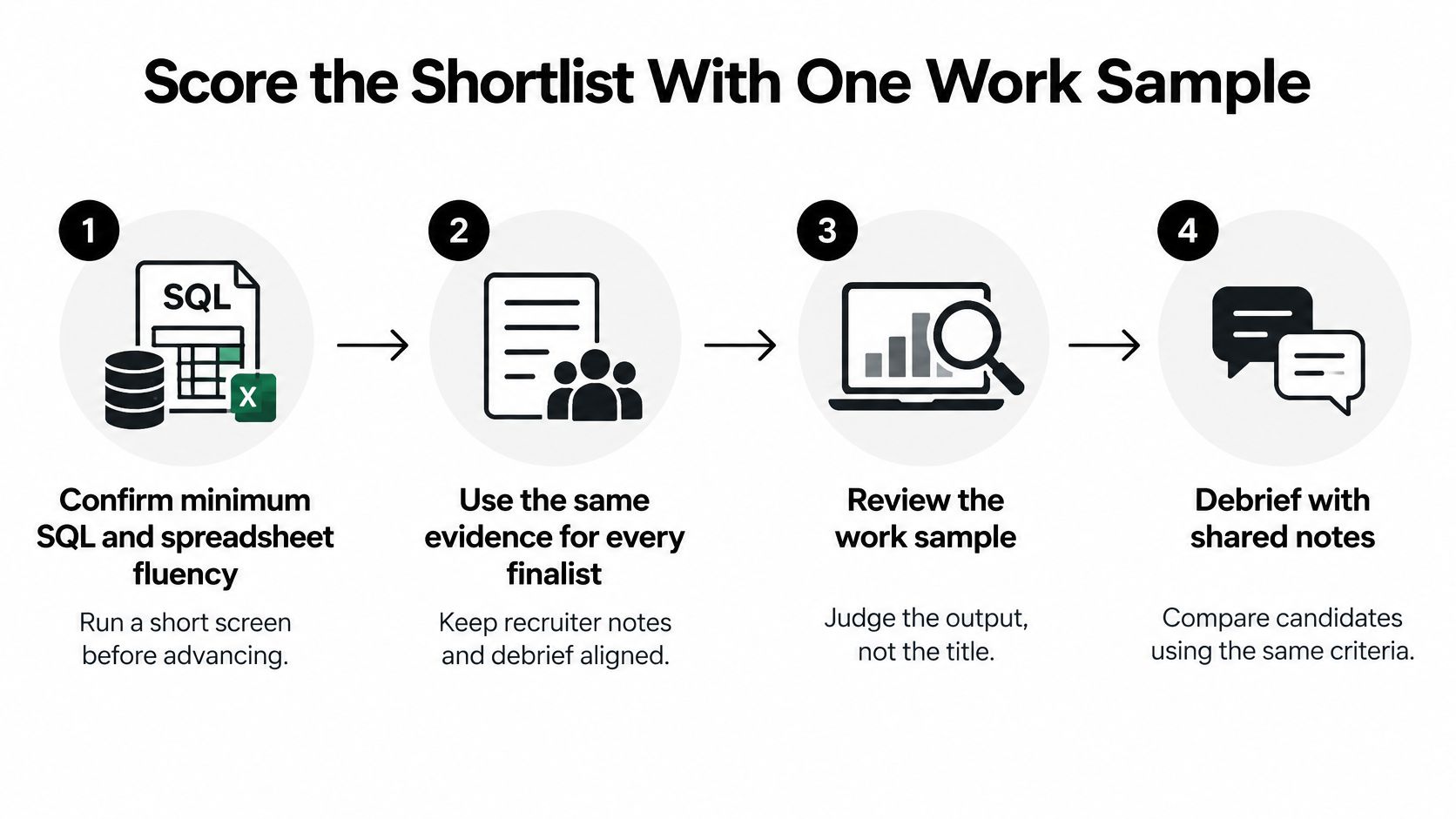
Run a standardized sequence
Confirm minimum SQL and spreadsheet fluency. Use a short screen with a join, aggregation, and basic reconciliation task. Don't advance someone solely on their previous title.
Give every finalist equivalent conditions. Supply the same small anonymized dataset, instructions, time box, and allowed tools. Require SQL extraction, identification of duplicate or missing records, a defensible metric, and a concise recommendation with assumptions and validation steps.
Score the output and process. Choose weights before reviewing submissions. For a reporting-focused seat, make technical accuracy and data-quality controls the highest priorities; for decision support, give reasoning greater emphasis.
Probe the exercise live. Have reviewers record evidence independently, then write a reason for each score. Ask what the candidate would change if a source table arrived late or an exclusion rule changed.</li>
Use explicit scoring anchors
The following is a proposed scoring template. Set each weight according to the seat's responsibilities before candidates start.
Prepare follow-ups from the candidate's actual work, using technical interview questions as prompts rather than an unrelated quiz.
Don't send an unpaid, open-ended take-home assignment or require access to your proprietary stack. Keep informal culture conversation outside the competency score; assess collaboration through concrete examples of handling disagreement, clarifying requirements, and correcting errors.
Set the Offer Without a Tool-List Premium
Price the offer for the responsibilities you'll assign, not the length of the candidate's skills section. Adding Python to a reporting résumé doesn't establish ownership of predictive modeling.
Within the approved range, evaluate independence, ambiguity, and accountability. Someone who can maintain an existing dashboard requires a different level of supervision from someone who must resolve conflicting metric definitions across product and finance.
Pay for accountable scope
Move the role into a different occupational comparison only when the work changes. Experiment design, forecasting ownership, or production model responsibilities must appear in the actual remit, not as optional capabilities the company might eventually use.
Ask the recruiter to support a higher offer with assessment evidence. A senior title at a previous employer isn't enough if the candidate still needs substantial prompting to validate a result.

Test AI fluency without opaque screening
PwC's US AI Jobs Barometer analysis found that skills requested in AI-exposed jobs were changing 66% faster than in other jobs, while US degree requirements fell from 63% of postings in 2019 to 53% in 2024.
Test useful behavior rather than AI vocabulary. Give the candidate AI-written SQL to validate, ask them to trace data lineage, identify an unsupported generated insight, and explain a privacy risk before uploading customer records.
Disclose automated evaluation and preserve human review. Don't make a missing degree an automatic rejection when the candidate can demonstrate the required analytical work.
Make cross-border terms explicit
If you source in Latin America, preserve the same output standard and assessment conditions. Set at least four hours of overlap with the relevant US Eastern or European working day as your scheduling requirement, and confirm it before shortlisting rather than assuming geography guarantees availability.
Explain how local market benchmarking and employment structure inform the offer. Don't invent a country-based discount from a US occupational median.
Confirm the employment arrangement in each country before issuing terms, including who employs the person and which benefits and obligations apply. Use a documented remote offer process so compensation, working hours, reporting lines, and acceptance conditions are explicit.
Offer discipline: A higher counteroffer needs new evidence of relevant responsibility, not a more impressive title.
GENTY recruitment offers data, AI, and ML hiring with a dedicated recruiter and pre-vetted candidates. Visit GENTY recruitment with your output statement, scorecard, assessment specification, and approved offer band to brief a search around the work your analyst will own.