
The popular advice for hiring a remote DevOps engineer is to start with cloud certifications and a Kubernetes checklist. Start with operating constraints instead. Before posting, decide the required time-zone overlap, on-call responsibility, production access and employment model. Then test incident judgment and automation ownership. A candidate who knows Terraform but can't coordinate a rollback without the infrastructure lead online isn't ready to own your production environment.
Define the Remote DevOps Role Before You Post
A remote role is an operating agreement, not a location perk. Your hiring manager, security lead and People Ops owner should agree on its boundaries before recruiters contact anyone.
Remote work is already normal in software engineering: Stack Overflow's 2024 Developer Survey found that 38% of respondents worked fully remotely and 42% worked in hybrid arrangements. The hiring question isn't whether infrastructure work can happen remotely. It's which arrangement your team can support.
Choose the constraints before sourcing
Use this worksheet to choose an option for each decision, then copy the selections into the job description. Treat geographic boundaries as hiring-policy choices, not assumptions about who can adjust their working hours.
What do you need?
Choose the hiring path that fits
After reading "DevOps Engineer Remote Hiring: Assess, Hire, Onboard", most teams compare these options before deciding how to hire.
Remote DevOps role decisions and their effect on the candidate pool
Overlap matters more than proximity when engineers must diagnose failures together. Pager duty plus deploy rights also demands more than pipeline maintenance: candidates must accept the schedule, and your company must approve their access.
Publish a plain-language role sheet
Include the title, overlap window in hours, on-call tier, access level, travel expectation and employment model. Use regional DevOps salary benchmarking to budget for that scope rather than pricing the title alone.
If deployment problems sit inside a stalled product, Grail Computer Labs' practical insights for stalled software products offer useful context for separating delivery-process problems from a missing infrastructure hire. Don't recruit someone to solve an undefined ownership dispute.
Score Operational Judgment Instead of Tool Lists
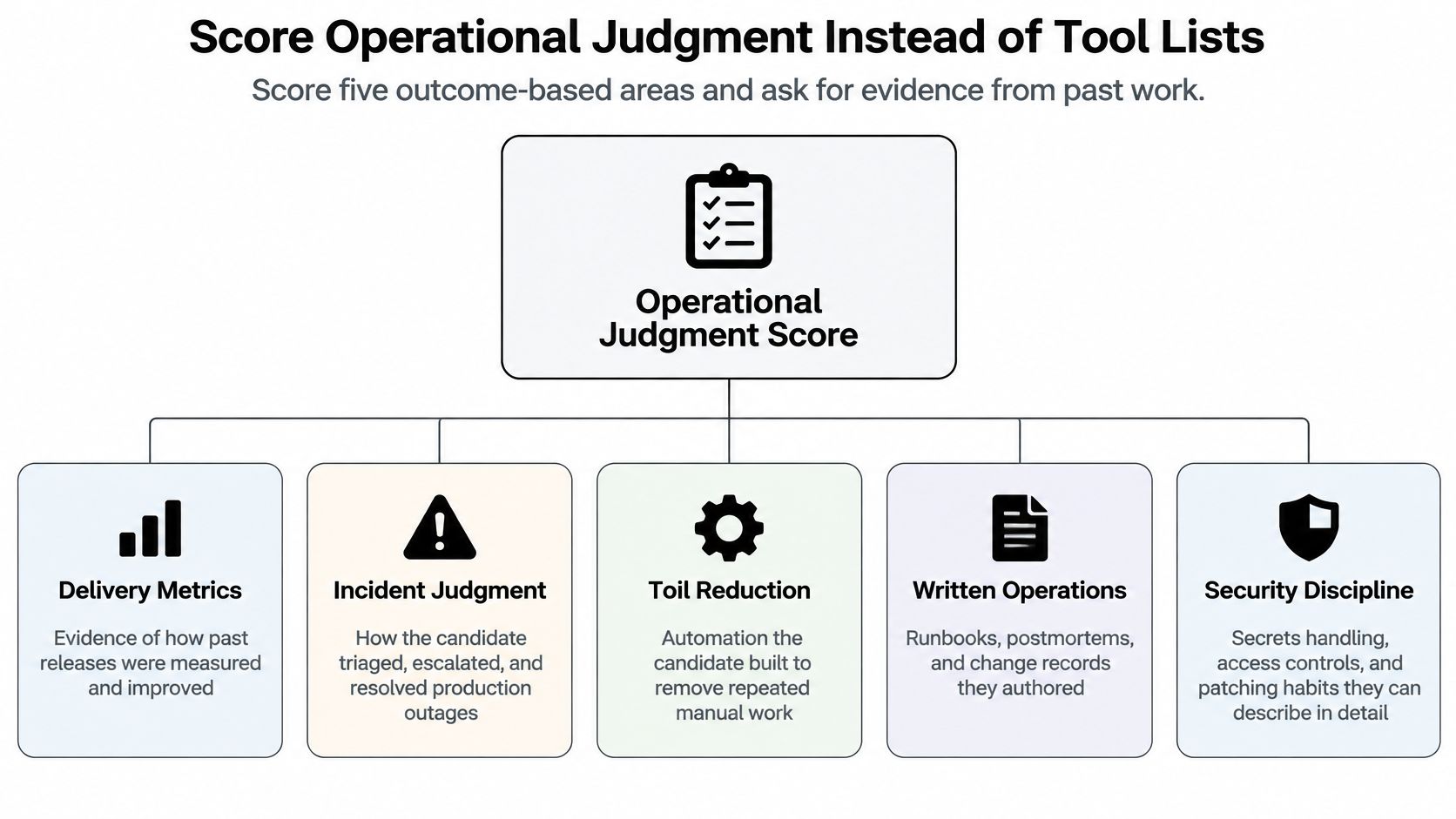
Score candidates on delivery metrics, incident judgment, toil reduction, written operations and security discipline. Ask for evidence from past work, not a recital of services they've configured. Cross-timezone coordination and tooling depth should validate those outcomes, not replace them.
Use the framework to keep interviewers focused on operational evidence.
Start with measurable delivery ownership
DORA's current metrics framework includes five measures: the throughput metrics change lead time, deployment frequency and failed-deployment recovery time, plus the instability metrics change fail rate and deployment rework rate. Ask what each measured, where events came from and what changed after the candidate's intervention.
Lead time should run from code committed to successful production deployment. A candidate should distinguish deployments requiring rollback or hotfix from unplanned remediation work, and explain whether increased deployment frequency also increased risky change volume.
A candidate who can't name a baseline hasn't demonstrated ownership of the metric. Accept an honest explanation of missing instrumentation, but don't score it as measured improvement.
Remote DevOps competency scorecard
Make scores defensible
Use a recommended 1–4 rating: unsupported assertion, assisted execution, independent ownership and improvement of the team's operating practice. Record the evidence behind every score of 3 or 4.
For incident judgment, probe who declared severity, when rollback became preferable to investigation, what stakeholders heard and what changed afterward. For security, ask what happens when emergency access expires while the incident continues.
Apply skills-first hiring principles without demanding confidential employer material. Accept reconstructed examples and sanitized artifacts, then ask enough follow-up questions to establish the candidate's personal contribution.
Run a Four-Stage Interview Loop for Remote Candidates
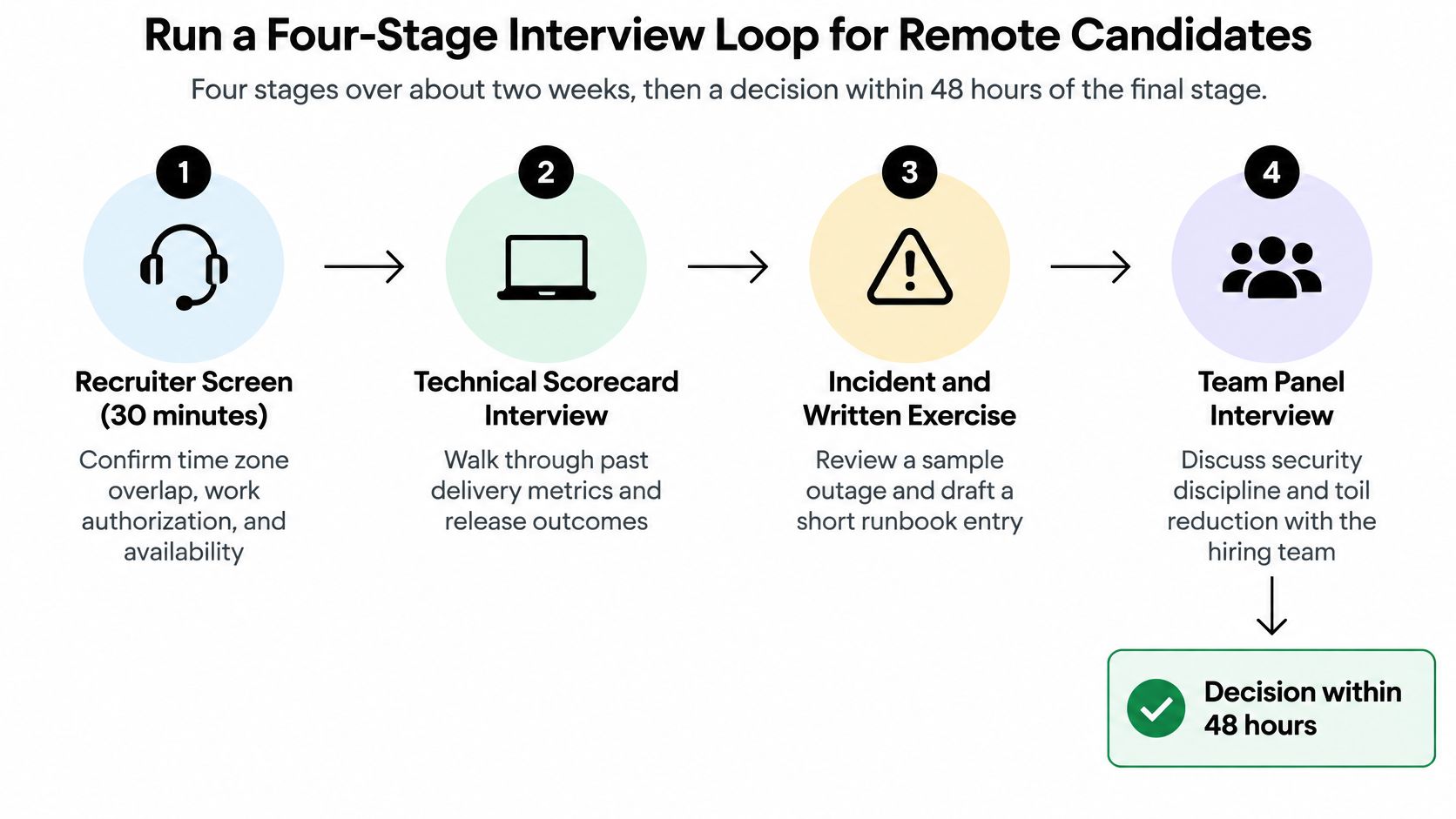
Run the loop over about two weeks and commit to a decision within 48 hours of the final stage. These are recommended process limits, not reasons to rush a weak assessment. Assign each interviewer a competency so candidates don't repeat the same career history.
Keep the sequence visible to candidates before they begin.
Test a different failure mode at each stage
Recruiter screen, 30 minutes. Confirm overlap hours, on-call acceptance, access eligibility and the proposed employment model. Reject a mismatch on a genuine requirement immediately rather than hoping compensation will resolve it. The pass signal is explicit agreement on the operating conditions, not enthusiasm for remote work.
Written operations exercise, 90 minutes asynchronously. Supply a failed-deployment timeline and ask for a recovery runbook or post-incident summary. Score sequencing, verification steps, escalation and whether another engineer could act without calling the author. A strong response separates known facts from hypotheses and names a stop condition.
Live design and incident session, 75 minutes. Ask for a canary release, rollback trigger and dashboard covering lead time, deployment frequency, change-failure rate and failed-deployment recovery time, with rework discussed separately. Then use a hypothetical deployment at 02:00 in the candidate's time zone that raises errors by 5%, and ask who gets paged, when they roll back, how they hand over and what customers hear. The pass signal is controlled mitigation with explicit ownership, not fast guessing.
Team panel, 45 minutes. Have two engineers review a sanitized Terraform module or pipeline file with the candidate. Probe state management, privilege boundaries, failure recovery and what they would leave unchanged. Pass candidates who explain trade-offs and ask for missing context before proposing a rewrite.
Calibrate the exercise, not the résumé
The 2024 DORA report placed elite teams at less than one day of change lead time and failed-deployment recovery in less than one hour. Treat those as directional benchmarks, not personal hiring thresholds. A candidate maintaining a regulated release process shouldn't fail because their team deployed less frequently.
Require the candidate to identify pull-request approval delays, pipeline queues and incident acknowledgement separately. Otherwise, they may recommend faster builds when the actual bottleneck is an unavailable approver.
Use a consistent DevOps interview question bank, but keep the same scenario and scoring anchors across candidates. Pay for take-home work exceeding two hours, and send feedback within three days.
For an additional interview-preparation resource, use the video below.
Hiring Remote DevOps Engineers from Latin America
Match the country and the candidate's actual working schedule to your overlap requirement before discussing an offer. Mexico can suit US Central and Mountain schedules; Colombia, Peru and much of Brazil can align closely with US Eastern hours. European teams should confirm the specific shared window rather than assume nearshore alignment applies equally to them.
Assess written English through the runbook exercise. A fluent introductory call doesn't establish whether someone can explain customer impact, distinguish a workaround from a fix or hand over an unresolved incident.
The hiring decision should connect working hours, employment structure and access, not just compensation.

Resolve employment before production access
JobGlance's remote DevOps listings identified only 209 of 2,146 remote roles as open to candidates anywhere worldwide. A remote label doesn't establish cross-border eligibility. Your employment and security owners need to approve the arrangement independently.
Direct employment requires an appropriate local employment structure; outsourcing payroll alone doesn't resolve every employer obligation. An employer of record can administer local employment, while a contractor agreement needs careful classification review and explicit IP, confidentiality and termination provisions.
Before extending an offer, obtain written answers to these checks:
Employment classification: Who signs the agreement, pays the engineer and owns the employment obligations?
Data residency: Can the engineer view logs, customer records and backups from their working country?
Privileged access: Do customer contracts or security policies restrict production administration by location?
Coverage: Who handles local holidays, connectivity failures and an unavailable primary responder?</li>
Compare total operating cost
Include employer fees, equipment, benefits, on-call compensation and management overhead when comparing candidates. A cheaper salary isn't a saving if your infrastructure lead must cover every overnight escalation.
Use a cross-border hiring checklist for CTOs to coordinate recruiting, finance and security. Put the approved countries and access restrictions in the requisition so recruiters don't build a shortlist your company can't employ.
Access rule: Don't issue privileged credentials while employment or contractual approval is still pending. A start date isn't an exception to your access policy.
Onboard Remote DevOps Engineers in 90 Days
Use four onboarding windows and make the first owned project a bounded toil reduction. The engineer should be able to finish it independently, while teammates retain the ability to review, operate and reverse it.
On day one, provision least-privilege access, enable MFA and send a written welcome document naming a buddy available during the overlap window. During the first week, have the engineer read incident history and ship a staging change through the pipeline without assistance.
Track evidence rather than attendance
Remote DevOps 90-day onboarding milestones
Google's SRE guidance on eliminating toil recommends measuring recurring operational work and quantifying the return from automation. Have the engineer classify manual releases, access requests, alert triage, certificate renewal and environment provisioning. Record frequency, average duration, interruption cost and error risk, then rank the work by monthly hours and production risk.
Choose a first toil item the engineer can finish alone in 60 days. Don't make their first success depend on a company-wide platform migration.
Make the automation maintainable
Establish the error budget before changing the workflow. Build the selected automation with infrastructure as code, policy checks, observable pipeline output and a documented rollback, then compare toil hours, incident rate and recovery behavior.
Schedule pairing during overlap, require a weekly asynchronous status note and hold a synchronous review each week. Use remote employee onboarding practices for the engineering workflow and FLYP LTD's remote onboarding guidance for People Ops to coordinate the employee experience. Keep employment paperwork, equipment delivery and technical permissions under named owners.
Pilot One Hire Before You Scale Your Remote Team
Pilot a single role through the full process before opening another equivalent position. Judge the result by operational ownership at day 90, not by how quickly someone accepts an offer.
Use a hiring-to-operations checklist
Publish the agreement. Put overlap hours, on-call tier, access level and employment model in the job post. Remove requirements nobody can justify against actual operating needs.
Require evidenced approval. Run the interview loop with a shared scorecard and require two engineers to sign off on scores of 3 or 4. Resolve disagreements through evidence, not seniority.
Clear the offer. Confirm the employment structure and data-residency position before making commitments. Assign unresolved questions to finance, legal or security rather than the candidate.
Instrument the pilot. Track delivery outcomes and toil from the start using consistent event definitions. Record service context so inherited reliability problems aren't mistaken for the new hire's performance.
Apply the scale gate. At day 90, expand only if the engineer owns an automation, has led a post-incident review and incident rate hasn't deteriorated. Use a historical incident or controlled exercise if no suitable live incident occurred.</li>
Separate sourcing help from technical accountability
If you lack an internal recruiting function, GENTY recruitment's RPO service is one option for sourcing and screening alongside an internal recruiter or specialist search firm. Its offering includes fixed-fee pricing by seniority, no upfront payments and a three-month replacement guarantee; confirm the applicable terms before engagement. Your engineering leader should still own the technical scorecard and final hiring decision.
Pick one open remote DevOps role this month. Approve its operating agreement, assign interview owners and put the pilot review on the calendar before sourcing starts.
GENTY recruitment helps companies source and assess remote DevOps candidates through IT recruitment, RPO and salary benchmarking. Visit GENTY recruitment to discuss a search built around your overlap requirements, incident responsibilities and production-access constraints.