
A 2025 Pursuit analysis of more than 1,400 U.S. sales and go-to-market searches found that hiring involved more interviews and steps and took longer to close than before. Adding interviews isn't the same as reducing hiring risk. A working sales recruitment process uses six stages, from intake through offer, with explicit pass rules and measured drop-off. Then it connects assessment results to onboarding and ramp performance, so your team can distinguish a persuasive candidate from a productive hire.
Sales Recruitment Process at a Glance
The hiring funnel runs through intake and scorecard, sourcing, recruiter screen, work simulation, structured interview, and offer and close. Onboarding and a 90-day review connect those hiring decisions to ramp progress.
Use this schedule as a planning guide, not a universal benchmark. Keep candidate interviews to three: the recruiter screen, simulation, and structured interview. Track candidate withdrawals separately from team rejections at every stage. That distinction shows whether the funnel is losing qualified candidates or screening out weak matches.
Sales hiring stages, timing and pass rules
The interview durations follow Prospeo's sales-recruiting guidance. The remaining timings are recommended planning windows.
Planning a hire?
Talk through the best hiring option
This article usually leads to one practical question: should you use rpo or sales recruitment? We can help you choose quickly.
Simple next step
Start with rpo and we will help you pick the best hiring setup.
The SmartRecruiters 2025 global benchmark reports a 38-day median time-to-hire, with an average funnel of 73 applicants, 3 interviewed, and 1 offer per role. Those figures imply roughly 4.1% reaching interviews and 1.4% receiving offers. Use them as context for funnel measurement, not as targets for every sales role.
More résumés will not necessarily fill an unfilled territory. Tight pass rules help managers identify weak matches early and reserve interview time for candidates who meet the role's requirements. Compare stage-by-stage conversion with later ramp milestones to see whether a high interview pass rate leads to productive hires.
Operating rule: Record a decision within 24 hours of each assessment stage. Name a backup approver who can decide when the hiring manager is unavailable.
Map the current hiring stages against the table, then review both withdrawals and rejections. Each points to a different place to improve the funnel.
Define Roles and Scorecards Before You Source
A vague requisition creates disagreement later. A request for a senior seller doesn't establish whether the company needs outbound meeting generation, ownership of complex deals, or technical support for an existing account team.
For a Series A–C company, define the sales motion before choosing a title. An enterprise seller accustomed to established demand may not suit a founder-led business still testing its buyer profile.
Sales role profiles for scorecard design
These are proposed first-90-day goals, not universal performance benchmarks.
Adjust closed-won expectations to the actual sales cycle. Don't make an enterprise AE responsible for closing business before a normal procurement cycle could finish.
The Bridge Group's 2025 research found average SDR ramp time of 3.0 months, the fastest in its series, according to UpperLevel's summary. I would therefore judge early SDR progress through pipeline milestones rather than year-one quota.
Build the scorecard before reviewing applicants
Write three 90-day outcomes, each with an observable deliverable.
Select four or five competencies tied to those outcomes.
Define a 1-4 scale with example behavior at each level. For discovery, progress from pitching without questions to validating business impact and buying steps.
Set two or three knockout criteria, separating necessities from preferences.
Approve the pay band and variable-pay plan before posting.</li>
These are recommended design choices. Freeze them before interviews begin; adding criteria after meeting a compelling candidate makes comparisons unreliable.
How to Source and Screen Sales Candidates
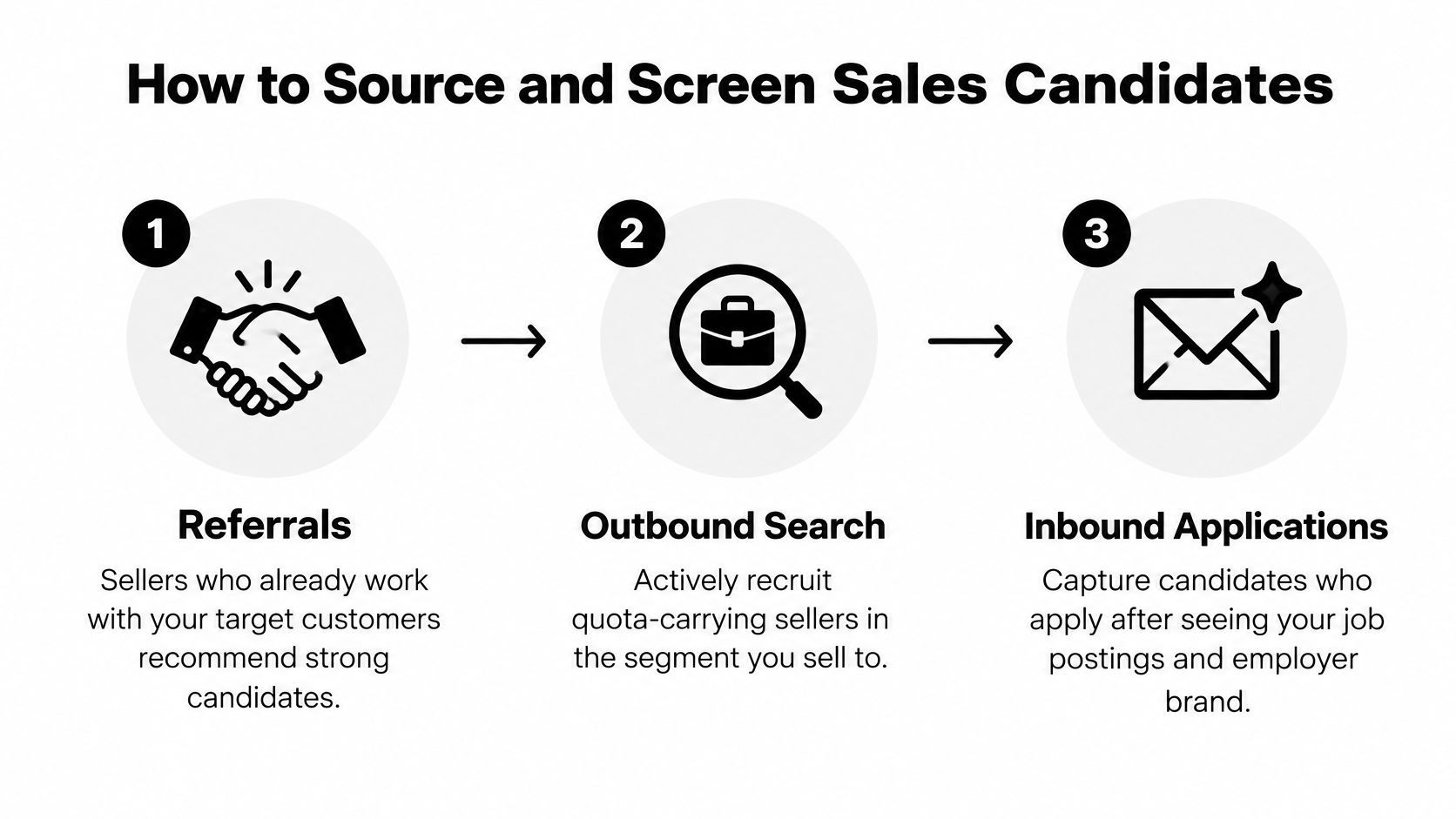
Use three channels. Ask sellers who already work with your target customers for referrals. Run outbound searches for quota-carrying sellers in your segment, and review inbound applicants for selling evidence rather than employer logos.
Write a five-line candidate profile. Record target-buyer experience, quota attainment, average contract value, sales cycle length, and team size. Include a note identifying what the candidate personally owned.
Run the planned recruiter screen. Verify territory experience, quota ownership during the last two years, employment eligibility, working-language fluency, time-zone overlap, compensation alignment, and target-buyer experience.
Record a decision within 24 hours. I would require a pass or decline note that cites the relevant knockout criterion, not an impression.
Send the simulation brief only after a pass. Confirm the agenda, preparation requirements, and decision date so candidates can judge the commitment.</li>
The sourcing channels serve different purposes, but every candidate should enter the same screening process.
Check ownership, not just attainment
A quota percentage without context isn't enough. Ask whether the seller inherited accounts, generated opportunities, received inbound demand, or relied on a partner channel. A recognizable SaaS employer doesn't establish that someone can prospect without brand recognition.
Skip questions about passion for sales. Ask the candidate to explain a recent opportunity from initial contact through its next committed step, including their own contribution.
For search organization, this candidate-search guide provides a useful starting point. When outbound records lack reliable company or contact details, looot's checklist of best data enrichment tools can help recruiters compare enrichment options. Verify enriched information before using it; a completed database field isn't evidence of quota ownership.
Test English fluency through the actual conversation rather than assuming it from location, education, or an English-language résumé. Ask the candidate to explain a buyer objection and write a short follow-up. Score clarity and comprehension, not accent or similarity to the interviewer.
Assessing Selling Skill With Simulations and Structured Interviews
A structured interview or work sample gives the hiring team a more consistent basis for judging selling skill than an unstructured conversation. The selection-research synthesis summarized by Cogn-IQ reports predictive-validity coefficients of r = .51 for structured interviews and r = .54 for work samples. These are correlations, not hiring-success percentages, and they do not guarantee the same results in every company.
The practical test is whether candidates demonstrate observable behaviors that can later be compared with post-hire ramp and attainment data.
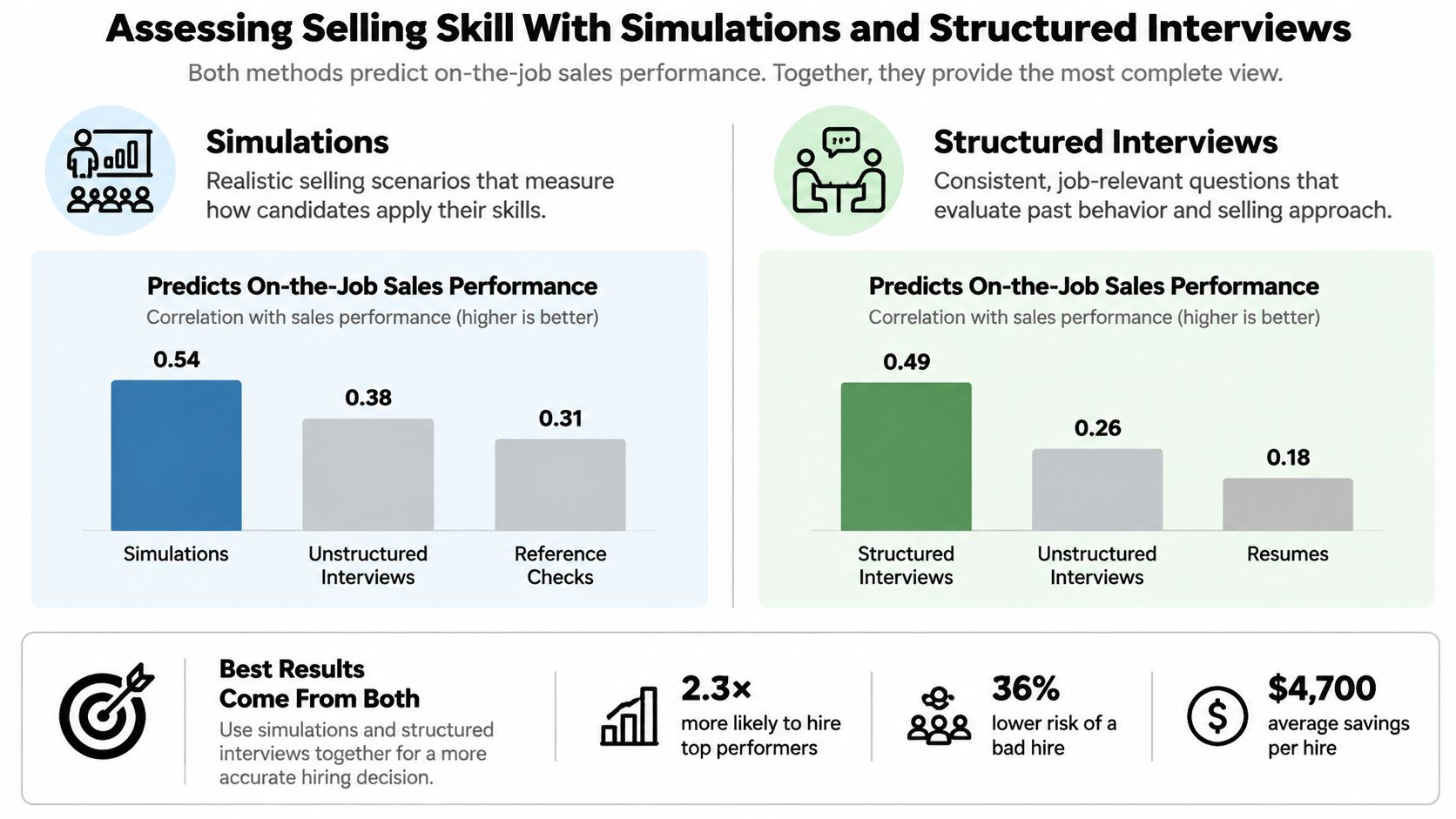
Predictive validity of common sales assessment methods
The behavioral-interview range and assessment-method comparisons are discussed in the Schneider sales-selection review. These categories can overlap, so the table is a guide to choosing evidence, not a ranking of interchangeable methods.
Standardize the task and the scoring
Give every candidate the same fictional account, product brief, and buyer persona. Use the scheduled simulation window to score discovery questions, problem framing, objection handling, next-step control, and written follow-up. Keep the task job-related; live-account prospect research turns an assessment into unpaid work.
For the structured interview, use six to eight core questions and two independent panelists. Ask for a specific stalled deal the candidate recovered, then probe their actions, metrics, and outcome. Score each answer against fixed anchors, not confidence or polish.
Record evidence immediately and score before discussing the candidate. A competency-based recruitment framework for tech and sales can help translate broad traits into observable behaviors.
A confident answer isn't a passing score. The interviewer must identify what the candidate did that meets the anchor.
If AI assists scoring, disclose its role, retain human review, and compare scores with post-hire attainment. Keep the scorecard tied to evidence so an unexplained output cannot override observed behavior.
Use the following video as supplementary material, not as a replacement for a job-specific rubric.
Closing Finalists Before Competing Offers Do
Rainmakers reports that 78% of top sales candidates received at least two offers in the first quarter of 2025, while 41% of VP-level sellers considered three or more; high-performing salespeople typically completed searches in under three weeks. A finalist shouldn't wait while finance discovers that the compensation plan needs approval.
I would reserve the decision-makers' calendars before the final interview. Speed should come from preparation, not waived diligence.
A deliberate offer pathway
Present the written terms alongside the verbal discussion, rather than leaving candidates to reconstruct the commission plan.

The offer package should include:
Compensation mechanics: Base and variable split, with a worked payout example using the approved plan.
Commercial ownership: Quota, territory, account allocation, and ramp expectations.
Practical terms: Start date, benefits, and the decision owner who can resolve questions.
Cross-border details: For Latin America hiring, employment structure, currency, payment timing, local compliance, working hours, and travel expectations.</li>
Candidates evaluate whether the revenue model makes the advertised earnings credible. Explain attainment distribution and territory potential, and interpret their past results against average contract value, lead sources, and manager turnover.
Use offer-acceptance benchmarks alongside decline reasons, not instead of them. A staffing partner can coordinate the pathway when internal calendars are constrained, but leadership must still own compensation decisions.
Measuring Hire Quality and Fixing Bottlenecks
Time-to-fill starts at requisition approval or opening. Time-to-hire starts when the candidate enters the process; both stop at accepted offer.
Workable's recruiting benchmarks put average Sales/Business Development time-to-fill at 52 days globally and 48 days in the United States and Canada. Use those figures for capacity planning, not as permission to leave candidates waiting.
Time-to-fill versus time-to-hire
Your ATS dashboard should show days in each stage, conversion between stages, and offer-acceptance rate. Separate employer rejection from candidate withdrawal, and track offer approval separately from the candidate's decision period. Use consistent definitions when configuring time-to-fill metrics.
Connect the funnel to ramp outcomes
Build a cohort report covering time to first qualified opportunity, first closed-won deal, pipeline coverage, 90- and 180-day attainment, and 12-month retention, consistent with the outcome-oriented approach described by Treeline's recruiting-performance framework. Compare outcomes by source, interview panel, assessment score, territory, and seniority.
Don't credit an assessment for stronger attainment if its highest-scoring hires also received the best territories. Look for patterns within comparable roles and conditions before changing the rubric.
Long time-to-fill, normal time-to-hire: Inspect requisition approval, sourcing start dates, and scheduling.
Long simulation or final-review stages: Fix interviewer availability and decision ownership before increasing applications.
Accepted offers, weak six-month attainment: Reassess source quality and selection criteria rather than celebrating offer volume.
Strong assessments, slow ramp: Inspect onboarding, lead access, and manager support before blaming selection.</li>
Choose Your Model and Start the Next Requisition
Keep hiring in-house when the recruiter and hiring manager can meet the planned stage windows without displacing essential work. The relevant question isn't whether an agency can produce more profiles. It's whether someone can reliably own the bottleneck.
For parallel sales requisitions, I would consider a managed RPO model when screens, simulations, and candidate updates exceed internal calendar capacity. Outsourcing sourcing alone won't help if finalists still wait for the same unavailable approver.
Decide what to retain and what to hand off
Use this comparison of in-house and agency recruiting to clarify responsibilities before choosing a provider. Keep role outcomes, hiring standards, and compensation authority with company leadership; delegate execution only where ownership can remain explicit.
I would review a managed model after two consecutive requisitions exceed the relevant planning baseline. If losses concentrate at offer stage, first determine whether the cause is pay credibility, unclear terms, or delayed decisions. A partner can coordinate the close but can't compensate for an uncompetitive proposition.
For nearshore LATAM hiring, check time-zone overlap, demonstrated working-language proficiency, and employment structure before comparing cost.
Use the hiring plan to assign responsibilities before opening the next role.

This week, choose the stage with the largest avoidable delay and assign its owner, deadline, and outcome metric. Hand it off only if those responsibilities remain visible in the dashboard.
GENTY recruitment offers sales recruitment and RPO support, including role intake, curated shortlists, and sales-skills assessment. Bring your next requisition, compensation plan, and current funnel timings to discuss which stages to retain internally and where dedicated recruiting support would help.