
Most hiring teams start a product manager search backward. They filter resumes for recognizable logos, exact industry experience, and years in seat, then fill the calendar with informal conversations to see who feels sharp. That habit rewards polished storytellers while letting strong product thinkers slip through the screen.
Learning how to hire a product manager comes down to testing product judgment, not pedigree. Years of experience predict almost nothing about how someone handles competing priorities or ships under engineering constraints. Instead, build a fixed six-stage process anchored by a written hiring thesis, a competency scorecard scored independently by every interviewer, a standardized written work sample, and a live prioritization case.
For a CTO, VP of Engineering, or HR Director at a Series A-C company, the cost of getting this hire wrong isn't just a recruiting fee. One misaligned product manager can burn two quarters of engineering capacity building features customers never adopt.
The Six Stages From Role Definition to Offer
A dependable product manager search runs through six stages in a strict order, where each stage produces a written artifact before the next stage opens. Skip an artifact, and your panel ends up debating interview charm instead of observable judgment.
Planning a hire?
Talk through the best hiring option
This article usually leads to one practical question: should you use staffing or salary guide? We can help you choose quickly.
Simple next step
Start with staffing and we will help you pick the best hiring setup.
Below is the exact six-stage sequence from initial scope alignment to signed offer.
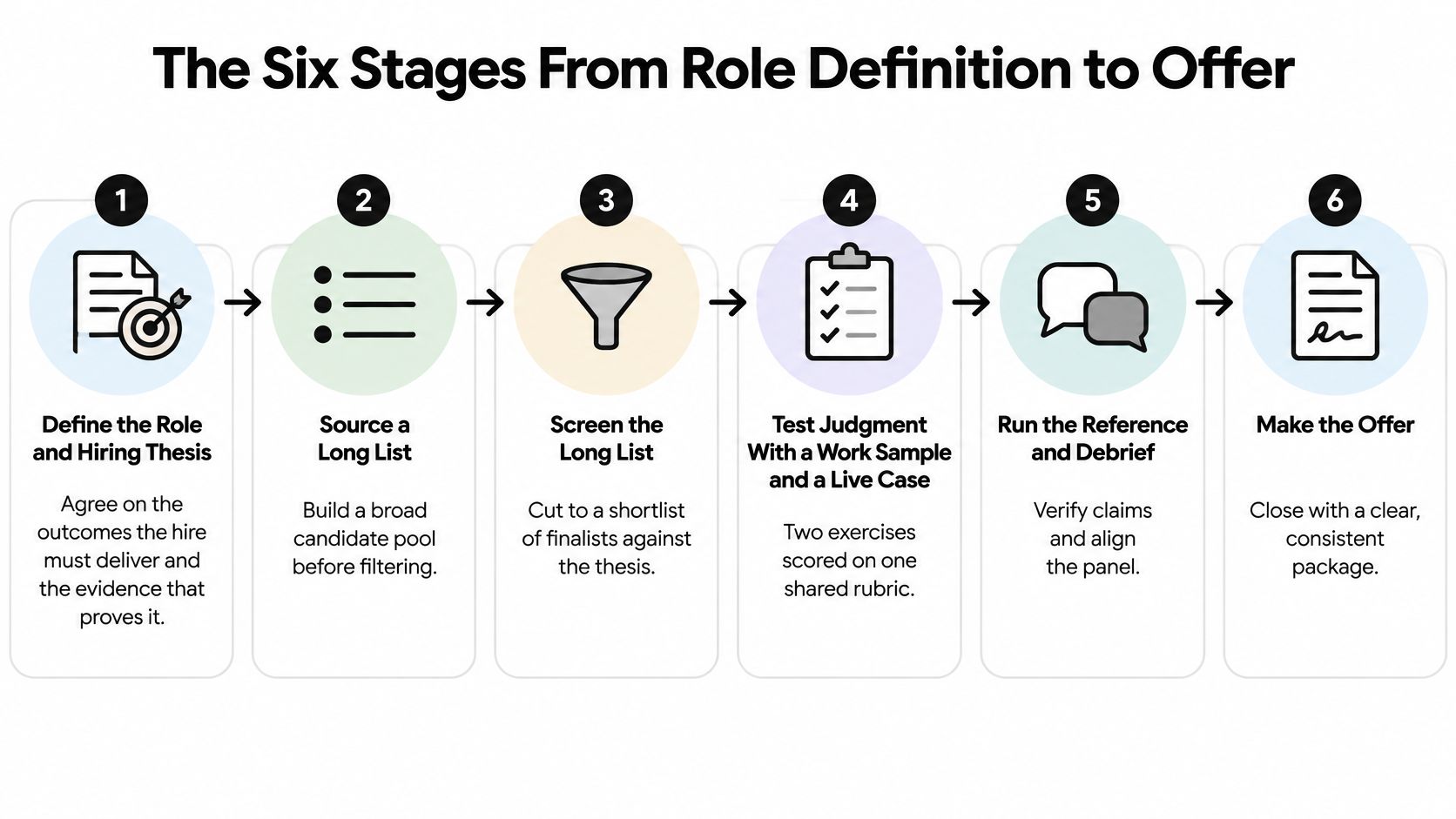
Every stage needs a single accountable owner and a clear output so nothing stalls between HR, engineering, and product leadership.
Why Sequence Order Protects Your Panel
Reordering these steps introduces bias that is nearly impossible to unwind later. If recruiters begin sourcing before leadership agrees on the hiring thesis, panelists judge every finalist against a moving target. Engineering wants a technical partner who can debate API trade-offs, sales wants an executive communicator, and the hiring manager rejects capable candidates because the role expands mid-search.
Skipping the written work sample creates a different failure mode. Without a standardized exercise graded on a rubric, charismatic candidates talk their way past weak analytical habits and surface problems only after onboarding.
Never let a candidate advance to the next stage until the current stage's owner submits a written artifact or independent score.
Before you post a job description this week, run a five-minute audit on your current hiring calendar. Put one named owner and one hard handoff deadline next to each of the six stages, and confirm that every panelist has blocked scoring time right after their interviews.
Define the Role Before You Open the Search
Product hiring volume has tightened while compensation for competitive seats keeps climbing. According to the 2026 Product Manager Salary and Hiring Report, PM hiring fell 45% from 2022, yet median compensation rose from $220,000 in 2022 to $224,000 in 2024, $236,000 in 2025, and $250,000 in 2026. You can't rely on one generic market profile in that environment, because an unfocused search either overpays for strategy you don't need or burns weeks interviewing people built for a different stage.
I would lock five role decisions on paper before writing a single line of a job post:
Name the product stage. A zero-to-one product needs someone comfortable with ambiguous discovery and rapid prototypes, while a growth or scaling product demands instrumentation, funnel discipline, and migration planning.
Write down decision authority. State explicitly what the product manager can ship with their engineering squad without executive sign-off, and where founders or leadership retain approval rights. Clear boundaries prevent turf battles during the first quarter.
Specify the engineering partnership and owned metrics. Identify the squad size, technical surface, and core business metrics the role owns, such as self-serve activation, net dollar retention, or checkout conversion. If the squad builds data pipelines, platform APIs, or core infrastructure, clarify the boundary between a technical product manager and a product manager so you don't recruit a generalist for an architecture-heavy seat.
Set the level from real scope. Base seniority on the breadth of ownership and organizational ambiguity, not on the title a founder hopes will attract senior applicants.
Commit to a one-page hiring thesis. Pick one clear archetype before outreach starts: an execution-focused PM who turns validated priorities into reliable releases, a senior product strategist who sets multi-quarter direction, or a domain specialist who brings deep regulatory or workflow fluency in areas like payments or healthcare compliance.</li>
Match Pay Bands to Defined Scope
Compensation should always follow the scope you defined, never the other way around. US recruitment data from Mind the Product's 2025 compensation analysis shows how sharply median total compensation separates by ownership level.
When a standout candidate's compensation expectation sits above the band tied to your defined scope, resist the urge to stretch the budget immediately. Reopen the scope conversation with engineering and executive leadership first. If the business needs product-line ownership rather than single-squad execution, upgrade the role deliberately; otherwise, hold the band and keep interviewing.
Before opening the requisition, run a quick alignment test. Hand your finished job specification to two hiring managers separately and ask each one to describe the ideal hire in three sentences. If they picture different profiles, tighten the thesis before sourcing begins.
Choose Your Sourcing Route Before the Search Opens
Your sourcing channel determines who owns pipeline quality and how quickly a calibrated shortlist lands on your calendar. Analysis in Lenny's Newsletter citing TrueUp and Live Data Technologies data recorded 5,752 open product-manager roles at technology companies globally as of September 2024, while remote PM roles dropped 35% from their peak. Plenty of experienced remote product managers are open to well-scoped roles, yet generic job-board blasts still flood hiring managers with mismatched resumes.
Decide which sourcing route fits your bandwidth and urgency before publishing the requisition.
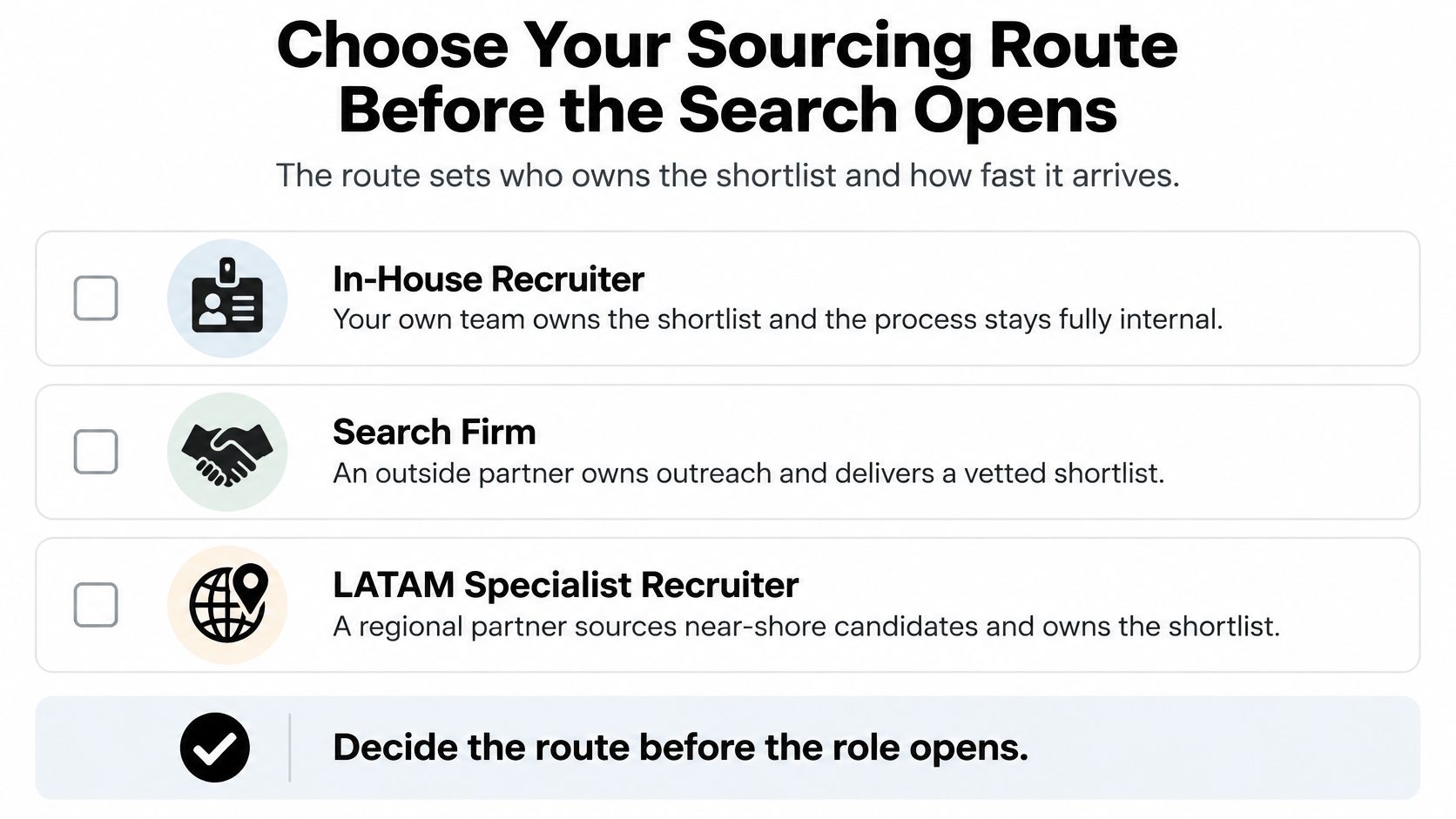
Each route solves a distinct operational bottleneck and carries a clear trade-off.
For Series A-C US and European companies where engineering calendars are the main bottleneck, Latin America is a strong nearshore option rather than an automatic default. Overlapping working hours make live product cases easy to schedule alongside US East Coast or European afternoons, and senior PMs in hubs like Buenos Aires, Sao Paulo, Mexico City, and Bogota routinely work directly with English-speaking engineering teams. Teams comparing regional pools can check the Lathire guide to hiring LATAM talent alongside broader talent sourcing practices to see which markets match their domain.
At GENTY recruitment, our fixed-fee IT recruitment service supports tech, sales, and operations roles across LATAM starting from $2,999. That standard placement fee covers sourcing across the region, English proficiency evaluation, motivation and culture-fit screening, hard and soft skills testing, a curated shortlist of interview-ready candidates, and a 3-month replacement guarantee, while final hiring decisions always stay with your team.
Set the Sourcing Handoff Rules
Once you choose a route, write four sourcing commitments into the hiring tracker so top-of-funnel screening matches panel expectations:
Assign one pipeline owner: Name the exact internal recruiter or external partner accountable for shortlist delivery and weekly funnel reporting.
Lock the shortlist deadline: Anchor the shortlist due date directly to your six-stage hiring calendar so panel interview slots don't sit empty.
Share the core scorecard criteria: Tell the sourcing team which three competencies matter most at the screening stage so they filter for real product ownership instead of keyword overlap.
Confirm exercise readiness upfront: Have recruiters confirm during the initial call that candidates are willing to complete a standardized two-hour work sample and a live prioritization case.</li>
Score Candidates With a Structured Scorecard
Informal "culture-fit" chats feel natural, yet they consistently produce noisy hiring decisions. A 2022 re-analysis by Sackett, Zhang, Berry, and Lievens published in the Journal of Applied Psychology and summarized by Noon AI estimated an operational validity of 0.42 for structured interviews in predicting job performance, compared with just 0.19 for unstructured interviews. That makes a structured conversation more than twice as predictive, while years of job experience scored an operational validity of only 0.07.
Validity estimates vary across meta-analyses, and older benchmark reviews place realistic work samples even higher on the scale, so treat this table as one rigorous ranking rather than an absolute hierarchy. The practical conclusion is clear either way: screening on years of experience barely beats a coin flip, whereas asking consistent, job-relevant questions dramatically improves signal.
Map Six Competencies to the Product Lifecycle
A product manager's remit stretches well past writing Jira tickets. As IBM's product management overview outlines, core ownership spans market research, product-vision development, cross-functional collaboration during delivery, and post-launch optimization. Your interview scorecard should measure those stages directly across six distinct competencies: customer discovery, prioritization, analytical reasoning, communication, stakeholder management, and product execution.
For any Series A-C search, require candidates to walk through four concrete pieces of evidence across the loop: one original customer or market insight, one difficult prioritization trade-off, one cross-functional delivery example involving engineering and design, and one measured post-launch outcome.
Scorecard rule: A candidate who describes busy roadmap activity but can't connect decisions to customer value or a measured product metric shows only partial fit for the role.
To keep the scorecard disciplined in practice, establish clear candidate evaluation standards before the first screen. Write a short rubric describing what strong, mixed, and weak evidence looks like for each competency, then ask every candidate the same core questions. Require every interviewer to submit their numerical scores and written notes in your ATS, whether you run Greenhouse, Ashby, or Lever, before anyone shares impressions in the debrief.
Make a deliberate effort to separate industry context from transferable judgment. Say you're hiring for a B2B payments platform and interview a PM from logistics software who ran clean pricing experiments, cut onboarding drop-off, and mediated a tough engineering-sales conflict. That candidate often ramps faster than a direct-competitor PM who spent three years passively transcribing feature requests from enterprise account executives.
Test Judgment With a Work Sample and a Live Case
Structured behavioral interviews tell you how a candidate frames past work, yet they still leave room for rehearsed answers. Adding practical exercises closes that gap. Historical selection research from the 1998 Schmidt and Hunter review summarized by Cogn-IQ reported an approximate validity of 0.54 for work-sample tests, compared with 0.51 for structured interviews and 0.38 for unstructured interviews.
Using one shared rubric across a short written work sample and a live prioritization case creates an apples-to-apples signal across different career paths, industries, and regions.

Design a Two-Hour Written Work Sample
Give every finalist the exact same realistic scenario and strictly time-box it to two hours. Keep the prompt focused on a representative product dilemma rather than free consulting on your unreleased roadmap: define a target user, outline a customer problem with real usage constraints, and include an active tension where engineering wants to refactor a brittle service, sales wants a custom enterprise toggle, and current customers are churning during setup.
Have the PM lead score the written memo before any live presentation, focusing on content rather than slide polish. Grade six criteria on a 1-to-5 scale: problem framing, evidence-based prioritization, clarity of assumptions, metric selection, written communication, and awareness of implementation constraints.
If your roadmap touches generative models or machine learning, resist hiring for an "AI PM" resume label and test AI product judgment directly inside the work sample. Job-market data tracked by Dexity found AI or ML mentioned in 85% of 654 PM postings and prior AI or machine-learning experience requested in 69% of AI-PM listings, yet only 12% of a reviewed sample required experience deploying AI at production scale, while product strategy, roadmapping, and stakeholder management remained core requirements. Add one prompt asking finalists to define quality and safety metrics for a model-backed feature, reason through inference cost trade-offs, and specify what the product does when model output is wrong or low-confidence.
Run a Live Prioritization Case With the Panel
Skip trivia questions about named frameworks. As Western Governors University's product manager career guide explains, prioritization is the act of deciding what to build first based on customer value, business goals, and technical feasibility, while a roadmap states what gets built, when, and why. Knowing how to recite RICE or MoSCoW tells you nothing about whether a candidate can say no to a loud stakeholder.
Bring product, engineering, and design together for a 45-to-60-minute live workshop on a shared board like Miro or FigJam. Hand the candidate five competing feature requests with brief context on customer impact, revenue potential, and rough engineering effort, then ask them to rank the list aloud and defend their decision criteria.
Midway through the session, introduce a realistic engineering constraint, such as a mandatory security patch or a third-party API deprecation that cuts sprint capacity in half. Watch how the candidate adapts, what questions they ask the engineer in the room, and how clearly they explain what gets deliberately deferred. Pairing this trade-off exercise with structured product manager interview questions exposes real decision mechanics instead of memorized buzzwords.
A live case is complete only when every panelist can score each rubric criterion independently without falling back on a general impression.
Calibrate the Level and Close the Offer
Final leveling should come strictly from the evidence scored across the loop, never from a candidate's current job title. Title inflation varies wildly across startups and enterprises. A "Senior PM" who ran feature delivery inside a five-person seed startup may score at a mid-level Product Manager bar in a Series C company, while a mid-level PM from a rigorous product organization may clear every Senior PM competency on your scorecard.
Compare the scope each finalist demonstrated in the work sample and live case directly against your five initial role decisions: product stage, decision authority, engineering partnership, owned metrics, and target level. Once the panel agrees on the demonstrated level, pull the approved pay band for that scope.
Five Steps From Debrief to Signed Offer
Confirm the scored level with written proof. Before anyone mentions salary numbers in the debrief, lock the candidate's calibrated level by tying every competency score to specific quotes, memo sections, or live-case trade-offs.
Validate compensation against band equity. Check the candidate's expectation against your target band, consulting regional benchmarks like LATAM product manager salary data when hiring nearshore talent. If a finalist sits above the band, revisit the role's scope with leadership before breaking internal pay parity.
Run scorecard-focused reference checks. Skip generic praise calls. Ask former engineering leads and direct managers which specific product decisions the candidate personally owned, what happened when a major launch missed its metric, and how they handled pushback from sales or engineering.
Issue the offer inside the approved band. Deliver the offer package cleanly and document the final hiring rationale with the exact panelists who scored the live case, keeping accountability intact through onboarding.
Audit your search timeline. Measure actual elapsed days from shortlist handoff to signed offer against the milestone dates set when you picked your sourcing route, so you can fix slow debriefs or scheduling bottlenecks before your next hire.</li>
Run one final gate before sending the offer letter: confirm that every competency on the scorecard carries a written score and a named panelist willing to stand behind that evaluation.
If you want to build a calibrated product shortlist without losing weeks to manual resume screening, GENTY recruitment helps US and European startups hire pre-vetted nearshore product and tech talent across Latin America in under 2 weeks. Our fixed-fee Recruitment plan starts from $2,999 and includes regional sourcing, English evaluation, hard and soft skills screening, and a 3-month replacement guarantee while you keep every final hiring decision. Visit GENTY recruitment to book a role intake call and get your first shortlist moving.