

A mid-level product manager in Latin America who works for a US company is typically paid somewhere between $45,000 and $60,000 a year, and senior hires usually land between $60,000 and $90,000, against a US median of $175,140 for computer and information systems managers, the closest standard occupational category the Bureau of Labor Statistics publishes. Those LATAM bands are planning ranges we use when scoping searches, built from public salary guides and live job postings, not quotes. The real number depends on the country, the product domain, and whether the candidate is paid in dollars or local currency. This guide shows how those variables move the figure, and how to budget for a hire.
TL;DR
- Plan on roughly $45,000 to $60,000 per year for a mid-level remote PM and $60,000 to $90,000 for a senior PM paid in USD by a US company. Heads of product and AI or FinTech specialists price higher.
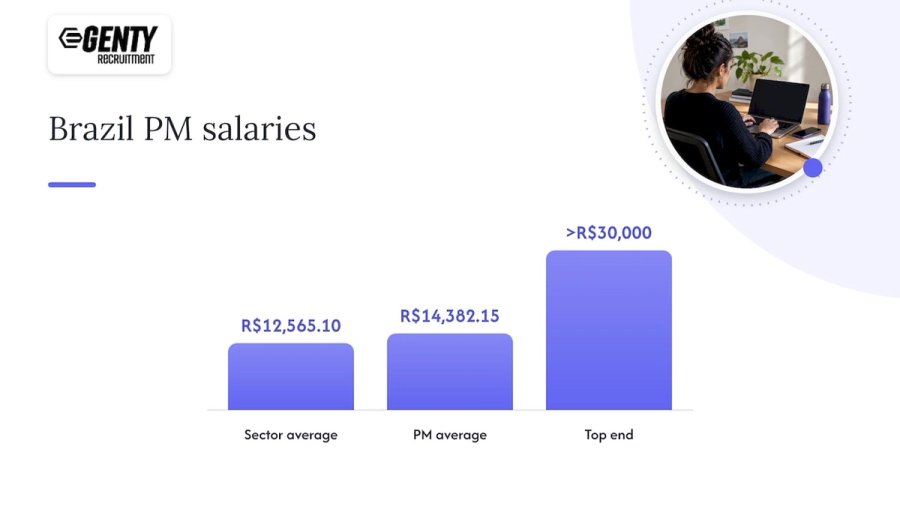
- Brazil is the most transparent market: the PM3 study puts the average PM salary at R$14,382.15, up almost 10% year over year.
- Mexico, Colombia, and Argentina overlap with US Central, Eastern, and (partly) Pacific working hours, so product discovery, sprint planning, and stakeholder reviews happen live.
- Salary is only part of the cost. Add employer contributions, equipment, and a recruiting fee, and compare the total with a US hire.
- GENTY recruitment places product, engineering, and sales talent in LATAM on a fixed fee from $2,999 per hire, with no upfront payment.
What a remote product manager earns in Latin America
Public data on LATAM product salaries is fragmented. Salary guides aimed at US employers quote USD ranges, local studies quote monthly local-currency pay, and job boards show asking rates. Reading all three together gives a more honest picture than any single page.
Three patterns hold up across sources:
- USD-paid remote roles sit well above local-employer pay. A PM in São Paulo working for a Brazilian retailer and a PM in São Paulo working for a Series B US SaaS company do the same job at very different price points.
- Seniority matters more than country. The gap between a mid-level and a head of product in the same city is larger than the gap between Mexico City and Bogotá at the same level.
- Domain premiums are real. PMs with payments, lending, compliance, or ML product experience command more than generalist consumer PMs.
Live postings confirm the spread. Remote job aggregators currently list product manager roles in Latin America with advertised pay that includes mid-level Argentina-based openings around $54,000 to $72,000 a year, and a headline range that runs far higher for senior US-company roles. Asking pay in postings skews high, so treat it as a ceiling when you budget.
Planning ranges by seniority
The table below is how we frame budgets for US companies hiring a full-time remote PM in LATAM, paid in USD as an employee or contractor. These are planning assumptions, not a price list, and they are base pay before employer costs.
Need help hiring?
See the next step after this guide
If this topic is relevant to your team, these are the most useful pages to check next.
Top-of-market senior compensation in remote roles with US companies can go higher, especially where equity or a US-style bonus is attached. If your budget sits at the bottom of a band, expect a longer search or a less experienced shortlist.
Salary by country: Brazil, Mexico, Colombia, Argentina
Country matters mostly through three channels: local market maturity, currency stability, and how many candidates have already worked for US teams.
Brazil
Brazil has the deepest product community in the region and the best published data. The PM3 “Panorama de Salários de Produto 2025-2026” reports an average digital product sector salary of R$12,565.10 in 2025, with the top end exceeding R$30,000. A separate write-up of the same study puts the average for the Product Manager title at R$14,382.15. Those are local-employer figures, so a US company paying in dollars competes by offering a package a few steps above them, typically with a USD base that clears the local mid-level and senior averages comfortably. Brazil operates on Brasília time, which is one hour ahead of US Eastern for much of the year depending on daylight saving, so a morning stand-up with New York works without anyone getting up early.
Mexico
Mexico City sits on US Central time, which makes it the easiest market for teams in Chicago, Austin, or Denver and a comfortable one for the East and West Coasts. Mexico’s fintech and e-commerce sectors have produced a strong pool of PMs who have shipped payments, onboarding, and marketplace products. In our planning frame, mid-level Mexico PMs fall inside the $45,000 to $60,000 band, with senior PMs from regional fintechs near the top of the senior range.
Colombia
Bogotá and Medellín run on the same clock as US Eastern for most of the year (Colombia does not observe daylight saving), so there is full-day overlap with New York and Miami in winter and a one-hour gap in summer. Colombia has grown quickly as a tech hub, and PMs there often come with strong English from multinational and nearshore delivery experience. Budget in the same mid-level and senior bands, and expect candidates with US-product exposure at the upper half.
Argentina
Argentina offers experienced PMs with strong analytical and engineering-adjacent backgrounds, and currency volatility has made USD contracts especially attractive to local talent. That makes the market competitive for US employers who offer stable dollar pay. The Argentina-based postings in the $54,000 to $72,000 range seen on remote boards fit our mid-to-senior bands. Argentina is on UTC-3 all year, so overlap with US Eastern is full in summer and one hour behind in winter terms, and with Pacific time you still get about five working hours of shared day.
How LATAM PM pay compares with the US
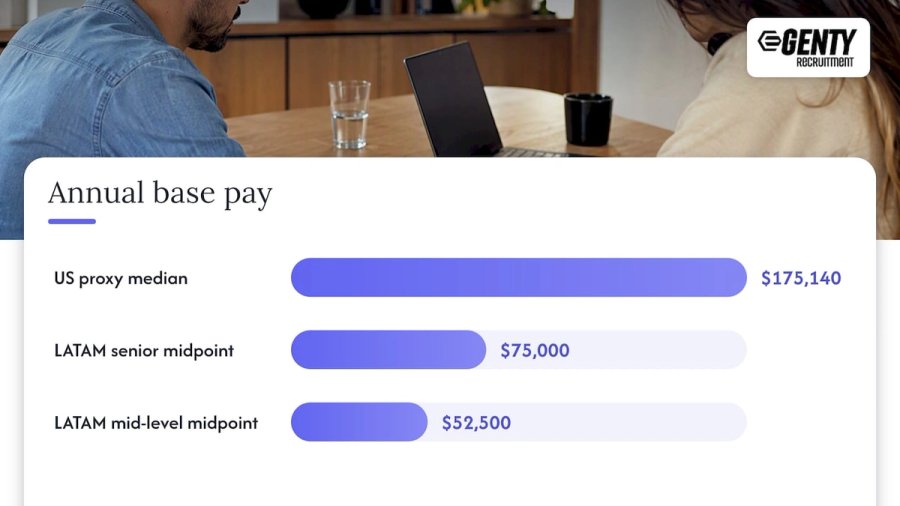
The BLS lists a median annual wage of $175,140 for computer and information systems managers, with the 10th to 90th percentile spanning $107,550 to $297,510. Product managers are not a separate BLS category, so this is a proxy rather than a PM-specific number, and many US tech PM packages also include equity and bonuses on top.
Set beside the planning bands above, the base-pay difference is large:
The saving on base pay is therefore well above the 40% we usually cite for total hiring cost, because that figure also counts US benefits, payroll taxes, and office costs that vary by company. Run your own numbers: the right comparison is your fully loaded US cost for the role against the LATAM base plus employer costs plus placement fee.
Budgeting beyond base salary
A realistic LATAM PM budget has five lines. Treat this as a checklist when you build the headcount request.
- Base salary in USD, from the bands above.
- Employer-side costs. If you hire through an employer of record or staffing arrangement, there are statutory contributions and benefits that differ by country. Our remote staffing and EOR service starts at $99 per employee per month.
- Bonus or equity. Senior candidates from US-facing companies expect variable pay or equity. Decide the structure before the first interview.
- Tools and equipment. Laptop, product analytics seats, and design tool licenses, the same as for any hire.
- Recruitment fee. A fixed fee is easier to forecast than a percentage of salary. Percentage-based fees scale up with the seniority of the PM you want; a fixed fee does not.
For a deeper look at total cost across roles, see our analysis of US tech employers hiring in Latin America. If you are also scoping engineering leadership, the Engineering Manager salary guide for LATAM uses the same method, and the DevOps salary guide covers the platform side.
What moves a PM’s price up or down
Two candidates with the same title and years of experience can differ by 30% or more in expectation. These are the factors that matter most:
- Domain depth. Payments, lending, risk, and AI product experience carry a premium over generalist B2C product work.
- Prior US-company experience. A PM who has already run discovery with US customers and written specs for a US engineering team needs less ramp-up.
- Technical fluency. PMs who can read an API contract, write SQL, and discuss architecture trade-offs with engineers are scarcer and priced accordingly.
- English level. Written and spoken fluency are non-negotiable for a role built on communication, and it narrows the pool noticeably.
- Contract type. Contractors paid in USD often ask for a higher gross than employees on a compliant local payroll, because they cover their own social contributions.
- Company stage. Candidates expect a discount-free offer from a funded Series B, but may trade some base for equity at seed stage.
Timezone overlap: why LATAM works for product roles
Product management is the most meeting-dense role on a software team. Discovery calls, roadmap reviews, sprint ceremonies, and customer interviews all need real-time overlap, which is why a PM in Asia or Eastern Europe is a harder fit for a US team than an engineer is. LATAM solves this directly.
Offsets shift with daylight saving, so confirm the exact hours for the candidate’s city. The practical result is that a PM in Bogotá or Mexico City can run a 9 a.m. Eastern stand-up, join a customer call at 2 p.m., and still hand off to engineers the same day.
Our perspective: price the outcome, not the title
We see the same mistake in a lot of PM searches: a team picks a number from a salary page, posts a role, and then wonders why the shortlist is thin. A PM is a judgment-heavy hire, and the salary band is only useful once you have decided what the person will own in the first six months.
Our view is that US teams get the best result when they fix three things before the search starts. First, the scope: is this a feature-team PM or someone who will set product strategy? That decision alone moves the budget one full seniority level. Second, the domain: if you are a FinTech or AI company, say so in the brief, because it narrows the pool to candidates who have already shipped in that space. Third, the overlap hours: define the working window in your timezone so candidates self-select.
The way we work reflects this. Each vertical has dedicated recruiters who focus exclusively on Latin America, our process is skill-first, and shortlists arrive within 7 days, triple-vetted before you see them. Fees are fixed by seniority level and nothing is paid upfront, so a senior PM search costs the same whether the candidate asks for $70,000 or $85,000. Placements carry a 3-month replacement guarantee. If you want to see how we think about the role itself, our guide to product manager recruitment walks through the search from brief to offer.
— Eugene
Hiring a LATAM product manager with GENTY recruitment
If you are ready to open a PM search, GENTY recruitment runs it as a fixed-fee engagement. Recruitment starts at $2,999 one-off per hire, with transparent pricing per seniority level, no upfront payment, and a curated shortlist within 7 days. See how our recruitment service works or, if the PM will sit inside an engineering organization, our IT recruitment page. For a role like head of product, executive search fits better, and we can also provide salary benchmarking so your offer is calibrated before you go to market.
Checklist: before you post a LATAM PM role
- Define scope, reporting line, and whether the PM manages other PMs.
- Set a USD base range from the seniority bands, and decide on bonus or equity.
- State the required overlap window in US time.
- Choose the employment route: EOR, contractor, or your own local entity.
- Pick the target country or countries and check the offset in each season.
- Write three screening exercises: a product teardown, a prioritization case, and a metrics question tied to your own funnel.
- Agree on who interviews, and decide the timeline up front. Strong candidates have multiple offers.
For the broader process, our guides on hiring remote talent from Latin America and the remote hiring playbook for LATAM tech teams cover sourcing, contracts, and onboarding. If you want to compare data sources before you set a budget, see our review of salary benchmarking tools.
FAQ
What is the average product manager salary in LATAM?
For remote roles paid in USD by a US company, a mid-level PM typically falls between $45,000 and $60,000 a year, and a senior PM between $60,000 and $90,000, based on our planning ranges. Local employers pay less: in Brazil, the PM3 study reports an average of R$14,382.15 for product managers.
Is a product manager a high-paying job?
Yes, in most markets. In the US, the closest BLS category has a median wage of $175,140. In Latin America, USD-paid remote PM roles are among the better-paid positions in tech, usually well above local-employer pay for the same title.
Which LATAM country is best for hiring a product manager?
It depends on your needs. Brazil has the deepest pool and the best data, Mexico has the easiest overlap for Central and Pacific teams, Colombia pairs Eastern hours with strong English, and Argentina offers experienced, analytical PMs. Most searches are best run across two or three countries.
Should I pay a LATAM PM in USD or local currency?
For US-based employers hiring senior talent, USD is the norm and what candidates expect, especially in Argentina. Your choice of employer of record or contractor arrangement affects the tax and benefit setup, so confirm it with an employment specialist in the candidate’s country before you sign.
Sources
- U.S. Bureau of Labor Statistics, May 2025 Occupation Profiles
- PM3 salary study coverage, Viva (October 2025)
- PM3 salary panorama coverage, Economia SC (December 2025)
- Remote product manager jobs in Latin America, Remote Rocketship