

Candidate evaluation is a systematic, multi-method process that assesses a job applicant’s skills, competencies, and potential fit against defined role requirements — going well beyond the initial screening pass that simply eliminates unqualified candidates. For CTOs and VPs of Engineering hiring from Latin America, getting this process right is especially high-stakes: a bad hire in Argentina or Colombia carries the same financial penalty as one in San Francisco, but the timezone alignment, English proficiency, and cost advantages of LATAM talent make a rigorous evaluation process worth every hour invested. The single most effective next step you can take right now is to run a focused job analysis for the open role and select two validated assessment methods, such as a structured interview paired with a work sample or coding task, before you review a single résumé.
What candidate evaluation really means (and how it differs from screening)
Screening and evaluation are not interchangeable, and conflating them is one of the most common reasons hiring pipelines produce mediocre shortlists. Screening is a knock-out filter: it removes applicants who fall outside non-negotiable thresholds such as visa status, salary band, or minimum years of experience. Candidate evaluation is what happens after that filter — a deeper, structured assessment of a candidate’s total capability, including skills, cognitive ability, culture fit, and potential.

The U.S. Office of Personnel Management’s Assessment Decision Guide defines the evaluation process as determining which candidates are best qualified based on job-related factors such as experience, education, and competencies. That framing matters because it anchors every assessment decision to the job itself, not to subjective impressions.
Where evaluation sits in the hiring funnel
A typical sequence runs: application → automated screening → evaluation stage → hiring-manager review → offer. Recruiters own the screening step; the evaluation stage is shared between the recruiter (who administers tests and coordinates logistics) and the hiring manager or panel (who conducts structured interviews and scores work samples). Keeping those ownership lines clear prevents the common failure mode where a hiring manager skips the rubric because “the recruiter already vetted them.”
Before you start hiring
Check location, salary, and hiring fit
If you are moving from research to action, start with the market basics so your hiring plan is clearer.
Core information types gathered during evaluation:
- Technical skills and job-specific competencies (coding tests, work samples, portfolio review)
- Cognitive ability and problem-solving capacity (reasoning tests, live debugging sessions)
- Behavioral and interpersonal competencies (structured behavioral questions, soft-skill assessments)
- Cultural and organizational fit (values alignment, communication style, autonomy signals)
- Reference and background verification (employment history, credential confirmation)
Pro Tip: Before designing any assessment, write a one-page job analysis that lists the five most critical competencies for the role. Every method you choose should map directly to at least one of those competencies — if it doesn’t, cut it.
What are the main candidate evaluation methods, and when should you use each?
Talent assessments — work samples, cognitive tests, and situational judgment tests — improve selection accuracy by measuring job-related skills objectively rather than relying on résumé signals alone. The challenge is choosing the right combination for the role, the hiring volume, and the stage of the funnel.
CIPD’s selection methods guidance confirms that combining methods typically yields better selection decisions than relying on any single tool. For technical roles, the strongest combination is a work sample plus a structured interview. For leadership or sales roles, add an SJT or a behavioral panel interview.
When hiring LATAM engineers specifically, prioritize work samples that reflect your actual product stack rather than generic algorithm puzzles. A senior backend engineer in Bogotá who has shipped production Node.js services will demonstrate that more clearly in a scoped take-home task than in a 45-minute LeetCode session. Adjust task language for clarity, and always confirm that the live-session window falls within the candidate’s working hours.
Soft-skill assessments are used by an estimated 57% of recruiters directly within interviews, which makes behavioral and situational questions a practical, low-overhead way to measure interpersonal competency without adding a separate test layer.
Pro Tip: For high-volume technical hiring, use a multi-hurdle design: automated cognitive filter first, then a take-home task, then a structured interview reserved for finalists. This protects engineering leadership time and keeps the pipeline moving.
Why does robust candidate evaluation matter for your P&L?
The financial case is direct. A poor hiring decision costs between 33% and 100% of the role’s first-year salary, once you account for lost productivity, re-hiring costs, onboarding time, and team disruption. For a senior engineer at a $140,000 annual salary, that’s a $46,000–$140,000 exposure per bad hire. For a LATAM hire at a comparable seniority level but at 40–60% of the U.S. rate, the absolute dollar loss is smaller — but the disruption to a lean engineering team is identical.
Valid evaluations also reduce turnover. When candidates are assessed against real job requirements rather than résumé signals, the people who accept offers are more likely to perform well and stay. That retention effect compounds: lower turnover means less re-hiring, more institutional knowledge, and faster product velocity.
Legal and compliance considerations for U.S. employers:
- EEOC guidelines require that selection procedures be job-related and consistent with business necessity; structured, criteria-based evaluations provide the documentation trail to demonstrate this.
- Cognitive and personality tests must be validated for the specific role and population; off-the-shelf tests used without validation studies carry legal risk.
- Candidate test data is subject to data privacy obligations; store scores in a secure ATS or HRIS with access controls and defined retention periods.
- Avoid questions in interviews or assessments that touch on protected characteristics (age, national origin, disability, religion, family status).
- Avoiding bad hires at the evaluation stage is far cheaper than managing a performance issue or a wrongful-termination claim after the fact.
Standardizing evaluation criteria across all candidates for the same role is the most effective single step toward both EEOC compliance and bias reduction. When every candidate answers the same structured interview questions and is scored against the same rubric, the process becomes auditable and defensible.
What does a reliable candidate evaluation process look like?
A reliable process has six non-negotiable features: a documented job analysis, standardized criteria, validated assessment tools, a calibrated interview panel, documented scoring, and a candidate feedback loop. Miss any one of these and the process degrades — either toward bias, legal exposure, or simply poor predictive accuracy.

Scoring rubric template
Panelists score each competency independently before the debrief to prevent anchoring. Aggregate scores by multiplying each rating by its weight, summing across competencies, and comparing totals across candidates.
For startup hiring, a lean version of this rubric covering three competencies (technical proficiency, problem-solving, communication) is sufficient for most engineering roles. Add collaboration and values fit for senior or team-lead positions.
Data fields to capture for auditability: candidate ID, role, assessment date, assessor name, method used, raw scores per competency, weighted total, hire/no-hire decision, and a brief rationale note. Store these in your ATS for at least 12 months post-decision.
Pro Tip: Run a 30-minute panel calibration session before the first interview of a new role. Walk through the rubric together, score a sample response, and align on what “3” versus “5” looks like for each competency. This single step eliminates most inter-rater disagreement.
Common evaluation mistakes and candidate red flags to watch
The most damaging evaluation mistakes are process failures, not judgment calls. Unstructured interviews, inconsistent scoring across candidates, over-reliance on CV credentials, and using assessment tasks with no demonstrated validity are the four most common process failures — and each one is fixable with a one-time investment in rubric design and panel training.
Cognitive bias patterns to watch:
- Halo effect: A strong first impression (polished résumé, confident opener) inflates scores on unrelated competencies. Mitigation: score each competency independently after the full interview, not in real time.
- Similarity bias: Interviewers rate candidates who share their background, communication style, or alma mater more favorably. Mitigation: diverse panels and blind scoring where possible.
- Recency bias: The last candidate interviewed scores higher simply because they are freshest in memory. Mitigation: complete scorecards within two hours of each interview.
- Confirmation bias: Interviewers seek evidence that confirms their initial read rather than probing disconfirming signals. Mitigation: assign one panelist the explicit role of “devil’s advocate” for each interview.
Candidate red flags in work samples and interviews:
- Work sample submitted with code that doesn’t run, with no explanation of the gap.
- Structured interview answers that are entirely hypothetical with no concrete examples from past roles.
- References who confirm employment dates but decline to comment on performance.
- Inconsistencies between the résumé timeline and what the candidate describes verbally.
- Dismissiveness toward the assessment process itself (“I don’t usually do take-home tasks”).
Pro Tip: Weight the work sample and structured interview scores at 60–70% of the total evaluation score. Reference checks and background verification should inform the final decision but rarely override strong performance data from validated methods.
How to run a candidate evaluation from start to finish
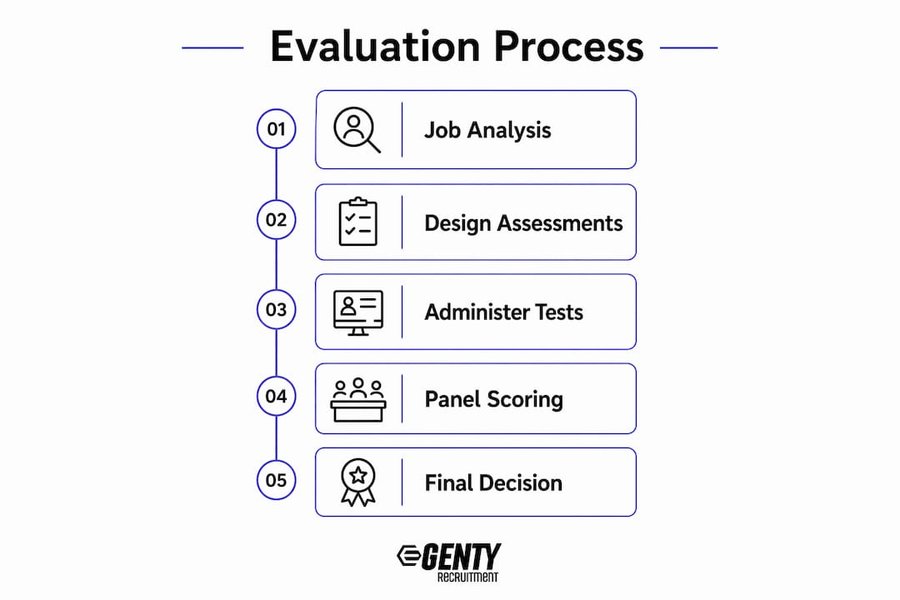
A repeatable evaluation workflow has three phases: preparation, execution, and decision. The multi-hurdle approach recommended for technical hiring maps cleanly onto these phases.
Phase 1: Preparation
- Complete a one-page job analysis: list the role’s five critical competencies and the performance outcomes expected at 90 days.
- Select 2–3 validated assessment methods appropriate to the role and funnel stage (e.g., cognitive screen → take-home task → structured interview).
- Build the scoring rubric and distribute it to all panelists before the first candidate interaction.
- Prepare a structured interview script: 5–8 behavioral or situational questions mapped to the competencies, with anchor responses for scores 1, 3, and 5.
- Draft a candidate communication plan: confirm assessment instructions, expected time commitment, and feedback timeline upfront.
Phase 2: Execution
Administer assessments in the order defined by your multi-hurdle design. For take-home tasks, set a clear scope (e.g., “3–4 hours maximum”) and provide a submission deadline. During structured interviews, ask every candidate the same questions in the same order, and take notes on observable behaviors rather than impressions. Score independently before the panel debrief.
Sample interview questions mapped to competencies:
Phase 3: Decision
Aggregate weighted scores from all panelists. If two candidates are within five points of each other on a 100-point scale, use reference check data as the tie-breaker. Conduct reference calls with a structured script: confirm role, tenure, performance relative to peers, and whether the referee would rehire. Post-interview evaluation captures evidence that interviews alone miss, so document the debrief discussion and record the final rationale before extending an offer.
For remote candidate vetting, add one additional step: confirm that the candidate’s working hours overlap with your team’s core hours before the offer stage, not after.
Applying candidate evaluation to LATAM hiring
LATAM engineering talent from Argentina, Brazil, Mexico, and Colombia brings specific strengths that a well-designed evaluation process can surface quickly. The key is calibrating your methods to the market rather than applying a U.S.-centric template unchanged.
Country-level notes
Argentina produces strong backend and full-stack engineers, with a high concentration of talent in Buenos Aires. English proficiency tends to be solid at senior levels. ART (UTC-3) overlaps with U.S. EST by 4–5 hours during standard working hours, making live pair-programming sessions practical.
Brazil has the largest engineering talent pool in LATAM. São Paulo and Florianópolis are the primary tech hubs. English proficiency varies more than in Argentina; include an English communication assessment for client-facing roles. BRT (UTC-3) provides the same EST overlap as ART.
Mexico offers strong timezone alignment with U.S. PST and CST, making it the preferred market for West Coast teams. Mexico City’s tech ecosystem is growing rapidly in FinTech and SaaS. CST (UTC-6) overlaps with PST by 2–3 hours and EST by 5–6 hours.
Colombia (Bogotá, Medellín) operates on COT (UTC-5), which aligns almost exactly with U.S. EST. The talent pool is strong in data engineering and DevOps. English proficiency at senior levels is competitive.
Salary comparison and cost context
Ranges reflect general LATAM market conditions and vary by country, seniority, and tech stack. Confirm current benchmarks with a salary benchmarking report before extending offers.
Assessment adjustments for LATAM hires:
- Use work samples that reflect international engineering standards, not locally specific frameworks or U.S.-only tooling.
- Avoid over-weighting academic credentials from institutions the panel doesn’t recognize; prioritize demonstrated output.
- For English proficiency, assess it directly in the structured interview rather than relying on self-reported fluency.
- Schedule all live sessions within the confirmed timezone overlap window; a candidate who can’t attend a 10 AM EST call is a real operational risk.
- Training remote staff across language backgrounds requires clear onboarding materials — factor this into your evaluation of communication skills.
GENTY recruitment integrates directly into this evaluation workflow. The candidate vetting process uses a skills-first approach that pre-screens for technical competency, English proficiency, and timezone fit before a candidate reaches your panel. Curated shortlists arrive within 7 days, and the 3-month replacement guarantee means that if a placement doesn’t work out, the search restarts at no additional cost.
Pro Tip: Confirm timezone overlap explicitly in the job description and again in the offer letter. A realistic job preview that states “this role requires 4 hours of daily overlap with U.S. EST” reduces early attrition because candidates self-select accurately from the start.
Key Takeaways
A structured, multi-method candidate evaluation process is the single most reliable way to reduce bad hires, support EEOC compliance, and make defensible hiring decisions at speed.
The part of candidate evaluation most hiring teams get wrong
Most hiring teams invest heavily in designing their interview questions and almost nothing in calibrating how those interviews are scored. The rubric exists, the questions are written, the panel is assembled — and then each interviewer walks out of the room with a completely different mental model of what “strong” looks like for that role. The debrief becomes a negotiation between impressions rather than a comparison of evidence.
The fix isn’t complicated. A 30-minute calibration session before the first interview, where the panel scores a sample response together and debates the rating, eliminates most of that variance. What’s harder to fix is the cultural resistance to structured scoring in organizations where hiring has always been a “gut feel” decision. Senior engineers especially tend to resist rubrics, viewing them as bureaucratic overhead that slows down a process they believe they can run on instinct.
The data doesn’t support that instinct. Structured interviews with fixed criteria consistently outperform unstructured conversations for technical roles, and the documentation they produce is the only thing standing between your company and an EEOC complaint if a rejected candidate challenges the decision. For LATAM hiring specifically, where candidates are geographically distributed and panels may never meet in person, standardized data points are the only way to make apples-to-apples comparisons across a shortlist that spans Buenos Aires, Bogotá, and Mexico City.
GENTY recruitment’s model is built around this principle. Every candidate in a shortlist has been assessed against the same skill-first criteria before the hiring manager sees them, which means the evaluation work your panel does is focused on fit and depth rather than basic qualification filtering. That’s a meaningful compression of the evaluation cycle, and it’s why the IT recruitment process can move from brief to shortlist in 7 days without sacrificing quality.
GENTY recruitment accelerates your LATAM evaluation cycle
Hiring pre-vetted engineers from Argentina, Brazil, Mexico, or Colombia can lead to substantial savings compared to equivalent U.S. roles — but only if the evaluation process is tight enough to identify the right candidate from a strong shortlist. GENTY recruitment shortens that cycle at both ends: candidates arrive pre-screened for technical skills, English proficiency, and timezone fit, and the fixed-fee pricing model means you know the cost before the search begins, with no upfront payment required.
The service covers IT recruitment, DevOps, data engineering, and sales roles across FinTech, AI, SaaS, and Web3. Shortlists are delivered within 7 days, and every placement comes with a 3-month replacement guarantee. A consultation includes salary benchmarking for your target market and a timezone-fit assessment for your team’s working hours. To see how the process works for your open roles, visit GENTY recruitment’s IT recruitment page or review the candidate vetting methodology in detail.
Useful sources and further reading
The sources below underpin the guidance in this article and are worth bookmarking for ongoing reference when designing or auditing your evaluation process.
A note on legal defensibility: when selecting psychometric or cognitive tests for use in U.S. hiring, consult the OPM and DOI guides above to confirm that your chosen tools meet validity and job-relatedness standards. This is especially relevant for roles where test results could be challenged under Title VII or the ADA.
This article provides general information on candidate evaluation practices and does not constitute legal or HR compliance advice. Confirm current EEOC requirements and applicable state laws with a qualified employment attorney or HR professional for your specific situation.