

The most repeated advice on inside sales vs outside sales is to default to inside because it costs less. That advice confuses cost per interaction with cost per closed deal, and it assumes every stage of every deal responds to a phone call the same way.
The answer, up front. Inside sales is the right default for repeatable, digitally explainable deals where volume and speed decide the outcome. Outside sales earns its travel budget only when physical presence, a buying group that needs to agree in a room, or a strategic account decides whether the deal closes. Everything else is coverage design, made deal by deal rather than chosen once for the whole company.
That reframing matters most for technical teams. A CTO selling a platform into a European enterprise and an HR director hiring the reps who will run it are both making a coverage decision, not picking a side in a debate.
Inside and Outside Sales Side by Side
The U.S. Bureau of Labor Statistics occupational outlook for wholesale and manufacturing sales representatives draws the line exactly where it belongs. Inside representatives work primarily from offices, generate prospects through outbound calls, handle incoming inquiries and process transactions. Outside representatives spend much of their time traveling to meet current and prospective customers, assess needs and recommend products or services.
What do you need?
Choose the hiring path that fits
After reading "Inside Sales vs Outside Sales: Which Model Fits Your Team", most teams compare these options before deciding how to hire.
That's an operating difference, not a rank. In 2025 the U.S. wholesale and manufacturing sales representative category employed approximately 1.3 million people, and the BLS projects about 123,400 job openings per year from 2025 through 2035, driven largely by replacement needs such as retirement and employee mobility rather than strong net growth. Two different jobs, both hiring constantly.
Why the title misleads you
The capability sets follow from the mechanics, not from seniority. Inside work rewards digital communication, prospecting discipline, CRM usage and rapid activity management. Field work rewards territory planning, consultative discovery, travel stamina and complex stakeholder engagement.
Promoting your best inside closer into an outside role because it sounds like a step up is how companies lose a good closer and gain a mediocre road warrior. Most organizations need both profiles working the same pipeline: inside reps qualify and develop opportunities, outside reps close and expand them.
Run one test on your own pipeline this week. Find the stage where deals sit the longest, then name which model owns that stage today. If stalled deals are stuck in qualification, your inside coverage is thin. If they're stuck in procurement with three stakeholders silent, you're asking a desk rep to do a field job.
How Each Role Spends a Working Week
Two calendars explain the cost gap better than any benchmark.
Inside, Monday to Friday
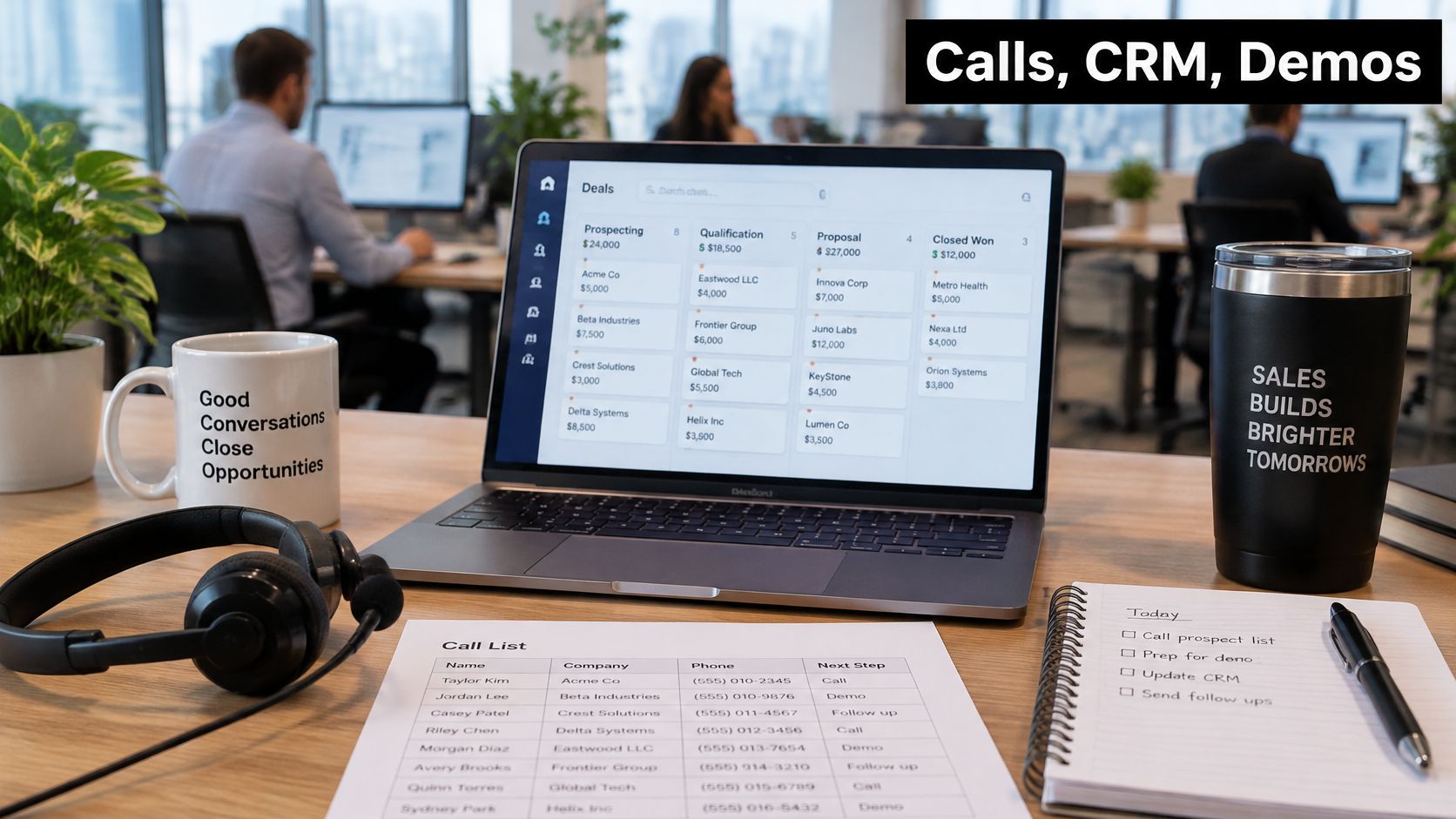
You start at 8:30 with a two-hour outbound block. That's 40 to 60 dials and 8 to 12 real conversations, and the good ones become meetings booked straight into a shared calendar. Before you dial, decide which leads deserve the call at all; Lead Printer's guide to outbound qualification covers the filters that separate a live prospect from a name in a list.
Midday goes to follow-up emails, inbound replies and CRM updates, because a record you fix today is a forecast you can trust on Friday. Afternoons hold two or three 30-minute demos and whatever inbound requests land. If your team splits sourcing from closing, the difference between an SDR and a BDR decides who owns which block.
Outside, Monday to Friday
Monday is territory planning and confirmations. Tuesday is a travel day built around two or three client meetings, one of which always runs long. Wednesday is proposals, internal coordination and the follow-ups you promised on Tuesday. Thursday is another travel day, Friday is expense reports and account reviews.
Nobody logs the transit hours, the airport Wi-Fi calls or the 6am drive. They just disappear from the activity count your dashboard reports.
Practical rule: set quotas and territory sizes from real selling hours, not headcount. Nominal rep counts overstate capacity in both models, and they overstate it worst in the field.
The calendar audit that settles the argument
Log one week by category. Calls, demos, proposals, travel, admin, internal meetings.
Mark each block as pipeline producing or overhead.
Compute the selling share for one inside rep and one outside rep in the same segment.
Compare against outcome, meaning pipeline created and stage progression, not activity totals.</li>
The audit answers one question: is your bottleneck the number of conversations, or the amount of time a rep can spend on the right accounts? Those need opposite hiring decisions.
What Each Model Costs Per Closed Deal
Start with the per-interaction gap. The MarketSource CFO guide to evaluating inside sales estimates an inside-sales call at approximately $50 against $308 for an outside-sales call, with inside representatives able to make 100 or more calls per day compared with roughly one or two meetings for many field representatives. The same benchmark reports inside reps spend about 13% more time actively selling, and that inside-team cost of sales can be 40% to 90% lower once salary, travel and expense differences are counted.
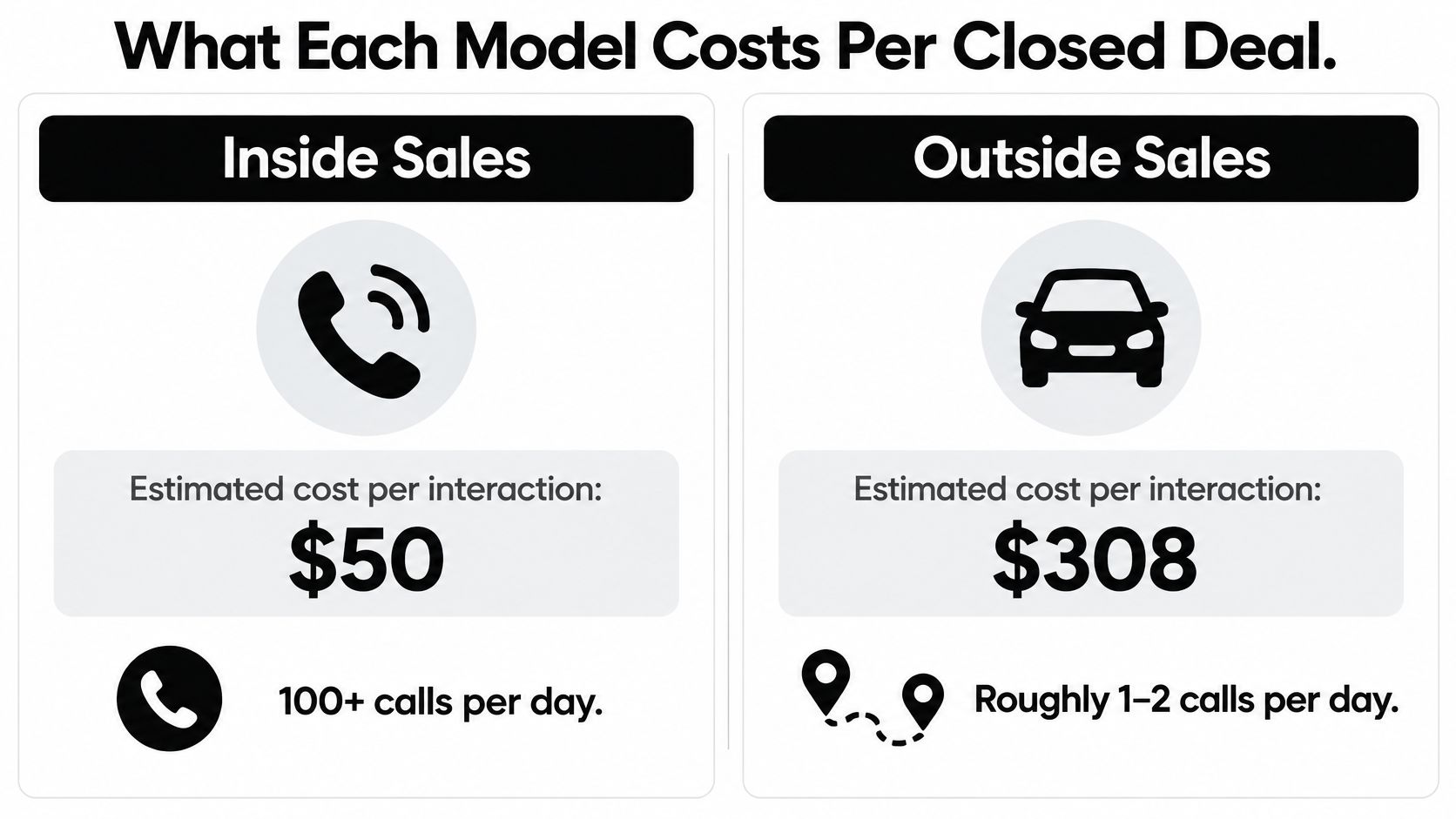
Treat that range as a scenario input, not a promise. A high-volume, digitally delivered SaaS product can land near the top of it. An enterprise deal with technical validation, security review and procurement sits far closer to the bottom, because the field time isn't optional.
Run the arithmetic on your own funnel
Add it all up. Compensation, travel, events, sales engineering, management, tools and ramp time.
Divide by qualified opportunities to get cost per qualified opportunity.
Divide by closed-won deals to get cost per closed deal, the only number that matters.
Normalize both figures by average contract value, segment and compensation design.
Compare the outside cost per deal against the conversion lift a field meeting produces.</li>
Steps two and three expose the error many teams make. A cheap interaction that never converts is the most expensive thing in your funnel.
{{VIDEO}}
Compensation arbitrage changes the inputs without changing the method. LATAM SDR team leads cost 50% to 70% less than US team leads, and the SaaS sales salary benchmarks for Latin America give you the compensation line for step one.
Outside sales justifies its premium on exactly one condition: a field meeting measurably raises conversion or protects revenue you would otherwise lose. If you can't show either, you're funding travel out of habit.
Matching the Model to Deal Complexity
Five criteria settle which model leads a deal: how well-defined the requirements are, how many stakeholders must agree, how much implementation risk the buyer carries, the deal value, and how much the outcome depends on personal trust. Deal size alone is a bad proxy.
That matters more than it did a few years ago. Survey reporting summarized by MarketSplash's inside sales statistics roundup indicates 67% of B2B buyers prefer a rep-free experience, while 69% still want a salesperson to validate information produced by AI. Buyers arrive having read your docs, watched your demo and compared you to two competitors. The rep's job is to add diagnosis, risk reduction, technical judgment and stakeholder alignment, not to recite the feature list.
Signals that justify a field visit
Procurement enters the thread. A named buyer with a sourcing process wants a room and a timeline.
Security or legal review starts. These conversations move faster when people can hear each other think.
A multi-site rollout appears. Site walkthroughs kill assumptions that email preserves.
An executive sponsor asks to meet in person. Never decline the meeting that closes the gap.</li>
The contrarian version: your best inside model may not be higher call volume, and your best outside model may not be more meetings. Both now have to add something after the buyer has finished researching alone.
Write these signals into the playbook so reps escalate by rule rather than by instinct. When the technical bar for a deal rises, a pre-sales specialist often carries the qualification, and the LATAM sales engineer salary data tells you what that coverage costs before you promise it to a customer.
Hiring Profiles and Screening Signals
Screen for the model, not the job title. Two people with "account executive" on their CV can need opposite capabilities.
Inside profile:
Prospecting discipline. They build a list, work it in blocks and don't wait for marketing.
Written clarity. Their first email tells a stranger why this matters in three lines.
CRM hygiene. Notes appear the same day, not before the forecast call.
Rejection tolerance. A hang-up doesn't end the hour.
Fast objection handling. Short cycles leave no room for a two-day think.
Comfort with volume. A 100-call day reads as normal, not brutal.</li>
Outside profile:
Territory planning. They can rank 40 accounts into a travel-efficient quarter.
Consultative discovery. Questions go past features into how the business runs.
Account plans. They map the buying group by name and by role.
Executive presence. They hold a room with a VP and a security lead in it.
Travel tolerance. Regional travel is part of the job, not a hardship posting.
Multi-stakeholder management. Six opinions get one plan.</li>
Two tests that score the right thing
Inside candidates run a live prospecting role-play. Score the opening (0 to 2), the qualification questions (0 to 3) and whether they secure a specific next step (0 to 5). Under 6, they need coaching before a quota.
Outside candidates complete an account plan. Score how they map the buying group (0 to 3), how they identify risk (0 to 3) and how they sequence meetings (0 to 4). Under 5, they'll default to calling one friendly contact forever.</li>
Give both tests before the final interview and tie every score to the complexity tier of the role. A high-score prospector is not a high-score account planner, and forcing one into the other costs you a quarter.
Inside roles are staffed from Latin America routinely, because time-zone overlap and English proficiency make remote coverage practical. Each role we work carries a dedicated consultant matched to it, with IT or sales expertise, which matters when the same title means two different jobs at two companies. If you're calibrating what a strong shortlist looks like, how to recruit sales agents walks through the sourcing sequence.
Hybrid Handoffs and Coverage Design
A 2025 academic study of 194 firms, published in the Journal of the Academy of Marketing Science, found that greater reliance on inside sales increased interaction volume and could improve performance, but those interactions were generally lower quality. The net benefit was strongest when customer exchanges were less demanding and managers could closely control inside activity.
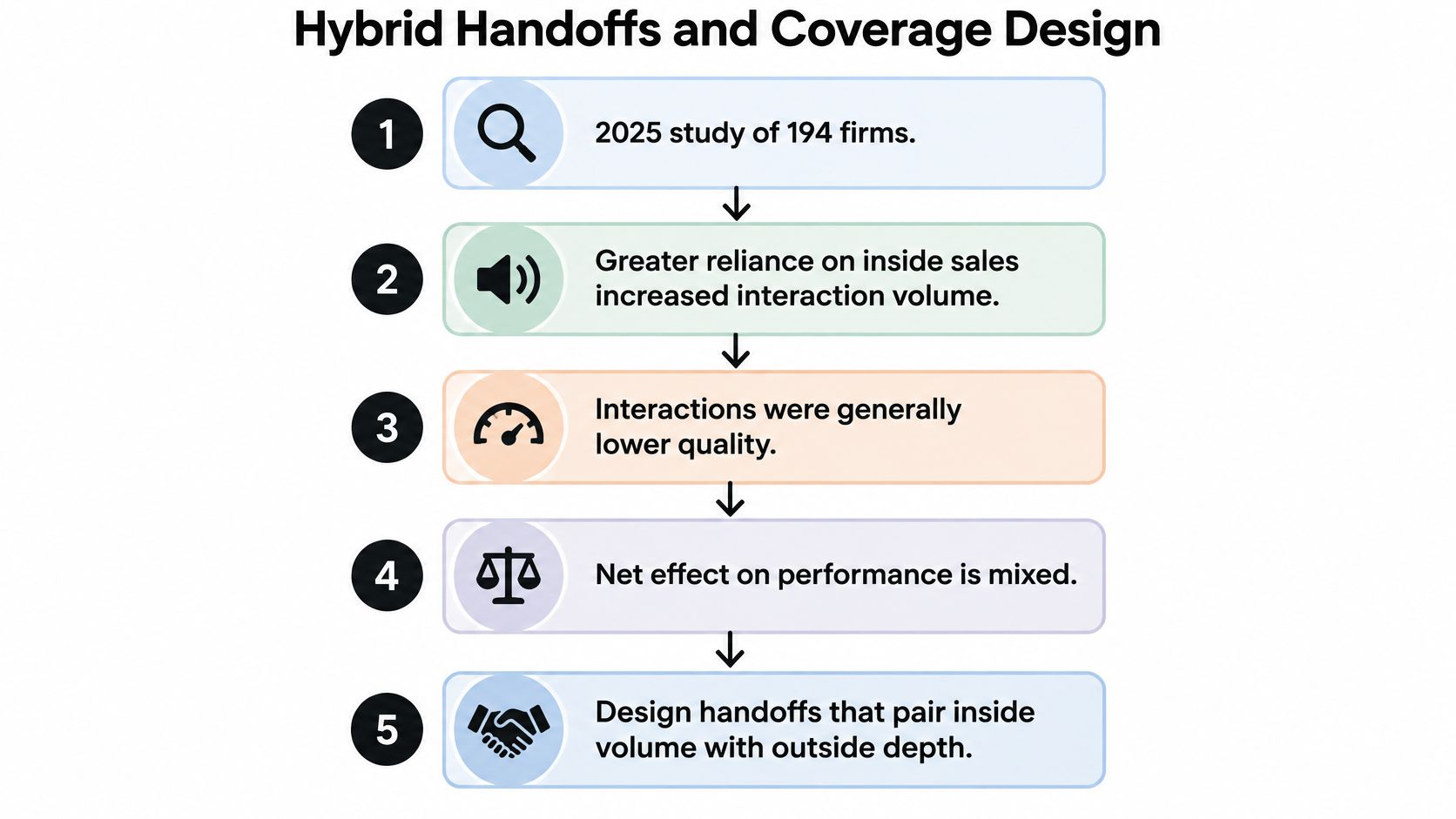
That finding kills the claim that inside sales is universally more efficient. Volume is easy to buy. Quality is designed.
The switch rule is complexity-based. Keep a deal inside while it's repeatable, lower risk and explainable on a screen. Introduce a field or senior seller when requirements turn ambiguous, stakeholders multiply, implementation risk rises, or trust has to be built across two organizations.
The handoff, step by step
Qualify against written criteria. Budget, decision process, use case. Failure: the criteria stay vague and everyone qualifies everything.
Score the opportunity for buying-group size, implementation risk and deal value. Failure: scores get assigned after the outcome is known.
Hand off above the threshold with a written account summary. Failure: handoffs arrive so late the buyer feels sold twice.
Run discovery together, with the inside rep attending. Failure: the field rep asks questions the buyer already answered in week two.
Split ownership by stage. Outside owns procurement, inside keeps the follow-up cadence. Failure: the split blurs and the deal stalls.</li>
A shared marketing and sales alignment playbook for B2B teams keeps the messaging consistent through that transition, which is where most handoffs leak credibility.
Three metrics that measure the design
Handoff acceptance rate. How often the field rep accepts the qualified deal without re-qualifying it.
Time from handoff to first outside meeting. Anything past a week means the buyer went cold between reps.
Stage conversion after handoff. Compare it to deals that stayed inside to see whether the field touch earned its cost.</li>
None of these is a meeting count. If your reporting starts and ends with meetings booked, you can't see whether the coverage model works. The same discipline applies when you scale remote sales representatives across several territories, because there's no hallway to absorb a slow handoff.
Choose Inside, Outside or Hybrid Sales for Your Stage
Seed to Series A companies should run inside sales with founders on the phone and exactly one outside pilot to test whether field time moves the needle. Series B companies selling across the US and Europe should run hybrid: inside builds pipeline, outside takes strategic and complex accounts. Series C companies with enterprise deals should add outside and executive-led coverage for named accounts while keeping inside teams on volume.
The economics behind that shift are documented. McKinsey's work on the future of B2B sales reports that remote sales representatives can reach four times as many accounts in the same amount of time and generate up to 50% more revenue, which is why inside coverage suits multi-territory expansion where transit time otherwise caps the pipeline.
If you're not ready to commit to a full field team, a fractional sales management guide is a cheaper way to test the structure before you hire for it. Whatever model you land on, the decision is reversible and belongs on the quarterly review alongside handoff and cost metrics.
Every search for a sales or marketing team lead we run starts with a detailed intake session covering the role's tech stack, seniority, team structure, culture, working style, timezone requirements, LATAM compensation benchmarks, success criteria and interview process design. Arrive with four numbers and the search starts from the right model:
Deal size, meaning average contract value by segment.
Buying-group size, meaning how many people must say yes.
Sales cycle length, in days from first touch to signature.
Regions, meaning where the accounts sit.</li>
Coverage design only works when the people in the roles match the model, and that's the part companies often get wrong when they hire quickly. GENTY recruitment builds shortlists for both inside and field sales roles across Latin America, with a dedicated consultant per role, fixed-fee pricing and a three-month replacement guarantee, so the hiring decision follows the coverage decision instead of trailing it. Bring your deal size, buying-group size, cycle length and regions to GENTY recruitment and we'll map the roles before you open a single req.