
Your engineering lead is covering an empty role, the shortlist keeps changing, and the last hire needed more supervision than the team could afford. Recruitment risk management means controlling that exposure before you approve another offer: define the job, measure the funnel, verify capability and identity, price the engagement correctly, and assign ownership for ramp and replacement. For a CTO or HR Director at a scaling tech company, the answer isn't another approval layer. It's a hiring operating system with clear evidence, named owners, and consequences when a control fails.
Why Hiring Risk Is an Operating Risk, Not an HR Problem
A failed hire doesn't stay inside the recruiting budget. Engineering managers inherit unfinished work, teammates absorb supervision, and finance pays for another search while the original delivery commitment remains.
A SHRM report on bad-hire costs cited an estimate that recruiting, hiring, and onboarding a replacement could cost as much as $240,000, including internal staff time, training, disrupted projects, lost customers, and employer-brand damage. That's a historical upper-end estimate, not a forecast for your next developer hire. Its practical value is showing why the agency invoice is an incomplete measure of exposure.
Define the loss before opening the role
Start intake with the work that won't happen while the seat is empty. Name the blocked product decision, customer commitment, or operational responsibility, then identify who currently owns it.
Need help hiring?
See the next step after this guide
If this topic is relevant to your team, these are the most useful pages to check next.
Next, describe the consequences of a miss. A developer who needs coaching creates a different exposure from an infrastructure specialist who receives privileged access before anyone verifies their capability.
Keep a role-level risk record with:
Business dependency: The deliverable or responsibility the hire will own.
Failure condition: What would make the appointment unsuccessful.
Evidence required: What candidates must demonstrate before an offer.
Decision owner: Who accepts any unresolved uncertainty.</li>
The hidden costs of bad hiring decisions in remote tech teams are a useful starting point for that finance conversation. Don't open a requisition until the hiring manager can distinguish a genuine hiring dependency from a workload or prioritization problem.
Separate sourcing from selection
More candidates won't repair an undefined role. Resources such as talent sourcing with Fetchin belong upstream, where recruiters build the candidate pool, not where managers decide whether someone can do the work.
Operating rule: Approve the evidence plan before approving the search.
A structured intake and a clearly scoped recruiting agreement should reduce repeated decisions, not create more meetings. The hiring manager supplies context once; the team uses it consistently.
The Four Risk Families Every Tech Hire Carries
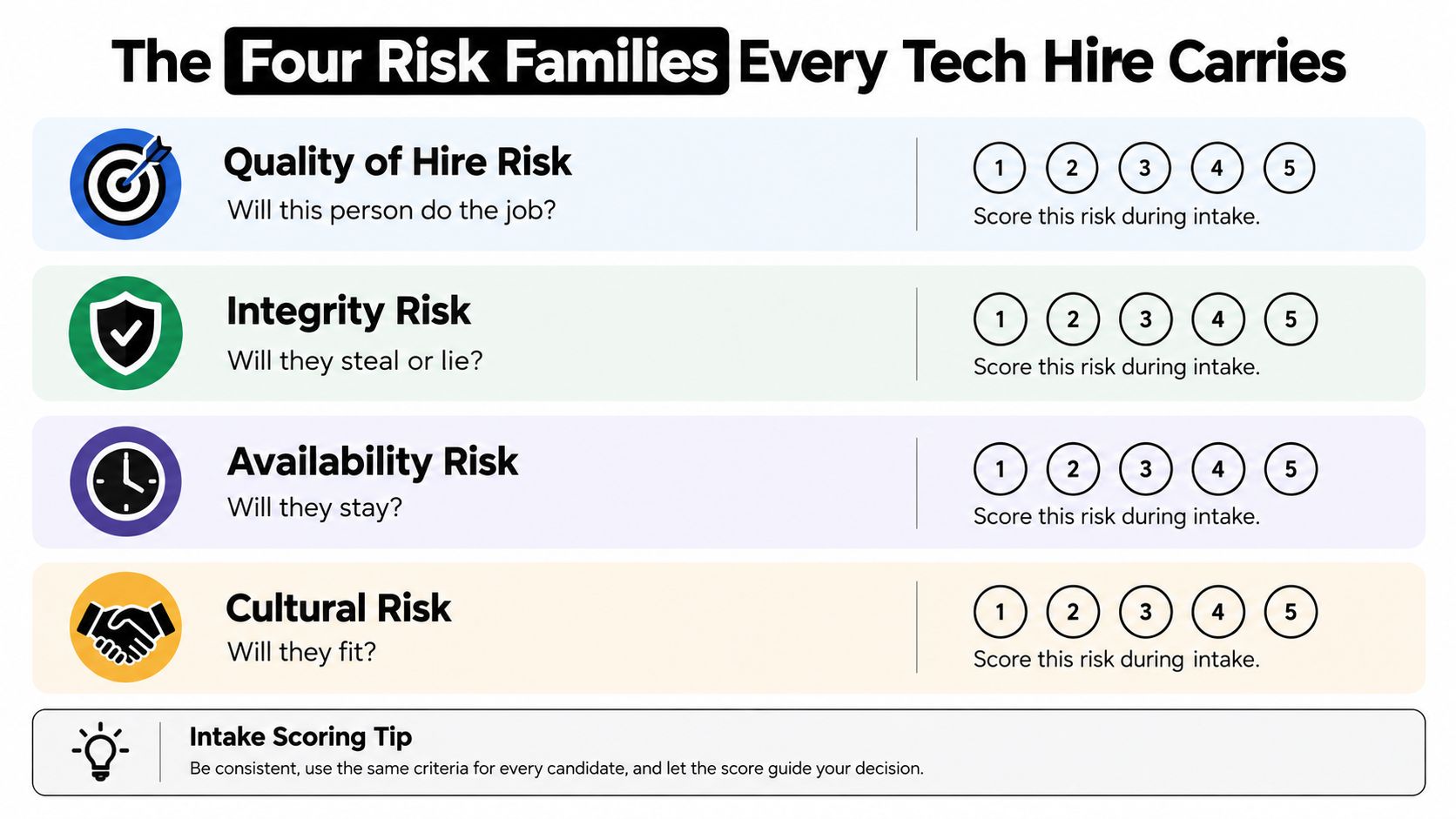
Use quality, integrity, availability, and collaboration as the intake categories. Treat timing, compensation, and legal setup as operating constraints across those categories rather than separate paperwork to resolve after selection.
The visual below provides a compact scoring aid. Treat its culture category as observable collaboration, not personal similarity.
Hiring Risk Intake Checklist
Use the visual's scale as an internal prioritization tool, not a validated prediction. Require a short explanation for each rating, an owner for the next action, and an explicit decision to proceed or pause.
For quality, ask the engineering manager to describe a realistic task and what acceptable execution looks like. For availability, ask what the team will stop doing if the search runs longer than expected.
Collaboration needs equally concrete evidence. Ask candidates to explain a trade-off in writing or respond to an ambiguous handoff; don't substitute conversational chemistry for working compatibility.
Resolve classification before negotiating
Contractor status isn't something a recruiter can establish by choosing a contract template. Under the U.S. Department of Labor's independent-contractor framework, economic reality matters, including control, permanence, investment, opportunity for profit or loss, integral work, and independent business initiative.
For cross-border hiring, have counsel review the applicable jurisdiction and actual working arrangement. Who sets schedules, controls methods, supplies equipment, and permits other clients matters more than the label in the offer.
Don't let legal review become the final obstacle after everyone has emotionally committed to a candidate. Resolve the employment model, benefits, compensation range, and decision scope during intake.
How to Monitor the Funnel for Fairness and Leaks
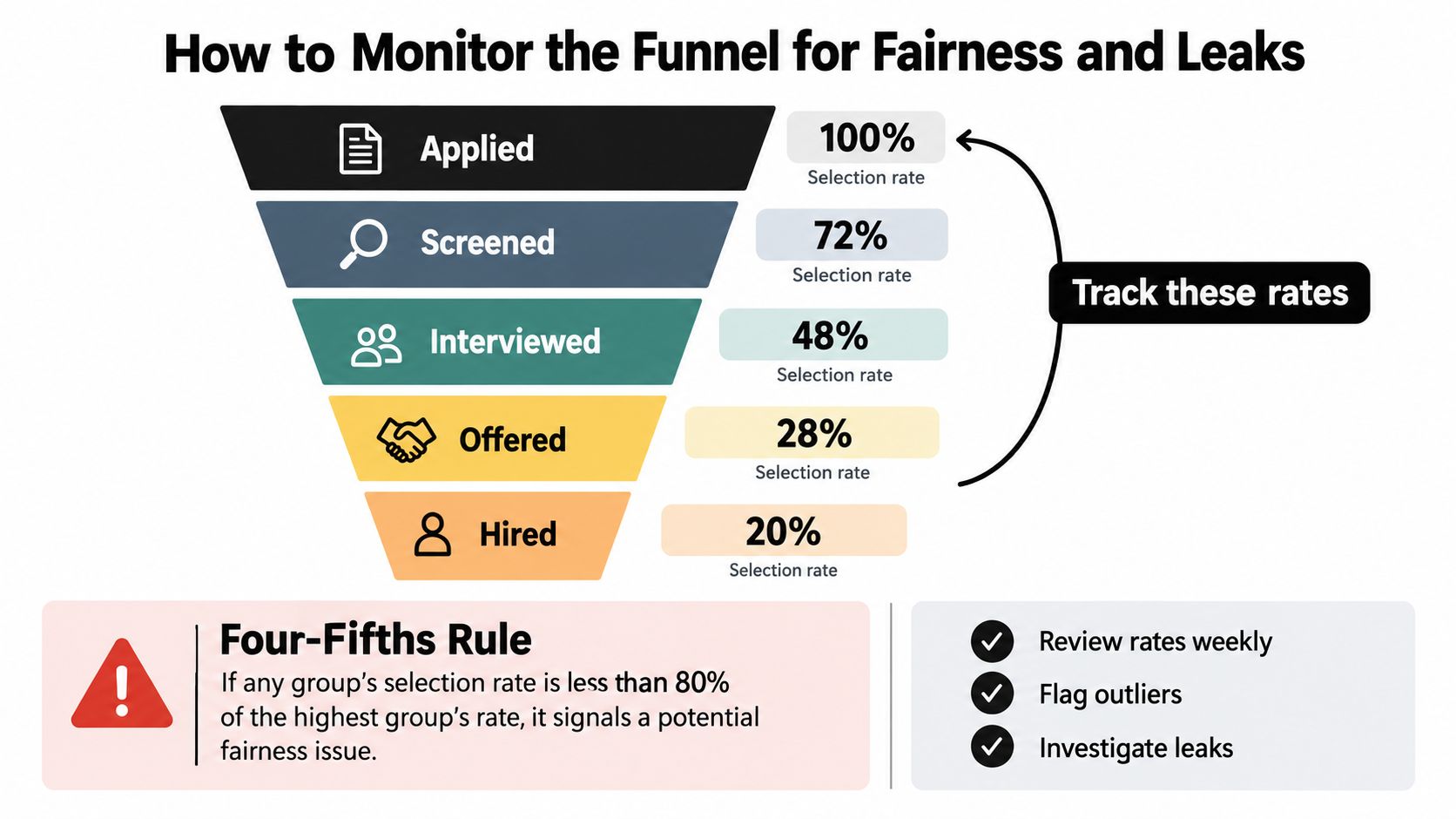
Instrument your applicant-tracking system the way your product team instruments conversion. Every stage needs an entry count, an advancement count, a withdrawal count, and a recorded reason for the outcome.
Use this funnel view to locate where candidates stop progressing, rather than judging fairness only from the final hires.
Calculate the warning signal correctly
For each stage, divide the selected candidates in each legally relevant demographic group by that group's applicants at that stage. Then compare each group's selection rate with the highest rate.
The EEOC's explanation of the Uniform Guidelines describes the four-fifths, or 80%, rule: a selection rate below that proportion of the highest group's rate generally signals potential adverse impact. The EEOC also makes clear that this is a rule of thumb, not a legal safe harbor.
Separate application review, recruiter screening, assessment, interviews, offers, and acceptance. A balanced final result can conceal disproportionate exclusion earlier, while missing withdrawal records can make a process problem look like candidate disinterest.
Preserve denominators: Keep applicant, advancement, withdrawal, offer, and hire counts by role and market.
Respect privacy: Collect demographic information only where lawful, with restricted access.
Handle small samples carefully: Flag unstable results and involve qualified statistical support rather than declaring success from volatile percentages.
Investigate sequentially: Review job necessity, screening proxies, assessment accessibility, and interviewer calibration before changing controls.</li>
The stage-level selection and fairness guidance supports examining individual stages and interpreting small samples cautiously. Keep a change log so you can distinguish a repaired criterion from a different candidate mix.
Improve the decision, not just the dashboard
Structured interviewing gives managers a repeatable basis for judgment. A meta-analytic review of employment interviews reported mean operational validity of 0.44 for structured interviews versus 0.33 for unstructured interviews when predicting job performance.
Define competencies, use standardized prompts, write behavioral scoring anchors, and require independent scores before group discussion. Don't let the most senior interviewer's confidence become the scoring system.
Share with HR: A flagged disparity requires investigation. An unflagged dashboard doesn't prove the process is fair.
Use the hiring compliance guide for HR leaders to frame ownership between recruiting, legal, and hiring managers.
For a supplementary discussion, use the video below alongside your team's documented review process.
Running Risk Control In-House vs. With a Fixed-Fee RPO Partner
An internal recruiter usually has easier access to business context. A specialist partner may offer dedicated search capacity, market calibration, and a more explicit delivery process.
Neither arrangement controls risk automatically. The relevant question is who performs each control, what evidence they produce, and who acts when it fails.
In-House vs Fixed-Fee RPO Risk Coverage
Keep the final technical hiring decision inside the company. Outsourcing coordination doesn't mean outsourcing accountability for whether the person can operate in your codebase, customer environment, or management structure.
Consider a recruitment process outsourcing arrangement when internal recruiting capacity is the bottleneck. Ask prospective partners to show a sample intake document, assessment rubric, funnel report, and exception log before discussing candidate volume.
Buy defined coverage, not a reassuring label
A fixed-fee model removes one source of uncertainty: how the recruiting fee is calculated. It doesn't remove the cost of management time, onboarding, vacancy, or a failed appointment.
Review the fixed-fee recruitment model alongside the actual service agreement. Confirm what seniority means, when payment becomes due, whether a changed role triggers a new fee, and what happens if the company pauses the search.
A three-month replacement guarantee can pair predictable fees with defined replacement support, but the written terms determine its value. Require clarity on the notification deadline, eligible departures, replacement scope, and exclusions before treating it as budget protection.
For LATAM hiring, use country- and seniority-specific salary calibration rather than a regional discount assumption. Verify working-hour overlap, job-relevant English, benefits, and management expectations with each candidate instead of inferring them from location.
The arrangement stops making sense when:
Managers won't participate: A partner can't calibrate against an unavailable decision-maker.
The role keeps changing: Repeatedly rewriting scope makes a stable shortlist impossible.
Reporting is opaque: Candidate submissions aren't a substitute for stage-level evidence.
Internal onboarding is broken: A replacement promise won't fix missing access, absent managers, or contradictory priorities.</li>
Choose the model that closes your actual control gaps, not the one that promises the most activity.
Identity, AI Fraud, and the New Verification Stack
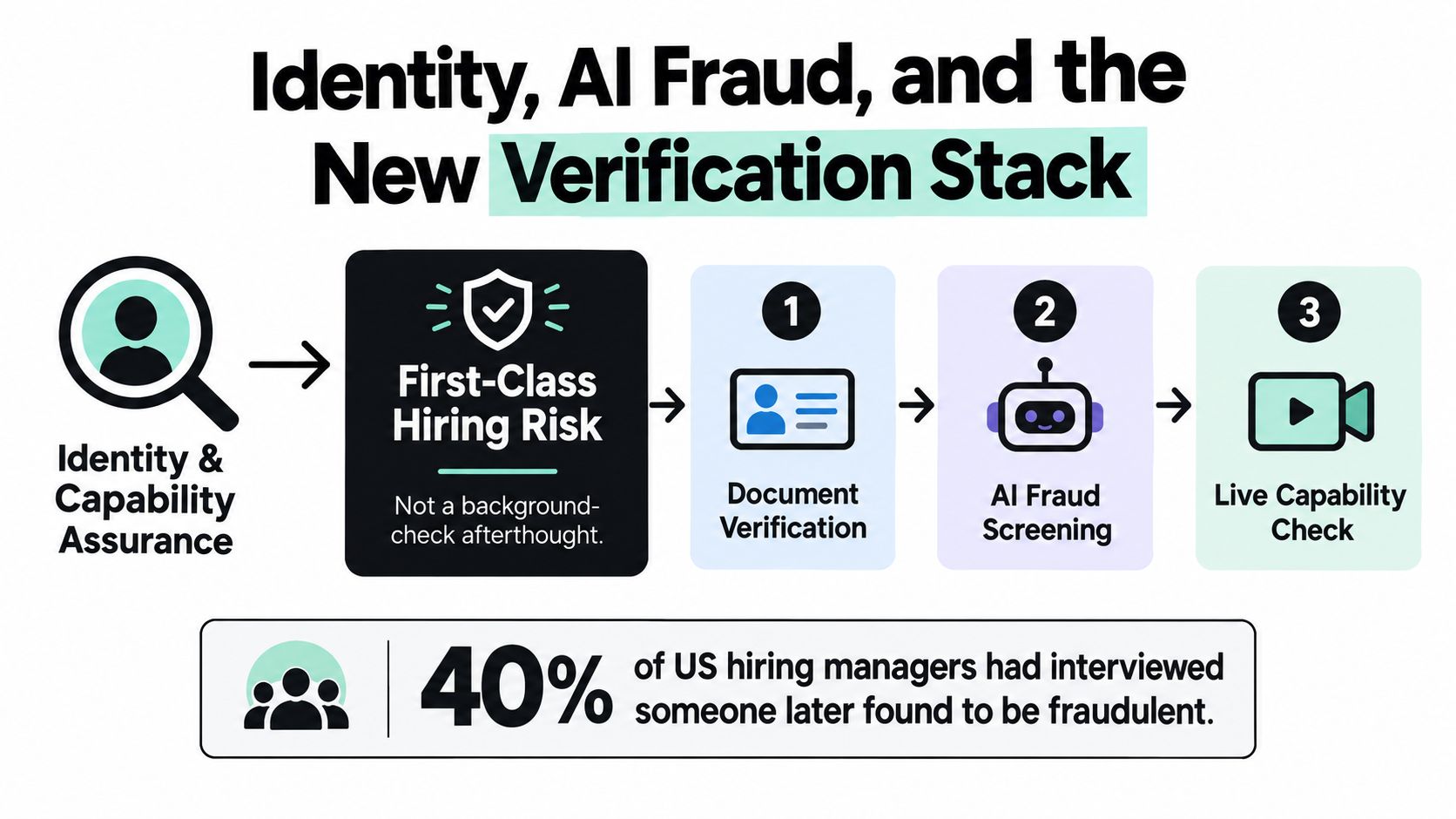
A legitimate résumé and a convincing video call aren't enough to establish capability. Separate who the candidate is, what work they performed, and what they can execute now.
A hiring-fraud survey reported by Checkr found that 65% of managers had uncovered candidates misrepresenting skills or experience. Separate hiring survey reporting found that 40% of U.S. hiring managers had interviewed someone later found to be using a fake identity, while only 23% were extremely confident in their detection process.
Those findings describe reported experiences, not the probability that your next applicant is fraudulent. They justify stronger verification, not blanket suspicion.
Use the process diagram as a reminder to connect document checks with direct capability evidence.
Verify ownership through the work
Set a clear assessment policy for AI assistance. If the job permits coding assistants, test the candidate's ability to inspect, explain, debug, and take responsibility for assisted output rather than secretly testing whether they use tools.
Run a live task: Use a bounded problem resembling the actual role.
Question submitted work: Ask why the candidate chose an approach, what failed, and what they'd change.
Maintain identity continuity: Resolve material inconsistencies between stages through a documented, proportionate process.
Check outcome-specific references: Ask about the candidate's contribution, decision ownership, and supervision needs.
Constrain initial access: Match permissions to assigned work and expand them after demonstrated need.</li>
A guide to background checks for regional hiring can support the documentation layer. It shouldn't replace technical follow-up or become an excuse to collect irrelevant personal information.
Protect candidates while protecting the company
Don't treat accents, poor connectivity, or unfamiliar interview formats as fraud indicators. Offer reasonable alternatives, investigate observable discrepancies, and apply the same job-related standards consistently.
Also define where identity documents, recordings, references, and interview notes live. The UK Information Commissioner's recruitment guidance says employers must tell candidates how long they'll retain information and whether they'll keep it for future vacancies.
Put deletion or review dates into the workflow. An indefinitely growing archive isn't a verification strategy.
Retention, Replacement Guarantees, and the 90-Day Scorecard
An accepted offer isn't the outcome. The outcome is someone performing the agreed work under the conditions you described during hiring.
Build a 90-day scorecard from the intake document. Use it as a proposed management cadence, not a universal productivity benchmark; an infrastructure specialist and an account executive shouldn't share the same ramp expectations.
Measure the promises both sides made
Keep the scorecard short enough that the manager updates it.
For engineering, assess completed work alongside review quality, defects, and task complexity. Raw ticket counts can obscure whether the employee is handling difficult work or receiving smaller assignments.
For sales, distinguish execution from territory, lead quality, and product readiness. Don't blame a new hire for conditions the hiring team misrepresented.
Make replacement a documented decision
Review the replacement guarantee in recruitment before a performance problem becomes an exit discussion. Preserve the original requirements, interview evidence, onboarding commitments, feedback, and agreed corrective actions.
That record helps separate a selection error from an employer-side failure. It also gives the recruiting partner something actionable to change in the replacement search.
Performance management needs its own safeguards. If an employee has raised a workplace concern, involve qualified counsel before taking adverse action; Nick Norris, P.A.'s information on retaliation is a relevant employment-law resource, not a substitute for advice on the specific facts.
Finally, return the outcome to intake: which competency was misjudged, which commitment changed, and which warning went unresolved? That's how recruitment risk management becomes an operating discipline rather than a recurring cleanup project.
GENTY recruitment offers skill-first tech and sales recruiting, salary benchmarking, and fixed-fee hiring support with a three-month replacement guarantee. Visit GENTY recruitment with your next role's scope, compensation assumptions, and ramp expectations to discuss which recruiting controls your team should retain and which a partner can own.