

A talent acquisition partner is an external specialist who owns the full hiring funnel for specific roles, combining sourcing, calibrated assessment, compensation intelligence, and post-hire accountability through 30-, 60-, and 90-day reviews. Hire one when your team needs accountable hiring execution, not another supplier sending resumes.
You're reviewing candidates between architecture meetings, your engineering managers keep rejecting shortlists, and the last hire still needs more supervision than expected. After months of that, the answer isn't more applications. It's someone who can diagnose where your hiring decisions fail and stay involved after the offer is signed.
What a Talent Acquisition Partner Actually Does
The partner owns the hiring process. You still own the hiring decision. That distinction matters for a Series A–C company where the CTO can't delegate technical standards but shouldn't spend every afternoon coordinating interviews.
Recruiting is an established professional discipline, not incidental administration. The Bureau of Labor Statistics describes HR-specialist responsibilities as including recruiting, screening, interviewing, and placing applicants. A partner should connect those activities to your workforce plan and delivery requirements.
Planning a hire?
Talk through the best hiring option
This article usually leads to one practical question: should you use rpo or it recruitment? We can help you choose quickly.
Start with the business constraint
Before approving a search, explain what the missing person must unblock. A team struggling with unreliable deployments might need stronger production ownership, not another developer with the same framework experience.
Ask the partner to challenge the specification. If they accept every requirement without asking what success looks like, you're buying execution against potentially flawed assumptions.
The engagement should assign responsibility for:
Role requirements: Translate roadmap priorities into observable capabilities and explicit trade-offs.
Sourcing strategy: Identify relevant candidate pools and explain which requirements constrain supply.
Assessment design: Agree on evidence, interview responsibilities, and decision criteria.
Offer calibration: Reconcile the role, candidate expectations, budget, and employment arrangement.
Onboarding handoff: Transfer assessment findings and unresolved risks to the hiring manager.
Post-placement support: Define review responsibilities and any contractual replacement coverage.</li>
Judge ownership, not presentation quality
A polished candidate summary isn't proof that the partner understands your engineering environment. Ask why the candidate fits your operating context, which capabilities remain unverified, and what your interviewers should investigate.
Practical rule: A shortlist should reduce uncertainty, not transfer the screening workload back to your engineers.
Don't assume a replacement guarantee or retention review comes with the title. Put both in the agreement if they matter to your decision. An external recruiter becomes a meaningful partner through documented responsibilities, not branding.
Partner Versus In-House TA Versus Traditional Agency
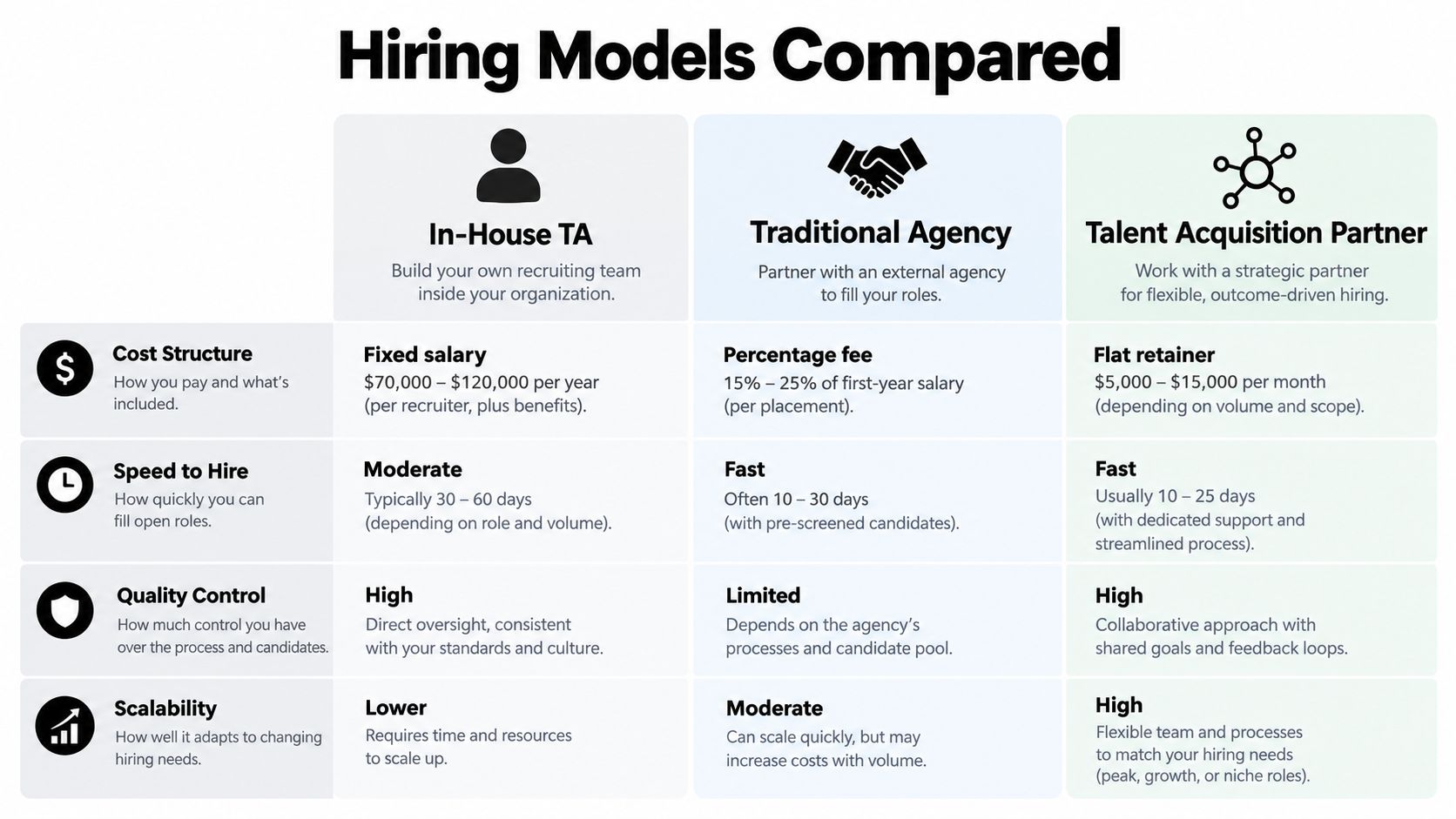
Choose the model around the work you need done. An internal recruiter, a contingency agency, and an embedded partner can all help, but they solve different capacity and ownership problems.
Use this comparison as a contracting framework, not a promise about every provider.
Three Hiring Models Compared
The visual comparison is useful for discussing the models, but the signed scope should govern your expectations.
Check capacity before adding headcount
A SHRM-referenced recruiting benchmark summarized by Flowmingo reports a median of 20 requisitions annually per in-house recruiter among organizations with dedicated recruiters. Treat that as a diagnostic reference, not a staffing formula: specialized searches and coordination-heavy interviews require different workloads.
Count the work your recruiter owns. Employer branding, onboarding, scheduling, and HR administration all compete with sourcing time. Don't describe someone as underperforming against a recruiting target while assigning them an unrelated operational workload.
Keep internal TA when sustained demand justifies it and the team can maintain close manager relationships. Use an agency for a bounded search; consider a partner when you need sustained execution plus process repair. This discussion of in-house versus agency recruiting provides another useful lens for assigning responsibilities.
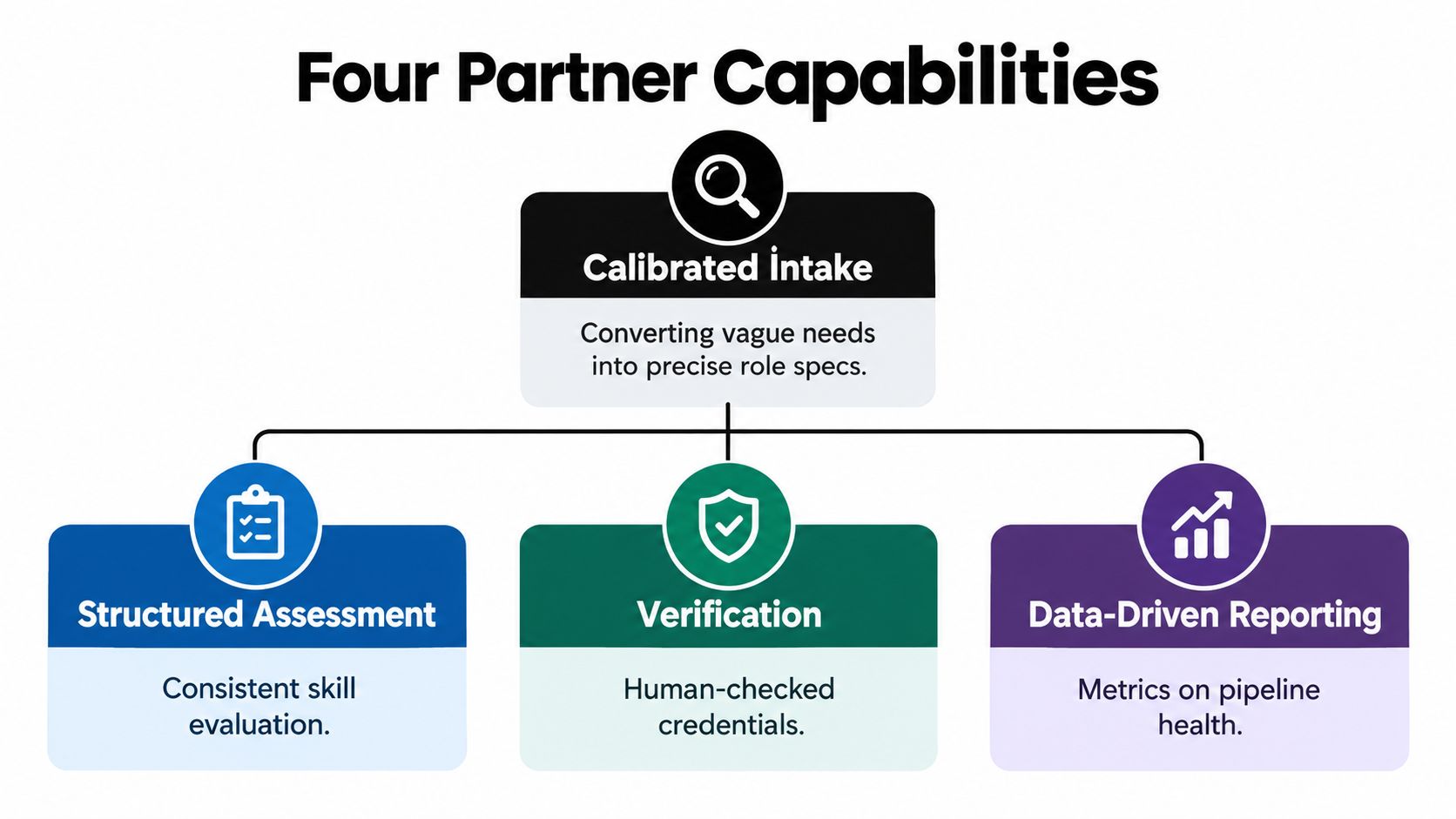
The Four Capabilities That Separate a Real Partner
Ask prospective partners to demonstrate their method using an actual vacancy. Don't accept a generic capabilities deck when you can inspect how they would handle your DevOps or full-stack search.
Calibrated intake and evidence-based assessment
Calibrated intake converts preferences into testable requirements. For a DevOps position, replace “strong cloud background” with evidence of incident response, deployment ownership, and explaining reliability trade-offs. Decide which capabilities are essential before sourcing begins.
For a full-stack candidate, a structured system-design discussion can examine ownership boundaries, failure handling, and testing choices. Require interviewers to record the evidence behind their judgments rather than submitting an overall impression.
LinkedIn reports that companies conducting the highest volume of skills-based searches are 12% more likely to make a quality hire. Its quality measure combines candidate demand before hiring, retention of at least a year, and internal mobility within a year. That's an association worth considering, not a guarantee for your next search.
Compensation intelligence and post-hire measurement
For a senior BI developer, ask the partner to explain how Mexican and Argentine compensation expectations affect the proposed offer. The comparison should distinguish seniority, engagement type, currency, benefits, and role scope. A generic US software-engineer average won't answer that question.
Then inspect the partner's quality review:
Performance evidence: Can the manager connect early delivery to the capabilities assessed?
Expectation gaps: Does the employee's actual work match what the hiring process described?
Retention signals: Are workload, compensation, or manager support creating avoidable friction?
Corrective action: Who changes the assessment or onboarding process when a mismatch appears?</li>
Don't confuse an employee staying with an employee succeeding. Retention belongs beside performance evidence, not in place of it.
Specialized assessment capacity deserves attention because the BLS projects software-developer employment growth of 15.8% between 2024 and 2034. Your response should be better role definition and evaluation, not a larger database of engineers.
Why Skills-First Hiring Now Requires Human Verification
More automation doesn't automatically produce better hiring decisions. If an application or coding submission looks impressive, you still need to establish what the candidate understands and can execute.
A live conversation should help the interviewer inspect reasoning, not merely confirm what appears on a resume.

A 2026 survey of 3,128 US hiring professionals reported that 60% believe AI has made candidates' real skills harder to evaluate. That finding argues for stronger verification, not a blanket ban on AI tools.
Assess reasoning under declared conditions
Tell candidates which assistance they may use. If AI is permitted, assess whether they can inspect its output, identify mistakes, and justify changes. Don't reward undisclosed assistance while penalizing candidates who follow the rules.
Use a role-specific work sample, then change a relevant condition during the discussion. Ask an engineer to debug unexpected behavior or a commercial candidate to adapt a discovery conversation after a new customer constraint emerges. Follow up on decisions, alternatives, and limitations.
For a deeper assessment design, review these approaches to vetting developers' technical and soft skills.
Use the following video as a discussion prompt when aligning interviewers on the hiring process.
Keep capability verification separate from employment eligibility. If a role involves relocation to Germany, LegalWeg's EU Blue Card requirements for Germany can support an initial eligibility discussion; qualified advisers should confirm the candidate's circumstances.
Ask for a candidate evidence packet containing:
Observed work: The task, conditions, and candidate's contribution.
Evaluator reasoning: Specific evidence supporting the recommendation.
Open questions: Capabilities your team still needs to verify.</li>
A partner who won't show that evidence hasn't earned your confidence.
A 30/60/90 Day Engagement Checklist
Treat the engagement calendar and the employee's tenure as separate clocks. A placement late in the engagement won't have completed its post-hire review when the initial contract period ends.
The following is a proposed operating plan, not a universal delivery benchmark. Write the dates, dependencies, and acceptance criteria into the statement of work.
30/60/90 Engagement Checklist
Put acceptance criteria beside each deliverable
Approve the search before outreach. Sign off on essential competencies, budget, reporting line, and working arrangements. Require the partner to flag contradictions instead of broadening or narrowing the role.
Start execution as soon as discovery is complete. These phases are management checkpoints, not waiting periods. Specify when the shortlist clock starts, what qualifies a candidate for submission, and which client delays pause delivery commitments.
Make candidate communication someone's job. Assign responsibility for updates, rejection feedback, and interview preparation. RedactAI's candidate experience improvement tactics can serve as a discussion resource when designing those touchpoints.
Close with an operational handoff. The manager should receive the agreed role expectations, assessment findings, and outstanding risks. HR should confirm who handles employment documentation, equipment, access, and start-date coordination.
Schedule reviews before the employee starts. Separate a skills mismatch from missing access, poor onboarding, or changed responsibilities. Record the action owner instead of letting everyone agree that the hire needs more time.
If an embedded model fits, use this explanation of how recruitment process outsourcing works to clarify which activities remain internal.
Contracting advice: A deliverable isn't complete because someone sent a document. Define who accepts it and what makes it usable.
When LATAM Nearshore Hiring Fits the Picture
Nearshore hiring makes sense when your team needs a broader candidate pool without abandoning synchronous collaboration. It doesn't make sense if the business can't support remote onboarding or if managers expect geographic proximity to substitute for clear operating practices.
For US teams, assess the actual working-hour overlap. For European teams, examine the schedule more carefully rather than assuming the same arrangement will work.
The interview should reflect the collaboration conditions the employee will face.

Match the location decision to the role
Full-stack development, DevOps, QA automation, and BI development are sensible roles to assess for distributed delivery. Onboarding and KYC specialists also deserve role-specific evaluation, particularly where customer communication or sensitive workflows matter.
Don't assume English proficiency from a country name. Test the communication the job requires: explaining an incident, challenging a specification, documenting a decision, or conducting a customer conversation.
Use these practical checks:
Schedule compatibility: Confirm normal hours, required meetings, and any on-call expectations.
Compensation comparability: Compare complete employment or contractor arrangements, not headline pay.
Employment structure: Assign country-specific classification and contracting questions to qualified advisers.
Manager readiness: Confirm that the team can provide access, documentation, feedback, and meaningful work remotely.</li>
GENTY places roles across Argentina, Mexico, Brazil, Chile, Colombia, Peru, and Uruguay, with initial candidate pools typically delivered within three to seven days and a three-month replacement guarantee. Treat pool delivery as an initial sourcing milestone, not evidence that assessment or hiring is finished.
For LATAM hiring, compare offshore and nearshore operating models against your team's needs. Then decide whether you need a dedicated IT recruitment service for defined searches or an RPO engagement for ongoing recruiting capacity.
Ask either provider to demonstrate country-specific salary benchmarking. Don't build the business case around a blanket savings percentage; compare the actual role, engagement structure, management requirements, and total cost.
How to Choose and Evaluate the Right Partner
Run the vendor conversation against an actual open role. Ask the provider to explain its proposed search, assessment, commercial terms, and reporting using that vacancy.
Check the contract against the pitch
Pricing: Is the fee fixed by seniority, retained, or contingent? What triggers payment, and what sits outside scope?
Guarantee: What activates replacement coverage, what exclusions apply, and who owns the replacement search?
Service levels: How are qualified shortlist delivery, interview-to-offer conversion, offer acceptance, and early retention defined?
Reporting: Will you see stage-level decisions, rejection reasons, unresolved risks, and named action owners?
Evidence: Can the partner show an anonymized assessment packet rather than a sample resume?</li>
Use these questions to ask a recruitment agency to pressure-test vague answers.
Reject promises without definitions. Fast delivery means little if “qualified” only means available and within budget. Fixed fees can improve cost predictability, but they don't replace rigorous assessment or fair guarantee terms.
Choose the partner who can explain what happens when a search fails, an offer is declined, or a new employee struggles. That conversation reveals more than a polished shortlist.
GENTY recruitment offers technical and sales recruiting, RPO, and salary benchmarking for companies building distributed teams. Visit GENTY recruitment with an open role, your compensation range, and the hiring problem you need solved, then ask for a scope covering assessment evidence, delivery commitments, and post-hire support.