

Hiring compliance is the practice of following all applicable federal, state, and local laws throughout every stage of recruitment and onboarding, from writing a job posting to completing an employee’s first-day paperwork. The industry term for this discipline is recruitment compliance, and it covers regulations like the Fair Credit Reporting Act (FCRA), I-9 verification requirements under the Immigration Reform and Control Act, and anti-discrimination rules enforced by the Equal Employment Opportunity Commission (EEOC). Failing to meet these standards exposes organizations to lawsuits, government fines, and reputational damage that can take years to repair. This guide breaks down the legal framework, the real cost of non-compliance, and the practical steps HR leaders can take to build a defensible hiring process in 2026.
What is hiring compliance and what does it cover?
Hiring compliance is defined as the systematic adherence to all laws and regulations that govern how an organization recruits, evaluates, and onboards employees. It is not a single rule but a layered framework that spans federal mandates, state statutes, and local ordinances, each adding requirements on top of the last.
The scope covers six core areas: job postings and minimum qualifications, application and screening procedures, interview conduct, background checks, offer letters, and onboarding documentation. Each area carries its own legal obligations. A job posting that requires a four-year degree for a role that does not genuinely need one, for example, can trigger an adverse impact finding during a compliance audit. An interview question about a candidate’s national origin violates Title VII of the Civil Rights Act of 1964 regardless of intent.

Compliance in hiring also intersects with data privacy law. Candidate records must be stored, accessed, and eventually purged according to specific retention schedules. The EEOC mandates a minimum one-year retention period, while laws like the California Consumer Privacy Act (CCPA) impose additional obligations depending on where candidates reside. Organizations that store candidate data indefinitely without a purge schedule face data privacy violations that compound over time.
Need help hiring?
See the next step after this guide
If this topic is relevant to your team, these are the most useful pages to check next.
Understanding the full scope is the starting point. The next step is knowing which specific laws create the most legal exposure.
Which laws and regulations govern hiring compliance in the U.S.?
Four federal frameworks form the backbone of U.S. hiring compliance, and each one targets a distinct phase of the recruitment process.
The FCRA governs every background check an employer orders through a consumer reporting agency. Before taking adverse action based on a report, employers must follow a two-step adverse action procedure: send a pre-adverse notice with a copy of the report, wait a reasonable period (typically five business days), and only then issue the final adverse action notice. Skipping either step creates direct legal liability.
I-9 verification requires employers to examine original identity and work authorization documents and complete Section 2 of Form I-9 within 3 business days of the employee’s first day. Remote hires add complexity because documents must be physically examined, which is why many distributed teams now use authorized representatives or E-Verify to satisfy this requirement.
The EEOC enforces Title VII, the Age Discrimination in Employment Act (ADEA), the Americans with Disabilities Act (ADA), and related statutes. Its enforcement reach is broad: any employer with 15 or more employees falls under Title VII. The OFCCP applies a separate layer of scrutiny to federal contractors, requiring written affirmative action plans and detailed recordkeeping on applicant flow data.
State and local laws add further complexity. Ban-the-box laws in cities like New York and Los Angeles restrict when employers can ask about criminal history. Salary history bans in states like California and New York prohibit asking candidates what they currently earn. HR teams operating across multiple states must map each jurisdiction’s rules to their hiring workflow.
Pro Tip: Build a jurisdiction matrix that lists every state and city where you hire, the specific laws that apply, and the date each law was last updated. Review it every quarter. Regulatory changes at the local level often move faster than federal updates.
What are the common risks and consequences of hiring non-compliance?
Non-compliance is not a theoretical risk. The EEOC processes roughly 80,000 discrimination claims per year, and individual settlements have reached $365,000 in age discrimination cases alone. That figure represents direct financial exposure before legal fees, HR time, or remediation costs are factored in.
The consequences of non-compliance fall into four categories:
- Financial penalties: Government fines, settlement payments, and back-pay awards can reach six figures per incident. Class-action suits multiply exposure significantly.
- Legal liability: Investigations by the EEOC or Department of Labor can trigger document requests, depositions, and consent decrees that restrict how you hire for years.
- Reputational damage: Discrimination claims become public record. Candidates, employees, and clients research employer reputation before engaging, and a visible compliance failure affects talent attraction and business development simultaneously.
- Operational disruption: An active EEOC investigation or OFCCP audit diverts HR, legal, and leadership bandwidth away from core business functions for months.
“Compliance audits are distinct from general HR reviews, emphasizing evidence-based evaluations linked to legal standards.” — Hiring Standards Audits and Self Assessment
The reputational dimension is often underestimated. A single high-profile discrimination claim can reduce qualified applicant volume, increase time-to-fill, and force salary increases to compensate for perceived employer brand risk. For tech companies competing for scarce engineering talent, that is a compounding disadvantage.
How does a hiring compliance audit work and why is it essential?
A hiring compliance audit is a structured, evidence-based review of your recruitment process against legal standards. It differs from a general HR review in that it produces documented findings tied to specific regulatory requirements, not general observations about process quality.
A well-designed audit follows four phases:
- Document review. Auditors examine job descriptions, interview guides, offer letter templates, background check authorization forms, and I-9 records. The goal is to identify missing disclosures, outdated language, or procedures that conflict with current law.
- Adverse impact analysis. This phase applies the 4/5ths (80%) rule to selection data. If the selection rate for a protected group (women, racial minorities, candidates over 40) falls below 80% of the selection rate for the highest-selected group, the difference signals potential disparate impact requiring investigation and remediation.
- Vendor review. Background check providers, pre-employment testing vendors, and applicant tracking systems (ATS) must themselves comply with applicable law. A vendor that delivers non-FCRA-compliant reports transfers legal risk back to the employer.
- Remediation planning. Findings are prioritized by legal exposure and assigned to owners with deadlines. High-risk items, such as missing adverse action notices or unvalidated minimum qualifications, receive immediate attention.
Annual hiring audits combined with quarterly reviews of key metrics, including adverse impact ratios and background check consent documentation, represent the current best practice standard. Quarterly reviews catch emerging issues before they accumulate into audit findings.
Pro Tip: When reviewing job descriptions during an audit, validate every minimum qualification against a current job analysis. Requiring a bachelor’s degree for a role that experienced workers perform without one is a documented path to adverse impact liability and one of the most common findings auditors surface.
What practical steps can HR leaders take to maintain hiring compliance?
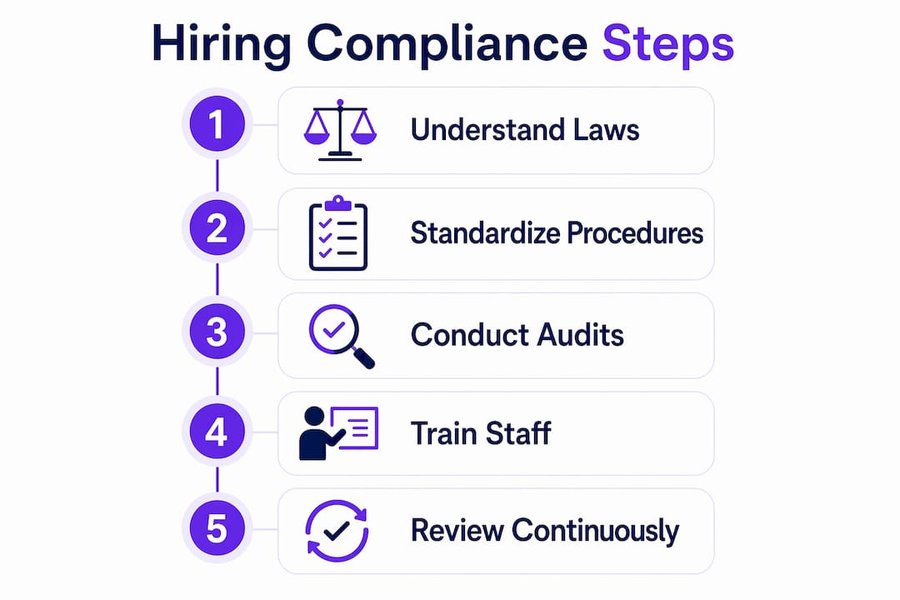
Maintaining hiring compliance is an ongoing operational discipline, not a one-time project. The following practices form a working hiring compliance checklist for HR teams and business leaders.
- Write legally defensible job descriptions. Every qualification must connect to a validated job requirement. Inflated credentials, such as requiring a master’s degree for a coordinator role, create adverse impact exposure. Review all active job descriptions against a current job analysis before posting.
- Implement structured interviews. Structured interviews using legally reviewed, job-related questions reduce unconscious bias and create a defensible record if a hiring decision is challenged. Unstructured conversations where interviewers ask whatever comes to mind are the single largest source of EEOC complaints tied to the interview stage.
- Train every person who touches hiring decisions. The EEOC’s current enforcement priorities emphasize consistent, unbiased decision-making across all levels of the hiring process, not just HR. Managers who conduct interviews without training on what questions are legally off-limits create direct liability for the organization.
- Use diverse interview panels. Diverse hiring panels reduce the influence of individual bias and align with EEOC guidance on merit-based selection. They also produce better hiring decisions by incorporating multiple perspectives on candidate fit.
- Manage candidate data with a retention schedule. Store application records, interview notes, and background check results according to EEOC minimums and applicable state law. Purge records on schedule. Indefinite storage without a documented retention policy is a compliance gap that data privacy regulators actively pursue.
- Audit your vendors. Background check providers must deliver FCRA-compliant reports. Pre-employment assessment vendors must provide validity evidence showing their tools predict job performance without adverse impact. Request this documentation annually and include vendor compliance in your contract terms.
For organizations hiring across borders, particularly those building remote tech teams in multiple jurisdictions, the compliance surface area expands considerably. Each country adds its own labor law requirements, data protection rules, and anti-discrimination frameworks that must be mapped to your process.
Key takeaways
Hiring compliance requires a documented, consistently applied process that satisfies federal, state, and local law at every stage of recruitment, from job posting through onboarding.
Compliance is a hiring quality issue, not just a legal one
After working through hundreds of hiring processes across technology companies, one pattern stands out clearly: organizations that treat compliance as a legal checkbox produce worse hires than those that treat it as a quality standard.
Here is what I mean. When you force yourself to validate every minimum qualification against an actual job analysis, you stop asking for credentials that do not predict performance. When you implement structured interviews with vetted questions, you start evaluating candidates on the same criteria, which makes your data comparable and your decisions defensible. When you train managers on consistent decision-making, you reduce the influence of gut feel, which is where most bias lives.
The companies I have seen struggle most with compliance are not the ones that ignore the law. They are the ones that apply rules inconsistently, where one hiring manager follows the structured interview guide and another does not, where one recruiter sends the FCRA pre-adverse notice and another skips it because the candidate “clearly wasn’t going to work out.” Inconsistency is the compliance failure mode that generates the most legal exposure, and it is also the one that produces the most erratic hiring outcomes.
Hiring compliance is dynamic, evolving with changing laws and enforcement priorities. The EEOC’s current enforcement plan signals increased scrutiny on AI-assisted hiring tools, which means any organization using algorithmic screening needs to validate those tools for adverse impact now, not after a complaint is filed. The organizations that build compliance into their process design, rather than bolting it on after the fact, will be better positioned to adapt as the regulatory environment continues to shift.
My practical advice: start with an audit of your job descriptions and your interview guides. Those two documents touch every candidate and generate the most compliance risk. Fix what you find, document what you changed, and build a quarterly review cadence from there.
— Eugene
Hire with confidence across borders
Building a compliant hiring process is demanding enough within a single jurisdiction. When you are hiring software engineers, FinTech specialists, or SaaS sales professionals across Latin America, the compliance surface area grows to include local labor law, data protection rules, and cross-border employment structures. Gentyrecruitment specializes in exactly this challenge. The team delivers pre-vetted, English-speaking tech and non-tech talent from Argentina, Brazil, Mexico, Colombia, and beyond, with a process built around structured assessment, legal employment structures, and full IT recruitment compliance. If your organization needs to scale a distributed team without adding compliance risk, explore Gentyrecruitment’s remote staffing solutions to see how the process works.
FAQ
What is hiring compliance in simple terms?
Hiring compliance is the practice of following all applicable laws and regulations during recruitment and onboarding, including FCRA background check rules, I-9 verification, and EEOC anti-discrimination requirements. It applies from the moment a job is posted through an employee’s first day.
What are the most important hiring compliance regulations?
The four most critical U.S. frameworks are the Fair Credit Reporting Act (FCRA), the Immigration Reform and Control Act (I-9 verification), Title VII enforced by the EEOC, and OFCCP rules for federal contractors. State and local laws, including ban-the-box and salary history bans, add jurisdiction-specific requirements on top of these federal standards.
How often should companies conduct a hiring compliance audit?
Full hiring audits should be conducted annually, with quarterly reviews of key metrics such as adverse impact ratios and background check consent documentation. This cadence allows organizations to catch emerging issues before they become regulatory findings.
What is the 4/5ths rule in hiring compliance?
The 4/5ths rule, also called the 80% rule, is a regulatory test for adverse impact. If the selection rate for a protected group falls below 80% of the selection rate for the highest-selected group, that gap signals potential disparate impact and requires investigation and remediation.
How does hiring compliance affect international or remote hiring?
Cross-border hiring adds data protection laws, local labor regulations, and employment structure requirements to the compliance framework. Organizations hiring internationally, particularly across Latin America, should review international hiring best practices and consider employer of record (EOR) structures to manage multi-jurisdiction compliance effectively.