
A better sales conversation isn't necessarily a better hiring assessment. Research summarized by CultureMatch supports combining structured interviews with additional job-relevant assessment rather than treating interview performance as the whole decision. A sales interview scorecard makes that practical: assess job-relevant competencies using fixed questions, anchored ratings, written evidence, and explicit hiring thresholds. For a Series A–C company, the benefit isn't more paperwork. It's distinguishing candidates who can sell your product from candidates who can sell themselves in an interview.
Sales Interview Scorecard Template and Core Criteria
A sales interview scorecard is a one-page form that evaluates five to seven job-relevant competencies using the same questions, a 1–5 anchored scale, evidence notes, and minimum scores on critical competencies.
Start with this SDR template. It tests targeting, buyer diagnosis, response to feedback, and operational discipline rather than rewarding presentation alone.
Starter scorecard template for an SDR role
In the working spreadsheet or ATS, add columns for competency ID, question ID, evidence noted, rating, and confidence. The competency identifies what you're measuring; the question ID identifies the prompt that generated the evidence.
Need help hiring?
See the next step after this guide
If this topic is relevant to your team, these are the most useful pages to check next.
Record the candidate's action or reasoning before choosing a rating. Confidence is a separate field, marked high, medium, or low, indicating how complete and interpretable the evidence was.
Include candidate, role, interviewer, interview stage, and scorecard version in the form header. Versioning matters when you revise an anchor: candidates assessed against different standards shouldn't appear in the same comparison.
Copy the table into your spreadsheet or ATS, then remove any row that doesn't map to a documented task in the job description.
Role-Specific Criteria for SDR, AE and Team Lead Hiring
Start with job analysis, not a competency library. Pull five to eight tasks from the job description and examine the work of the last three successful people in the role, where available. Keep a competency only when it maps to an actual task.
The U.S. Office of Personnel Management explains that standardizing questions, observations, and evaluation improves interviewer agreement. Generic labels such as hunger or culture add don't tell an interviewer what evidence to collect.
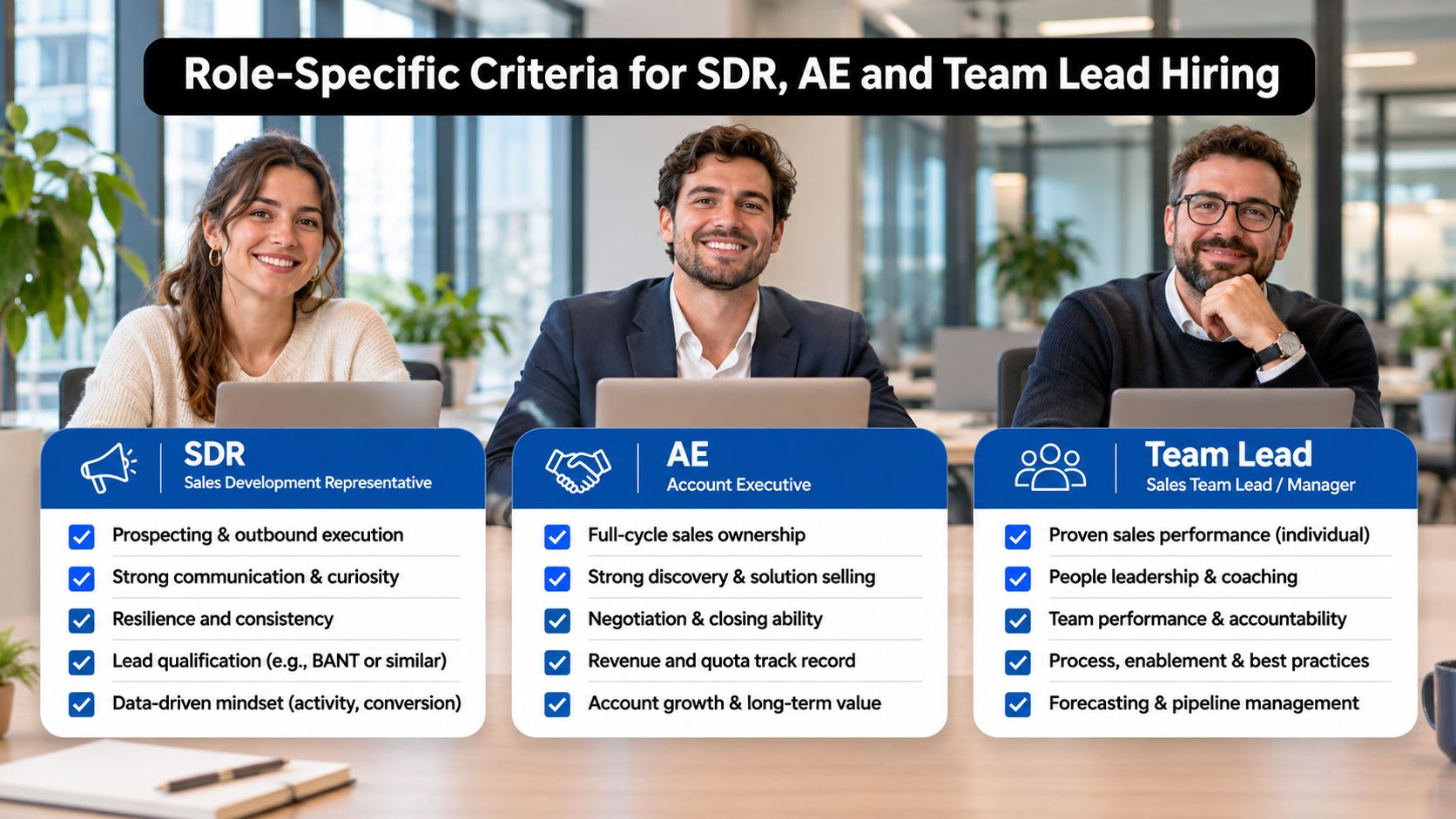
An SDR builds and qualifies pipeline through outreach; an AE advances multi-stakeholder buying decisions. That difference should change both the assessment and the weights.
Titles aren't reliable scope definitions. Outbound Consulting's sdr vs bdr comparison helps clarify prospecting responsibilities before you choose criteria, while GENTY's tech sales hiring guide provides broader role-design context.
For team leads, don't let personal selling ability substitute for coaching evidence. Require the candidate to diagnose another seller's performance and explain the intervention.
Interview Question Bank by Competency
Use fixed wording and order so each rating traces to a question ID. These are working prompts for the SDR template, not quotations from a published questionnaire.
Q1, prospecting judgment. Here is a list of ten target accounts. Choose three, explain why you'd contact each first, and describe your opening message.
Q2, discovery. Run a ten-minute mock call. I'm a prospect who says we're looking at options. Start as you would with a real buyer.
Q3, objection handling. The prospect says we have no budget this year. Reply. Then they say we already use a competitor. Reply again.
Q4, coachability. I'll give feedback halfway through the exercise. Retry the opening sixty seconds. What did you change, and why?
Q5, resilience. Tell me about a deal or quota you missed. What caused it, and what did you change afterward?
Q6, process discipline. Explain how you move deals between CRM stages, trigger follow-ups, and decide whether a deal belongs in the forecast.</li>
Underdog.io's structured interview techniques for startups offers useful implementation context. For additional prompt development, consult GENTY's questions to ask candidates in an interview.
Write permissible follow-ups into the template and give every candidate the same opportunity to answer them. Improvised coaching during one candidate's interview changes the assessment.
Rating Scale and What Each Score Means
Use five anchored scores, from unsupported to exceptional, and judge the answer against the relevant competency rather than against the previous candidate.
Rating scale with evidence and hire signal
The mechanics described in Factlen's structured interview explainer illustrate the distinction: objection handling can range from an unsupported pitch to a diagnostic response that earns a committed next action.
I'd use five points rather than ten. Unless you can describe the observable difference between a seven and an eight, the extra precision is cosmetic.
For objection handling, a low score means pitching without understanding the objection. An acceptable answer offers a plausible reply but weak diagnosis; an exceptional answer uncovers business impact and earns a committed next action.
Evidence rule: A rating without written evidence is invalid. Low confidence calls for better evidence, not an automatic lower score.
The hire signals are screening defaults, not substitutes for the final threshold policy. If interviewers differ by two or more points, compare their evidence and anchor interpretation before discussing the candidate's overall suitability.
Writing Behavioral Anchors for Each Competency
Describe observable behavior, not personality. Executive presence, confidence, and polish leave too much room for interviewer preference. An anchor should tell another evaluator what the candidate did.
Behavioral anchors for three sales competencies
These anchors belong to specific competencies. Don't require an account-prioritization answer to demonstrate every element of discovery merely because the general rating table uses discovery language.
Write the strongest and weakest responses first, then define the midpoint. Fill the remaining levels with meaningful differences in completeness, accuracy, and independence, not adjectives such as good and very good.
Calibrate before live use
Have two interviewers independently score the same recorded practice answer, with appropriate recording consent. If they assign different scores, identify whether they noticed different evidence or interpreted the anchor differently, then rewrite the ambiguous wording.
Don't resolve calibration by asking evaluators to meet halfway. Resolve it by making the scoring rule clear enough that another interviewer could reproduce the judgment.
How to Weight Criteria and Set Hire Thresholds
Starting weights by criterion for SDR and AE roles
These are illustrative starting weights, not validated predictors for your company.
Separate competencies, skills, and outcomes before weighting. Yardstick's sales interview scorecard guidance distinguishes repeatable behaviors such as ownership from selling skills such as qualification, and from post-hire outcomes such as qualified pipeline.
The SDR example emphasizes prospecting and discovery. The AE example shifts emphasis toward discovery and deal execution. Map the template's individual competency scores into these categories before interviewing so nothing is counted twice.
Apply gates before averages
For an initial pilot, require no critical competency below 3 and a weighted average of at least 3.5. Treat a critical score of 3 as requiring confirmation against the role-specific anchor before advancing, consistent with the conservative screening signal in the rating table.
Calculate the weighted average by multiplying each rating by its decimal weight, then adding the results. Any override requires written job-related evidence and a named decision owner.
These thresholds are implementation choices, not research findings. A strong presentation mustn't compensate for unsupported qualification or unethical forecasting.
A high total doesn't repair a failed must-have.
Review dimension scores against ramp time, quota attainment, pipeline quality, retention, and manager assessments quarterly. Reconsider criteria with no apparent connection to performance, while accounting for territory, onboarding, and manager differences before blaming the rubric.
Structured Scoring Paired With Work Samples
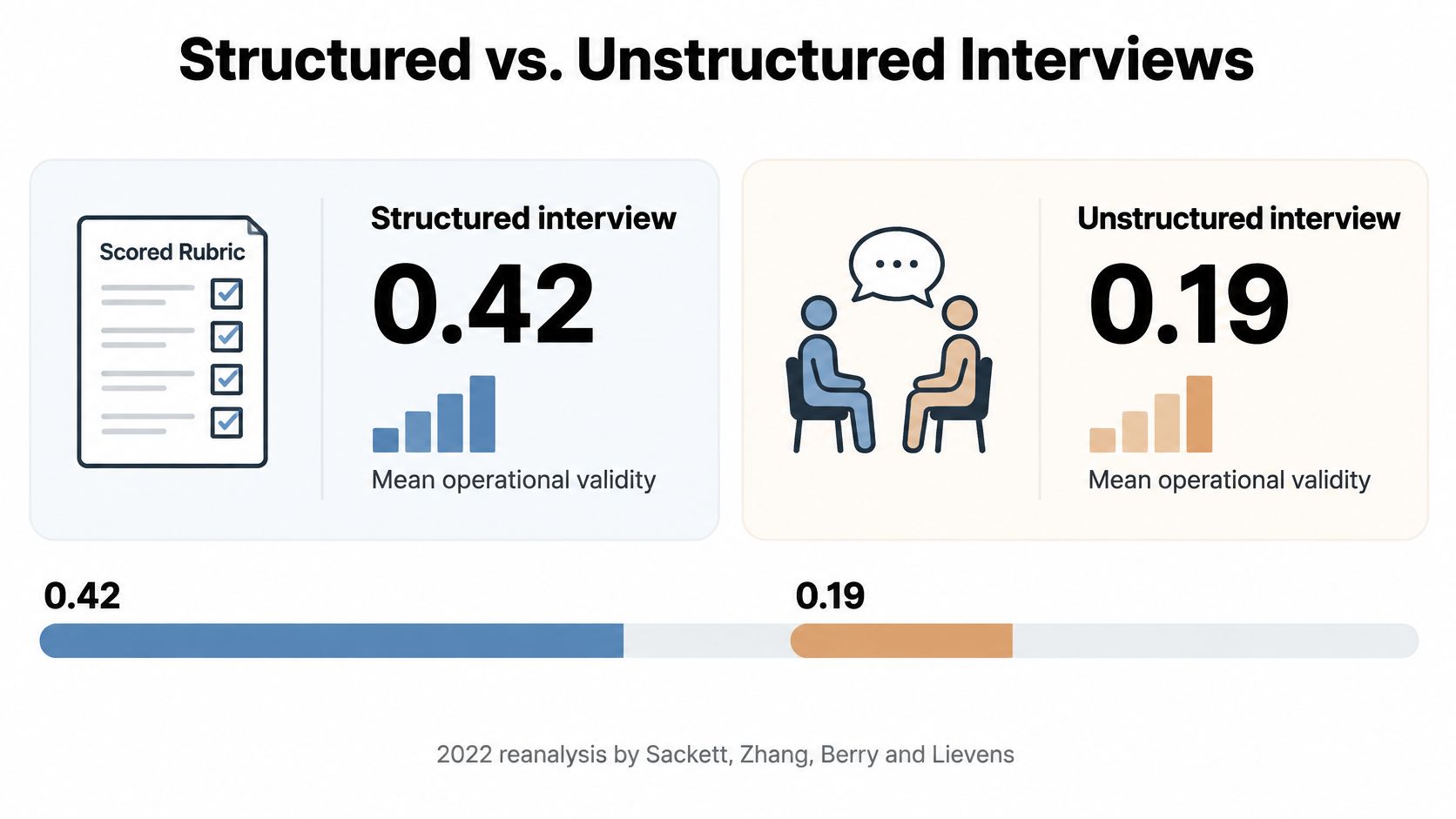
The 2022 reanalysis by Sackett, Zhang, Berry, and Lievens, summarized by SocialTalent, found mean operational validity of 0.42 for structured interviews versus 0.19 for unstructured interviews, more than twice the predictive signal. These are correlation coefficients, not hiring-success percentages; the structured-interview estimate's 80% credibility interval was approximately 0.18–0.66.
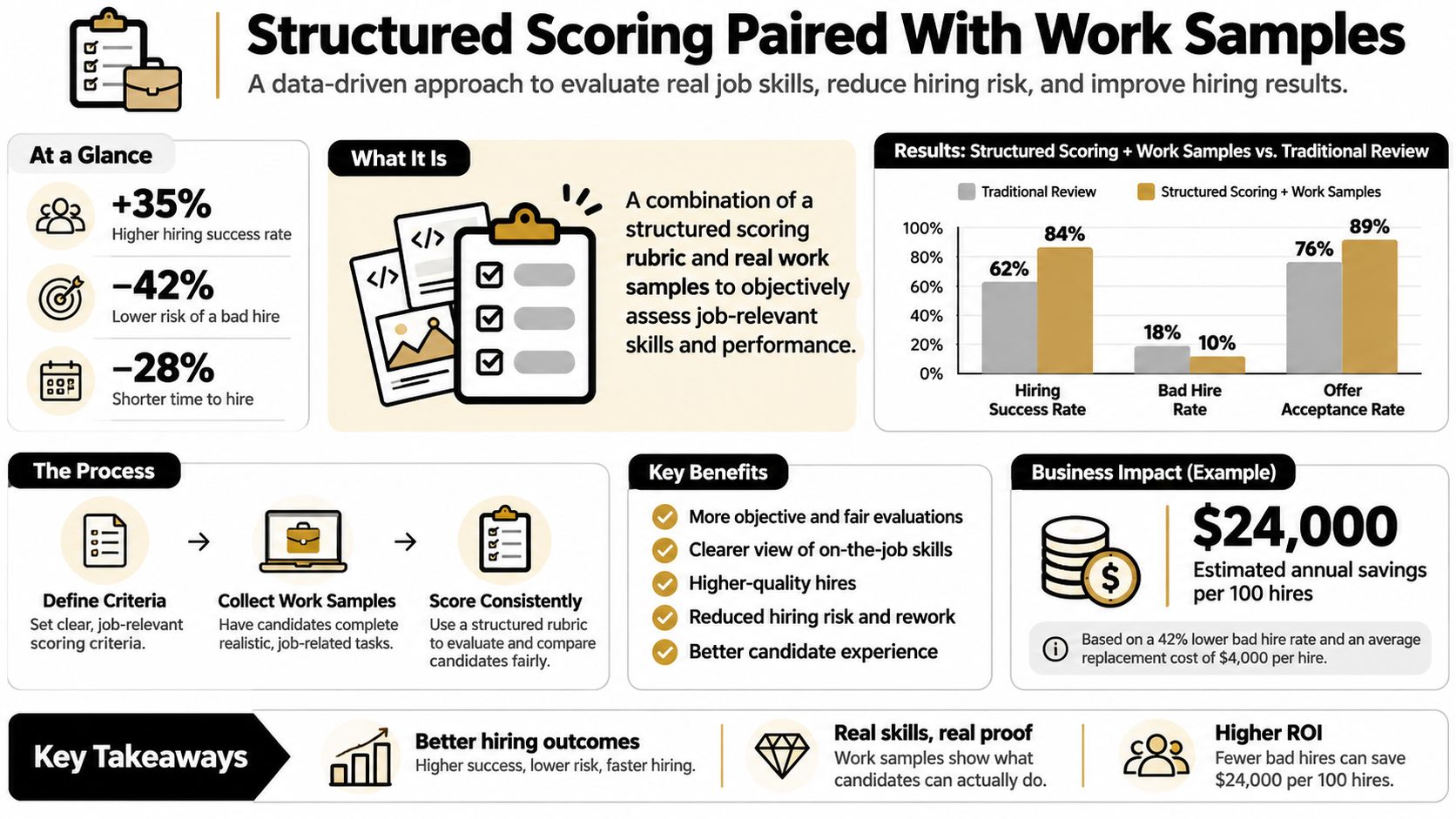
The broader comparison summarized by BehaviorHiring provides context for using job-relevant assessments alongside interviews:
These pooled averages don't establish the validity of your particular interview-and-exercise combination. They support disciplined assessment design, not a promised hiring outcome.
Choose exercises that expose the actual work
Use these as planning estimates, selecting relevant exercises rather than automatically assigning the entire set:
Discovery simulation, 20–30 minutes: Assess diagnosis and objection handling.
Account prioritization, 15–20 minutes: Assess targeting logic and process discipline.
Written prospecting message, about 10 minutes: Assess personalization and communication.
Sample pipeline review, 20–30 minutes: Assess forecast judgment and CRM discipline.</li>
Give candidates identical inputs and time limits. Record exercise evidence before rating, then apply predefined anchors and the hiring gates without double-counting the same behavior.
At GENTY recruitment, every candidate goes through a skills-based technical assessment before any client sees their profile. Our sales recruitment process provides context for placing assessment within the broader hiring workflow.
Fair Evaluation Across Languages and Cultures
A structured rubric isn't automatically fair. You can standardize bias just as easily as you standardize evidence if your anchors reward native idioms, aggressive closing, or a familiar educational background.
The PIN structured interview guide summarizes greater bias susceptibility in unstructured interviews, with reported effect sizes of d=.59 versus d=.23 for structured formats. That difference doesn't excuse examining what your own rubric rewards.
Separate selling capability from familiar presentation
Score language separately. Define the English level the job requires, then assess sales reasoning independently of accent or idiomatic fluency.
Control the exercise. Use identical work samples, buyer information, and role-play conditions.
Accept equivalent evidence. Experience in another market or sales motion can demonstrate the same underlying judgment.
Require behavioral explanations. Replace fit-based recommendations with observations about diagnosis, follow-up, qualification, or deal advancement.</li>
For remote SDR and AE hiring across Latin America, a candidate may interview in a second language yet diagnose buyer needs accurately and manage opportunities rigorously. Don't confuse a less familiar storytelling style with weaker selling capability.
GENTY's multilingual recruiting guide offers context for designing language-aware evaluation. The practical test is whether the candidate can perform the customer communication the job demands.
Compare pass rates by language and nationality groups quarterly where lawful and appropriate. Investigate differences in prompts, anchors, and interviewer behavior rather than assuming either fairness or discrimination from a small sample.
Quick Reference for Recording Ratings and Panel Decisions
Competency ID: Identify the capability being evaluated.
Question ID: Record the standardized prompt used.
Observable evidence: Capture a specific behavior or the candidate's exact words.
Anchored rating: Assign a score from 1 to 5 against the matching description.
Confidence: Mark high, medium, or low based on evidence completeness.
Critical flag: Identify whether the competency triggers a hiring gate.
Independent recommendation: Submit an overall decision before panel discussion.
Deviation reason: Document any job-related departure from the assessment rules.</li>
Run the panel on disagreements
Compare independent scorecards, then address competencies with differences of two or more points first. Ask each interviewer to identify the evidence and behavioral anchor supporting their rating, using the competency-specific anchors to resolve meaning.
Keep original ratings visible alongside any revised decision. Otherwise, you lose the record of where the panel disagreed and whether seniority influenced the outcome.
The panel's job is to reconcile evidence, not negotiate an average everyone can accept.
Record the final decision against the critical gates and weighted threshold. A scorecard supports judgment; it can't determine whether your territory design, compensation, or onboarding will let the hire succeed.
Confirm the Scorecard Before Your Next Interview Loop
Pilot before adopting. Use the next two or three candidates for one role, with two interviewers independently scoring each recorded answer, subject to appropriate consent and recording practices.
Run these checks in order:
Rewrite ambiguous anchors whenever the interviewers assign different scores.
Remove unmapped competencies that have no matching job task.
Adjust weights and gates if a critical gap can still produce a passing decision.
Confirm question order so the six SDR prompts run consistently.</li>
Schedule the first post-hire review when the initial cohort reaches ramp, then compare dimension scores with ramp time, quota attainment, pipeline quality, and retention quarterly. Keep the original scorecard version attached to each hire.
If sourcing is outsourced, share the finished rubric before screening begins. Our Sales / Marketing Team Lead first shortlists are delivered in 5–7 business days; a settled assessment standard gives the hiring panel a clear basis for reviewing them.
GENTY recruitment offers staffing support to turn fixed hiring criteria into a screened shortlist. Visit GENTY recruitment to discuss your sales hiring scorecard and request the free LATAM Hiring Guide 2026, covering 2026 salary benchmarks, hiring model comparisons, compliance watch-outs, and screening steps.