

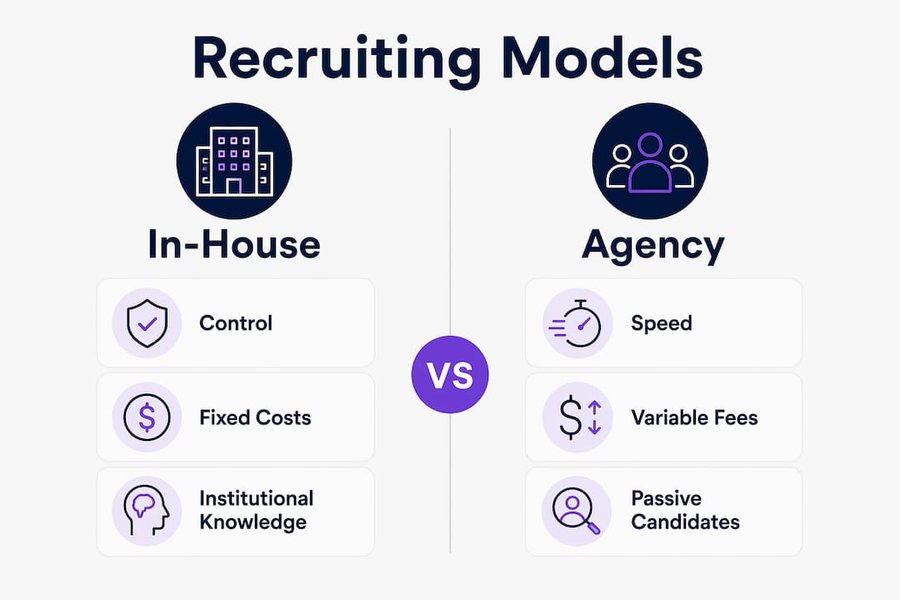
The differences between in-house and agency recruiting come down to four variables: control, cost structure, speed, and strategic alignment. In-house recruiting, also called internal talent acquisition, means your own team manages every stage of hiring. Agency recruiting means you outsource that function to an external firm that sources, screens, and presents candidates for a fee. For tech startups and growing companies, choosing the wrong model at the wrong time costs more than just money. It costs momentum.
How do in-house and agency recruiting differ in cost, speed, and candidate quality?
The financial structure of each model is fundamentally different. Mid-level in-house recruiters earn $65,000–$90,000 in base salary, while agency recruiters earn a lower base but carry on-target earnings of $100,000–$200,000 or more through commissions. That commission structure matters to you because it directly affects what you pay per hire.
Agency fees typically run 15%–25% of a candidate’s first-year salary. For a senior software engineer at $150,000, that is a $22,500–$37,500 placement fee per hire. In-house teams spread their cost across every hire they make, which means the per-hire cost drops significantly as hiring volume grows. Internal hires can be up to six times more cost-effective when total costs including onboarding are factored in.

Speed is where agencies hold a clear advantage for external candidates. Agencies deliver qualified shortlists in 10–14 days, while average in-house external hiring takes around 44 days. That gap matters when you need a DevOps engineer to unblock a product launch next month.
What do you need?
Choose the hiring path that fits
After reading "In-House vs Agency Recruiting: Key Differences Explained", most teams compare these options before deciding how to hire.
Candidate quality depends on what you mean by “quality.” Agencies access passive candidates who are not actively job hunting, which is a real advantage for senior or specialized roles. In-house teams understand your culture, your team dynamics, and your product well enough to screen for fit in ways an agency simply cannot replicate from a brief.
Pro Tip: Track your cost-per-hire and time-to-fill separately for in-house and agency channels. Most startups discover their agency spend is concentrated in a handful of roles where speed was critical. That data tells you exactly where each model earns its place.
What are the in-house recruiting advantages for tech startups?
In-house recruiting builds institutional knowledge that compounds over time. A recruiter who has spent two years inside your company understands which engineering managers are difficult to hire for, which team cultures attract certain profiles, and which interview processes convert top candidates. That knowledge does not exist on day one of an agency engagement.
In-house teams enable deeper alignment with company culture, employer branding, and long-term workforce planning. For a Series A or Series B startup, this matters because your employer brand is still forming. Every candidate interaction shapes how engineers in your market perceive your company.
The strategic advantages of building an internal talent acquisition function include:
- Process ownership: You control the candidate experience from first contact to offer, which directly affects acceptance rates.
- Employer brand consistency: Internal recruiters represent your values in every conversation, not a generalized pitch.
- Workforce planning: In-house teams can map hiring needs six to twelve months out, aligning with product roadmaps and funding cycles.
- Hiring data: Every search builds internal benchmarks on salary, sourcing channels, and conversion rates.
The limitations are real too. In-house teams have capacity ceilings. A two-person talent acquisition team cannot simultaneously fill fifteen roles without quality dropping. Internal hires perform 18% better in their first two years, but building the internal function requires time, budget, and leadership support that early-stage startups often cannot commit.
“In-house recruiters should be treated as strategic talent partners, not transactional role-fillers. The companies that get this right build hiring functions that become a genuine competitive advantage.” — Tribepad
Startups that rely on remote tech hiring strategies often find that in-house teams need external support to source across geographies they have no existing network in.
When do recruitment agencies excel, and what are their downsides?
Recruitment agencies are built for speed and specialization. Their entire business model depends on placing candidates faster than you could find them yourself. For a startup that just closed a funding round and needs to hire eight engineers in ninety days, that capability is genuinely valuable.
Agencies provide expert screening, salary guidance, market insight, and reduce hiring risk through specialized networks that most startups lack internally. A FinTech-focused agency, for example, already has relationships with compliance engineers, blockchain developers, and financial systems architects who are not on LinkedIn actively looking.
Here is when agency recruiting delivers the most value:
- Urgent hiring: You need a role filled in under three weeks and your internal team is at capacity.
- Niche technical roles: Roles requiring rare skill combinations, such as ML engineers with financial modeling experience, where passive sourcing is required.
- Geographic expansion: Hiring in a new market, such as Latin America or Eastern Europe, where you have no existing candidate relationships.
- Executive search: C-suite and VP-level roles where discretion, network depth, and structured assessment matter more than speed.
- Surge hiring: Post-funding headcount growth that exceeds what your internal team can absorb.
The downsides of agency recruiting are structural, not incidental. Agencies work on contingency or search-by-search arrangements, which means their incentive is to close placements, not to build your long-term talent pipeline. Commission-driven compensation rewards speed and volume, which can work against thoroughness on culture fit.
“The risk of over-relying on agencies is that you outsource not just the work, but the institutional knowledge. When the engagement ends, you own nothing.” — RecruitBPM
Pro Tip: When selecting an agency, choose one that specializes in your industry vertical and your target geography. A generalist agency filling a senior AI engineer role will underperform a specialized tech recruiter with an existing network in that space every time.
How can startups combine in-house and agency recruiting effectively?
The most effective tech startup hiring strategy combines an internal core team with selective agency partnerships. Hybrid recruitment models deliver better agility and cost-effectiveness for scaling tech companies because they assign each hiring channel to the work it does best.
The practical structure looks like this:
- In-house team handles: High-volume roles, employer brand, candidate experience, workforce planning, and roles where culture fit is the primary screen.
- Agency partners handle: Urgent fills, senior or executive roles, niche technical searches, and geographic markets where the internal team has no sourcing network.
Maintaining employer brand consistency across both channels requires deliberate coordination. Your in-house team should brief agency partners on your culture, your values, and the specific attributes that predict success in your environment. A one-page candidate brief is not enough. A structured intake call with the hiring manager, a clear scorecard, and agreed-upon communication protocols make the difference between an agency that represents you well and one that sends volume without context.
Startups that want to speed up tech hiring without sacrificing quality typically find that the hybrid model gives them the flexibility to respond to business changes without rebuilding their recruiting function from scratch every six months.
Pro Tip: Set a quarterly review of your agency spend versus in-house output. If agencies are filling more than 40% of your roles consistently, it is a signal to invest in internal capacity. If your in-house team is taking more than 60 days to fill technical roles, it is a signal to bring in specialized support.
Key takeaways
The right recruiting model for a tech startup is not a permanent choice. It is a decision that should shift as your headcount, funding stage, and hiring complexity evolve.
What i’ve learned about choosing between these two models
After observing how dozens of tech startups approach talent acquisition, one pattern stands out clearly. The companies that struggle most are the ones that treat recruiting as a binary choice. They either build an internal team and refuse to use agencies, or they rely entirely on agencies and never develop internal capability. Both extremes create problems.
The startups that hire well treat their in-house recruiters as genuine business partners, not administrative coordinators. When a recruiter understands the product roadmap, the team dynamics, and the competitive context, they make better decisions at every stage of the process. That kind of alignment is impossible to buy from an agency on a per-placement basis.
The speed argument for agencies is real, but it is often overstated. Yes, agencies can shortlist faster. But if the brief is unclear, the agency’s speed just means you get the wrong candidates faster. I have seen startups burn through three agency engagements on a single senior role because they never invested the time to define what success actually looked like in that position.
The honest answer for most growth-stage tech companies is that recruiters unlock startup growth most effectively when internal and external functions are designed to complement each other. Build the internal function for the roles you hire repeatedly. Use specialized agencies for the roles where their network and speed genuinely outperform what you can do in-house. And review that split regularly, because what works at 30 employees rarely works at 150.
— Eugene
How Gentyrecruitment supports both models for tech startups
Choosing between in-house and agency recruiting is easier when you have a partner who understands both sides of the equation.
Gentyrecruitment specializes in IT recruitment for tech startups across the US and Europe, connecting companies with pre-vetted, English-speaking talent from Latin America, including Argentina, Brazil, Mexico, and Colombia. Whether you need to augment your internal team with specialized sourcing support or run a full search for a senior technical role, Gentyrecruitment delivers qualified candidates faster than traditional hiring timelines. The process combines structured assessment, technology, and hands-on recruiting to give your team candidates who are technically qualified and ready to integrate. Explore how Gentyrecruitment can support your next hire.
FAQ
What is the main difference between in-house and agency recruiting?
In-house recruiting uses an internal team that manages hiring end-to-end with deep company knowledge. Agency recruiting outsources that function to external firms that charge a per-placement fee, typically 15%–25% of first-year salary.
When should a startup use a recruitment agency?
Agencies are most effective for urgent roles, niche technical positions, executive searches, and hiring in geographic markets where the internal team has no existing candidate network.
Is in-house recruiting always cheaper than using an agency?
In-house recruiting becomes more cost-effective at higher hiring volumes. For low-volume or highly specialized hiring, agency fees can be justified by the speed and candidate quality they deliver.
How do internal and external hires compare in performance?
Internal hires perform 18% better in their first two years and carry lower failure risk than external hires, though external hiring through agencies can access broader talent pools for specialized roles.
What is a hybrid recruitment model?
A hybrid recruitment model uses an internal team for volume, culture-fit screening, and long-term planning, while engaging specialized agencies for urgent, niche, or senior roles that exceed internal capacity or network reach.