
Competency-based recruitment is defined as a hiring method that evaluates candidates on demonstrated skills and observable behaviors directly tied to job performance, rather than on degrees or job titles. Also called skills-based hiring, this approach replaces credential screening with structured, evidence-based assessments. The result is measurable: mis-hiring rates drop by up to 88% when teams evaluate verifiable work outputs instead of résumé pedigree. For HR professionals and hiring managers in tech and sales, this shift is not theoretical. It determines whether you place a DevOps engineer in Bogotá who ships on day one, or a credentialed candidate who struggles for months. GENTY recruitment applies this exact framework to source pre-vetted LATAM talent for US and European tech companies.
What is competency-based recruitment, and how does it differ from traditional hiring?
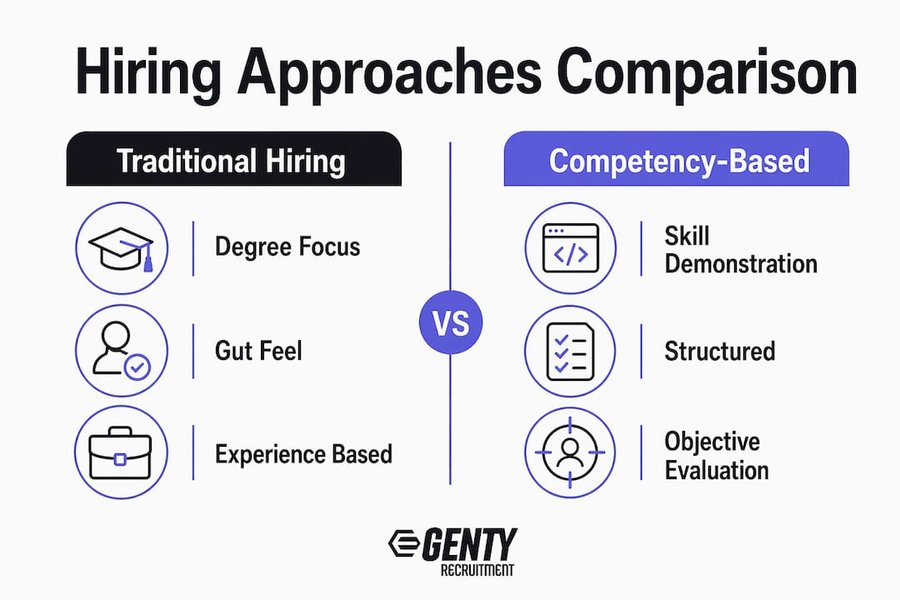
Traditional hiring filters on proxies: a computer science degree, a brand-name employer, or years of experience in a title. Competency-based hiring filters on evidence: can this person write a technical query, manage a sprint, or close an enterprise deal? The distinction sounds simple, but it changes every step of the process.
Structured, objective assessment replaces gut-feel interviews. Competency-based hiring ties every evaluation criterion directly to job duties, which removes the room for interviewers to favor candidates who “feel right.” That shift matters especially in tech and sales, where performance is measurable and the cost of a bad hire is high.

The table below shows where the two approaches diverge most sharply.
Need help hiring?
See the next step after this guide
If this topic is relevant to your team, these are the most useful pages to check next.
Bias reduction is one of the most underrated benefits. When every candidate answers the same behavioral questions and is scored against the same rubric, personal affinity stops driving decisions. This matters for LATAM hiring, where candidates from Argentina, Brazil, or Colombia may lack US or European brand-name employers on their résumés but carry deep, verifiable technical ability.
Pro Tip: Replace “Tell me about yourself” with “Describe a time you reduced deployment time by 20% or more.” The second question produces scorable evidence. The first produces a rehearsed pitch.
How to implement competency-based recruitment in tech and sales roles
Implementation follows a clear sequence. Skipping steps, especially the first one, is the most common reason competency frameworks fail.
<p>Define role-specific competencies. Start with the job’s actual outputs, not its inputs. A senior backend engineer in Mexico City needs to write performant SQL, review pull requests, and mentor junior developers. List those outputs. Then identify the skills and behaviors that produce them. Limit the list to 3–5 core competencies per role. Over-engineering competency frameworks with too many requirements deters high-potential candidates and dilutes focus.</p>
<p>Rewrite job descriptions around responsibilities. Shift language from “requirements” to “responsibilities.” This single change increases application volume by 14%, which directly expands your LATAM candidate pool. A job post that demands “a CS degree from an accredited university” excludes a self-taught developer from Medellín who has shipped three production SaaS products.</p>
<p>Design structured interviews with scoring rubrics. Write behavioral questions for each competency. Use a 1–5 scoring scale with defined anchors. For example, a score of 5 on “technical communication” means the candidate explained a complex system to a non-technical stakeholder without jargon. Every interviewer scores independently before comparing notes.</p>
<p>Add a skills assessment. For tech roles, a take-home coding challenge or a live pair-programming session produces direct evidence. For sales roles, a mock discovery call or a pipeline review exercise works. Keep assessments under two hours to respect candidates’ time and maintain completion rates.</p>
<p>Use your ATS to track competency scores. Most applicant tracking systems support custom fields. Tag each candidate with scores per competency, not just a pass/fail. This data lets you compare candidates objectively and identify patterns in your LATAM talent pool over time.</p>
Pro Tip: Separate “must-have” competencies from “nice-to-have” ones before posting the role. Clear differentiation prevents candidate drop-off and keeps your hiring team focused on what actually predicts success.
What are the benefits of competency-based recruitment for LATAM tech and sales hiring?
The benefits are concrete, not abstract. For teams hiring in Latin America, competency-based hiring removes the barriers that would otherwise exclude the region’s strongest candidates.
Expanded talent pool. Removing degree requirements does not lower standards. It raises the bar by centering on verifiable capabilities. LATAM produces a large number of self-taught engineers, bootcamp graduates, and developers with non-traditional backgrounds who perform at senior levels. A competency framework captures them. A credential filter does not.
Diversity and inclusion gains. Skills-based hiring bypasses degree barriers and welcomes non-traditional candidates, including military veterans, apprentices, and career changers. In Colombia and Brazil, where formal CS education is less uniformly distributed than in the US, this matters. You access a wider, deeper pool of talent.
Cost savings with timezone alignment. Hiring a senior software engineer in Argentina or Colombia costs significantly less than an equivalent US hire, with clients of GENTY recruitment saving up to 40% compared to US or European rates. LATAM engineers and sales professionals in Argentina, Brazil, Mexico, and Colombia work within US EST/PST overlap hours, which means real-time collaboration without the friction of a 9-hour time difference. You can review hiring cost reduction strategies to see how competency-based vetting compounds those savings.
Improved retention. When you hire on demonstrated ability rather than assumed potential, new hires perform faster and stay longer. The mis-hiring rate reduction of up to 88% translates directly into lower turnover costs and more stable engineering and sales teams.
The table below shows approximate monthly salary ranges for competency-vetted LATAM tech roles compared to US equivalents.
What are the common challenges in competency-based recruitment, and how do you solve them?
Competency-based hiring is not self-executing. Three specific failure modes appear consistently across tech and sales hiring teams.
<p>Over-engineered competency lists. Hiring managers often add every desirable trait to the framework, producing a list of 12 competencies for a single role. Candidates see the list and self-select out. The fix is strict prioritization: 3–5 core competencies maximum, with clear must-have versus nice-to-have labels.</p>
<p>Stakeholder resistance to removing degree requirements. Legal, finance, and senior leadership sometimes push back on dropping credential filters, citing risk. The counter-argument is data-driven: removing degree requirements elevates hiring quality by shifting focus to verifiable skills. Present the mis-hiring rate data and the expanded candidate pool metrics to move the conversation.</p>
<p>Vague competency definitions. “Good communicator” is not a competency. It is a trait. A competency is observable and measurable: “Explains API architecture to non-technical stakeholders in under 10 minutes without jargon.” Hiring managers must shift from vague traits to concrete, job-related outputs for the framework to work. This applies equally to assessing technical and soft skills in developer candidates.</p>
Pro Tip: Run a pilot on one role before rolling out the framework company-wide. A single structured hiring cycle produces enough data to refine your competency definitions and scoring rubrics before you scale.
The fair hiring practices dimension also deserves attention. Competency frameworks reduce the risk of discriminatory screening, which protects your organization legally and improves candidate experience.
Key Takeaways
Competency-based recruitment reduces mis-hiring rates by up to 88% by replacing credential screening with structured, evidence-based assessment of job-relevant skills and behaviors.
Why I think most hiring teams implement this backward
Most hiring teams I work with start by designing the interview questions, then work backward to the competencies. That sequence produces frameworks that feel structured but measure the wrong things. The questions drive the competencies instead of the other way around.
The right sequence starts with the job’s outputs. What does success look like in 90 days? What does the person actually produce? Only after you answer those questions should you define the competencies, and only then should you write the questions that surface evidence of those competencies.
The second mistake I see consistently is treating competency-based hiring as a one-time project. The first framework you build will be imperfect. The competencies you define for a senior sales engineer in Mexico City in 2026 will need revision after your first three hires. The teams that get the most value from this approach treat their competency models as living documents, updated after every hiring cycle based on what actually predicted performance.
For LATAM hiring specifically, the mindset shift is even more important. Candidates from Argentina, Brazil, Colombia, and Mexico often arrive without the credential signals that US hiring managers are trained to trust. A competency framework is not just a fairer process. It is the only reliable way to evaluate this talent pool accurately. GENTY recruitment’s vetting process is built on exactly this principle, which is why shortlists arrive pre-scored against role-specific competency criteria rather than filtered by résumé keywords.
— Eugene
GENTY recruitment applies competency-based hiring to LATAM tech and sales roles
GENTY recruitment sources and vets candidates across Argentina, Brazil, Mexico, and Colombia using competency-aligned evaluation at every stage. Every shortlist is built against role-specific criteria, not résumé keywords, and delivered within 7 days with transparent fixed-fee pricing and a 3-month replacement guarantee.
For tech hiring, the IT recruitment service covers software engineers, DevOps, and data specialists pre-vetted against technical competency rubrics. For revenue teams, the sales recruitment service places SDRs and account executives who have demonstrated pipeline generation and closing ability, not just listed it on a résumé. Contact GENTY recruitment to get a curated shortlist for your next role.
FAQ
What is competency-based recruitment?
Competency-based recruitment is a hiring method that evaluates candidates on demonstrated skills and observable behaviors tied directly to job performance, rather than on degrees or job titles. It replaces credential screening with structured, evidence-based assessment.
How does competency-based hiring reduce mis-hiring rates?
Competency-based hiring reduces mis-hiring rates by up to 88% by evaluating actual job-relevant capabilities instead of résumé proxies like degrees or employer brand. This produces higher-quality hires with faster time-to-productivity.
How many competencies should a job role have?
Best practice limits each role to 3–5 core competencies. Over-engineering the framework with too many requirements deters high-potential candidates and dilutes the hiring team’s focus.
Does removing degree requirements lower hiring standards?
Removing degree requirements raises the bar rather than lowering it. Competency assessments center on verifiable skills and demonstrated outputs, which are stronger predictors of job performance than formal education credentials.
What is the difference between competency-based and skills-based recruitment?
The terms are often used interchangeably. Skills-based recruitment typically emphasizes technical abilities, while competency-based recruitment also includes observable behaviors and soft skills tied to specific job duties. Both approaches prioritize demonstrated ability over credentials.