
A working product can still be an expensive mistake. CB Insights' analysis of 431 venture-backed companies that shut down since 2023 identified poor product-market fit in 43% of cases, according to Divtechnosoft's summary. The cheapest vendor becomes costly when you pay to build the wrong workflow, replace an undocumented system, or recruit a team that can't maintain it.
Among these top MVP development companies, shortlist Rootstrap or BairesDev for US-aligned engineering capacity, thoughtbot for discovery and knowledge transfer, Uptech for coordinated design and development, Upsilon for staged budgeting, Simform for technical breadth, and MVP.dev for scope-led delivery.
For a Series A–C company, the decision usually concerns a new product line, market experiment, or replacement workflow rather than the company's first software release. Compare budget floors, pricing models, post-launch ownership, and delivery locations before booking sales calls. Treat every published range as a planning input, not a quote, and distinguish a prototype from production software with security, analytics, and operational support.
1. Rootstrap
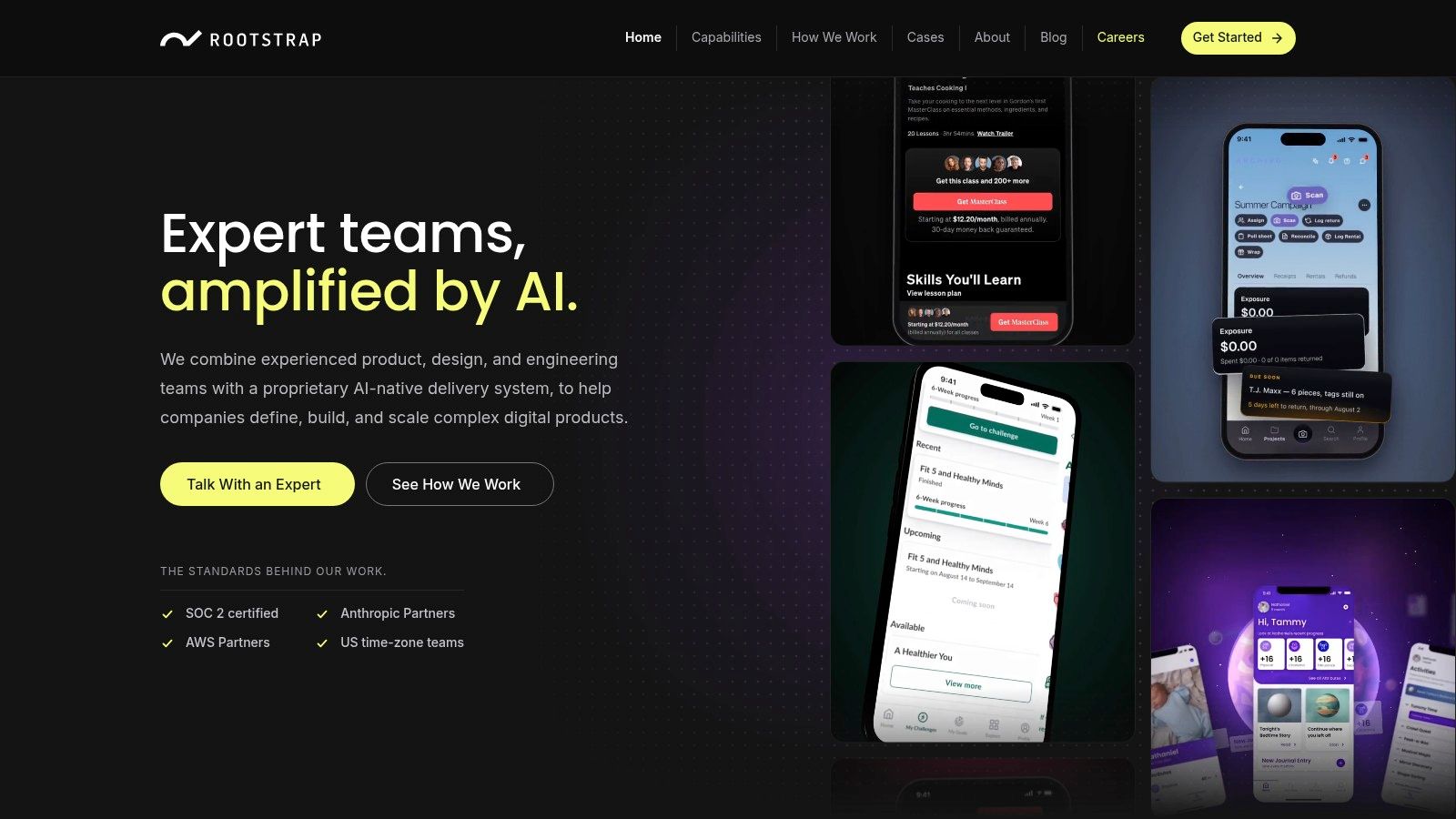
Rootstrap fits a product initiative that needs discovery and continuing engineering, not just outsourced coding. Its delivery model combines product strategy, design, prototyping, and implementation, either independently or alongside your existing team.
Before you start hiring
Check location, salary, and hiring fit
If you are moving from research to action, start with the market basics so your hiring plan is clearer.
Rootstrap has teams in Argentina, Uruguay, Colombia, and the US, with a typical minimum project size of $50,000+. That makes it a practical candidate for a US company seeking a LATAM delivery team, but a less natural choice for a disposable prototype with a tightly constrained budget.
Where the engagement makes sense
Discovery before commitment. Use prototyping to resolve workflow uncertainty before approving the full build.
Integrated delivery. Product, design, and engineering can work from a shared backlog rather than separate supplier briefs.
Ownership. Its client-ownership positioning should become explicit contractual terms covering code, intellectual property, and account access.</li>
Client feedback emphasizes communication, collaboration, project management, and proactive technical contributions. A reviewed startup engagement also describes an MVP that supported the client's pursuit of seed funding, although that outcome isn't a promise of commercial validation.
The trade-off is buying a product partnership rather than the lowest-cost engineering capacity. Require named delivery roles and clarify whether senior people participate throughout implementation or mainly during discovery.
For a lean retained team, the distinction between broad full-stack responsibility and overloaded generalists matters. GENTY's guide to when a full-stack engineer can replace separate roles helps frame that staffing decision before you approve the vendor's team composition.
2. BairesDev
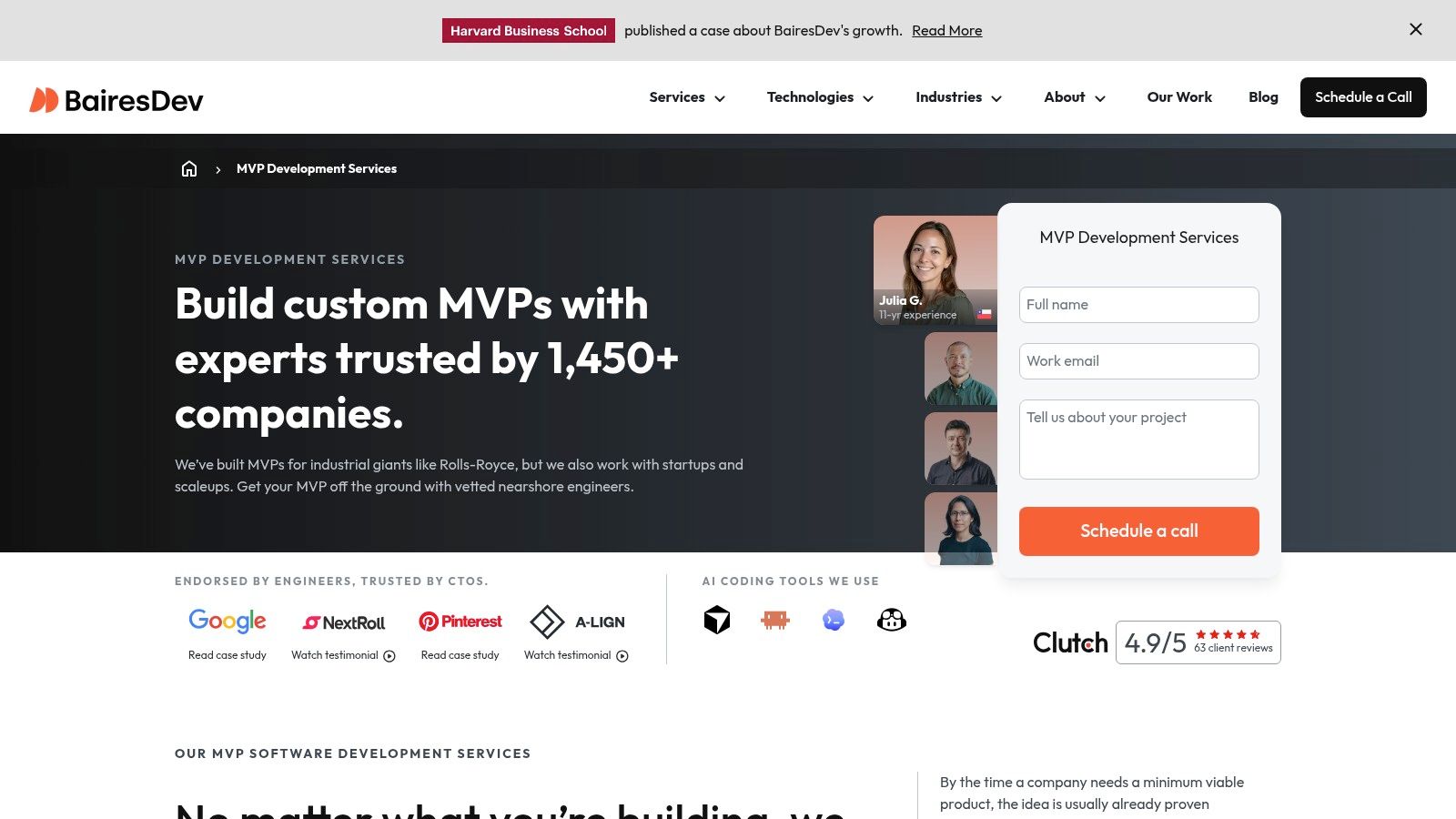
If the initial release is likely to become an ongoing engineering program, BairesDev deserves a place on the shortlist. It offers end-to-end delivery and staff augmentation, so the commercial discussion can cover both a defined launch and continued capacity.
BairesDev's MVP offering publishes indicative development timelines of 8–14 weeks and staffing timelines of 2–4 weeks, with a typical minimum project size of $50,000+. Those figures describe different activities, not interchangeable promises about when your product will be ready.
Separate staffing speed from delivery readiness
A staffed team still needs access, architectural context, acceptance criteria, and dependency owners. Its described MVP approach includes core features, key user flows, analytics, and iteration based on user activity, which is more useful than treating deployment as the end of validation.
Dedicated teams can include engineering, UX, QA, and technical project management. Client feedback commonly highlights technical quality, communication, timely delivery, and team ramp-up, but the proposed people and governance model matter more than aggregate reputation.
A fast staffing commitment doesn't establish that discovery, integration access, and security review are complete.
Its regional engineering presence supports collaboration during US working hours. Compare the proposed team's actual overlap, not just the provider's footprint, using the distinctions in developer salaries, time zones, and productivity.
The limitation is potential overcapacity. A narrow experiment may not need a sizable multidisciplinary engagement; a product with parallel integration, design, and testing work may justify it.
3. thoughtbot
Who will understand the product after the consultancy leaves? That question makes thoughtbot relevant for engineering leaders who want stronger internal capability alongside a launch.
thoughtbot's MVP development service combines strategy, design, and engineering, with an MVP Shaping Sprint to clarify assumptions, involve target users, and establish a roadmap. Pricing is proposal-based rather than a standard published MVP package, so budget qualification needs to happen early.
Buy learning as an explicit deliverable
Its offering includes web and mobile development, health-tech work, coaching, mentorship, and team integration. The collaborative model is attractive when internal engineers need to understand why the team chose a particular architecture or user flow, not just receive repository access.
During discovery. Require a prioritized assumption list, user-testing outputs, and reasons for excluding features.
During implementation. Include pairing, code review participation, and architecture decision records.
During transition. Have your engineers deploy, troubleshoot, and modify the application before handover is accepted.</li>
A Clutch review describes thoughtbot as dependable and professional on an MVP project. That's useful qualitative evidence, but relevant references should still establish how the consultancy handled changing assumptions and transferred responsibility.
The trade-off is paying for product judgement and capability building, which won't suit a buyer seeking coding capacity alone. Delivery-location fit also needs to be established for the assigned team rather than inferred from the brand.
The same ownership questions apply when you recruit the permanent team. This guide to remote developer hiring mistakes CTOs should avoid helps distinguish technical competence from effective distributed collaboration.
4. Uptech
A new healthcare workflow might require a web dashboard and a mobile experience, with uncertainty about both. Uptech is a candidate when discovery, UX/UI, and implementation need to stay coordinated, rather than passing through separate vendors.
Uptech's MVP service covers web, iOS, and Android development, with a typical minimum project size of $25,000+; its cited Clutch profile snapshot showed 4.9/5 across 45 reviews. Its examples include fintech, healthcare, and AI-related products, and client feedback commonly emphasizes communication, organization, collaboration, and design quality.
Match product design to operational requirements
A coordinated team can reduce ambiguity between a tested prototype and the implemented interface. It doesn't remove your responsibility to define data access, compliance boundaries, or acceptance criteria.
For products subject to GDPR, Article 25 requires data protection by design and by default, including appropriate safeguards and processing only the personal data necessary for each purpose. Translate that into schema decisions, restricted default visibility, retention rules, and permission tests before approving the build.
The location trade-off matters. Uptech's principal delivery locations are outside the Americas nearshore model, so a US team should confirm working-hour overlap and escalation coverage; a European buyer should evaluate those same details against its own operating day.
Its budget floor may also exceed what a clickable prototype requires. Separate discovery outputs from production commitments, and specify who supports the product after launch.
If the agency will eventually hand over to distributed employees, GENTY's remote hiring guide for CTOs provides a useful framework for planning the receiving team.
5. Upsilon
Upsilon provides an accessible starting point for budget discussions. Its startup-focused offering describes a staged journey from discovery through design, development, deployment, and post-launch analytics.
Upsilon's startup service states a discovery phase of 14–21 business days and a typical MVP range of $25,000–$75,000, alongside a cost calculator. Treat the range as an initial feasibility check, not evidence that your integrations, security requirements, and operating costs are included.
Make discovery a purchasing gate
The described discovery outputs include a roadmap, specifications, wireframes, a prototype, and architecture. Those deliverables should let your CTO decide whether to proceed, reduce scope, or stop, rather than merely authorize the next invoice.
Scope clarity. Map each proposed feature to a user problem and a testable assumption.
Budget clarity. Separate discovery, implementation, third-party services, and support.
Validation clarity. Specify analytics events and continuation criteria before development starts.</li>
Budget rule: Compare the assumptions behind an estimate before comparing the total.
The staged process is particularly useful for a first-time founder or a product team entering an unfamiliar market. Published startup case studies provide examples of its work, but the retrieved Clutch profile had no client reviews, leaving limited independent review evidence.
That calls for direct reference checking, not automatic rejection. Request examples with comparable integration and operational complexity, then establish who delivered them.
Confirm the assigned team's location and overlap separately. A startup-oriented process doesn't establish nearshore fit, and post-launch analytics don't necessarily include an ongoing engineering commitment.
6. Simform
Simform is a stronger fit when an MVP depends on more than interface work. Complex integrations, cloud infrastructure, AI components, and data workflows may call for broader engineering coverage than a small product studio offers.
Simform is a US-headquartered digital engineering company. Its marketplace listing indicates a mid-range project minimum, a moderate hourly rate, and a strong review average. Treat those figures as screening signals, not as a quote or a way to calculate the full project budget.
Test engineering depth against your actual risks
Simform works across software, mobile, AI, and cloud engineering, with support that can extend beyond an initial MVP. Reviews praise responsiveness, technical ability, communication, and project management on web, mobile, and data-heavy applications.
The review record also includes a client report of missed milestones and unclear delivery and billing. Reduce that risk with explicit acceptance criteria, evidence at each milestone, written change approvals, and invoice reconciliation.
For technical evaluation, use the delivery measures in DORA's Accelerate State of DevOps report: deployment frequency, lead time for changes, change-failure rate, and time to restore service. Ask for comparable project evidence and a demonstration of release automation and rollback procedures.
Simform's breadth can be unnecessary for a simple product. Ask which specialists the scope requires, and confirm where the assigned engineers will work rather than assuming US headquarters guarantees delivery overlap.
For interface-heavy products, planning hires who can build scalable frontends can help clarify which work stays in-house while a vendor handles specialized platform tasks.
7. MVP.dev
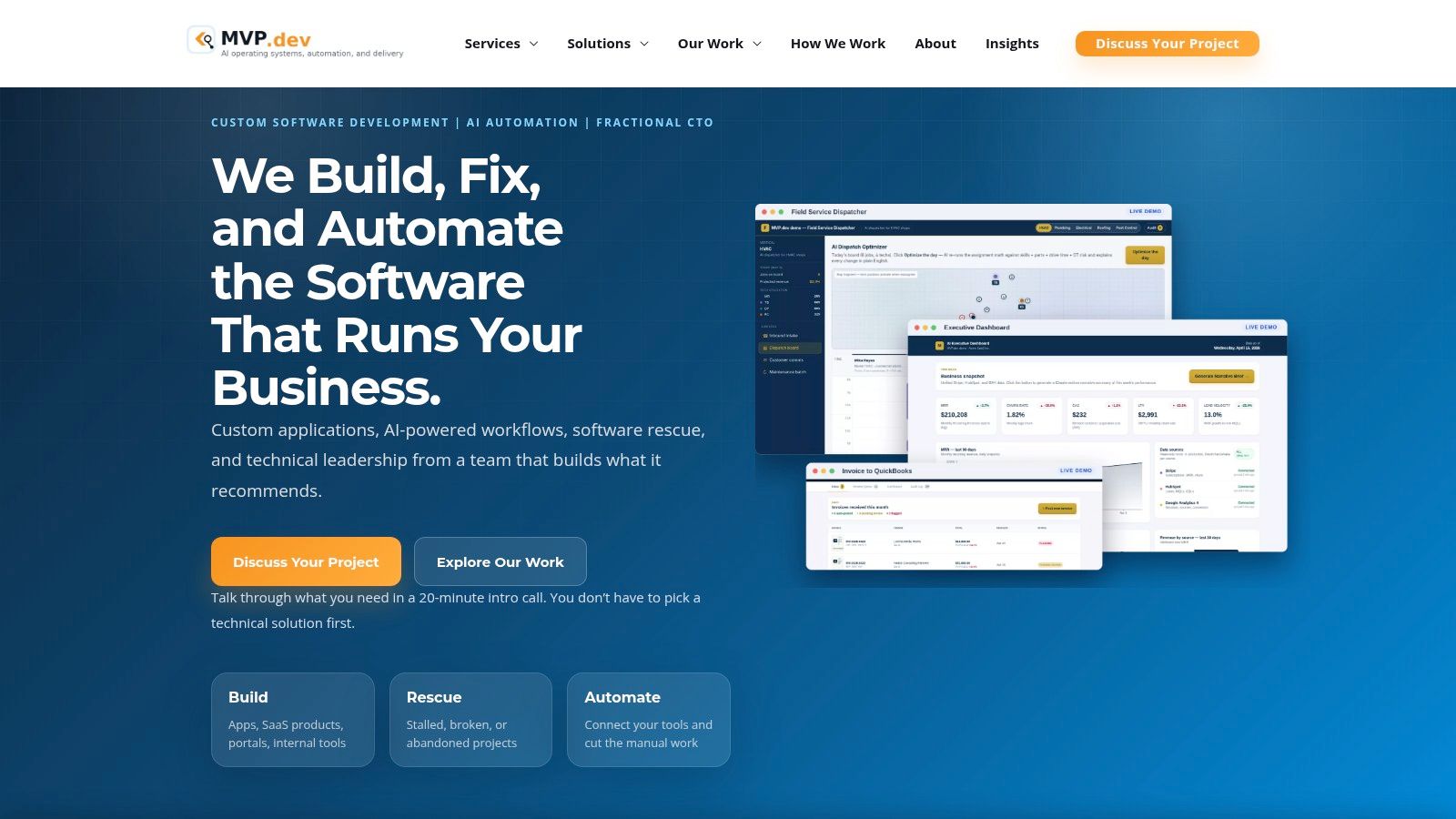
MVP.dev's most useful positioning is contractual clarity. It describes discovery followed by a written scope, iterative development, testing, and launch for startup products, SaaS applications, internal tools, portals, and integrations.
MVP.dev states that most builds use fixed pricing against an agreed scope and that clients own the code, repository, and hosting accounts. It doesn't publish a standard MVP package price, so fixed-price positioning shouldn't be confused with a public budget floor.
Fixed price needs explicit assumptions
A fixed price works when the parties agree on behavior, dependencies, and acceptance conditions. It becomes contentious when a feature label conceals unresolved requirements, such as whether reporting includes exports, permissions, scheduled delivery, or audit history.
Define boundaries. Specify supported user journeys, integration behavior, and excluded work.
Control changes. Establish how discoveries affect price, sequence, and acceptance.
Prove handover. Require deployment instructions, credentials transfer, and a successful release by the receiving team.</li>
Owning the repository isn't the same as being able to operate the product without the vendor.
Its project-rescue and fractional CTO offerings may help buyers who need technical direction alongside implementation. Live software demos are useful for assessing interaction quality, but relevant references should establish maintainability and post-launch responsiveness.
For portal and SaaS work, require object-level access tests. OWASP's API Security Top 10 identifies broken object-level and function-level authorization as distinct risks, so authentication alone isn't sufficient.
Confirm delivery location, working-hour overlap, and support terms directly. Neither fixed pricing nor ownership language establishes whether the team fits your nearshore operating plan.
How the seven MVP development companies compare on minimum project size, pricing visibility, and best-fit buyer
Turning Your MVP Vendor Shortlist into a Signed Scope
Choose the provider whose scope resolves your highest-risk uncertainty, not the one with the most impressive demo. For an established startup, that uncertainty may be customer adoption, a difficult integration, sensitive-data handling, or whether internal engineers can assume ownership after launch.
Published minimums help eliminate obvious budget mismatches. Published ranges and timelines help structure planning, but only a written proposal can establish what your company is buying.
Put the acceptance conditions in writing
Separate the phases. Price discovery, prototyping, production development, and post-launch operations distinctly. State what evidence allows you to proceed between them.
Define validation. Name the target user, core hypothesis, activation event, retention signal, and continuation threshold. Instrument those events before inviting users.
Secure ownership. Confirm repository and hosting-account ownership, intellectual-property terms, deployment access, documentation, and third-party dependencies.
Verify comparable delivery. Request two references from similar projects and discuss missed assumptions, change handling, and support after release.
Plan the receiving team. Assign internal owners for architecture, releases, security, and product decisions, then identify which permanent hires are missing.</li>
Don't wait for the vendor's final sprint to plan recruitment. The incoming technical lead needs time to understand architectural decisions, review operational documentation, and participate in deployment before accepting responsibility.
Once the MVP demonstrates demand, decide whether continued agency delivery or permanent hiring better fits your roadmap. LATAM engineers and technical leads are an option for extending US-aligned collaboration while retaining product knowledge internally.
Through our IT recruitment service, we help companies hire engineers across software development, data, infrastructure, cloud, and other technical disciplines. Define those roles alongside the vendor scope so recruiting and delivery support the same ownership plan.
A signed scope should leave you with more than a launch date. It should identify the evidence you'll collect, the assets you'll control, and the people who can keep the product running.
GENTY recruitment helps US and European startups hire vetted nearshore engineers and technical leaders through a skill-first recruitment process. Visit GENTY recruitment for a free consultation to map the permanent roles your MVP will need and plan the transition from vendor delivery to internal ownership.