

The popular advice to find an average salary and apply a regional discount gets cross-border hiring backward. Salary benchmarking means matching the actual job to a relevant labor market, building a pay range, and choosing a target percentile deliberately. Price scope, seniority, and scarce skills first, then the country market. For a CTO or HR director learning how to do salary benchmarking, the useful output isn't a salary lookup. It's an offer range you can explain to finance, candidates, and current employees.
What a Salary Benchmark Must Produce
A DevOps engineer in Mexico City isn't automatically comparable to a generic software developer in the United States. Before trusting a pay difference, align occupation, location, industry, seniority, and employment context. Otherwise, you may mistake a difference in responsibility or compensation structure for a geographic saving.
The benchmark should describe the peer group in writing. A useful description identifies what people do, where they work, which employers compete for them, and whether the figures represent employee base pay or another compensation measure. Latin America only prices cleanly country by country, not as a single discounted version of a US salary.

A distribution, not a neat average
The BLS Occupational Employment and Wage Statistics program reports the 10th, 25th, 50th, 75th, and 90th percentiles, using employer-reported wage data organized by occupation and geography. Its median separates the lower-paid half from the higher-paid half; the upper quartile represents a more competitive market position.
Before you start hiring
Check location, salary, and hiring fit
If you are moving from research to action, start with the market basics so your hiring plan is clearer.
Don't confuse a percentile with a percentage premium. A target percentile identifies a position within a wage distribution, not an instruction to add that percentage to the average. The distance between market positions must come from the actual distribution.
Consistent classification matters, too. If a provider changes its job taxonomy or geographic boundaries, an apparent pay movement may reflect a different comparison group rather than employers increasing salaries.
Practical rule: A defensible benchmark explains who belongs in the comparison before it explains what you should pay.
The artifact your team needs
Your compensation owner should produce:
A market distribution showing the available percentile points and any missing or unreliable observations.
A written peer group identifying the job match, labor market, employer context, and compensation measure.
A target position justified by hiring difficulty, scarce capabilities, and your pay strategy.
A usable range with an effective date, assumptions, and approval owner.</li>
That artifact connects job content, market cuts, currency and location views, pay bands, and the offer conversation. Without those connections, even an accurate salary figure can support the wrong decision.
Price Remote Roles Without a Blanket Discount
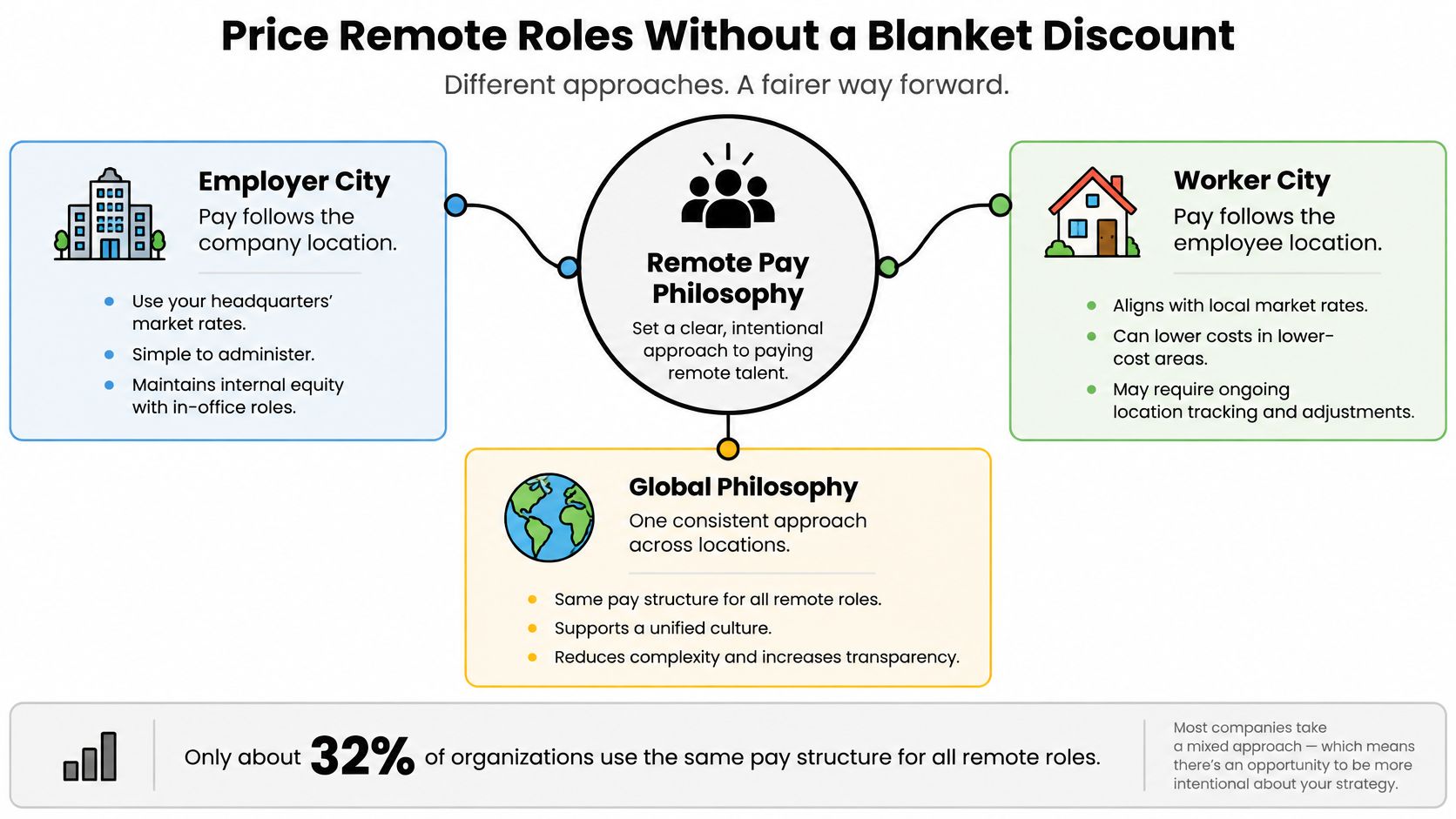
Only about 32% of organizations use the same pay structure for remote and on-site employees, while roughly 18% use a single national structure, according to the ERI remote-work compensation whitepaper. Those findings don't establish one correct remote-pay policy. They show why employers must make that policy explicit.
Should pay follow the employer's city, the worker's city, or a global philosophy? The answer is a compensation-policy choice, not something a salary database can decide for you.
Make the pricing decisions in this order
Price the work. Establish scope, seniority, and scarce skills before introducing location. Owning production reliability and incident decisions isn't equivalent to maintaining deployment scripts under supervision.
Compare the country labor market. Identify the employers and remote opportunities available to candidates who meet that scope.
Model the offer economics. Include exchange-rate exposure, benefits, contractor or employer-of-record costs, and the premium required to compete with local and international offers.</li>
Say a strong Brazil-based DevOps candidate already interviews with international companies. Their English proficiency, timezone overlap, production ownership, and alternative remote offers all affect the hiring decision. A discount calculated from your headquarters salary may have little connection to what persuades that person to join.
The US versus nearshore developer comparison provides context for considering compensation alongside working-hour overlap and delivery needs. Use that broader comparison to define the hiring case, not to substitute for a role-specific benchmark.
Recommend an offer strategy
Your recommendation should distinguish a plausible recruiting range from the approved budget. If the budget only supports a narrower role, change the scope rather than keeping senior expectations behind a cheaper title.
This reasoning extends beyond engineering. Teams planning to hire virtual legal assistants through Virtual Legal Assistants should likewise define responsibilities and the employment arrangement before comparing remote costs.
Date the benchmark file and identify its refresh triggers. Inflation, currency changes, or shifting demand can make an annual survey unsuitable for a live search. The output is a range plus a hiring recommendation, not one supposedly correct salary.
Source the Market Data and Use Talent Intelligence
Government wage statistics measure reported employment pay. Compensation surveys from providers such as WorldatWork and Mercer offer employer-pay and policy context, but you must inspect the specific survey's country, role, and population coverage. Candidate-side information measures something different: what people currently considering a move expect.
The BLS OEWS overview describes coverage of approximately 830 occupations and excludes self-employed workers. It's a useful US anchor, not a complete contractor benchmark or a substitute for country-specific evidence.
Decide which observations enter the peer group
Inventory each source. Record its survey date, geographic scope, incumbent-versus-new-hire population, and percentile definition.
Check job content. Keep responsibility-and-level matches. Discard sources that match only the title.
Test scarcity with Talent Intelligence. Ask a recruiting partner for candidate expectations, qualified-pool estimates, and comparable hiring timelines for the same skill cluster in Argentina, Mexico, and Brazil.
Cross-check your own payroll. Flag internal groups with too few comparable employees to support a reliable conclusion.
Rank the evidence. Start with relevant government and multi-year surveys, use recent partner information for scarcity adjustments, and treat thin internal samples as a cross-check rather than the market.</li>
Talent market intelligence is particularly useful when a survey category can't distinguish ordinary platform work from Kubernetes ownership or stakeholder-facing English requirements. Keep candidate expectations separate from accepted offers, though. An asking price isn't a completed transaction.
A precise-looking number from the wrong country or job family is still the wrong benchmark.
Don't average incompatible sources to resolve disagreement. Investigate their populations, dates, and compensation definitions first.
How to Run the Benchmark from Role to Range
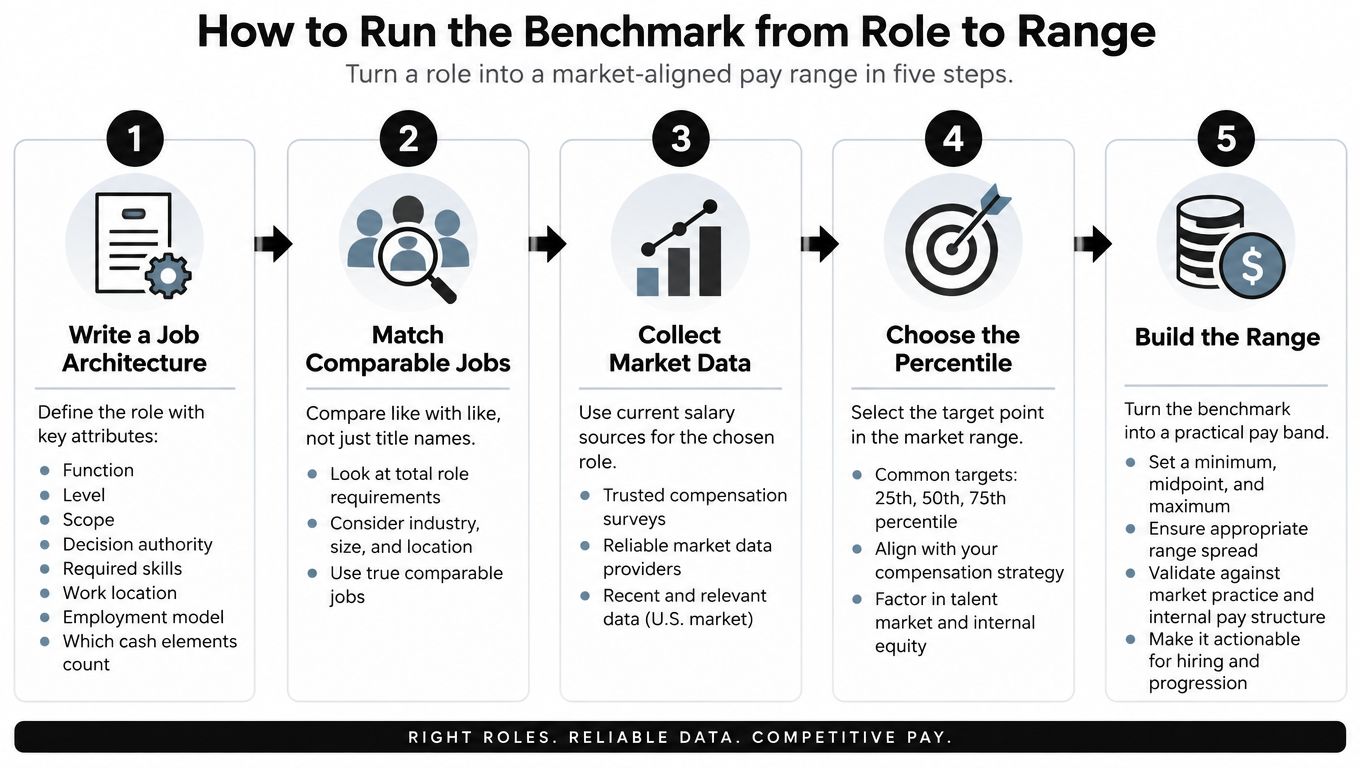
Build the workflow around job content, not titles. WorldatWork's compensation benchmarking guide identifies role definition, data collection, job matching, segmentation, percentile analysis, and translation into pay ranges as the core process.
Run the operational checklist
Write the job architecture. Record function, level, scope, decision authority, required skills, work location, employment model, and included cash components. For a senior DevOps seat, specify whether the person designs the platform, owns incident response, or executes an existing roadmap. Failure mode: hiring managers assign different meanings to senior.
Match external jobs by responsibility and level. Compare the survey description with the actual work, including autonomy and operational accountability. A software engineer title isn't enough. Failure mode: a broad development benchmark gets used for a production-critical infrastructure role.
Segment the relevant market. Apply country, city or labor market, industry, company size, experience, and scarce-skill filters. Include Kubernetes, stakeholder English, and on-call obligations where they materially change the job. Failure mode: excessive filtering leaves an apparently customized comparison with almost no supporting observations.
Calculate the central and upper-market positions. Include the lower quartile, median, and upper quartile, and qualify or suppress cells with insufficient observations. Don't manufacture precision by displaying more decimal places. Failure mode: a tiny sample becomes an authoritative-looking range.
Set the midpoint and boundaries. Place the midpoint at the selected market position, then define minimum and maximum placement criteria. Explain what distinguishes a developing incumbent from someone operating fully at the level. Failure mode: the maximum becomes an arbitrary negotiation ceiling.
Write separate compensation policies. State your approach to base salary, total cash, and equity independently. Don't assume uncertain equity will compensate for cash below a candidate's requirements. Failure mode: managers describe materially different packages as equivalent.
Validate the final comparison. Check sample size, age, and source quality. Before combining employee and contractor observations, normalize benefits, taxes, paid time off, and employer costs. Failure mode: contractor invoices inflate the apparent employee salary market.
Apply the workflow to the same role across countries
Consider a US employer assessing senior DevOps candidates based in Argentina, Mexico, and Brazil. Keep the architecture constant while maintaining separate country comparisons. The candidates may meet identical technical expectations while competing in different labor markets.
Use country salary context to orient the comparison, then retain the actual survey match and evidence behind each country range. If the team can't articulate the required capabilities, skill-first role definition provides a practical starting point before pricing.
The finished file should contain a documented job match, including exclusions and confidence flags. A saved title search isn't enough.
Normalize Pay Before You Compare Markets
Maintain separate views of local purchasing power and market-currency competitiveness. Purchasing power helps assess what compensation supports locally; market currency helps assess the offer against alternatives available to the candidate. Neither view replaces a benefits and employment-cost calculation.
The OECD average annual wages indicator uses purchasing-power parities to adjust for national price differences and expresses annual wages on a full-time-equivalent basis. That supports PPP as a secondary planning lens, not as the hiring price for a scarce engineer.
Apply adjustments in a fixed sequence
First, annualize compensation to a common workload. Separate base, variable pay, equity, and employer costs before aging historical observations to the offer's effective date. Then convert currencies with a stated exchange rate and publish the local-currency range alongside any secondary PPP comparison.
Say a senior specialist proposes an hourly contractor arrangement while your alternative candidate quotes a monthly employee salary. Calculate expected billable workload and account separately for paid leave, benefits, employer contributions, and service-provider costs. Comparing the headline amounts would conceal different economic arrangements.
Record the survey date, geographic scope, population, inclusion rules, currency, and percentile definition beside the adjusted result. For Mexico, include an explicit review of aguinaldo in the compensation budget rather than assuming monthly base salary represents the complete annual package.
Adjustments required before pay figures are comparable
Mark each control complete, incomplete, or excluded with a written reason. Use a quarterly review default for fast-moving technical roles, with earlier recalculation when inflation, foreign exchange, or hiring difficulty materially changes.
If analysts are modeling repeated observations from the same employers, they can compare mixed-effects models and GEE using PlotStudio AI's methodological explanation. That's a specialist modeling decision, not a prerequisite for maintaining a transparent compensation workbook.
Build Pay Bands You Can Explain
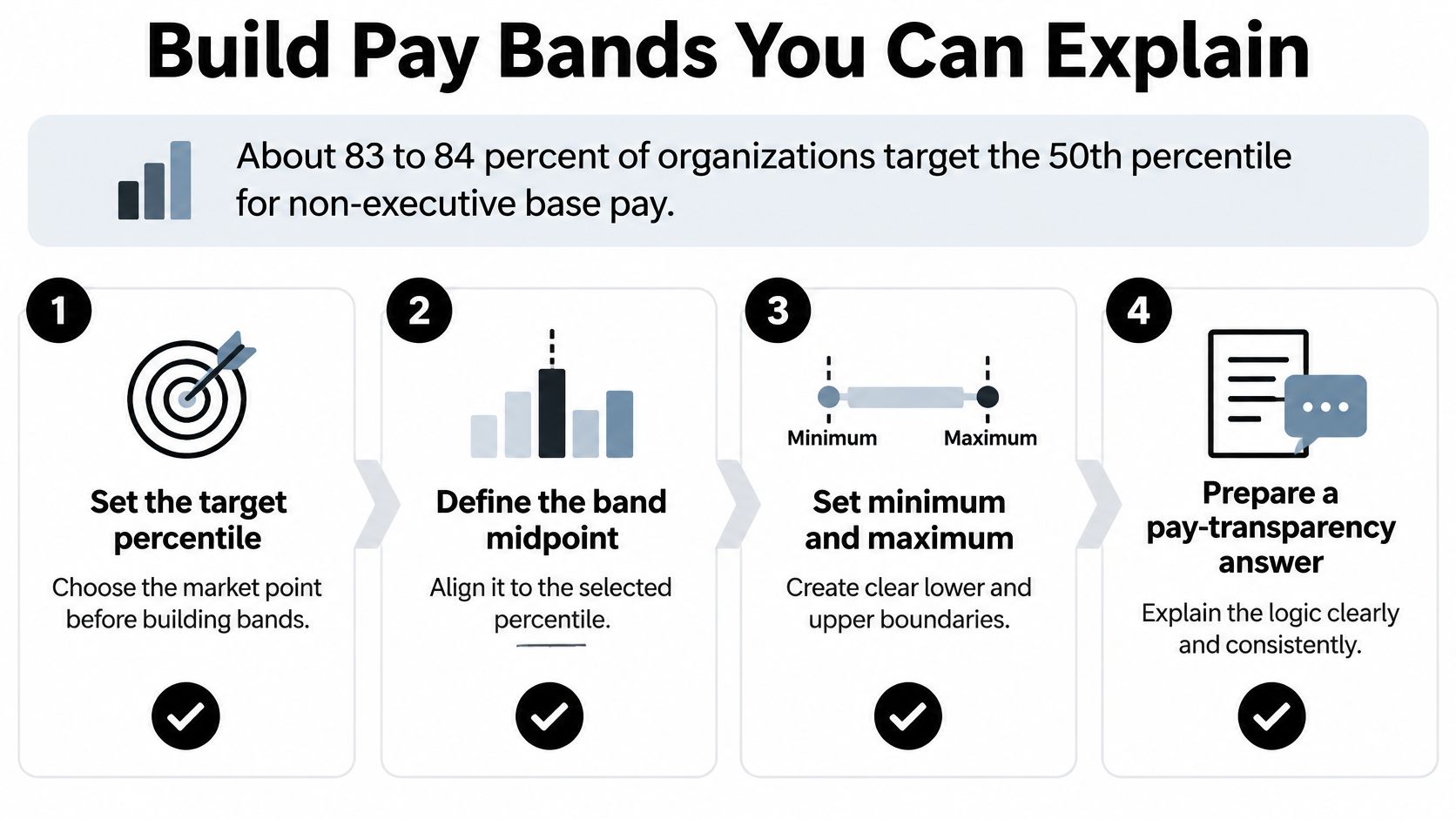
A market target becomes useful only when managers can explain placement within the band. Start with a median-oriented policy for ordinary hiring conditions and consider an upper-market stance for scarce senior engineering capabilities. These are policy choices, not guarantees of candidate acceptance.
Mercer's pay-transparency findings report that 77% of surveyed global organizations had developed or were developing strategies, yet only 14% had fully implemented them. Mercer also projected hiring-range disclosure to rise from 60% in 2024 to 94% by the end of 2026. Preparation therefore needs to include explainable placement criteria, not just a range printed in an advertisement.
Which percentile to target by hiring situation
These positions are illustrative compensation policies, not empirical promises about hiring outcomes. A lower-market target still needs to pass candidate acceptance and internal-equity checks.
Make the band defensible
Document the role's level and scope, lock the target position, and establish minimum and maximum criteria. Test whether country ranges overlap sensibly, then audit the proposed offer against employees performing comparable work.
If a new hire would enter above an established employee doing equivalent work, investigate the reason before approval. The answer may involve scope, sustained capability, or a genuine market adjustment, but negotiation skill alone isn't a consistent placement rule.
A competitive benchmark still fails if base salary, variable pay, equity, benefits, and employer costs hide inside one number.
Explain those components separately in candidate disclosures. Have local counsel review applicable transparency requirements rather than assuming the employer's headquarters rules settle every cross-border case.
Our negotiation tip is to offer a firm dollar rate with a quarterly review tied to scope. Where the employment arrangement and local rules permit it, document payment currency, conversion responsibility, and review conditions so ordinary FX movements don't reopen the whole package every month.
Lock the Offer and the Refresh Rule
Freeze the benchmark file before a candidate hears a number. The approved version should contain the range, peer group, target market position, currency method, effective date, and named approver. Recruiters and hiring managers should negotiate from that version, not whichever survey screenshot appears during the call.
If the market has moved, reopen the file through a dated refresh. Record what changed and whether the change affects only this role or comparable employees as well. An exception should have an owner and rationale, not become an undocumented new band.
Align compensation before interviews
Hiring speed depends on interview velocity and compensation alignment. Confirm the approved package and candidate expectations before investing in the full interview loop. A compensation reset after the final round creates avoidable friction precisely when both sides expect a decision.
Use a defined remote offer process to assign approval, negotiation, and follow-up responsibilities. Keep technical assessment decisions separate from last-minute attempts to make the budget fit.
Refresh on evidence. Repeated candidate declines or changed expectations should trigger investigation, not an automatic premium.
Preserve version history. Retain the old range, new range, effective date, and reason for the change.
Recheck internal consistency. Decide whether a revised hiring band requires an incumbent-pay review.</li>
Fill evidence gaps before making the offer
When internal comparisons are too thin, our Salary Benchmarking service provides country- and role-specific salary data, percentile-based compensation bands, and a custom PDF report for hiring-manager discussions. Pricing is custom and requested through a quote. Using real regional salary data, benchmarking can save up to 25% on compensation without losing top talent, though that isn't a guaranteed outcome for every search.
For teams still comparing hiring models, our free LATAM Hiring Guide 2026 covers 2026 salary benchmarks, a hiring-model comparison, compliance watch-outs, and screening steps. Request a custom quote or access the hiring guide before your next offer call.
GENTY recruitment offers salary benchmarking and skill-first recruiting to connect a defensible compensation range with the candidates your team needs. Visit GENTY recruitment to discuss a country- and role-specific benchmark, and bring your job scope, target locations, and planned employment model so the offer starts from a matched comparison.