
The usual advice, choose staff augmentation for flexibility and outsourcing for hands-off delivery, misses the expensive part: someone still has to manage the work. Choose staff augmentation when you have a capable lead who can direct external engineers inside your team. Choose outsourcing when you can define an outcome and hold a provider accountable for it. For a Series A–C company, the key comparison is governance capacity and total delivery cost, not the monthly rate on a proposal.
Staff Augmentation vs Outsourcing at a Glance
Staff augmentation puts external specialists inside your process, with your team setting priorities, reviewing code and making architecture decisions. Outsourcing assigns a defined deliverable, service or function to a provider that manages execution against a statement of work.
Staff augmentation vs outsourcing on the decisions that change the contract
The contract-changing distinction: Are you buying people you'll direct, or a result the provider must deliver?
Planning a hire?
Talk through the best hiring option
This article usually leads to one practical question: should you use rpo or staffing? We can help you choose quickly.
Control creates work for the buyer
A product team with an established technical lead should usually start by evaluating augmentation. External engineers can use the same GitHub repositories, Jira backlog and pull-request rules as employees. Your lead doesn't need to translate every product adjustment into a commercial negotiation.
That flexibility doesn't make a change free. Moving an engineer onto an urgent integration still delays another task. Augmentation removes some contractual friction, not the underlying capacity constraint.
A bounded module with acceptance tests belongs in the outsourcing column first. Say you need an internal reporting tool that reads an existing API, applies documented permissions and exports approved reports. A provider can estimate that package and take responsibility for its delivery without joining every product-planning discussion.
Knowledge needs an owner
Repository ownership isn't the same as knowledge retention. An augmented engineer can leave undocumented deployment steps behind, just as an outsourcing vendor can deliver excellent runbooks. Assign responsibility for architecture notes, operational instructions and handover before work starts.
Circle the two rows you won't trade away. If they're daily direction and roadmap changes, test your management capacity before buying seats. If they're payment against acceptance and vendor-owned execution, test whether your scope is ready to contract.
Who Employs the People and Owns the Result
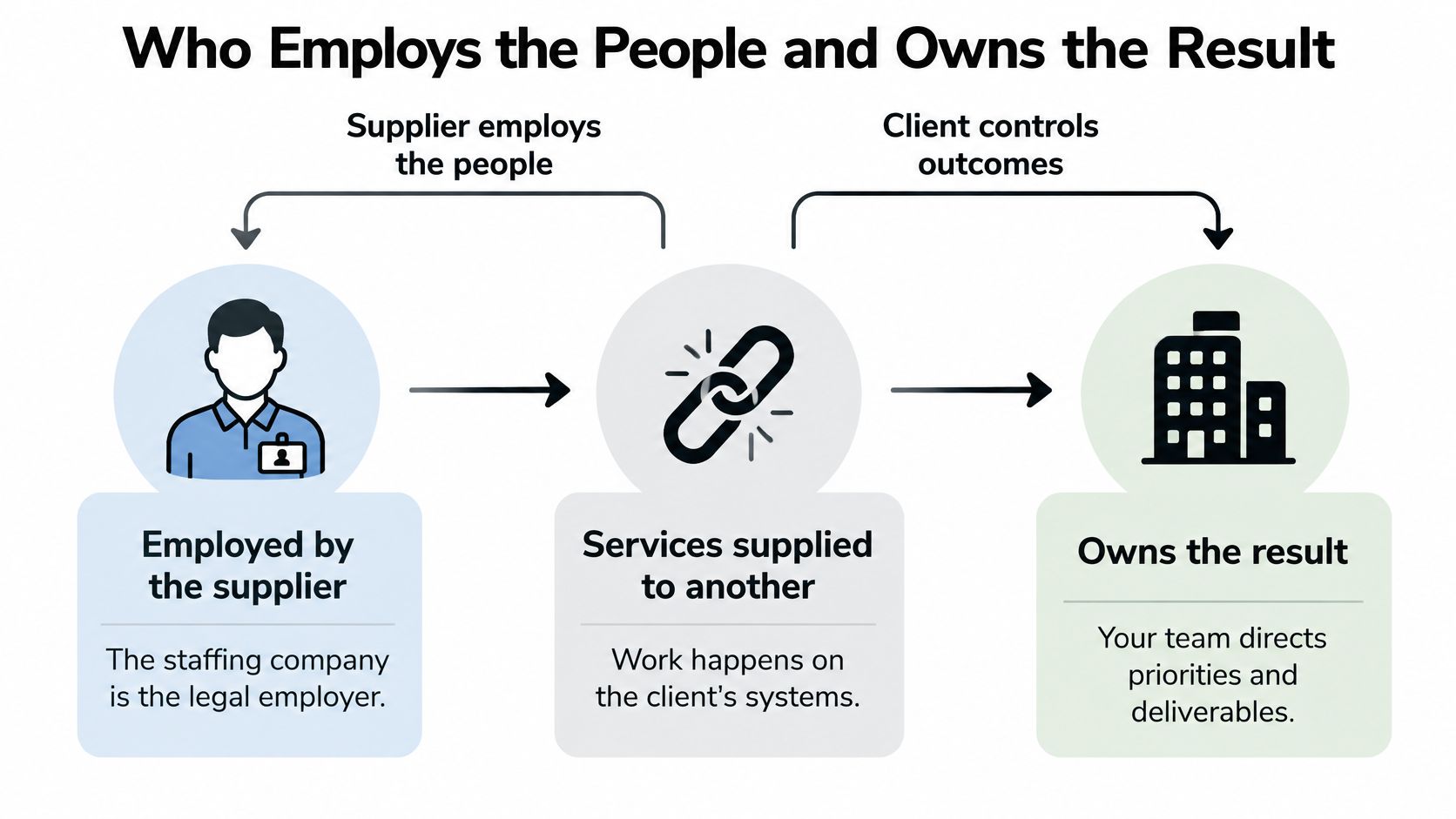
The proposal's label matters less than its operating mechanics. The U.S. Bureau of Labor Statistics' alternative-arrangements definitions describe contract-firm workers as people employed by a company that supplies them or their services to another organization under contract, usually assigned to one customer and often working at that customer's site.
That pattern resembles many augmentation engagements. The supplier remains the formal employer, while your engineering organization directs technical work. In outcome-based outsourcing, the vendor instead controls staffing and execution within the agreed specification.
This diagram separates the employment relationship from responsibility for delivery.
Classify the proposal before comparing its price
Apply this checklist to the actual agreement:
Name the employer of record. Identify the entity responsible for the employment relationship.
Name the daily manager. Who assigns tasks, approves working arrangements and gives performance feedback?
Assign delivery risk. If a feature slips, must the supplier repair delivery at its expense, or have you purchased more engineering time?
Identify the payment trigger. Does the invoice follow hours supplied, accepted deliverables or service performance?</li>
If your company controls tools, hours, task order and replacement decisions, the arrangement functions operationally like supplied labor. Calling it outsourcing doesn't transfer project management to the supplier. Legal classification still needs jurisdiction-specific review.
Separate employment support from project delivery
Pure augmentation means your lead manages named professionals. Staffing with employment support adds payroll, benefits and employment administration, but your team still directs product work. Project outsourcing makes the provider responsible for the agreed result.
At GENTY recruitment, we hire, onboard and manage professionals through our staffing offering so clients can focus on building their products. Our staffing and employment-support path includes payroll, compliance, benefits handling, onboarding, HR support and a dedicated account manager, with flexible scaling subject to contractual notice terms.
For a separate deliverable, use the web-development outsourcing evaluation guide to frame the delivery discussion. The practical risk is mislabeling: supervision, security offboarding and quality escalations must follow who controls the work.
Governance Capacity Before You Add Heads
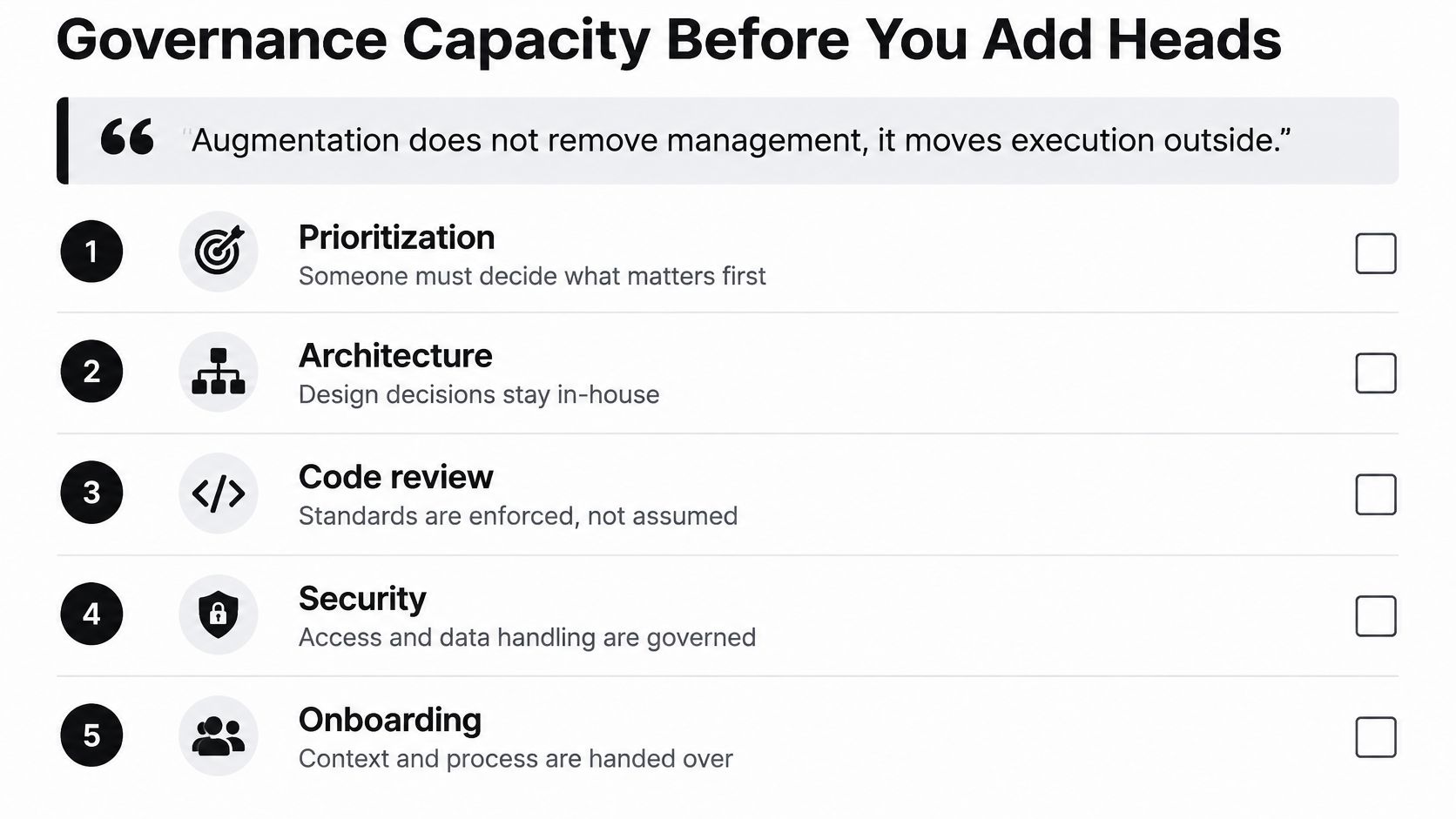
Augmentation doesn't remove management. It moves execution outside while leaving prioritization, architecture, code review, security, onboarding and performance management with the client.
A PACIS study of 194 organizations associated detailed service-level agreements with better cost and service outcomes; 48% of respondents benchmarked performance after outsourcing, while 52% didn't. Benchmarking during the contract had the strongest reported relationship with success, explaining 10% of variance in a composite of strategic, technical, cost, service, satisfaction and value outcomes.
These findings support measurement discipline, not a guarantee that a particular contract will succeed. Define a baseline before the supplier starts, then compare actual performance against it.
Use this checklist to assign internal owners before approving additional capacity.
Give each model a different control system
For augmentation, keep measurement inside your existing engineering tools:
Flow and reliability. Track cycle time, deployment frequency, change-failure rate and mean time to restore.
Quality. Review escaped defects alongside pull-request review delays and recurring rework.
Team continuity. Monitor utilization and retention without treating logged hours as proof of useful delivery.</li>
For managed outsourcing, turn the supplier-owned portion into explicit service-level agreements. Define reporting cadence, escalation rules, remediation triggers and service credits where appropriate. Keep product outcomes, such as whether customers adopt the feature, under client ownership rather than pretending the supplier controls them entirely.
A 2025 consulting comparison from Ardura directionally estimates that management can consume 15–20% of a team lead's time, onboarding can reduce productivity for 2–4 weeks, and outsourcing may be 15–25% cheaper after indirect costs on programs longer than 12 months. These are consulting estimates, not universal benchmarks.
The management question also deserves a conversation with the people who'll review the work.
Make readiness a yes-or-no decision
Before adding engineers, answer these questions:
Product ownership. Is a named person accountable for product decisions?
Technical leadership. Is an experienced lead available to guide the work?
Review capacity. Can reviewers commit to a response window that keeps engineers unblocked?
Contract readiness. Can you require documentation, repository access, security controls, replacement coverage and an exit plan?</li>
A no on leadership or review capacity is a reason to delay augmentation. It isn't a reason to sign an outsourcing agreement with undefined deliverables.
Effort Hours, Overhead and Seat Cost
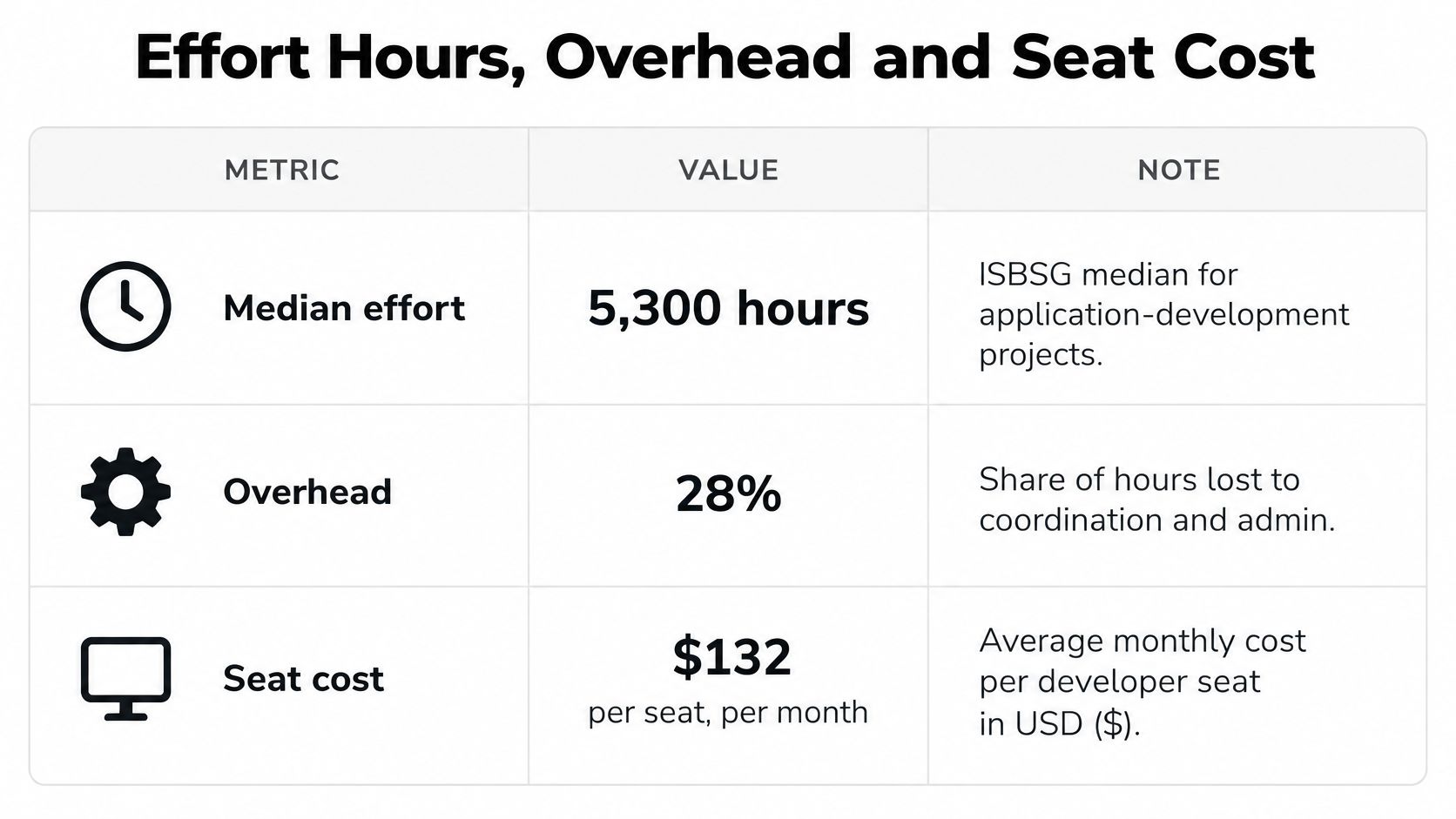
Delivery effort and cost markers
The effort and throughput medians come from ISBSG's application-development comparison: 13.2 versus 10.5 effort hours per function point, and 21.2 versus 29.4 function points per month, for in-house and outsourced projects respectively. Multiplying those effort medians by the table's hypothetical scope produces the illustrated hours.
In-house isn't synonymous with augmentation. These benchmarks compare in-house and outsourced application development, not otherwise identical augmented and outsourced teams. Project mix, complexity, requirements stability, supplier capability and governance can all affect the result.
A cost worksheet should separate delivery effort, internal overhead and the commercial seat quote.
Compare the same delivery boundary
Use the benchmark only when work is modular and acceptance criteria exist. Define expected behavior, defect limits, dependencies and delivery milestones before requesting bids. Otherwise, one supplier may price production deployment while another prices only code completion.
For an annual comparison, calculate:
Seat expenditure. Multiply each monthly quote by the months you expect to need that engineer.
Internal coordination. Add the lead's fully loaded cost for the management time you reserve.
Ramp and support. Account for onboarding at reduced output, reviewer time, tooling and access administration.
Comparable outsourced scope. Add expected change requests, acceptance testing and transition work to the statement-of-work price.</li>
For a hypothetical annual planning worksheet, monthly seats can be multiplied by twelve. Don't automatically add a management allowance for every engineer if one lead supports the whole squad; allocate the lead's time once and test whether that capacity is sufficient.
Use role-specific quotes, not regional averages
Our part-time DevOps contractor ranges in Colombia, for 0.5 FTE or about 80 hours, are $1,600–$2,800 per month for entry-level, $2,400–$4,400 for mid-level, and $3,600–$6,800 for senior. Match the quote to the required responsibility, especially whether production ownership or scheduled availability is included.
Our remote staffing and EOR service starts at $99 per employee per month. That service starting price isn't the engineer's compensation or the complete seat cost. Our clients typically see total hiring costs drop by up to 40% compared with US or Western European hires, but that comparison doesn't establish that augmentation beats outsourcing.
Use the developer hiring cost breakdown to structure the recruiting budget separately. Then compare total delivery expenditure, not a staffing administration fee against an entire project bid.
Scenarios That Settle the Choice
A changing product roadmap
Choose augmentation for a hypothetical Series B squad adding four senior full-stack engineers when priorities change every sprint. The existing lead should retain architecture and backlog sequencing, while the incoming engineers join the same review and release process. For named developers your team will manage, IT recruitment support is an appropriate hiring route.
Nearshore Latin America can work well for US collaboration hours; European teams should agree the actual overlap rather than assume a full shared day. Compare the working schedule using the offshore versus nearshore hiring guide, then put required review and meeting windows into the role brief.
An operational queue with a stable runbook
Choose outsourcing for an around-the-clock support desk or KYC operations queue with documented procedures, volume targets and defect thresholds. The provider can own coverage, substitutions and service performance. Your operations owner still needs authority to resolve exceptions and approve changes to the runbook.
Don't buy individual seats if the real requirement is continuous coverage. An available professional and a managed service are different purchases, particularly when someone is absent or an incident crosses shifts.
A team without an engineering manager
Don't add a full augmented squad yet if a company wants six developers but has no one to direct them. Hire the lead first, or outsource one module whose inputs, outputs and acceptance tests can be written down. A larger team won't resolve an unanswered architecture decision.
Our Staffing service provides access to vetted professionals within 7 days for short-term or project-based needs. Treat that as access to candidates, not proof that your organization is ready to onboard and manage them.
An AI feature under active discovery
Choose augmentation or a hybrid when prompts, evaluation criteria and product judgments change weekly. Your team should review model behavior, maintain evaluation cases and decide which errors are acceptable. A vendor can own a narrow pipeline without owning your product judgment.
Buying rule: Delegate a bounded implementation, not an unresolved product decision.
Recruitment process outsourcing is a separate path when you want to own the employees but delegate the hiring operation. Our RPO service covers the client's full hiring process with an expert team; it doesn't transfer engineering delivery responsibility.
Write your situation in one sentence about scope stability and another about who reviews the work. Match those sentences to the closest scenario before requesting a proposal.
Access, IP and a Clean Exit
External professionals may access repositories, production systems, customer data, model prompts or cloud credentials under either model. Attendance at your standup doesn't make access safe. Your security team needs evidence of what each person can reach and who can revoke that access.
Morgan Lewis's outsourcing guidance identifies AI governance, data quality, human review, intellectual-property ownership and exit planning as contract concerns for AI-enabled work, alongside hybrid delivery arrangements. Translate those concerns into assigned responsibilities rather than a general promise to follow security best practices.
The working environment may look familiar, but the access boundary still needs explicit controls.

Assign the model by operational risk
Put the exit into the starting agreement
Require these controls under either model:
IP assignment to the client, with treatment of pre-existing components and permitted dependencies documented.
Subcontractor approval before another party touches code or data.
Same-day offboarding across identity, repository, cloud and support systems.
Individual privileged accounts, with no shared administrator credentials.
Repository access logs available on request.
A written transition plan covering documentation, return in-house and a replacement window.</li>
Use the remote-contractor IP assignment guide to prepare the ownership discussion with counsel. Include cross-border data transfers and restrictions on putting confidential material into AI tools.
Outsourcing can centralize security operations while creating vendor dependence. Augmentation can preserve repository control while fragmenting account administration. Ask who is accountable on the incident bridge, and require an answer with a name and escalation route.
Decide This Quarter and Staff the Gap
If the package is specified, request an outsourcing bid. Scope, acceptance tests and defect limits should already be written. Limit the bid to that package rather than transferring an unsettled roadmap.
If leadership capacity exists, augment with named people. Reserve explicit time for review and unblocking inside your existing tools. As a planning test, ask whether the lead can protect roughly a day each week, then validate that allocation against the actual squad.
If neither condition holds, fill the leadership gap first. Don't buy a large external team. Hire a lead or contract a single module you can specify and accept.
Before the start date, complete the protection terms. Include IP assignment, same-day access removal and a transition plan. Give each obligation an accountable owner.</li>
For a US or European team choosing augmentation or employment support, prepare a scoped brief with the role list, each engineer's named reviewer and the roadmap's expected stability window. We help startups hire vetted nearshore talent in under 2 weeks, while final hiring decisions stay with the client. Our staffing headcount can scale up or down with 30-day notice, so include that notice period in capacity planning rather than assuming seats can end immediately.
GENTY recruitment offers a free consultation for companies building a remote engineering team, alongside recruiting, staffing and employment support. Bring your role list, reviewer assignments and scope assumptions to GENTY recruitment so you can discuss a hiring arrangement that fits the work your team can govern.