

Your roadmap is slipping, the local hiring pipeline is thin, and every new offshore developer looks like a fast way to add capacity. Then the work starts. Pull requests wait overnight, nobody knows who owns the release, incidents bounce between teams, and the “cost saving” becomes rework.
Hiring offshore developers works when you design the operating model before you source the people. Define decision rights, ownership, working-hour overlap, security controls, and success measures first. Then choose the geography, hiring channel, contract structure, and onboarding plan that support those choices. Offshore software development is now a major global labor market, with 28.7 million software developers worldwide and offshore development projected to reach $151.9 billion by 2025, according to the software development outsourcing market summary. The opportunity is substantial, but headcount alone won't make a distributed team effective.
Why Offshore Hiring Is an Operating Model Decision
A CTO inherits an offshore team after a roadmap miss. Developers were approved one at a time, based on attractive profiles or urgent tickets, without deciding how the group would plan, review, release, or respond to production failures. The result is a contractor bench rather than an engineering unit.
Offshore hiring changes how work moves through the company. It affects technical decision rights, knowledge retention, incident response, and the handoffs between internal and external staff. Treating the decision as a salary exercise leaves those operating questions to be settled during a crisis.
What do you need?
Choose the hiring path that fits
After reading "Hiring Offshore Developers: A Practical Playbook for 2026", most teams compare these options before deciding how to hire.
Practical rule: If you cannot name the owner for each workstream, release decision, and incident escalation, you are not ready to hire.
Make the seven decisions in sequence
Use this order:
Choose the operating model. Decide whether you need fully offshore staff augmentation, a managed nearshore partner such as GENTY, or a hybrid pod embedded with internal engineers.
Define the work. Separate critical-path product work from bounded, commoditised tasks. Critical work requires continuity and judgment. Bounded work can tolerate more asynchronous execution.
Pick the geography. Compare regions by working-hour overlap, communication needs, legal exposure, talent depth, and budget. Do not begin with a country list.
Run the funnel. Screen for evidence rather than resume volume. Test the work the candidate will perform.
Lock contracts. Resolve IP ownership, worker classification, access, confidentiality, governing law, and exit support before work starts.
Onboard deliberately. Set a bounded first outcome, assign a named buddy, and provide the context required for independent decisions.
Measure the system. Track delivery quality, review latency, incident ownership, documentation, and time to productivity.</li>
The broader outsourcing market is expanding, which gives companies more ways to add external engineering capacity. Scale does not solve unclear ownership or weak handoffs. It makes a defined operating system more valuable.
The same principle applies outside engineering. Leaders assessing the benefits of hiring an offshore accounting agency face the same requirements: explicit ownership, documented controls, reliable handoffs, and clear quality expectations.
Before selecting a partner, review offshore versus nearshore hiring models. Choose the model that fits the work system, decision speed, and collaboration pattern you need. Cost and sourcing channel come after those choices.
Defining the Role Before You Search
Don't post “React developer” and expect the market to clarify your needs. A vague title attracts candidates who can discuss a tool, while your company needs someone to own a product surface, review code, and ship without constant escalation.
Write a requirements brief with three parts.
Start with the problem and its boundary
The first paragraph should describe the business problem, not the technology preference. For example: “The billing team needs a reliable subscription workflow that handles plan changes, failed payments, and customer visibility without creating manual support work.”
Then define the boundary. State what the developer owns and what they don't own. Include non-goals such as redesigning the entire billing platform, replacing the data warehouse, or changing unrelated authentication flows. Explicit boundaries prevent a new hire from spending early weeks solving adjacent problems.
The final part identifies seniority and decision authority. A contributor executes within an established design. A tech lead chooses implementation direction, sets review standards, and coordinates dependencies. A founding engineer works through ambiguity, establishes patterns, and makes decisions before the company has complete answers.
Match seniority to first-week evidence
Ask two questions before interviewing anyone: “What does done look like in 90 days?” and “Who owns the on-call rotation?” Add “What release autonomy does this role have?” and “Who can reject or approve an architectural change?” If the answers are unclear, the role isn't defined.
A precise brief might require ownership of a React application, API contract decisions, observability in an existing cloud environment, code review for other contributors, and independent release coordination. That description gives candidates something concrete to evaluate and gives interviewers a consistent standard.
For adjacent hiring patterns, use these SaaS job role examples for hiring managers. Your aim isn't to produce a longer job description. It's to define the decisions the person must make.
Choosing Where and How to Source Candidates
Sourcing channels trade off signal quality, speed, control, and operational risk. Choose the channel based on the role's failure cost. A critical backend owner deserves a different process from a short-term test automation assignment.
Compare channels before committing
For a deeper approach to reaching engineers who aren't actively applying, review this guide to passive candidate sourcing. Don't confuse a large candidate pool with a useful shortlist. Your team needs people whose evidence matches the role's actual constraints.
Score geography against the work
Nearshore and far-shore regions present different trade-offs. Nearshore teams usually offer more shared working time with US teams, while far-shore delivery can provide deeper asynchronous coverage and access to different talent markets. Visa friction may be lower when the engagement doesn't require relocation, but IP jurisdiction, classification rules, language fit, and data access still need legal review.
The cost gap is real. Offshore development typically costs 30–40% less than onshore teams in the United States and Europe, according to World Metrics' outsourcing statistics. That same source reports hourly offshore rates of roughly $20–$45 in Asia compared with $80–$150 in the United States and Canada. Treat those as market context, not a hiring budget.
My default recommendation is clear. Use a managed nearshore model for product work that depends on rapid feedback, shared planning, and senior ownership. Use far-shore contractors for well-specified tasks where handoffs are limited and the work can be reviewed asynchronously. Score each geography against the brief instead of selecting a location first.
A Skills-First Vetting and Interview Funnel
The interview process should resemble the work. Resumes are useful for establishing context, but they don't prove that a candidate can write maintainable code, reason about trade-offs, or own a production problem.
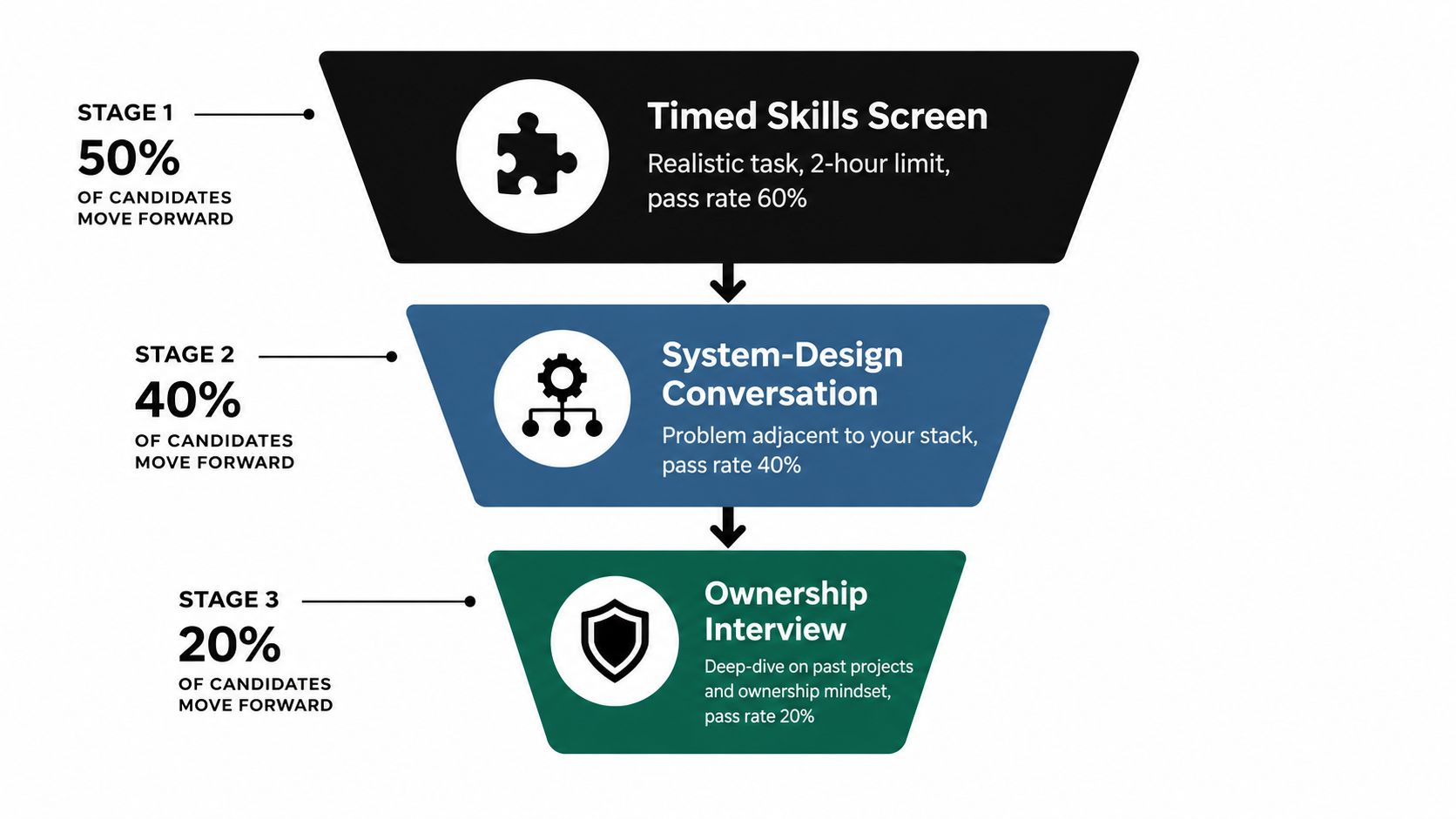
Use three weighted stages. Treat the weights as an internal decision rule, not a mathematical truth.
Stage one tests practical execution
Start with a timed skills screen based on a realistic task. Give the candidate a small problem adjacent to your product, such as extending an API, fixing a data consistency issue, or adding a user-facing workflow. Ask for tests, a short README, and a brief explanation of trade-offs.
Evaluate code structure, edge cases, test quality, and the candidate's ability to make reasonable assumptions. Reject exercises that reward puzzle memorisation but don't resemble your codebase. The screen should tell you how the person works under a clear constraint.
Stage two tests system judgment
The system-design conversation should use a problem near your stack. Ask the candidate to design a service, explain data boundaries, identify failure modes, and describe how they'd observe the system after release. Strong candidates can make a decision and explain what information would change it.
Stage three tests ownership
Ask about a production failure they caused, a decision they reversed, and a time they delivered with incomplete requirements. Candidates who cannot describe code they shipped, defer every architecture question to “it depends,” or avoid responsibility for failures aren't ready for autonomous offshore work.
Use a scorecard for every interviewer:
Technical evidence, roughly 50%. Implementation quality, debugging, testing, and stack fluency.
System thinking, roughly 30%. Boundaries, reliability, security, and trade-offs.
Ownership signals, roughly 20%. Judgment, follow-through, communication, and response to failure.</li>
These weighted areas reflect the requirements of the role. The process should also include a 30-minute culture and communication round for senior candidates, because remote teams amplify unclear writing and delayed escalation.
Finish with references. Ask whether the person delivered under ambiguity, how they handled missed commitments, and whether you'd trust them with an incident at an inconvenient hour. A skills-first hiring framework can help standardise the funnel and reduce halo effects.
Contracts, IP, and Worker Classification
Legal structure is an engineering control. If the contract doesn't establish who owns the code, who can access production, and how the relationship ends, your team will improvise under pressure.
Start with a present-tense IP assignment. The agreement should transfer source code, designs, documentation, inventions, and related rights to your company as the work is created. Many jurisdictions default to contractor ownership unless a written assignment exists, so don't rely on a generic “work for hire” phrase. Include a moral-rights waiver where enforceable and address pre-existing materials separately.
The US classification analysis also isn't solved by calling someone a consultant. Under the FLSA, misclassification occurs when a worker who is an employee is treated as an independent contractor, and the applicable standard can vary by law. Review contractor misclassification considerations from RNC Group alongside US counsel and local advice.
Compare the engagement structures
Add confidentiality, background-check authorisation, device-isolation rules, and least-privilege access. Specify governing law, arbitration venue, and a termination process that includes 30 days of transition support and source-code escrow on termination where appropriate.
For practical drafting issues, see this guide to IP assignment for remote contractors. Have counsel adapt the terms to the developer's residence and the contract's governing law. A signed agreement after work begins is already late.
Onboarding That Compresses Ramp Time
Remote onboarding fails when the company sends a repository link and assumes competence will compensate for missing context. It won't. The new developer needs a sequence of increasingly difficult responsibilities, with a named person available to answer questions before small misunderstandings become expensive rework.
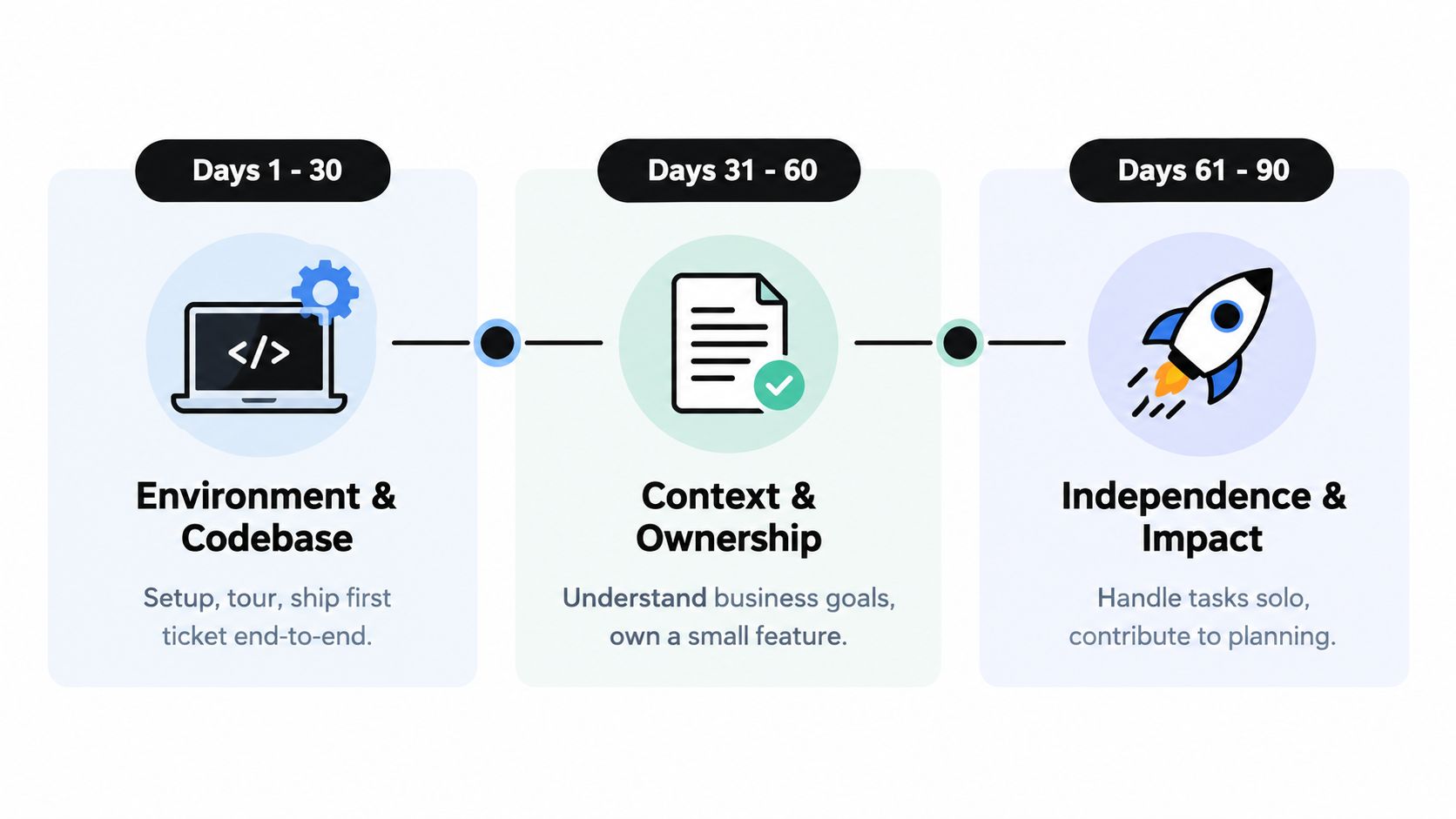
Prepare a 30-60-90 plan before the first day.
Days 1 to 30 establish a safe delivery loop
The first month is about environment setup, a codebase tour, and one clearly bounded ticket shipped end to end. Give the developer access to the tools they need, explain the release path, and show how the team investigates incidents. Pair them with a named onboarding buddy for the first month.
Run synchronous architecture walkthroughs during the first two weeks. Verbal explanation exposes assumptions that a wiki page often hides, while the developer can ask why a service exists instead of merely reading what it does.
Days 31 to 60 add context and ownership
Move the developer into the regular planning, review, and release cadence. Assign small features with a reviewer named for every pull request. Require a short design note before changes that cross service or data boundaries.
The goal isn't maximum ticket volume. It's reliable participation in the team's normal operating rhythm, including clear updates, sensible escalation, and documented decisions.
Days 61 to 90 test independence
By the third month, the developer should own a workstream, identify risks before they become blockers, and help unblock another contributor. Keep production access behind a change-management gate during ramp. Broader write access should follow evidence, including a clean incident-free month and consistent review behaviour.
Use the following video as a discussion prompt for your onboarding owners, particularly around remote collaboration and team integration.
Productivity depends more on process maturity, team size, knowledge sharing, ownership, and working-hour overlap than geography alone. Research summarised by FullScale's offshore productivity review supports the practical conclusion: control coordination overhead before adding headcount.
Cost, Time Zones, and When Nearshore LATAM Wins
The cheapest rate isn't the lowest delivery cost if every decision waits a day, every review requires a second explanation, and no engineer can join a release conversation. Cost, overlap, and role complexity must be evaluated together.
Senior developers in LATAM can cost roughly 40–65% below US equivalents, while annual compensation across Latin American markets ranges from about $25,000 to $85,000. Senior monthly costs often cluster around $4,000–$8,000, depending on country and specialisation, according to nearshore development rate analysis. Budget variance comes from seniority, complexity, and local wage pressure, not geography alone.
Use this decision framework
Use nearshore when the role needs sustained overlap, a short asynchronous cycle, and shared context with US product or design teams. It also fits work where AI tools have reduced the value of routine coding and increased the value of architecture, verification, security, and product judgment. Recent coverage from FullScale's developer hiring trends analysis describes this shift toward higher-context engineering and stronger governance expectations.
Use far-shore delivery when the scope is stable, interfaces are documented, reviews are predictable, and the team can work asynchronously without blocking product decisions. Don't choose it for a critical-path role because the bill rate looks lower.
For teams assessing daily collaboration, guidance on how South American teams align with U.S. Eastern Time is useful context. GENTY recruitment can source and screen senior LATAM engineers for embedded workflows, allowing an engineering leader to keep ownership of product delivery while reducing recruitment administration.
GENTY recruitment helps startups and scale-ups source skill-screened developers, DevOps engineers, QA specialists, and other technology talent across Latin America. Visit GENTY recruitment to discuss a role brief, choose an engagement model, and build a shortlist aligned with your operating requirements rather than hiring on rate alone.