
You're probably hiring because the product is moving and the current interview loop is telling you too little. A resume says the candidate has touched React, Node, and SQL. Then the panel asks trivia, a whiteboard puzzle, and a loose culture conversation, and nobody leaves with evidence about whether this person can ship a feature across the full stack.
If you want a better result, stop interviewing a full stack developer like two separate junior roles glued together. Run one end-to-end feature trace, score it with a rubric, and use follow-up questions to see how the candidate reasons when the UI, API, and database all matter at once.
Why Most Full Stack Interviews Miss the Mark
The common failure mode is easy to spot. One interviewer asks about REST verbs, another throws a sorting problem on a whiteboard, and a third asks whether the candidate “fits the team.” Nobody ever checks whether the candidate can take a product requirement from browser state to database write and back again without breaking the flow.
That's the wrong shape for the role. Full-stack work is integration work, not a pile of isolated trivia. CoderPad's 2026 hiring data shows why mixed assessment matters, since recruiters reported technical discussion in 56% of teams, live coding in 43%, work sample tests in 33%, asynchronous technical tests in 20%, and portfolio review in 23%, while 69% still use resume review but only 16% think it predicts performance, which is exactly why a structured skills-based process beats résumé screening alone CoderPad 2026 State of Tech Hiring report.
What do you need?
Choose the hiring path that fits
After reading "How to Interview a Full Stack Developer", most teams compare these options before deciding how to hire.
The candidate who can explain one feature across UI, API, and data usually tells you more than the candidate who can recite definitions.
The bigger issue is that generic interviews over-index on narrow signals. A LeetCode-style screen shows algorithm comfort. A generic system design prompt shows abstract scaling fluency. A culture-fit chat shows communication style. None of those, by themselves, prove that someone can debug a broken auth flow, reason about invalid state, or make a trade-off between frontend complexity and backend simplicity.
The right mental model
Treat every loop as a single feature trace. Give the candidate one small user action, then trace it through the interface, the API contract, the data model, and the failure modes. That lets you see judgment, not just recall.
The rest of the process should sit on four pillars, a job-specific rubric, one coding task that spans layers, layered questions for each part of the stack, and structured scoring that survives the debrief.
Defining the Competencies You Are Hiring For
Start before you write a single question. Map the actual surface area the hire will touch in the next 90 days, then define the competencies that match that work. If the role lives in a product squad shipping consumer features, you should weight frontend craft and debugging differently than if the role sits closer to platform work.
A practical model is five competencies, frontend craftsmanship, backend and data modeling, system thinking and trade-offs, debugging under pressure, and AI-assisted workflow fluency. You do not need to weight them equally. Weight them according to the actual bottlenecks in your stack and team composition, not some generic hiring blog formula.
A structured rubric like this is cleaner than improvising in the room. GENTY recruitment's full-stack developer skills guide aligns with that same skill-first approach, especially when you need to screen for practical work instead of credential polish.
Copy this rubric rule
Write behavioral anchors, not adjectives. “Good communicator” is useless in a debrief. “Explains why an endpoint should reject invalid input and gives a concrete example” is usable evidence.
Calibrate the rubric with two senior engineers before launch. If they can't score the same sample interview within one point, the rubric is too vague.
This document becomes the source of truth. Every screen, take-home review, live coding session, and debrief should point back to it. If a panel debate wanders into taste, bring it back to the behaviors on the page.
Designing a Coding Task That Tests the Full Stack
Use one feature, not a grab bag of tasks. A good live exercise traces a single user action end to end, and it should fit inside 45 to 60 minutes so you can watch how the candidate works, not whether they can brute-force a partial build. The most useful shape is a small entity like a saved item, comment, or bookmark, because it touches UI state, API handling, and persistence without turning into a side project.
A clean format is three 15-minute segments. The first segment is frontend. The candidate builds or edits a small interactive component, like a sortable list or search-with-autocomplete, while you watch for state management, accessibility, empty states, loading states, and error handling. The second is backend. They design or implement a REST endpoint with validation, pagination, and sane database querying. The third is integration and debugging. You hand them a broken feature and see whether they trace browser, network, server, and database behavior in a disciplined way.
Here's a sample prompt you can use:
Saved Items feature
A user can save an article to a personal list. Build the frontend state for saving and unsaving an item, define the API contract, and implement the persistence logic. The list should support pagination, duplicate prevention, and basic error handling. If the user is not authenticated, the UI should behave gracefully, but the exact product behavior is not fully specified.
That last sentence matters. You want at least one underspecified requirement so the candidate has to ask a clarifying question. Good candidates stop and ask about auth, ownership, duplicate behavior, or how the product handles offline failure. Weak candidates charge ahead and make hidden assumptions.
For junior or early-career candidates, use a smaller variant. Ask them to implement a list component and a single API call, then explain what would change if saved items needed pagination or cross-device sync. That still tests reasoning without creating false negatives.
A few red flags should stop you fast:
Skipping validation means they're optimizing for speed over correctness.
Hardcoding IDs or response shapes means they don't think in contracts.
Ignoring error states means they haven't built product code before.
Refusing to ask about auth means they're guessing at the hardest part.
Over-engineering with microservices means they're solving a toy problem with architecture theater.</li>
Your interviewer behavior matters too. Stay silent for the first few minutes, because that's when the candidate shows how they approach ambiguity. Nudge only when they've fully explored one path and are stuck, then score the progress against the rubric from the previous section.
If you want a live format that mirrors this well, GENTY recruitment also publishes a pair programming interview guide, which is useful if your loop depends on real-time collaboration rather than take-home work.
The Question Set for Frontend, Backend, and System Thinking
Use questions that force the candidate to trace one user action through the stack. That's where you learn whether they can connect state, contracts, and production behavior. For each layer, I want one core question, one follow-up that deepens the signal, and one red flag that tells you to move on.
Frontend rendering and state
Ask, “A user clicks Save. What state lives in the component, what state lives in the server, and what happens when the request fails?” The strongest follow-up is about accessibility or render trade-offs, for example, how they'd keep the control usable with keyboard navigation or avoid unnecessary re-renders.
A strong answer sounds like a product engineer thinking in states, not a frontend hobbyist naming hooks. The red flag is when the candidate only talks about UI polish and never mentions optimistic updates, loading states, or accessibility.
Backend and data layer
Ask, “Design the API for saving an item and explain how you'd prevent duplicates.” Push once with error handling, then ask what happens when the same request is retried or when two writes land at the same time. A solid answer should mention validation, idempotency, and database constraints without rambling into abstract theory.
System thinking and release behavior
Ask, “A saved item disappears for one user but not another. Trace the request through caching, queueing, and the database until you find the likely fault line.” The strongest candidates will talk through possible layers in order, state what they'd check first, and explain how they'd isolate variables.
Don't accept a list of buzzwords. Make them name the sequence of checks they'd run in production.
Debugging and observability
Use a real production-style trace, not a puzzle. Ask them to read a log or watch a failure scenario and explain how they'd narrow it down. The signal you want is method, not cleverness. If they jump to a fix before they've named a hypothesis, they're not debugging, they're guessing.
AI-tool fluency
Ask, “Where do you use AI assistants in your workflow, and how do you verify the output?” A strong answer shows they can draft faster without outsourcing judgment. A weak answer either worships the tool or rejects it outright. The role needs someone who can reason without autocomplete, debug AI-generated code, and validate output with tests and profiling, because that's where modern hiring is heading in practice Karat and related interview guidance.
Scoring Candidates with a Structured Rubric
Unstructured debriefs become personality contests. One interviewer liked the candidate's confidence, another liked the architecture answer, and a third just had a good vibe. That is how strong candidates get rejected and weak candidates get hired.
Use a four-band rubric, Strong Hire, Hire, No Hire, and Strong No Hire. Score each of the five competencies separately, and require evidence before anyone writes a number. A published interview framework recommends 1-to-4 scoring with written behavioral anchors and no half-points, because whole-number ratings reduce score inflation and force cleaner decisions KORE1 structured interview guidance.
Have every interviewer write notes independently before the debrief. No one should enter a score without citing a moment. That single rule cuts noise fast.
A worked example helps. If a candidate builds the save flow cleanly, asks one clarifying question about auth, but misses duplicate handling and can't explain their retry strategy, the debrief should reflect that split. A defensible comment sounds like, “Strong on frontend state and collaboration, moderate backend judgment, weak on idempotency.” That is useful. “Seemed sharp but not senior enough” is not.
GENTY recruitment also publishes a tech assessment tools guide, which fits well if you're choosing between live interviews, work samples, and structured screens.
Two rules keep the panel honest. No score without a cited moment. Forced rank at the end of every loop. If everyone lands at “hire,” you're inflating grades, not evaluating talent.
Running Remote and Nearshore Interviews Without Dropping Signal
Remote loops fail when logistics are sloppy. The biggest operational mistake is trying to run a live coding interview across mismatched calendars and flaky tooling, then pretending the result is comparable to an in-room session. If you want signal, lock the mechanics first.
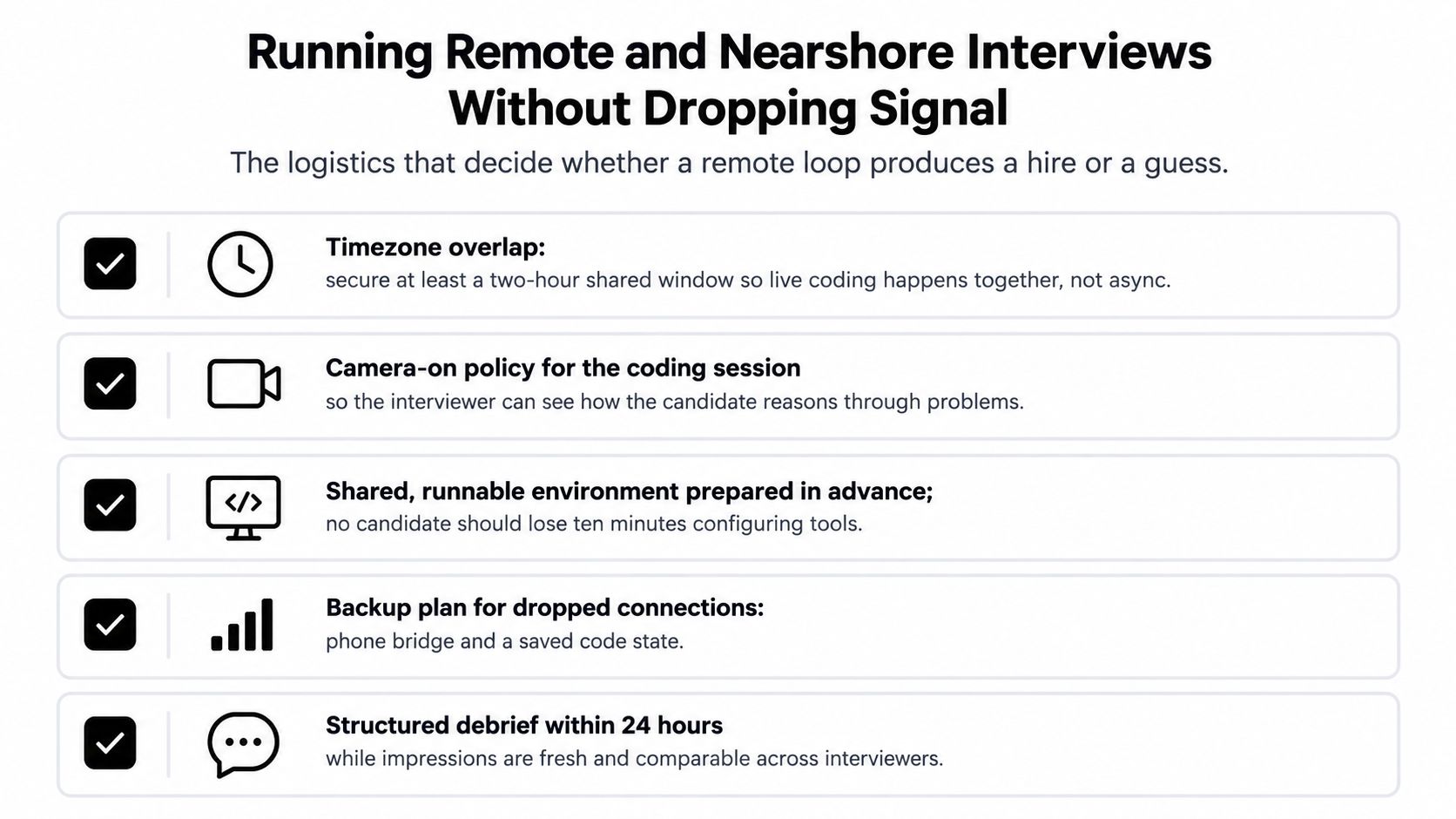
A remote interview should feel boring in the right way. Use a shared, runnable environment before the call starts. Have a backup plan if the connection drops. And make sure the interviewer and candidate have at least a two-hour overlap so the exercise happens live, not as awkward async theater.
If you use proctoring, be honest about why. It can add signal when the role is sensitive and the candidate is senior enough to understand the process. It just adds friction when you treat it like a substitute for a good prompt. The better control is a structured loop, not surveillance.
For nearshore hiring, LATAM is a practical option for US teams that need time-zone overlap and strong collaboration without the lag of a far-flung schedule. GENTY recruitment's asynchronous video interview guidance is a good complement if your process mixes live and async steps. Set the basics early, including payroll, legal review, and working hours overlap, so nobody discovers a mismatch after the panel loves the candidate.
Lock these four decisions before you schedule the loop:
Timezone overlap so live coding happens together.
Shared environment so setup doesn't eat the interview.
Backup connection path so a drop doesn't ruin the session.
Structured debrief timing so notes stay fresh and comparable.</li>
A 30-60-90 Day Rollout for Your Hiring Panel
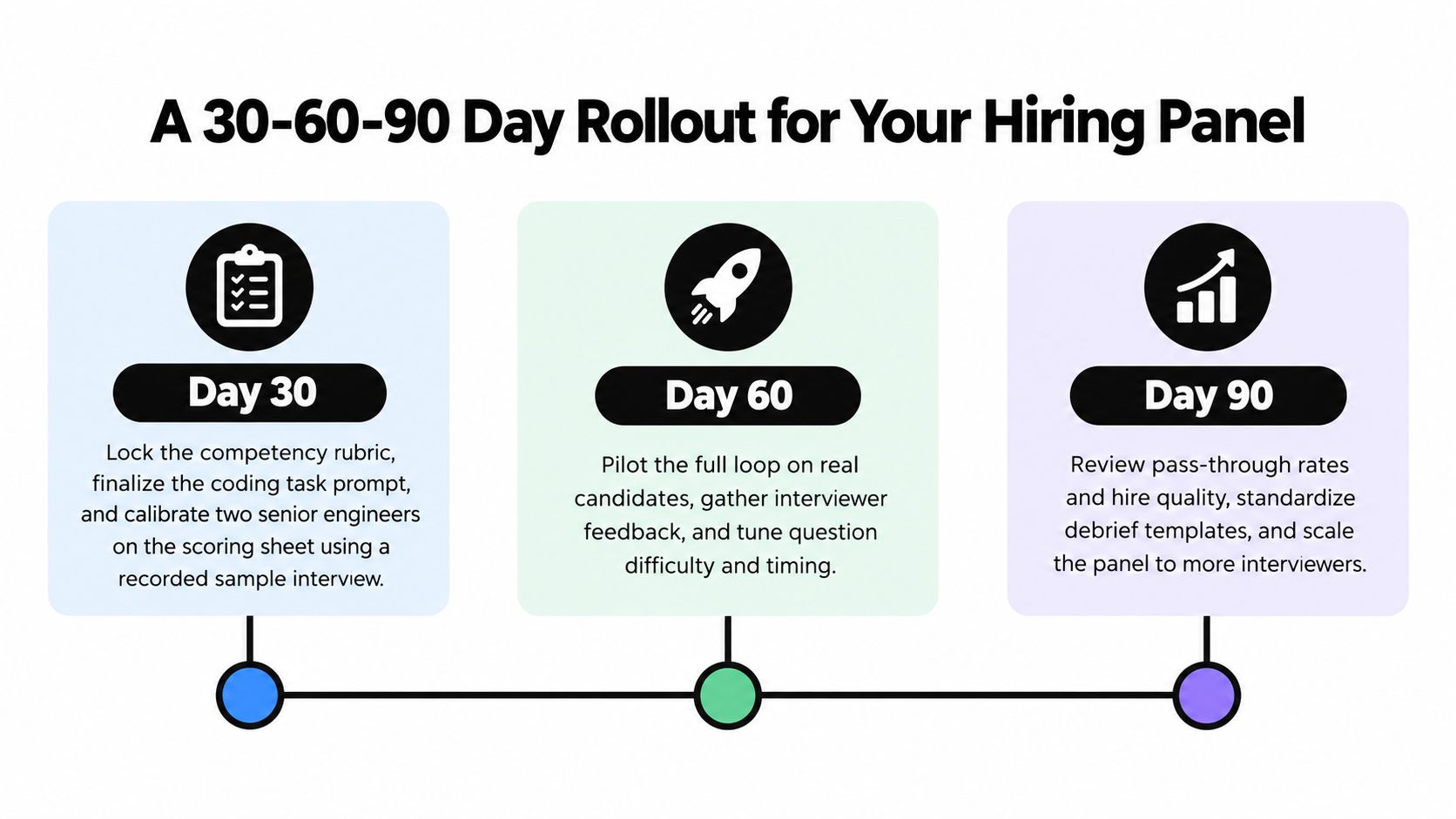
Day 30 is foundation work. Finalize the competency rubric, write the coding prompt, and calibrate two senior engineers against a recorded sample interview. Send that package to the panel and stop changing the rules midstream. GENTY recruitment's remote onboarding guide is a useful reference for the handoff after acceptance, so your panel measures the same expectations onboarding will later enforce.
Day 60 is the pilot. Run the full loop on three live candidates, collect feedback, and align the panel so scores differ by no more than one point unless the evidence itself differs. Document edge cases, including career switchers and bootcamp graduates, so the team stops arguing process exceptions in every debrief.
Day 90 is when you make it the default. Replace legacy whiteboard-only screens and any take-home that does not map to real work. Measure funnel conversion, time-to-hire, and 90-day new-hire performance against your previous baseline, then adjust the prompt if the data shows a problem while keeping the structured process intact.
Use this one-page checklist to keep the panel aligned:
Prep materials are shared before the loop.
Panel composition covers frontend, backend, and product judgment.
Rubric distribution happens before any interviews start.
Debrief format forces evidence before scores.
Candidate experience stays consistent and calm.</li>
If you need help building a full-stack hiring process that surfaces real engineering judgment, GENTY recruitment can support the sourcing and screening side with a skill-first process, including structured shortlists and nearshore LATAM hiring. Bring them in when you want your panel to spend time evaluating engineers, not sorting resumes.