

If your foreign contractor performed all their work outside the United States, you generally do not issue to them a Form 1099-NEC. That’s the core rule, and it surprises a lot of finance teams who assume any paid contractor triggers a 1099. The IRS treats payments to foreign persons who perform all services outside the U.S. as generally exempt from 1099-NEC reporting.
But three exceptions flip that answer fast, and missing any one of them creates real withholding exposure:
- The contractor is actually a U.S. person for tax purposes (citizen, green card holder, or resident alien), regardless of where they live.
- Some or all of the work was physically performed on U.S. soil, even briefly.
- Payment routes through a U.S. entity or intermediary that has its own reporting obligations.
When a contractor is genuinely foreign and works entirely offshore, the correct path isn’t a 1099 at all. It’s collecting a Form W-8BEN or W-8BEN-E to document foreign status, and in some cases filing Form 1042-S instead. Get this classification wrong and you’re not just filling out the wrong paperwork. You’re potentially on the hook for withholding you never collected.
Key Takeaways
Foreign contractors performing all services outside the U.S. generally skip Form 1099-NEC entirely, but missing documentation or unreported U.S. workdays can turn that exemption into a withholding liability overnight.
Planning a hire?
Talk through the best hiring option
This article usually leads to one practical question: should you use staffing or salary guide? We can help you choose quickly.
Simple next step
Start with staffing and we will help you pick the best hiring setup.
This article is general information, not a substitute for advice from a qualified financial advisor. Consult a qualified financial professional about your own circumstances before acting on anything here.
1099 for Foreign Contractors: When Form 1099-NEC Actually Applies
The entire question hinges on one term: U.S. person. This isn’t about nationality or where someone lives day to day. A U.S. person includes citizens, green card holders, and resident aliens who meet the substantial presence test (generally 183 days across a weighted three-year calculation), plus any entity organized under U.S. law. A Brazilian developer working from São Paulo who happens to hold a U.S. green card is still a U.S. person for reporting purposes, full stop.
Once you’ve confirmed someone is a U.S. person, Form 1099-NEC applies for nonemployee compensation above the threshold. Here’s where the rules just shifted: for tax years beginning after 2025, the reporting threshold rises to $2,000, up from the long-standing $600. If you’re still budgeting compliance work around the old $600 figure, update your internal documentation now, because vendors and templates referencing the historic number will confuse your accounting staff during the next filing season.
Run every new contractor through this sequence before the first invoice gets paid:
- Confirm citizenship, green card status, or resident alien status using the substantial presence test.
- If foreign, confirm zero U.S.-based work is planned for the engagement.
- Collect the appropriate W-8 form before issuing payment, not after.
- Flag the file for 1099-NEC only if the payee is a confirmed U.S. person above the new threshold.
- Flag the file for potential Form 1042-S treatment if the payee is foreign and any U.S.-source income exists.
Skip step 3 and you inherit the withholding risk described later in this guide.
Which Forms to Collect From Foreign Contractors
Documentation isn’t a formality here. It’s the only evidence you have if the IRS questions why you didn’t withhold or report on a payment. Three forms do the heavy lifting, and each serves a distinct purpose.
Form W-9 goes to anyone you’ve determined is a U.S. person. It certifies their taxpayer identification number and confirms domestic status, which is what justifies 1099-NEC treatment down the line.
Form W-8BEN (individuals) or Form W-8BEN-E (entities) goes to confirmed foreign contractors. This is the form that certifies foreign status and can also claim a reduced withholding rate under an applicable tax treaty, if one exists between the contractor’s country and the U.S.
Form 8233 comes into play specifically when a foreign individual is claiming a treaty-based exemption on compensation for personal services, rather than the standard W-8BEN treaty claim. It’s less common in contractor relationships than W-8BEN, but it matters when a contractor performs some services inside the U.S. and wants to claim treaty relief on that portion.
A few practical checkpoints:
- W-8 forms remain valid through the end of the third calendar year after signing, not indefinitely.
- An expired W-8 on file is functionally the same as no form at all if the IRS audits the payment.
- Always request the form before the first payment goes out. Retroactive collection doesn’t erase the withholding exposure that existed during the gap.
Pro Tip: Build W-8 expiry tracking into your vendor management system, not a spreadsheet someone has to remember to check. An automated reminder 60 days before expiration, tied to an audit log with timestamp and file checksum, is the difference between a clean file and a scramble during tax season.
Where the Work Happens Determines the Filing Path
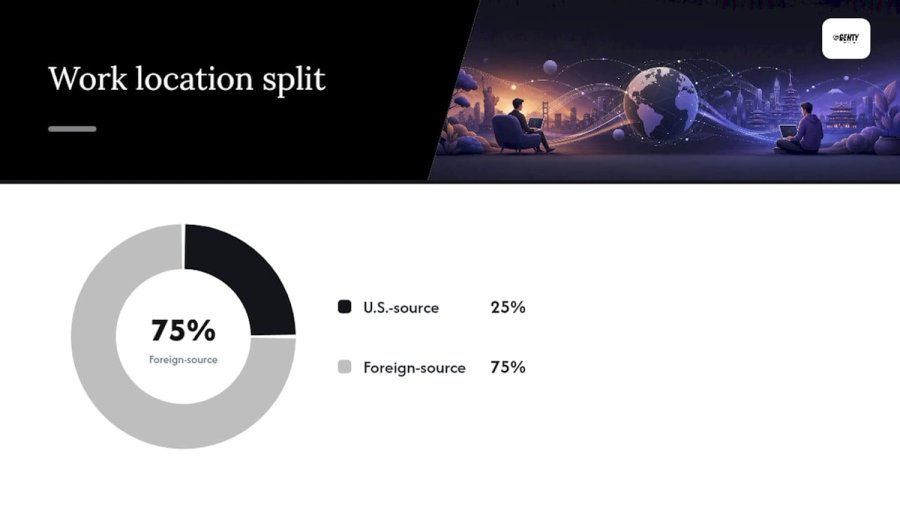
Source of income, not the contractor’s citizenship, decides whether Form 1042-S enters the picture. Compensation is U.S.-source when the services are physically performed on U.S. soil, regardless of where the contractor lives or banks. A Colombian contractor who flies to your Austin office for a two-week sprint has just created U.S.-source income for those two weeks, even if the rest of the engagement happens remotely from Bogotá.
This distinction drives real dollars:
- Foreign-source income (100% offshore work) generally stays off both 1099-NEC and Form 1042-S.
- U.S.-source income paid to a foreign person triggers Form 1042-S reporting and, absent a treaty reduction, a default 30% NRA withholding rate that you as the payer are responsible for collecting and remitting.
- A tax treaty between the contractor’s home country and the U.S. can lower or eliminate that 30% rate, but only if the contractor has submitted a properly completed W-8BEN claiming the treaty benefit.
Mixed-location engagements are the messiest case in practice. The cleanest approach is a day-count method: track exactly how many days the contractor worked physically in the U.S. versus abroad, and allocate that portion of the payment as U.S.-source. Keep timesheets, travel records, or calendar logs as backup. If a foreign contractor spends three weeks of a twelve-week project onsite in Miami, roughly a quarter of that payment likely needs 1042-S treatment, and you’ll want the documentation to defend that allocation if questioned.
Backup Withholding vs. NRA Withholding: What’s at Stake
These two withholding regimes get confused constantly, and the confusion is expensive. Backup withholding applies at 24% and generally targets U.S. persons who fail to provide a valid TIN or certify their status correctly on Form W-9. NRA withholding (chapter 3) applies at 30% by default to U.S.-source payments made to foreign persons, unless a treaty or exemption reduces it.
The liability sits with you, the payer, not the contractor. Publication 515 makes clear that the withholding agent bears responsibility for collecting the right amount before the money leaves your account. If you paid a contractor in full because their W-8BEN never arrived, and it turns out a portion of their work was U.S.-source, the IRS can pursue you for the withholding you should have collected, plus penalties and interest.
The burden of proof runs one direction: toward the company that paid, not the contractor who received. A correctly completed, unexpired W-8 on file before the first payment is the single strongest piece of evidence a withholding agent can produce during a compliance review.
Mitigate this with two habits: collect forms before any money moves, and retain dated proof of where the work was actually performed, not just where the contractor claims to live. Invoices, project management timestamps, and travel expense records all help.
The Onboarding-to-Filing Checklist for Every Contractor
Finance teams that stay clean on this run the same sequence every time, regardless of how urgent the hire feels.
Onboarding:
- Finalize contract terms specifying work location expectations.
- Collect W-8BEN, W-8BEN-E, or W-9 before the first invoice is approved.
- If a treaty claim applies, confirm the contractor’s foreign TIN is included on the form.
- Set up invoicing controls that flag any planned U.S. travel or onsite work.
Ongoing management:
- Track physical work location for every billing cycle, not just at kickoff.
- Log any U.S. days separately from offshore days.
- Monitor W-8 expiry dates against your internal calendar.
- Run a quarterly review of contractor classifications with your accounting lead.
Year-end decisions:
- Determine whether each contractor needs a 1099-NEC (U.S. person, above threshold), a Form 1042-S (foreign person, U.S.-source income), or neither (foreign person, fully offshore work).
- Reconcile any withholding collected during the year against what’s actually owed.
Deadlines and Records You Need on File
The federal calendar here is unforgiving, and the two forms run on different clocks. Form 1099-NEC must be furnished to recipients by January 31. Form 1042-S and the accompanying Form 1042 are due by March 15, a full six weeks later, which trips up teams that mentally lump all contractor reporting into one deadline. Extensions exist through Form 8809, but that request needs to go in well before the original due date.
Assign ownership clearly: one person on finance owns W-8 collection and expiry tracking, another owns the actual 1099/1042-S filing process. Splitting these across two people creates a natural check against forms slipping through unnoticed.
Hiring in LATAM Without Creating a Compliance Headache
Most of the contractors triggering these questions for U.S. tech companies right now are based in Argentina, Brazil, Mexico, and Colombia, and the good news is that the compliance mechanics don’t change based on which of those four countries you’re hiring in. What changes is the operational payoff.
Timezone overlap is the practical advantage nobody quantifies until they’ve lived without it. A developer in Bogotá or Mexico City works essentially the same hours as a team in Austin or Chicago, with only one to two hours of offset against U.S. Eastern or Central time. Compare that to hiring in Eastern Europe or South Asia, where a five-to-twelve-hour gap turns every code review into an overnight wait. Argentina and Brazil sit closer to U.S. Eastern time than most of Europe does to U.S. Pacific time.

Senior DevOps or data engineering talent in Brazil often lands similarly below U.S. market rates while still commanding strong English proficiency and remote-collaboration experience.
This is where GENTY recruitment fits into the compliance conversation directly, not just the hiring conversation. Every candidate placed through our process goes through structured onboarding that includes W-8 collection, correct invoicing setup, and documentation of work location from day one, which closes the exact gaps that create withholding exposure later.
What the Rules Actually Demand vs. What Companies Assume
Most of the confusion around 1099s and foreign contractors doesn’t come from the IRS rules being unclear. It comes from finance teams applying domestic contractor habits to international relationships without checking whether the underlying assumption still holds. The default instinct is “we paid someone for services, so we issue a 1099.” That instinct is correct for a Texas-based freelancer and wrong for a fully remote developer in Medellín who never sets foot in the U.S.
The bigger risk isn’t misfiling a form. It’s skipping the W-8 collection step entirely because a company assumes “foreign contractor, no U.S. reporting needed” and stops thinking about it. That assumption holds only until the contractor spends two weeks onsite for a product launch, or a mid-year classification review reveals they picked up a green card. Without a W-8 on file and a system tracking work location, you have no defense when that happens.
If there’s one place to prioritize effort, it’s building the habit of collecting documentation before the relationship starts generating invoices, not after a filing deadline forces the question. Everything else, the thresholds, the treaty math, the 1042-S mechanics, is manageable once that discipline exists.
— Eugene
Managed Hiring That Keeps Your LATAM Compliance Clean
Building this compliance infrastructure in-house takes real time away from actually hiring, and most growth-stage companies don’t have a dedicated tax specialist reviewing every contractor file. GENTY recruitment handles the sourcing and the onboarding groundwork together, so the W-8 collection, invoicing setup, and work-location documentation happen automatically as part of bringing a candidate on board, not as a separate scramble your finance team owns alone.
Companies working with GENTY recruitment typically see curated shortlists within seven days and cost savings up to 40% compared to hiring the same role domestically, without sacrificing the timezone overlap that makes daily standups and code reviews actually work. Our fixed-fee pricing means no upfront payment and no surprise costs stacked on top of the contractor’s own rate, and every placement comes with a three-month replacement guarantee if the fit isn’t right. If you’re planning to bring on engineering, DevOps, or sales talent from Argentina, Brazil, Mexico, or Colombia, start a recruitment search with GENTY recruitment and get the compliance groundwork handled as part of the hire, not after it.