

Hiring in Mexico is defined by a strict legal requirement: foreign companies cannot employ Mexican workers directly without either a local legal entity or an Employer of Record (EOR). This is not a gray area. The Federal Labor Law and the Mexican Social Security Institute (IMSS) impose registration deadlines, mandatory benefits, and payroll tax obligations that apply from day one. Employer costs run 30–40% above base salary when you account for IMSS, INFONAVIT, SAR contributions, profit sharing, and the annual Christmas bonus known as Aguinaldo. Founders and hiring managers who understand these obligations before posting a job description avoid the budget surprises and legal exposure that derail most first-time Mexico hires.
How to hire in Mexico: choosing the right legal structure
The two primary compliant options for recruiting in Mexico are establishing a local legal entity or working through an EOR. Each has a distinct cost profile and timeline.
Establishing a Mexican legal entity gives you full operational control. The two most common structures are the Sociedad Anónima de Capital Variable (SA de CV) and the Sociedad de Responsabilidad Limitada de Capital Variable (S de RL de CV). Entity formation costs $2,000–$15,000 and takes 4–12 weeks, depending on state requirements and notary availability. You will need a registered shareholder, a legal director, a physical address in Mexico, and registrations with the SAT (tax authority) and IMSS. This path makes sense when you plan to hire more than 20 employees long term.

An EOR lets you onboard a Mexican employee in 1–2 weeks without any entity setup. The EOR becomes the legal employer on paper, handles payroll, and manages IMSS registration on your behalf. EOR is cost-efficient for teams under 15–20 employees, but per-employee fees accumulate quickly at scale. Once your headcount crosses that threshold, running your own entity typically costs less per month.
Need help hiring?
See the next step after this guide
If this topic is relevant to your team, these are the most useful pages to check next.
Shelter companies exist primarily for manufacturing operations and are rarely relevant for tech startups. Independent contractors appear attractive but carry serious legal risk, covered in detail below.
Pro Tip: If you are testing the Mexican market with your first 2–3 hires, start with an EOR. Set a calendar reminder to evaluate entity formation once you approach 15 employees. The cost crossover is real and predictable.
What mandatory costs and benefits must employers budget for in Mexico?
Mexico’s statutory employer obligations are non-negotiable and cover every full-time employee from their first day of work.
Social security and housing contributions form the largest cost block. IMSS (social security) contributions cover healthcare, disability, and retirement. INFONAVIT contributions fund employee housing credit. SAR contributions go into individual retirement accounts. State payroll taxes vary by state but typically add 2–3% of gross payroll on top of federal obligations. Taken together, these contributions push total employer cost 30–40% above gross salary.
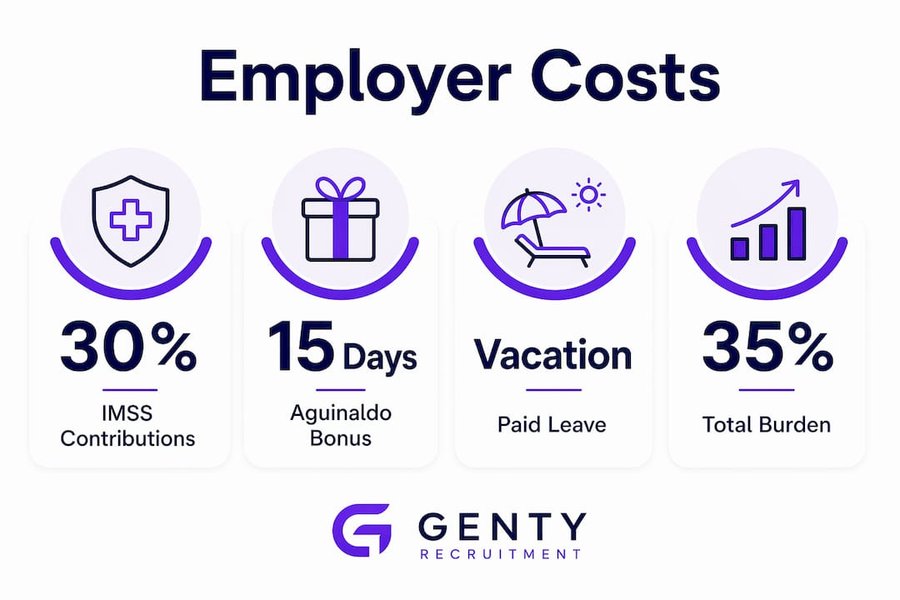
Aguinaldo is a mandatory annual Christmas bonus equal to at least 15 days of salary, paid before december 20. Missing this deadline triggers immediate legal exposure. Most tech companies pay it in full rather than risk a labor complaint.
Vacation and profit sharing add two more layers of cost. Employees earn vacation days that increase with tenure, and all vacation pay carries a 25% vacation premium on top of the base daily rate. Profit sharing, known as PTU, requires employers to distribute 10% of pre-tax profits to employees by may 30 each year. PTU is capped at three months of an employee’s salary or the average PTU paid over the last three years, whichever is higher.
Pro Tip: Build your Mexico compensation model with a 35% employer burden on top of gross salary as a conservative baseline. Use Gentyrecruitment’s salary benchmarking data for Mexico to set gross salaries that are competitive without overcommitting your payroll budget.
How to execute the hiring process compliantly in Mexico?
A compliant hiring process in Mexico follows a clear sequence. Skipping any step creates retroactive liability.
- Draft a written employment contract. Written contracts aligned with Federal Labor Law are required from day one. The contract must specify the role, salary in Mexican pesos, working hours, work location (remote or office), and applicable benefits. Undocumented agreements offer no legal protection to the employer.
- Issue a formal privacy notice before background checks. Background checks require a formal privacy notice under Mexico’s Federal Law on Protection of Personal Data. Criminal records and socioeconomic checks are permitted, but only after the candidate receives and acknowledges this notice. Skipping this step violates data protection law.
- Register the employee with IMSS within five business days. IMSS registration must occur within five business days of the employee’s start date. Late registration results in financial penalties and personal liability for the company’s legal representative in Mexico.
- Set up bi-monthly payroll aligned with SAT. Mexican payroll runs on a bi-monthly cycle by default, though weekly and bi-weekly cycles are also common. All payroll must be reported to the SAT using electronic invoicing (CFDI). Payroll errors trigger audits.
- Onboard with remote work expectations in writing. For remote roles, define equipment ownership, working hours, and communication norms in the contract or a separate remote work addendum. This protects both parties and sets clear expectations from the start.
“Clear written contracts are the single most effective tool for preventing labor disputes in Mexico. Every condition that is not written down defaults to the statutory minimum, which is always more expensive for the employer.” — Federal Labor Law principle, widely applied in Mexican labor courts.
For guidance on structuring remote job offers for LATAM talent, the contract and onboarding stage is where most compliance gaps appear.
What common mistakes should employers avoid when hiring in Mexico?
The most expensive mistakes in Mexico hiring share one trait: they all stem from underestimating how strictly the law is enforced.
- Misclassifying employees as contractors. Misclassification risks penalties up to $300,000 plus retroactive benefits and potential tax fraud charges. The legal test looks at control, exclusivity, and integration. Providing equipment, setting fixed hours, or requiring exclusivity can legally convert a contractor into an employee, triggering all statutory liabilities retroactively.
- Delaying IMSS registration. Many first-time employers assume they have a payroll cycle to register new hires. They do not. The five-business-day deadline is firm, and the company’s legal representative faces personal liability for violations.
- Under-budgeting total employer costs. Employers commonly underestimate costs by ignoring Aguinaldo and PTU when building compensation models. A $5,000 monthly gross salary becomes approximately $6,750 in total employer cost once statutory obligations are included.
- Ignoring Mexico’s four time zones. Mexico spans four time zones, from the Pacific coast to the Yucatan Peninsula. Addressing time zone differences early prevents scheduling conflicts and builds more effective remote teams. A developer in Tijuana operates on Pacific Time, while one in Cancun is on Eastern Time.
- Staying on EOR too long. EOR is the right tool for market entry. Beyond 15–20 employees, transitioning to a local entity reduces per-employee costs significantly. Founders who delay this transition pay a meaningful premium every month.
For a deeper look at vetting technical candidates during the Mexico hiring process, structured assessment frameworks reduce both bad hires and compliance risk.
Key takeaways
Hiring in Mexico requires a compliant legal structure, accurate employer cost budgeting, and strict adherence to IMSS registration and contract requirements from day one.
What I have learned from placing tech talent in Mexico
The founders who struggle most with Mexico hiring are not the ones who lack budget. They are the ones who treat compliance as an afterthought. I have seen companies onboard three engineers on contractor agreements, pay them for six months, and then face a labor audit that reclassified all three as employees. The retroactive IMSS contributions, Aguinaldo, and PTU added up to more than a year of salary per person.
The EOR model genuinely works for early-stage companies. It removes the entity setup burden and gets engineers productive in under two weeks. But I have watched startups stay on EOR past 30 employees because “it was working fine.” At that scale, the monthly fee differential versus a local entity is substantial. The transition is not painless, but it is predictable if you plan for it at the 15-employee mark.
One thing that rarely gets mentioned: Mexico’s labor courts strongly favor employees. A missing contract clause, a late Aguinaldo payment, or an undocumented remote work policy can become a formal complaint within days. The fix is not expensive legal counsel after the fact. The fix is a well-drafted contract and a payroll calendar that respects every statutory deadline. That combination, paired with a local HR partner who knows IMSS registration inside out, is what separates companies that scale in Mexico from those that stall.
— Eugene
Gentyrecruitment’s approach to tech hiring in Mexico
Tech founders who want to move fast in Mexico without building a compliance function from scratch have a direct path forward.
Gentyrecruitment places pre-vetted tech talent across Mexico and LATAM, with shortlists delivered in as few as five days. Every candidate is technically assessed, English-speaking, and ready to integrate into a distributed team. The process covers role scoping, structured vetting, and salary benchmarking so you hire at the right rate for the market. For startups scaling from a first hire to a full engineering team, Gentyrecruitment’s Mexico hiring service supports both EOR-based onboarding and entity-ready placements, depending on where you are in your growth stage.
FAQ
What is the fastest legal way to hire in Mexico?
An Employer of Record is the fastest compliant option, enabling onboarding in 1–2 weeks without requiring a local legal entity.
How much does it cost to employ someone in Mexico?
Total employer cost runs 30–40% above gross salary when statutory obligations including IMSS, INFONAVIT, Aguinaldo, and PTU are included.
Can I hire Mexican workers as independent contractors?
Contractor arrangements are legally risky. Misclassification can trigger penalties up to $300,000 plus retroactive benefits and tax fraud charges if the worker meets employee criteria.
When must I register a new employee with IMSS?
Mexican law requires IMSS registration within five business days of the employee’s start date. Late registration results in financial penalties and personal liability for the company’s legal representative.
When should I switch from an EOR to a local entity in Mexico?
The cost crossover typically occurs between 15 and 20 employees. At that point, maintaining a local entity is more economical than paying per-employee EOR fees.