

Candidate shortlisting is defined as the recruitment stage that narrows a full applicant pool down to a focused group of qualified individuals ready for interview consideration. It sits between initial screening and interview scheduling, and it is the step where quality control separates recruiters who hire well from those who waste panel time. For tech teams hiring across Latin America, including Argentina, Brazil, Mexico, and Colombia, shortlisting also factors in timezone overlap with US EST and PST, English proficiency, and local salary benchmarks. 64% of job seekers report confusion from unclear job expectations, which means weak shortlisting criteria hurt both sides of the hiring equation. Getting this stage right is not optional. It is the foundation of every efficient, defensible hire.
What is candidate shortlisting, and how does it differ from screening?
Candidate shortlisting and candidate screening are two distinct stages, and conflating them is one of the most common mistakes recruitment teams make. Screening is the first pass: it checks whether an applicant meets basic qualifications such as a valid work authorization, a required degree, or a minimum number of years of experience. Shortlisting comes next. It is the quality control step that evaluates screened candidates against a richer set of criteria to determine who is genuinely worth interviewing.
Keeping these stages separate prevents premature rejection and protects interview time from being wasted on candidates who looked acceptable on paper but were never truly competitive. The table below shows how the two stages differ in practice.
For LATAM roles specifically, screening might confirm that a candidate in Mexico City holds the required AWS certification. Shortlisting then evaluates whether that candidate’s English proficiency, timezone (Central Time, which overlaps well with US EST and PST), and salary expectations align with the role’s actual demands.
Before you start hiring
Check location, salary, and hiring fit
If you are moving from research to action, start with the market basics so your hiring plan is clearer.
What are the essential and desirable criteria for shortlisting applicants?
Every shortlist starts with two categories of criteria: essential and desirable. Essential criteria are non-negotiable. A candidate who does not meet them does not advance, regardless of other strengths. Desirable criteria improve a candidate’s ranking but do not disqualify anyone on their own.
Essential criteria for a typical LATAM tech role include:
- Legal right to work in the candidate’s country of residence
- Minimum years of hands-on experience with the required stack (e.g., Python, Node.js, or Solidity for Web3 roles)
- Required certifications (e.g., AWS Certified Solutions Architect, Google Cloud Professional)
- English proficiency at a level sufficient for daily collaboration with US or European teams
- Timezone overlap of at least 4 hours with US EST or PST
Desirable criteria that strengthen a shortlist include:
- Experience in a specific industry vertical such as FinTech, SaaS, or AI
- Prior remote work experience with distributed teams
- Familiarity with agile workflows and async communication tools
- A portfolio of shipped products or open-source contributions
- Salary expectations within the budgeted range for the seniority level
Documenting both categories before reviewing a single resume is the single most effective way to prevent criteria drift, where the bar shifts unconsciously as you read more applications. Clear shortlisting criteria also give every reviewer on the team a shared reference point, which matters when multiple hiring managers are involved.
Pro Tip: Build your criteria list as a shared document before the job goes live. Revisiting it mid-process to add new requirements is a sign that the job description needs revision, not that the criteria should change.

How can recruiters reduce bias with objective shortlisting workflows?
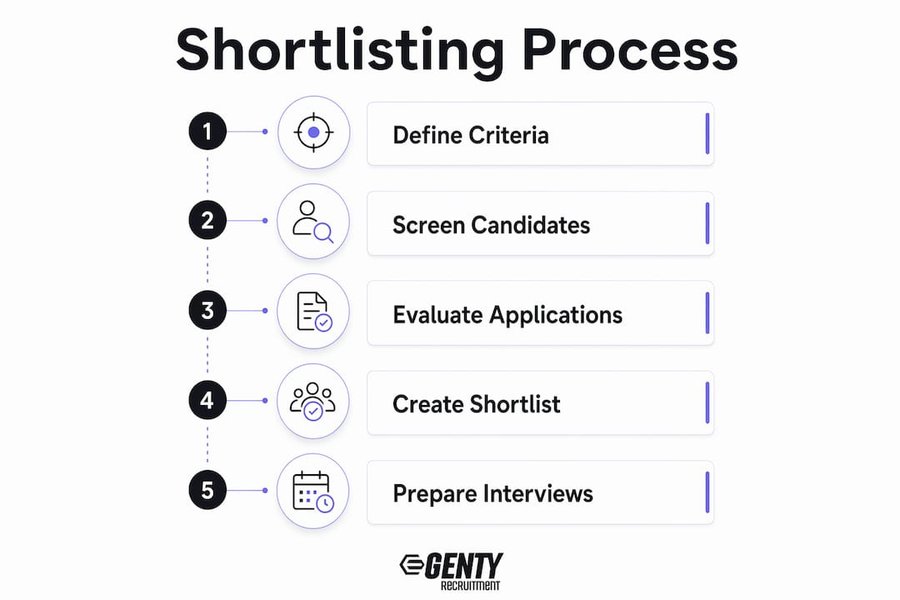
Bias in shortlisting is not always intentional. It often enters through familiarity (preferring candidates from recognizable universities), affinity (favoring candidates with similar career paths), or recency (rating the last resume read more favorably than the first). Structured workflows counter all three.
A bias-reducing shortlisting process follows these steps:
- Define criteria before reviewing applications. Lock in essential and desirable criteria in writing. Any reviewer who sees the criteria after reading resumes has already been influenced.
- Apply blind screening on the first pass. Remove names, photos, and university names from resumes before scoring. This is especially relevant when hiring across Argentina, Brazil, and Colombia, where name recognition can introduce regional bias.
- Score every candidate on a standardized scorecard. Assign numeric values to each criterion. A candidate who scores 4/5 on technical skills and 3/5 on English proficiency produces a comparable, auditable record.
- Document the rationale for every decision. Record why each candidate advances or is rejected. Documenting shortlisting decisions protects organizations from legal risk and supports consistent hiring across multiple roles and hiring managers.
- Have a second reviewer check borderline cases. Any candidate within 10% of the cutoff score should be reviewed by a second person before rejection.
Standardized scorecards significantly reduce subjective hiring bias. That reduction matters most when you are comparing candidates across different countries, where cultural differences in resume presentation can otherwise skew first impressions.
Pro Tip: Store completed scorecards in your ATS or a shared folder tied to the job requisition. If a rejected candidate ever requests feedback or files a complaint, you have a clear, documented record of the decision.
For teams building out their candidate assessment process, pairing scorecards with structured technical assessments produces the most defensible shortlists.
What are the best practices for separating shortlisting from other recruitment stages?
The most common shortlisting mistake is treating it as an extension of screening rather than a distinct, deliberate stage. When recruiters move directly from resume filtering to interview invitations, they skip the quality control layer entirely. The result is interview panels that waste time on candidates who were never truly competitive, and hiring managers who lose confidence in the recruitment process.
Shortlisting should always follow screening and always precede interviews. The sequencing is not arbitrary. Screening removes candidates who fail basic qualifications. Shortlisting then evaluates the remaining pool against the full set of criteria, ranks candidates, and produces a curated list. Interviews then focus exclusively on candidates who have already cleared both gates.
For LATAM hiring, this staged approach also manages volume. A well-written job post targeting software engineers in Brazil or Argentina can attract hundreds of applications within the first week. Without a formal shortlisting stage, hiring managers end up interviewing 20 candidates when 6 would have been sufficient. That wastes engineering time, which is the most expensive resource in any tech company.
The shortlisting stage also acts as a diagnostic for the recruitment funnel. If the shortlist consistently comes up short, the problem is usually upstream: the job description is attracting the wrong applicants, or the sourcing channels are not reaching the right talent pools. Treating shortlisting as a feedback mechanism, not just a filter, gives recruitment teams the data they need to fix the root cause.
How does a strong shortlist improve hiring outcomes for LATAM roles?
A well-built shortlist does more than save interview time. It changes the quality of every conversation that follows. When every candidate on the list has cleared a documented set of criteria, interviewers can focus on depth rather than qualification checks. Panel discussions shift from “does this person meet the bar?” to “which of these strong candidates fits the team best?”
A varied shortlist with balanced strengths and weaknesses among candidates leads to better final hiring decisions. Seeking only “perfect” candidates narrows the pool artificially and often introduces its own form of bias. A shortlist that includes a candidate with deep FinTech domain knowledge alongside one with stronger DevOps experience gives the hiring panel a richer decision to make.
The downstream benefits of strong shortlisting for LATAM roles include:
- Faster interview scheduling. A curated list of 5–8 candidates is easier to coordinate across US and LATAM timezones than an unfiltered list of 25.
- Better salary alignment. Candidates who clear the salary criteria stage arrive at interviews with realistic expectations, reducing offer rejection rates.
- Stronger diversity outcomes. Maintaining diversity in a shortlist helps organizations evaluate a range of perspectives and experiences, leading to better hiring outcomes.
- Recruitment diagnostics. If candidates frequently fail shortlisting, it signals issues with job adverts or sourcing strategies, giving teams a clear signal to revise before the next role opens.
GENTY recruitment’s LATAM tech hiring process applies these principles directly, delivering curated shortlists within 7 days for roles in FinTech, AI, SaaS, and Web3. Clients hiring from Argentina, Brazil, Mexico, or Colombia benefit from nearshore timezone alignment and salary ranges that run up to 40% below equivalent US or European hires, without sacrificing technical depth.
Key Takeaways
Effective candidate shortlisting is a documented, criteria-driven quality control stage that sits between screening and interviews, and it is the single most reliable predictor of interview quality and hiring speed.
Why structured shortlisting changed how I think about LATAM hiring
The first time I ran a shortlisting process for a distributed engineering team hiring across Colombia and Argentina, I made the classic mistake: I conflated screening with shortlisting and handed the hiring manager a list of 18 “qualified” candidates. He interviewed six, made no offer, and came back frustrated. The problem was not the candidates. The problem was that I had never defined what “qualified” actually meant beyond the resume checklist.
What changed everything was building the criteria document before the job went live, not after. Once the team agreed on essential versus desirable criteria in writing, the shortlist shrank to seven candidates, all of whom the hiring manager genuinely wanted to meet. Two received offers. One accepted within a week.
The LATAM context adds a layer that most shortlisting guides ignore: you are often comparing candidates across three or four countries simultaneously, each with different salary norms, English proficiency levels, and timezone positions. A developer in Buenos Aires and one in Bogotá may have identical technical scores but very different salary expectations and working hours. Your scorecard needs to account for that explicitly, or you will make the comparison in your head, which is where bias lives.
The other thing I have learned is that documentation is not bureaucracy. It is the thing that lets you defend a decision six months later when a rejected candidate asks why, or when a hiring manager wants to reopen a role and asks what went wrong the first time. The shortlisting rationale is your institutional memory. Treat it that way.
— Eugene
How GENTY recruitment builds shortlists that actually hold up
Recruitment teams that want to apply these principles without building the infrastructure from scratch have a direct path forward.
GENTY recruitment specializes in IT recruitment across LATAM, covering Argentina, Brazil, Mexico, Colombia, and Chile for roles in FinTech, AI, SaaS, Web3, and DevOps. The process applies structured criteria scoring and blind screening at every stage, delivering pre-vetted shortlists within 7 days. Fixed-fee pricing by seniority level, no upfront payments, and a 3-month replacement guarantee make the model straightforward for US and European tech companies. Teams that want to see how the remote tech hiring process works in practice can reach out directly to discuss their next role.
FAQ
What is candidate shortlisting in recruitment?
Candidate shortlisting is the stage between initial screening and interview scheduling where applicants are evaluated against defined essential and desirable criteria. It produces a curated list of candidates who are genuinely ready for deeper evaluation.
How many candidates should be on a shortlist?
Most recruitment best practices recommend 5–8 candidates for a standard role. A list smaller than 5 limits the hiring panel’s options, while a list larger than 10 defeats the purpose of the shortlisting stage.
What criteria should I use when shortlisting applicants?
Essential criteria include legal work authorization, required certifications, minimum experience, and language proficiency. Desirable criteria include industry experience, remote work history, and salary alignment with the budgeted range.
How does shortlisting reduce hiring bias?
Blind screening combined with standardized scorecards removes identifying information and replaces subjective impressions with numeric scores, making the process consistent and auditable across all reviewers.
Why does shortlisting matter for LATAM tech hiring?
LATAM hiring involves comparing candidates across multiple countries with different salary norms and timezone positions. A structured shortlisting process with documented criteria ensures those variables are evaluated consistently rather than left to individual judgment.