

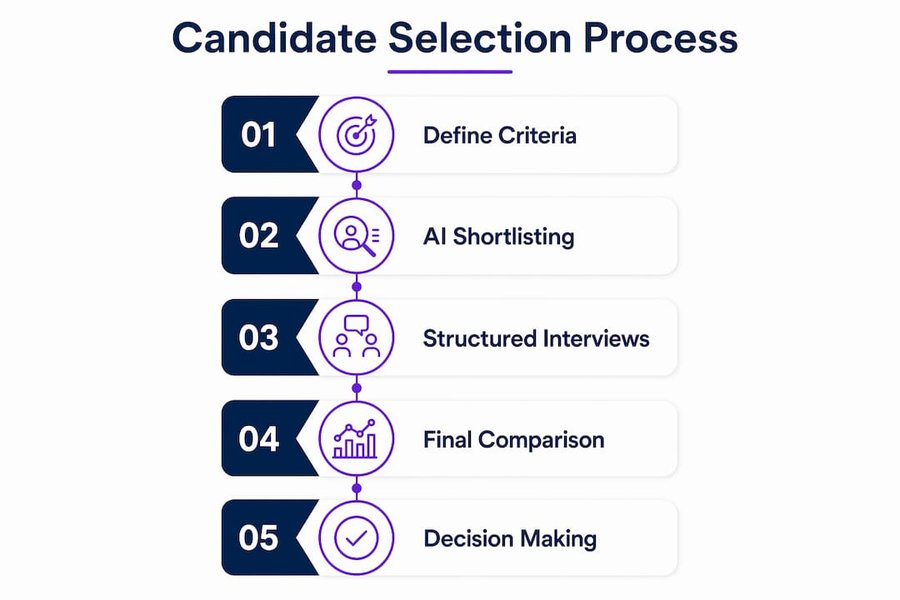
The process to pick top candidates is a structured, multi-phase method combining precise role definition, AI-powered shortlisting, and rubric-based evaluation to identify the best fit for your remote tech roles. Most hiring managers treat candidate selection as a linear checklist, but the most effective teams in FinTech, SaaS, and AI startups treat it as a calibrated system where each phase feeds the next. Tools like Skima AI and Metaview have changed how early screening works, but the underlying logic remains the same: define what success looks like before you evaluate anyone. This guide walks you through every critical stage of the candidate selection process, from intake to final offer decision.
What does the process to pick top candidates actually involve?
The candidate selection process is defined as a sequence of structured phases: intake and criteria definition, AI-assisted shortlisting, structured interviewing, and data-driven comparison. Each phase has a distinct purpose, and skipping any one of them creates gaps that surface later as bad hires or wasted interview cycles. 93% of Talent Acquisition professionals believe accurately assessing candidate skills is critical, yet only 25% feel confident measuring quality of hire. That gap exists because most teams lack a repeatable system, not because they lack effort.
The distinction between a good candidate and an aligned candidate is the core insight that separates high-performing hiring teams from average ones. Alignment means the candidate’s demonstrated competencies match the specific success outcomes of the role, not just a generic job description. A senior backend engineer who thrives in monolithic architectures may be technically excellent but misaligned for a startup migrating to microservices. Recognizing that distinction early saves weeks of interviewing the wrong people.

For remote tech roles specifically, the stakes are higher. You cannot rely on office proximity to course-correct a misaligned hire, and the cost of replacing a remote engineer in Latin America or Eastern Europe includes not just recruiting fees but onboarding time, knowledge transfer, and team disruption. Getting the process right upfront is the only reliable way to avoid that cost.
What do you need?
Choose the hiring path that fits
After reading "Process to Pick Top Candidates for Remote Tech Roles", most teams compare these options before deciding how to hire.
How to define clear job criteria before sourcing begins
The intake meeting is not a job description briefing. It is a rubric-definition session that shapes every downstream evaluation decision. The hiring manager and recruiter must co-create a competency-anchored rubric that specifies what success looks like at 30, 60, and 90 days, not just what the candidate should know on day one.
Shifting from generic qualifications to success outcomes changes the entire sourcing brief. Instead of “5 years of Python experience,” the rubric reads “has independently shipped a data pipeline serving over 1 million records within a 6-month delivery cycle.” That specificity makes screening faster, fairer, and more predictive. Defining success outcomes at intake creates sharper candidate rubrics and correlates directly with assessment stability throughout the process.
One of the most common mistakes in early-stage startups is overfiltering. Teams add requirements because they sound good, not because they are genuinely necessary. Overfiltering by non-essential criteria leads directly to overlooking top talent. The fix is to separate true non-negotiables from nice-to-haves before the job description is written, not after the pipeline is already thin.
Here is a practical framework for criteria calibration during intake:
- Must-haves: Technical skills or certifications without which the candidate cannot perform the core function (e.g., proficiency in TypeScript for a frontend role requiring a specific framework)
- Strong preferences: Competencies that accelerate ramp-up but can be developed on the job (e.g., prior experience with Jira or Notion in a remote-first environment)
- Disqualifiers: Behaviors or gaps that signal misalignment with the team’s working style or delivery expectations
- Success profile: A written description of what the ideal candidate will have accomplished by month 3 and month 6
Pro Tip: Record the intake meeting using a tool like Metaview or Otter.ai. Transcripts let you revisit the original rubric when disagreements arise during final selection, preventing criteria drift.
How does AI shortlisting improve candidate screening?
AI resume parsing and ranking tools, particularly those that integrate directly with applicant tracking systems, have compressed early-stage screening from days to hours. Skima AI, for example, generates match scores based on skills, certifications, role fit, and evidence-based qualifications rather than keyword density alone. That distinction matters because keyword-heavy resumes from average candidates often outscore sparse resumes from exceptional engineers who simply write differently.
Efficient shortlisting narrows the candidate pool to between 3 and 10 candidates per role. That range is deliberate. Fewer than 3 creates a false sense of scarcity and pressure to hire someone who is merely acceptable. More than 10 dilutes interviewer attention and slows the process to the point where top candidates accept competing offers. AI tools make hitting that target range repeatable rather than dependent on a recruiter’s intuition on any given day.
Speed of outreach is a critical variable that AI shortlisting enables. Reaching high-potential candidates within 48 hours of their application significantly improves response rates and conversion. In competitive remote markets, the best engineers in Argentina, Brazil, and Colombia are often in multiple processes simultaneously. A 72-hour delay in outreach is frequently enough to lose them to a faster-moving competitor.
Balancing automation with human judgment is non-negotiable. AI tools surface candidates efficiently, but they do not evaluate motivation, communication quality, or the nuanced judgment calls that determine whether someone will thrive in a remote-first, high-autonomy environment. The hands-on recruiting approach that combines AI shortlisting with recruiter-led screening consistently outperforms fully automated pipelines on quality-of-hire metrics.
Pro Tip: Set a minimum AI match score threshold for automatic advancement, but always have a recruiter manually review the top 5 candidates regardless of score. Scores reflect pattern matching; recruiters catch the outliers that patterns miss.
How to conduct structured interviews that reduce bias
Structured, rubric-based interviews are the single most reliable candidate assessment method available to hiring teams. The mechanism is straightforward: every candidate receives the same competency-based questions in the same order, and interviewers score responses against pre-defined criteria immediately after each answer. Performing scoring in real time during the interview reduces recall biases that accumulate when evaluators wait until after the conversation to write notes.
The practical steps for running a structured interview process are:
- Write 4 to 6 competency-based questions tied directly to the intake rubric. Each question should target a specific competency (e.g., “Describe a time you diagnosed a production incident with incomplete data” targets debugging under ambiguity).
- Define scoring anchors for each question. A score of 1 means the candidate described a situation without demonstrating the competency. A score of 3 means they demonstrated it with clear outcomes. A score of 5 means they demonstrated it, reflected on what they would do differently, and showed transferable learning.
- Assign independent reviewers. Use at least two interviewers per candidate, and require them to submit scores before comparing notes. Multiple independent reviewers who compare notes only after scoring independently minimize halo bias and recency effects.
- Incorporate a technical test or case study aligned to a core competency. For a SaaS backend role, this might be a 45-minute live coding session in a shared environment like CoderPad, focused on a realistic problem the team has actually solved.
- Eliminate pet questions. Questions like “What animal would you be?” or “Where do you see yourself in 5 years?” produce no signal relevant to job performance. Structured interviews with consistent scoring are critical for fairness precisely because they remove the subjective noise that pet questions introduce.
Pro Tip: Use AI call coaching tools like OffBook to train interviewers on scoring consistency before they enter live interviews. Calibrated interviewers produce more reliable data, which makes final selection decisions faster and more defensible.
How to compare finalists and make the final hiring decision
Comparing finalists is where most hiring teams reintroduce the subjectivity they worked to eliminate during screening. The most common error is framing the decision as “Candidate A vs. Candidate B” rather than “Candidate A vs. the rubric” and “Candidate B vs. the rubric.” Comparing candidates against a pre-agreed rubric rather than against each other prevents the framing bias that inflates the perceived strengths of whoever interviewed most recently.
The aligned vs. misaligned framing is more predictive of long-term retention than good vs. bad screening. A candidate who scores 4.2 on your rubric but has a known gap in async communication is a different risk profile than a candidate who scores 3.8 across all competencies. Understanding the nature of the gap, not just its size, determines whether it is an acceptable trade-off for your specific team context.
Practical tools for final comparison include:
- Scorecard summaries: A single-page document per candidate showing rubric scores, interviewer notes, and a written strengths-and-risks summary
- Trade-off mapping: A structured discussion where the hiring team explicitly names what they are accepting and what they are not, for each finalist
- Tie-breaking criteria: Pre-agreed in advance during intake, such as prioritizing async communication skills over synchronous availability for fully distributed teams
For remote tech hiring, one additional criterion deserves weight: demonstrated experience working across time zones with minimal supervision. This is not a soft skill. It is a functional competency that predicts whether a remote hire will integrate successfully into a distributed team without requiring constant management overhead.
Key takeaways
A structured, rubric-anchored candidate selection process is the most reliable method for hiring managers to identify aligned remote tech talent quickly and with minimal bias.
What I’ve learned about candidate selection in fast-moving startups
The most expensive mistake I see hiring managers make is treating the intake meeting as a formality. They walk in with a job description already written, spend 20 minutes confirming it with the recruiter, and then wonder six weeks later why the finalist pool feels wrong. The intake call is where the entire process either gets calibrated or gets corrupted. Every hour invested there saves three hours of interviewing misaligned candidates.
The second pattern I see consistently is over-reliance on AI scores without understanding what those scores actually measure. AI ranking tools are excellent at identifying candidates who match a defined pattern. They are poor at identifying candidates who break the pattern in ways that matter, the engineer who has never worked at a funded startup but has shipped a product used by 500,000 people independently. Those candidates require a recruiter with judgment, not an algorithm with a threshold.
Speed and thoroughness are not opposites in remote hiring. The tech hiring process for startups that moves fastest is almost always the one that invested the most time upfront in calibration. When the rubric is clear, shortlisting takes hours instead of days, interviews produce clean data, and final decisions happen in one meeting instead of three. The bottleneck is almost never the process itself. It is the lack of alignment at the start.
Candidate experience also deserves more attention than most startup hiring managers give it. In competitive remote markets, how you treat candidates during the process signals how you treat employees after the offer. Slow feedback, inconsistent communication, and disorganized interview scheduling are visible to candidates, and the best ones notice. The talent vetting process that respects candidate time consistently attracts stronger applicants than one that does not.
— Eugene
How Gentyrecruitment helps you hire top remote tech talent faster
Gentyrecruitment specializes in placing pre-vetted, English-speaking tech professionals from Latin America, including Argentina, Brazil, Mexico, and Colombia, into remote roles at US and European tech startups. Every candidate goes through structured competency assessment before reaching your interview stage, which means you spend time evaluating finalists, not filtering noise.
If your team is hiring for FinTech, AI, or SaaS roles and needs to move faster without sacrificing quality, Gentyrecruitment’s IT recruitment for tech startups delivers shortlists of qualified candidates up to five times faster than traditional recruiting timelines. You can also explore pre-vetted LATAM tech talent options tailored to your specific role requirements. Contact Gentyrecruitment to discuss your next hire.
FAQ
What is the first step in the candidate selection process?
The first step is the intake meeting, where the hiring manager and recruiter co-create a competency-anchored rubric that defines success outcomes for the role. This session determines the criteria used for every subsequent screening and evaluation decision.
How many candidates should be shortlisted per role?
Efficient shortlisting targets between 3 and 10 candidates per role. This range balances thorough evaluation with recruitment speed and prevents interviewer fatigue from diluting assessment quality.
How do structured interviews reduce hiring bias?
Structured interviews reduce bias by asking every candidate the same competency-based questions in the same order and scoring responses immediately against pre-defined criteria. Using multiple independent reviewers who compare notes only after scoring separately further minimizes halo and recency effects.
How quickly should you contact top candidates after shortlisting?
Outreach to high-potential candidates within 48 hours of identification significantly improves response rates. In competitive remote markets, delays beyond 72 hours frequently result in losing top candidates to faster-moving employers.
What is the difference between a good candidate and an aligned candidate?
A good candidate demonstrates strong general competencies, while an aligned candidate’s specific skills and work style match the success outcomes defined for the role. Hiring for alignment rather than general quality produces better long-term retention and faster ramp-up in remote tech teams.