

Hiring costs are defined as the total expenses a company incurs to fill an open role, including sourcing fees, recruiter time, job board spend, and interview overhead. For tech startups, these costs compound fast. A bloated process with unclear requirements, excessive interview rounds, and fragmented tools can turn a single engineering hire into a months-long budget drain. Knowing how to reduce hiring costs starts with identifying exactly where your process leaks money, then applying targeted fixes through AI automation, process compression, and smarter agency management.
How to reduce hiring costs: where your process is losing money
Most hiring inefficiencies stem from unclear role requirements, not technology gaps. Before you invest in any new tool, audit your current workflow to find where time and money actually disappear.
The most common cost drivers in tech startup recruiting are:
- Manual sourcing and screening. Recruiters spend hours reviewing resumes that could be filtered automatically. This is the single largest time sink in most hiring pipelines.
- Too many interview rounds. Each additional stage beyond three reduces offer acceptance rates by 11 percentage points and adds 4–7 days to time-to-fill. That math compounds across every open role.
- Fragmented systems. When your ATS, calendar, and feedback tools don’t connect, coordinators spend hours on manual follow-up. This creates delays that cost you candidates.
- Overinflated job requirements. Demanding five years of experience in a two-year-old framework is a real pattern. It shrinks your candidate pool and extends your search unnecessarily.
- No feedback SLA. Without a defined turnaround time for interview feedback, decisions stall and candidates accept other offers.
Map each stage of your current process and assign a time estimate. You will quickly see which steps add evaluation value and which add only delay.
Before you start hiring
Check location, salary, and hiring fit
If you are moving from research to action, start with the market basics so your hiring plan is clearer.
Pro Tip: Run a simple audit: pull your last 10 hires and record the number of interview stages, days between stages, and offer acceptance rate. The pattern will tell you exactly where to cut.
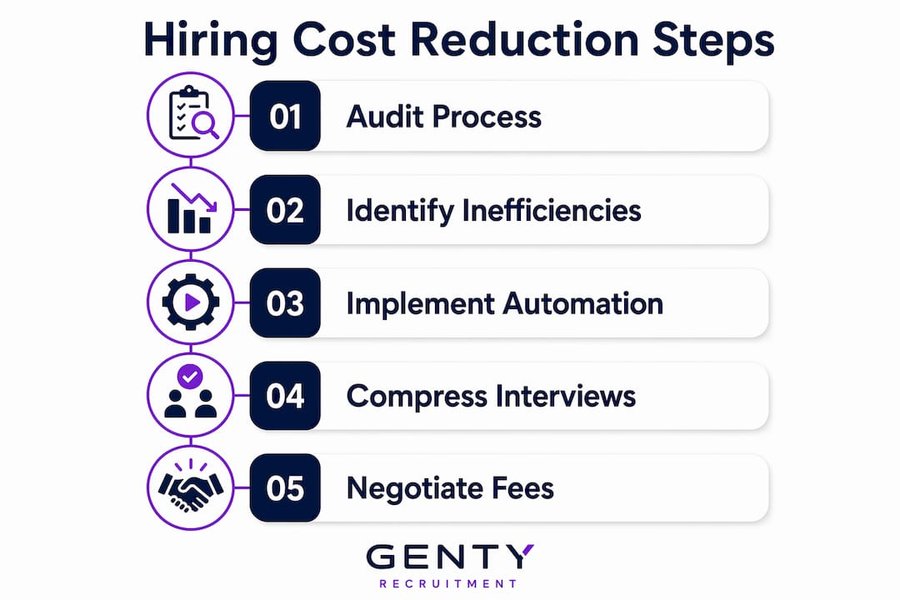
How can AI and automation reduce hiring costs effectively?
Automation is the fastest path to cutting recruitment expenses without reducing quality. The key is knowing which stages to automate and which require human judgment.

AI-powered resume screening cuts manual review time by 70–80%, which translates to a 30–50% reduction in cost per hire. That means a recruiter who previously spent three days reviewing 200 applications can now focus on the top 20 candidates surfaced in minutes.
The four stages that benefit most from automation are:
- Sourcing. AI tools scan LinkedIn, GitHub, and job boards to identify candidates who match your technical criteria. This replaces hours of manual Boolean searching.
- Resume screening. Automated ranking scores candidates against your defined criteria before a human reviews a single profile.
- Interview scheduling. Automated scheduling tools eliminate the back-and-forth email chains that add 2–4 days per interview stage.
- Feedback collection. Structured digital scorecards sent automatically after each interview reduce the time coordinators spend chasing evaluators.
A fully automated hiring process reduces time-to-fill by 40–60% and cuts administrative workload by 70%. That is not a marginal gain. For a startup running 10 concurrent searches, that difference is measured in months and tens of thousands of dollars.
One critical point: AI screening requires a calibration phase. Rejected candidates should be manually reviewed during the first 4–6 weeks to fine-tune your criteria and avoid filtering out high-potential applicants. Skipping this step is the most common mistake teams make when adopting AI tools.
Pro Tip: Before deploying any AI screening tool, define your must-have criteria versus nice-to-have criteria in writing. The AI will only be as accurate as the inputs you give it.
For a deeper look at how automation applies to fast growth hiring, the patterns are consistent across FinTech, SaaS, and AI companies.
What are the best ways to compress your interview process?
Compressing your interview process is one of the most direct ways to cut hiring expenses. Fewer stages mean lower recruiter hours, less candidate drop-off, and faster decisions.
The practical steps that work are:
- Cap stages at three. A technical screen, a skills assessment, and a final panel cover everything you need for most engineering and product roles. Adding a fourth or fifth stage rarely surfaces new information.
- Use structured scorecards. Every interviewer should evaluate the same competencies using the same scale. This removes subjectivity and speeds up debrief meetings from 45 minutes to 10.
- Enforce a 24-hour feedback SLA. A 24-hour feedback turnaround prevents candidate ghosting and eliminates the costly cycle of re-sourcing candidates who accepted other offers while waiting.
- Parallelize where possible. Reference checks and compensation approvals do not need to happen after the final interview. Start them earlier in the process.
- Combine assessments. A take-home technical task can replace both a phone screen and a first-round technical interview when designed well.
Streamlining hiring is about removing process friction, not cutting evaluation quality. The goal is to make decisions faster, not to make worse decisions faster. Standardizing your interviewer training is what makes that distinction real. When every interviewer knows what they are evaluating and how to score it, debrief conversations become short and decisive.
How to use internal mobility and agency renegotiation to cut staffing costs
External hiring is always more expensive than promoting or redeploying someone already on your team. Most startups underuse their internal talent pool because they have no formal process to surface it.
The steps to build one are straightforward:
- Create a skills inventory. Document the technical and functional skills of every current employee. A simple spreadsheet works at early stages. This becomes your first sourcing channel for every new role.
- Set an internal-only posting window. A 14-day internal posting window gives current employees first access to open roles. This reduces external spend and improves retention simultaneously.
- Train managers to assess internal candidates fairly. Without structured evaluation criteria, internal candidates are often passed over due to familiarity bias rather than capability gaps.
- Audit your agency spend by placement. Pull data on which agencies filled roles, at what fee, and with what retention rate. Most companies are paying similar fees to agencies with very different performance records.
- Create performance tiers. Shift volume toward your top-performing agencies. Using placement data to renegotiate can reduce commission rates by 3–5%. On a $120,000 salary placement, that is real money.
Skills-based hiring also expands your talent pool and reduces reliance on expensive agencies. When you define roles by what candidates need to do rather than where they went to school or which company they worked for, you find qualified people faster and at lower cost.
Pro Tip: When renegotiating agency fees, bring your placement data to the conversation. Agencies respond to volume commitments and retention data. Vague requests for discounts rarely work.
Key takeaways
Reducing recruitment costs requires fixing process inefficiencies first, then applying automation and smarter sourcing to the cleaner workflow.
The uncomfortable truth about cutting hiring costs
The most common mistake I see tech startups make is treating cost reduction as a procurement problem. They focus on negotiating lower agency fees or switching to a cheaper ATS, while ignoring the fact that their job descriptions require skills that do not exist in a single candidate.
Overinflated requirements are the real budget killer. A role that demands a senior full-stack engineer with deep machine learning experience, five years of FinTech domain knowledge, and startup experience at a Series A company is not a real job. It is a wish list. Every week that role sits open costs money in recruiter time, lost productivity, and delayed product work.
The fix is not faster sourcing. The fix is a 30-minute conversation between the hiring manager and the recruiter to separate must-haves from nice-to-haves before the role goes live. IBM’s research on hiring efficiency with AI makes this point clearly: clarity of requirements precedes efficient funnel management.
I also want to push back on the obsession with time-to-fill as the primary metric. A role filled in 14 days with a candidate who leaves in 90 days costs far more than a role filled in 30 days with someone who stays for three years. Track quality-of-hire alongside speed. The two are not in conflict when your process is well-designed.
Automation tools like AI screening and automated scheduling are genuinely powerful. But they amplify whatever process you feed them. A well-defined role with clear criteria will produce excellent AI-screened shortlists. A vague role with contradictory requirements will produce noise, faster.
— Eugene
How Gentyrecruitment helps tech startups hire faster and spend less
Tech startups working with Gentyrecruitment get access to pre-vetted, English-speaking talent from Latin America, covering FinTech, AI, SaaS, and Web3 roles. The process combines AI-assisted screening, structured assessments, and hands-on recruiting to deliver qualified candidates faster than traditional agency timelines.
For startups looking to cut external hiring costs without sacrificing candidate quality, Gentyrecruitment’s IT recruitment services cover engineering, product, and technical leadership roles across Argentina, Brazil, Mexico, and Colombia. Teams that need remote LATAM talent quickly can also access salary benchmarking and executive search services in the same engagement. Contact Gentyrecruitment to discuss your current hiring pipeline and get a cost estimate.
FAQ
What is the fastest way to reduce cost per hire?
Compressing your interview process to three stages or fewer and automating resume screening are the two fastest levers. AI screening alone reduces manual review time by 70–80%.
How many interview rounds is too many?
Three rounds covers most roles effectively. Each round beyond three reduces offer acceptance rates by 11 percentage points and adds 4–7 days to your time-to-fill.
Does AI recruitment automation work for small teams?
Yes. Automated scheduling and AI screening tools reduce administrative workload by 70%, which is especially valuable for small recruiting teams managing multiple open roles simultaneously.
How do I renegotiate agency recruitment fees?
Pull placement data by agency, including fill rate and retention, then use that data to shift volume toward top performers. Placement data gives you leverage to negotiate commission reductions of 3–5%.
What is internal mobility and how does it reduce hiring costs?
Internal mobility means filling open roles with existing employees before recruiting externally. A structured internal posting window of 14 days surfaces internal candidates first and avoids unnecessary external recruitment spend.