

Global outsourcing places each function where cost, talent, and time zone fit best. For US tech leaders, that means using LATAM for synchronous engineering and nearshore support while blending other hubs for scale. The Deloitte 2024 Global Outsourcing Survey shows that Many organizations now operate on outcome-based contracts, and a significant number use outsourced services for front-office functions such as sales and R&D — a signal that the old “lift and shift” model is finished.
Three actions you can take in the next 30 days:
- Pilot function: Move a DevOps or QA pod to Argentina or Mexico. Both markets offer strong English proficiency, direct EST/PST overlap, and mid-market salary bands ($2,500–$5,500/month for senior engineers) that are 35–40% below US equivalents.
- Governance checkpoint: Assign a vendor owner internally before you sign anything. The single most common failure point is a contract without a named internal counterpart.
- Budget ballpark: Plan for total cost of ownership (TCO) that is 1.3–1.5x the base salary line. Transition costs, management overhead, and attrition remediation add up fast.
What trends are reshaping global outsourcing in 2024–2026?
67% of organizations have adopted outcome-based outsourcing contracts as of 2026, and 50% now use outsourced services for front-office functions including sales, marketing, and R&D — Deloitte 2024 Global Outsourcing Survey.
Three trends are changing how tech companies buy and govern outsourcing services right now.
Outcome-based contracts are replacing headcount models. When you pay per FTE, the vendor’s incentive is to keep seats filled. When you pay per outcome — tickets resolved, features shipped, revenue influenced — the incentive aligns with yours. This shift requires tighter KPIs and joint value roadmaps, but it also gives you a cleaner basis for renegotiation or exit.
Planning a hire?
Talk through the best hiring option
This article usually leads to one practical question: should you use rpo or it recruitment? We can help you choose quickly.
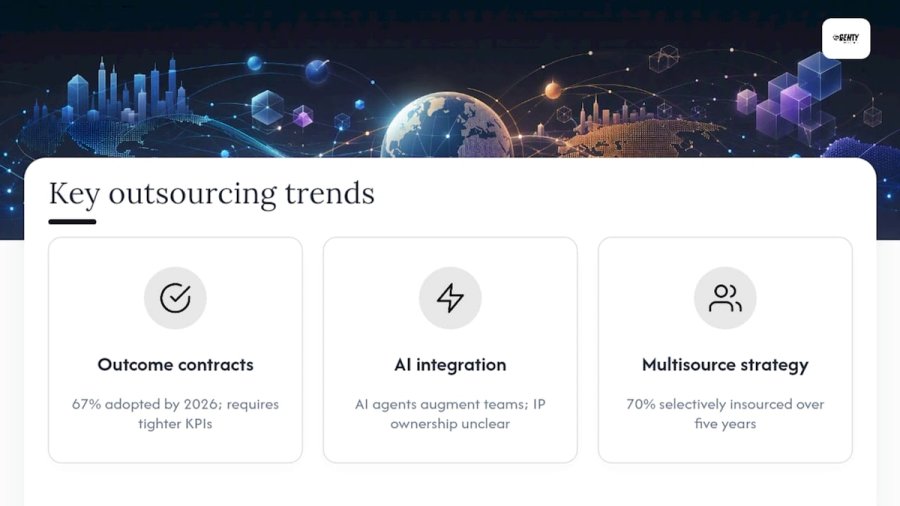
AI and digital workers are entering the delivery mix. Vendors are deploying AI agents alongside human teams for tasks like code review, QA automation, and first-line support. For tech execs, this changes two things: the KPIs you write into contracts (throughput per human FTE becomes less meaningful) and the IP clauses you need (who owns the model outputs?). Contracts written in 2022 are not fit for 2026 delivery.
Multidimensional sourcing is replacing single-vendor strategies. According to Deloitte’s multidimensional workforce research, 70% of organizations selectively insourced previously outsourced work over a five-year period to regain quality control. The pattern is not a rejection of outsourcing — it is a maturation. Companies are building GICs for core IP, using third-party providers for commodity functions, and adding staff augmentation for surge capacity. The EWMO role exists to govern all three simultaneously.
For tech execs specifically: the AI trend changes vendor selection (ask for AI-augmented delivery metrics, not just headcount), and the insourcing trend changes contract design (build exit ramps and knowledge-transfer milestones into every multi-year deal).
What are the real benefits and risks of outsourcing services?
Research on international outsourcing and productivity shows measurable productivity gains for firms that outsource services — particularly exporters and companies with international market exposure. The gains are real, but so are the costs that rarely appear in the initial business case.
Benefits worth quantifying for your CFO:
- TCO reduction: LATAM engineering talent typically costs substantially less than US rates at comparable seniority, while Philippines voice/support teams offer similarly significant cost advantages compared to US equivalents.
- Talent access: Argentina produces top-tier software engineers; the Philippines IT-BPM sector employed 1.9 million workers and generated $40 billion in revenue in 2024, demonstrating the depth of available talent.
- 24/7 operations via timezone stacking: Pair a LATAM engineering pod (EST/PST overlap) with an India or Philippines support team (overnight coverage) and you get continuous delivery without on-call burnout.
- Faster scaling: A fixed-fee recruitment model in LATAM can deliver a curated shortlist in 5–7 days. Hiring the same role in the US typically takes 6–10 weeks.
Hidden costs that inflate TCO — and that most business cases omit:
- Transition and knowledge-transfer costs (typically 10–20% of year-one contract value)
- Internal management overhead (a vendor manager at 20% of their time is not free)
- Attrition-driven remediation: replacing a mid-level engineer costs 50–100% of annual salary in lost productivity and rehiring
- Quality remediation when SLAs are written around activity metrics rather than outcomes
The practical risks checklist from nibusinessinfo.co.uk identifies confidentiality exposure, supplier instability, and service delivery gaps as the top operational risks. Geopolitical and regulatory risk is the one most US tech execs underweight: currency controls in Argentina, data residency rules in Brazil (LGPD), and evolving labor classification rules in Colombia all affect contract design.
Pro Tip: Convert each qualitative risk into a contract clause. Data breach risk becomes a defined SLA with financial remedies. Vendor concentration risk becomes a contractual right to dual-source after 12 months. Geopolitical risk becomes a force-majeure clause with a 90-day transition obligation.
The hidden costs of bad hiring decisions in remote tech teams compound quickly — a single mis-hire at the senior level can set a product sprint back by a full quarter.
How do you design a global outsourcing strategy that holds?
Governance is where most outsourcing programs fail quietly. The contract looks fine; the delivery degrades over 18 months because nobody owns the relationship internally.
Governance structure:
- Assign an EWMO lead (or a Vendor Management Office lead for smaller programs) who owns all external delivery relationships, reports to the CTO or COO, and has budget authority.
- Build a RACI that covers vendor performance reviews, security audits, knowledge-transfer milestones, and escalation paths. HR and InfoSec must be named stakeholders, not just informed parties.
- Run quarterly business reviews (QBRs) with every strategic vendor. Monthly for the first six months of any new engagement.
Contract design:
- Use outcome-based contracts for functions with measurable throughput (engineering velocity, ticket resolution rate, pipeline generated). Use per-FTE for roles where output is harder to isolate.
- For LATAM staff augmentation, build in a 90-day scale-up clause and a named replacement SLA (30 days maximum for a like-for-like replacement).
- Price flexibility into the contract from day one. A fixed-fee recruitment model for LATAM roles gives you predictable cost per hire without a retainer that locks you in when headcount plans shift.
KPI checklist:
- Business outcomes: revenue influenced, time-to-market, feature throughput per sprint
- Operational measures: first-contact resolution (FCR), mean time to resolve (MTTR), defect escape rate
- People metrics: voluntary turnover rate, vendor NPS, knowledge-transfer completion rate
Pro Tip: Add three non-negotiable clauses to every outsourcing contract: (1) a named knowledge-transfer plan with milestones and sign-off; (2) an AI usage disclosure requirement — the vendor must tell you when AI tools are used in delivery and who owns the outputs; (3) a skill-continuity clause requiring 30-day notice before rotating key personnel.
For outsourcing HR functions specifically, governance integration with your internal HR system is the step most companies skip — and it creates compliance gaps within the first year.
How do you roll out a global outsourcing program from pilot to scale?
A four-phase rollout keeps risk contained and gives you real data before you commit to scale.
- Phase 0 — Assess and map (weeks 1–4): Audit current functions for outsourcing readiness. Score each on: regulatory risk, KPI clarity, cross-team dependency, and throughput measurability. Select one pilot function that scores low on risk and high on measurability.
- Phase 1 — Pilot (days 30–90): Run a single pod or function with a defined scope, a named internal owner, and weekly check-ins. Use this phase to validate salary benchmarks, onboarding timelines, and KPI baselines.
- Phase 2 — Stabilize and transfer (months 3–6): Document processes, complete knowledge transfer, and run the first QBR. Decide whether to extend, adjust scope, or exit based on KPI performance.
- Phase 3 — Scale (months 6–18): Add functions or headcount based on Phase 2 data. Introduce a second hub if timezone stacking is part of the design.
Pilot go/no-go checklist at 90 days:
- KPIs are hitting at least 80% of target
- Onboarding documentation is complete and owned by the vendor
- Internal management overhead is under 10% of one FTE
- No open security or compliance findings
- Voluntary turnover on the vendor team is below 15% annualized
Common pitfalls and how to avoid them:
- Poor onboarding: Fix it with a written onboarding playbook delivered before day one, not after.
- Unclear KPIs: Write outcome metrics into the SOW, not just the SLA. “Deploy 2 features per sprint” beats “maintain high quality.”
- Underfunded governance: Budget at least 0.5 FTE of internal management time per 10 outsourced seats.
The Deloitte 2024 Global Outsourcing Survey found that 67% of organizations have moved to outcome-based contracts — a structural shift that makes KPI clarity at the pilot stage non-negotiable, not optional.
Pro Tip: Use a staffing strategy workflow to map how outsourced hires integrate into your sprint ceremonies and incident response rotations before the pilot starts. Teams that skip this step spend the first 30 days of the pilot solving process problems instead of shipping.
Where in LATAM should you hire, and what does it cost?
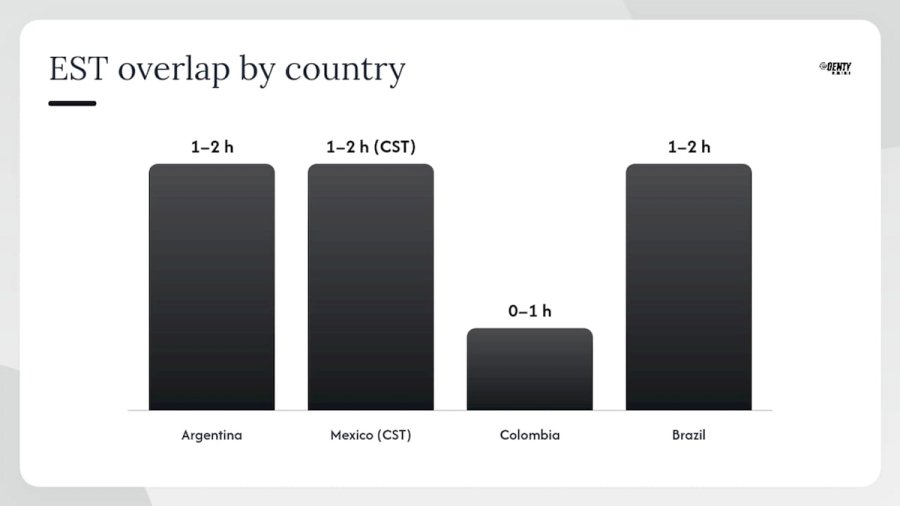
For US tech companies, LATAM nearshoring offers something no other region matches: synchronous working hours. Most LATAM hubs overlap with US EST by 1–4 hours and with PST by 3–5 hours, which means sprint ceremonies, incident response, and architecture reviews happen in real time, not asynchronously.
Recruiting realities by country:
- Argentina’s talent density is high but the market is competitive. Engineers receive multiple offers simultaneously; speed of shortlist delivery matters more than in any other LATAM market.
- Mexico’s talent pool is the largest in LATAM for DevOps and operational roles. Cultural proximity to the US reduces onboarding friction significantly.
- Colombia’s bilingual workforce makes it the strongest choice for customer-facing and sales roles. Attrition in Bogotá’s tech sector runs higher than in Medellín — factor that into your replacement SLA.
- Brazil requires LGPD-compliant data handling from day one. Build legal review into your timeline before the pilot starts.
Checklist for selecting a LATAM market:
- [ ] Does the role require synchronous collaboration? Prioritize EST overlap.
- [ ] Is the function customer-facing? Prioritize Colombia or Mexico for bilingual proficiency.
- [ ] Does the role involve data processing or storage? Check Brazil’s LGPD and Colombia’s Habeas Data law.
- [ ] Is speed of hire critical? Argentina and Mexico have the deepest senior engineering pools.
- [ ] Is cost the primary driver? Colombia and Brazil offer the widest mid-market salary bands.
Pro Tip: Use a fixed-fee recruitment model for LATAM hiring rather than a percentage-of-salary retainer. Fixed fees give you predictable cost per hire regardless of salary band, which matters when you are scaling a pod from 3 to 15 engineers over 12 months. GENTY recruitment’s LATAM hiring service delivers curated shortlists in 5 days across 14 countries.
For a broader view of remote team benefits and how nearshoring compares to fully distributed hiring, the operational evidence strongly favors LATAM for US tech companies that need synchronous delivery.
How do you vet an outsourcing partner before you sign?
Provider due diligence is where procurement teams cut corners and pay for it 18 months later. The IAOP Global 100 is the most credible starting point for shortlisting established providers — it evaluates size, growth, customer satisfaction, and management capabilities. But the IAOP list is a filter, not a verdict.
Signals that indicate a trustworthy provider:
- IAOP recognition or ISO 27001 / SOC 2 Type II certification for any function touching your data
- Named client references in your industry, willing to take a 30-minute call (not just a written testimonial)
- Documented knowledge-transfer process with milestone sign-offs
- Transparent pricing with a written breakdown of what changes at scale
- Voluntary turnover rate below 20% annualized (ask for it; a good vendor will share it)
Red flags that should stop a deal:
- Opaque pricing that changes after the SOW is signed
- No named escalation path above the account manager
- Missing or vague data protection controls (especially for GDPR or LGPD-adjacent work)
- Resistance to a knowledge-transfer clause or a named replacement SLA
Security checklist for procurement and InfoSec sign-off:
- [ ] SOC 2 Type II or ISO 27001 certificate (current, not expired)
- [ ] Data processing agreement (DPA) signed before any data is shared
- [ ] Defined incident response SLA (notification within 24 hours)
- [ ] Remote access controls documented and reviewed by your InfoSec team
- [ ] Background check policy for all personnel with access to production systems
For remote and outsourced teams, remote work security best practices from Total Cyber Solutions provide a practical IT leader checklist that maps directly to the contract clauses above.
The Grossman and Helpman outsourcing framework from Princeton explains why market thickness matters: in a thin supplier market, you are more likely to accept a poor fit because alternatives are scarce. Vetting rigorously before you need to scale is cheaper than renegotiating under time pressure.
Key Takeaways
Global outsourcing works when governance, contract design, and location selection are treated as a single integrated decision — not three separate workstreams.
What most executives get wrong about global outsourcing
The conventional wisdom says the hardest part of global outsourcing is finding the right vendor. After working with US and European tech companies on LATAM hiring, the harder problem is almost always internal: companies sign contracts before they have a named internal owner, write SLAs around activity metrics instead of outcomes, and underestimate how much management time a new vendor relationship actually consumes in the first 90 days.
The Deloitte data on insourcing is instructive here. The fact that 70% of organizations selectively insourced previously outsourced work is not a failure of outsourcing as a model. It is a failure of contract design and governance. When the vendor relationship drifts, the instinct is to bring the work back in-house rather than fix the governance structure. That is expensive and slow.
The LATAM opportunity is real and the salary data supports it. But the companies that extract the most value are the ones that treat nearshoring as an operating model decision, not a cost-cutting exercise. They invest in onboarding, they write outcome-based contracts, and they assign a named internal owner before the first hire starts. The ones that treat it as a procurement transaction are the ones who call 18 months later to ask why quality has degraded.
Three things that consistently predict success: a written onboarding playbook delivered before day one, a KPI set that measures business outcomes rather than hours logged, and a fixed-fee recruitment model that removes the vendor’s incentive to inflate headcount. The outsourced hiring guide for tech startups covers the operational mechanics in detail for teams building this for the first time.
GENTY recruitment places pre-vetted LATAM engineers in 5–7 days
US and European tech companies that need to hire in LATAM without a 10-week search cycle use GENTY recruitment’s IT recruitment service to get a curated shortlist of pre-vetted engineers, DevOps specialists, and sales professionals within 5–7 days. Fixed-fee pricing per seniority level means the cost is predictable from the first conversation, with no upfront payment and a 3-month replacement guarantee. Clients typically save up to 40% compared to equivalent US or European hires, with candidates in Argentina, Mexico, Colombia, and Brazil who work in your time zone and communicate in strong English.
The next step is straightforward: share the role, the seniority level, and the target start date, and GENTY recruitment returns a shortlist within a week. No retainer, no lock-in.
Authoritative sources and further reading
The sources below underpin the claims in this article and are worth reading directly before a major outsourcing decision.