

For US and European tech leaders who need reliable, timezone-aligned engineering capacity, the clearest path is a managed nearshore recruitment partner that delivers pre-vetted LATAM engineers. Specifically, a skill-first partner like GENTY recruitment that supplies curated shortlists within 7 days, charges a transparent fixed fee by seniority, and backs every placement with a 3-month replacement guarantee.
Why LATAM over offshore alternatives? Three reasons that directly affect your sprint velocity:
- Timezone overlap: Engineers in Argentina, Brazil, Mexico, and Colombia share 4–7 hours of daily overlap with US EST/PST, enabling real-time standups, pair programming, and same-day blocker resolution.
- Speed to hire: A skill-first shortlist in 7 days means your team can be interviewing candidates before a typical job posting even closes.
- Cost efficiency: GENTY recruitment clients report up to 40% savings compared to equivalent US hires, without sacrificing seniority or English proficiency.
Immediate next steps: Define the role and seniority level, choose between a pilot engagement (30–60 days) or a dedicated team model, request a curated shortlist, and confirm the replacement SLA before signing.
Pro Tip: Before your first vendor call, write a one-page role brief: stack, seniority, sprint cadence, and must-have domain knowledge (FinTech, SaaS, etc.). Partners who ask for this upfront are the ones who will actually match on skill, not just availability.
What do you need?
Choose the hiring path that fits
After reading "Outsourcing Web Development Services: A CTO's Guide", most teams compare these options before deciding how to hire.
Which provider type fits your product stage?
Outsourcing web development services spans a wide range of provider types, and picking the wrong one is the most common reason projects stall or balloon in cost. The table below maps each model to the scenarios where it performs best.

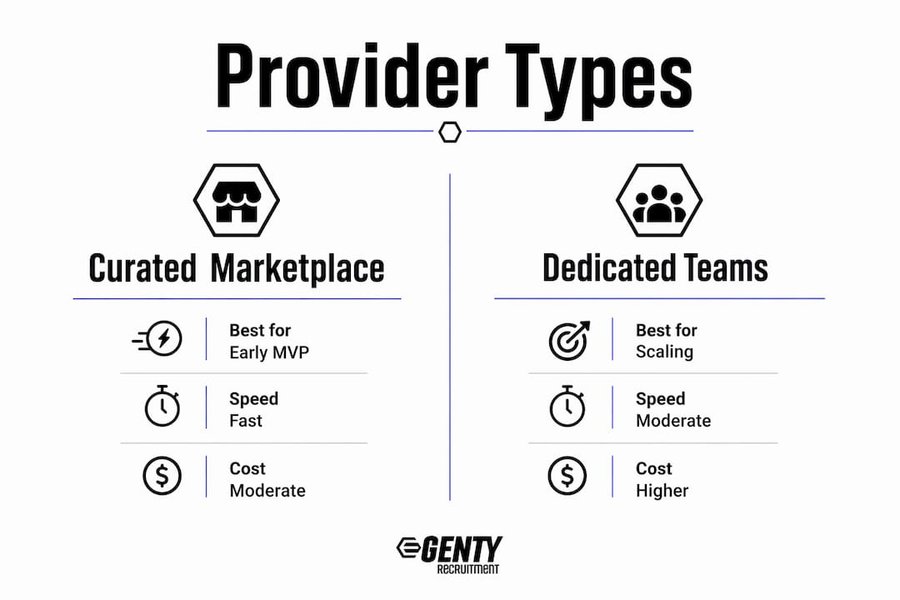
For an early MVP, a curated marketplace or a short-term contractor can work if scope is tightly defined. For rapid scaling or regulated products (FinTech, healthcare), a recruitment-first partner with a replacement guarantee and compliance-aware process is the safer choice. Long-term roadmap work almost always benefits from a dedicated team model, where the engineers build context over time rather than cycling through.
How do you evaluate a web development outsourcing partner?
The right engagement model is the single biggest predictor of outsourcing success or failure. But even the right model fails with the wrong vendor. Use this framework before signing anything.
Core evaluation criteria
- Pre-vetting depth: Does the partner run technical assessments, not just resume screens? Ask for a sample assessment or a repo review from a recent placement.
- English proficiency standard: Request a video intro from shortlisted candidates before the first interview.
- Timezone overlap: Confirm at least 4 hours of daily overlap with your core engineering hours.
- Trial or pilot option: Any credible partner should offer a 30–60 day pilot before a long-term commitment.
- IP and security standards: Require work-for-hire IP assignment, NDA, and data-handling clauses in the contract. Ask whether the partner’s process meets SOC 2 or ISO 27001 where applicable.
- Replacement SLA: Confirm the exact window (e.g., 90 days) and whether replacement is at no additional cost.
- Shared tooling: The team should work inside your Jira, Slack, and GitHub from day one, not a parallel system.
For a deeper look at technical and soft-skill vetting methodology, GENTY recruitment publishes its assessment framework publicly.
Red flags to watch for
- Vague vetting descriptions (“we screen all candidates”) with no assessment details.
- No replacement guarantee or a guarantee with hidden fees.
- Average time-to-fill over 30 days with no bench of pre-vetted candidates.
- Unclear code quality SLA or no QA integration plan.
- Resistance to working in your tooling stack.
RFP questions to ask every vendor
- What does your technical assessment include, and can I see a sample?
- What is your average time from brief to shortlist?
- How do you handle a placement that underperforms in the first 90 days?
- Which countries do your engineers work from, and what are their typical working hours in EST/PST?
Which engagement model matches your product stage?
Choosing between fixed-price, time and materials, dedicated teams, and staff augmentation comes down to how stable your scope is and how much delivery risk you want to carry.
- Fixed-price: Best for stable, well-documented scopes (a redesign with a defined spec, a migration with clear inputs). You get cost predictability; the vendor carries delivery risk. Works poorly when requirements evolve mid-build.
- Time and materials (T&M): Suited to discovery phases and iterative product work where scope shifts weekly. You carry cost risk, but gain flexibility. Requires strong internal PM discipline.
- Dedicated team: The right model for ongoing roadmap work. Engineers embed in your sprint cadence, build domain context, and own quality over time. Governance is shared; you run standups, the partner handles HR and payroll.
- Staff augmentation: Short-term capacity injection. An engineer slots into your existing team for a defined period. Fast to start, fast to end, but limited knowledge transfer.
For FinTech or healthcare builds, dedicated teams with clear IP assignment and security protocols are the default choice. For SaaS growth iterations, T&M or dedicated models both work depending on sprint stability. An IT staffing agency guide covers the governance differences in more detail.
Pro Tip: Start with a 30–60 day pilot sprint on a real but non-critical feature. It stress-tests communication, code standards, and timezone fit before you commit to a 6-month dedicated engagement.
What does LATAM talent actually cost vs. US benchmarks?
GENTY recruitment clients save up to 40% compared to equivalent US or European hires. The table below shows why, using gross monthly salary ranges for software engineers and DevOps professionals across key LATAM markets.
Sample calculation: A senior engineer hired in Argentina at $5,500/month, plus a fixed recruitment fee and estimated EoR costs, totals roughly $6,800–$7,200/month all-in. The US equivalent, fully loaded with benefits, payroll taxes, and recruiting overhead, typically runs $15,000–$17,000/month. That gap is where the 30–40% savings figure comes from in practice.
Additional cost factors to budget for: fixed recruitment fee (one-time, per placement), monthly EoR or payroll fees if you use an Employer of Record, and notice periods that vary by country (typically 30–60 days in Argentina and Brazil). For frontend-specific salary bands, GENTY recruitment publishes role-level benchmarks.
What does the hiring timeline look like end to end?
Working with a LATAM recruitment partner like GENTY recruitment, the process from brief to first sprint typically runs 30–45 days.
The ramp period matters as much as the hire itself. Assign an internal engineering lead to bridge product context, document technical requirements before the engineer starts, and define sprint-1 scope before day 30. Teams that skip this step typically see a 2–3 week productivity lag that a structured remote hiring workflow prevents.
- Confirm codebase documentation is current before onboarding day.
- Set up CI/CD access and environment credentials in the first 48 hours.
- Schedule a 30-day check-in to assess fit and adjust sprint scope.
Contractor, EoR, or direct hire: which legal structure fits?
Three payroll structures are available to US companies hiring LATAM engineers, and the right choice depends on headcount, timeline, and risk tolerance.
- Independent contractor: The engineer invoices you directly or through a vendor. Fast to set up, lowest overhead. Requires a strong contract with work-for-hire IP assignment, NDA, and data-handling clauses. Misclassification risk increases with long-term, exclusive engagements.
- Employer of Record (EoR): A third-party EoR employs the engineer locally, handles payroll, social contributions, and local compliance, and bills you a monthly fee. Best for 1–9 hires in a country where you have no legal entity. EoR fees typically run $300–$600/month per employee on top of salary.
- Direct local hire (own entity): Requires registering a legal entity in the country. Justified at scale (typically 10+ hires in a single market). Gives you full control over HR and payroll but adds administrative overhead and setup time of 3–6 months.
IP essentials for every contract: work-for-hire assignment covering all deliverables, NDA with a defined scope, data-handling and access-control clauses, and US-friendly governing law. For outsourcing HR structure and compliance considerations, GENTY recruitment’s guide covers the key decision points.
Pro Tip: Use an EoR for your first 3–5 LATAM hires while you validate the team model. Only set up a local entity once you have confirmed you will hire 10 or more people in a single country and plan to stay for at least 3 years.
How GENTY recruitment works and where it fits your strategy
GENTY recruitment operates as a skill-first IT recruitment partner for US and European tech companies hiring engineers, DevOps specialists, and data professionals from Argentina, Brazil, Mexico, and Colombia. The process is built around speed and quality: a curated shortlist within 7 days, fixed-fee pricing by seniority level, no upfront payments, and a 3-month replacement guarantee if a placement does not work out.
Operationally, GENTY recruitment integrates with your existing tooling from day one. Engineers are onboarded into your Jira, Slack, and GitHub environments, and the team supports QA integration and sprint alignment during the ramp period. For FinTech teams that need compliance-aware hiring and for SaaS product squads that need engineers who can own features end to end, GENTY recruitment’s vertical focus means shortlisted candidates already have relevant domain context.
GENTY recruitment is best suited for companies building sustained product roadmaps, not one-off projects. If you need a senior React or Node.js engineer in Buenos Aires or a DevOps lead in Bogotá embedded in your team for 12+ months, this is the model that delivers consistent quality without the overhead of managing a staffing agency’s bench.
Request a curated shortlist or a salary benchmarking report to see current LATAM rates for your specific stack and seniority level.
Key takeaways and your next three moves
Speed, timezone alignment, and quality guarantees are the three variables that separate a productive LATAM outsourcing engagement from a costly one. Act on these before your next sprint planning session:
- Define the role brief (stack, seniority, domain) before contacting any vendor.
- Choose your engagement model: pilot sprint for new partnerships, dedicated team for ongoing roadmap work.
- Request a skill-first shortlist from GENTY recruitment and compare against your internal hiring timeline.
- Confirm the replacement SLA and IP assignment terms before signing.
- Schedule a 30-day ramp check-in as a fixed calendar event on day one.
Pro Tip: Run a 30–60 day pilot on a real feature, not a test task. Real code under real sprint pressure reveals communication quality, timezone fit, and technical depth faster than any interview.
Key Takeaways
Nearshore LATAM recruitment via a managed partner like GENTY recruitment delivers pre-vetted engineers within 7 days, at up to 40% lower total cost than US hires, with full timezone alignment.
Post-hiring support and ongoing vendor management
The quality of an outsourcing engagement is determined as much by what happens after the hire as by the hiring process itself. Engineers who receive structured onboarding, clear sprint ownership, and regular feedback ramp to full productivity in 30–45 days; those dropped into an undocumented codebase without an internal owner often take twice as long.
Treat the outsourced team as an extension of your internal engineering department. Use the same tools, hold the same sprint ceremonies, and assign an internal lead who owns the product context bridge. For teams using internal tooling like custom dashboards or admin panels, migrating to a structured app framework early in the engagement reduces onboarding friction significantly.
Ongoing vendor management should include a monthly performance review covering sprint velocity, code review turnaround, and blocker resolution time. If a placement is underperforming at the 60-day mark, raise it with your recruitment partner immediately. A partner with a genuine replacement SLA will act on this; one without will deflect. For broader remote team management practices, GENTY recruitment’s 2026 guide covers the governance cadence in detail.
A direct take on outsourcing as a velocity lever
Most CTOs frame outsourcing as a cost decision. That framing leads to the wrong choices. The real question is whether an outsourced team can match your sprint cadence, communicate without friction, and ship code that your internal engineers are proud to review. Cost is a consequence of getting those things right, not the goal itself.
LATAM nearshore teams have a structural advantage here that offshore alternatives do not. Synchronous overlap with US time zones means you can run a standup at 9 AM EST with an engineer in Buenos Aires or Medellín and get a PR reviewed before lunch. That daily rhythm compounds over a quarter into meaningfully faster release cycles. The engineers coming out of Argentina, Brazil, Mexico, and Colombia are not a cost-optimized compromise. Senior engineers from these markets work at the same technical level as their US counterparts, often with stronger full-stack depth because smaller local markets reward generalists.
The cultural fit question is also less fraught than it is with fully offshore teams. English proficiency is high across LATAM’s senior engineering population, and the professional culture in tech hubs like Buenos Aires and São Paulo is closely aligned with US product-led development norms. The practical tips that actually move the needle: appoint one internal engineering lead as the context owner, document your architecture decisions before the first sprint, and use shared tooling from day one. Teams that skip the documentation step consistently report slower ramp times regardless of the engineers’ individual quality.
Sources and further reading for procurement teams
These resources support vendor evaluation, RFP preparation, and LATAM hiring decisions:
- Web Development Outsourcing: Full Guide — Model definitions, cost drivers, and project scoping guidance for procurement teams.
- How to Outsource Web Development the Right Way — Engagement model selection framework and risk reduction strategies.
- Web Design Outsourcing: A Complete Guide — Covers provider types, cost benchmarks, and when outsourcing design makes sense.
- Outsourcing Web Development: Benefits and Costs — Practical breakdown of outsourcing locations, team structures, and cost variables.
- GENTY recruitment LATAM Insights Hub — LATAM hiring intelligence, salary benchmarks, and engineering market reports for procurement teams.
- Top IT Skills in Demand — Skills benchmarking data useful for defining role requirements and seniority bands.
- IT Recruitment in LATAM — GENTY recruitment’s core service page, including process details and engagement options.
This article provides general information for technology hiring decisions. Salary ranges, legal structures, and payroll requirements vary by country and company situation. Confirm current rates and compliance obligations with a qualified employment or legal advisor for your specific context.