

A bad hire is defined as any candidate who fails to meet role expectations within the first 90 days, causing productivity loss, team disruption, and direct replacement costs. Hiring managers at fast-growing tech startups face this risk at every stage of growth, and the consequences compound quickly when engineering or sales roles go sideways. The good news: structured hiring reduces mis-hires by 30–40% compared to gut-feel interviewing. Knowing how to avoid bad hires is not about luck. It is about applying a repeatable, evidence-based process before a single offer goes out.
How to avoid bad hires: start with clear role success criteria
Vague job descriptions are the first point of failure in most hiring processes. When a posting lists 15 requirements and no clear outcomes, quality applicants self-select out while generalists flood the pipeline. The result is a high-volume, low-signal funnel that wastes everyone’s time.

The fix is defining 5–7 core responsibilities and 3–5 non-negotiable requirements before you post anything. Each responsibility should describe an outcome, not a task. “Own the CI/CD pipeline and reduce deployment failures by 20%” is a success criterion. “Responsible for DevOps” is not.
Three benchmark categories give your criteria real teeth:
What do you need?
Choose the hiring path that fits
After reading "How to Avoid Bad Hires at Your Tech Startup", most teams compare these options before deciding how to hire.
- Technical benchmarks: Specific languages, frameworks, or system design skills required at the seniority level you are hiring
- Cognitive benchmarks: Problem-solving speed, ambiguity tolerance, and learning agility relevant to your product stage
- Behavioral benchmarks: Communication style, ownership mindset, and collaboration patterns that match your team’s working model
For LATAM hires specifically, salary benchmarks matter as much as skill benchmarks. A senior software engineer in Argentina or Colombia typically costs 40–60% less than a US-based equivalent, while delivering comparable output and overlapping with US Eastern and Pacific time zones. Setting salary expectations based on LATAM market data from the start prevents misalignment later.
Pro Tip: Write your success criteria before writing the job description. If you cannot define what “great” looks like in 90 days, you are not ready to hire.
Why structured interviews are the most reliable screening tool
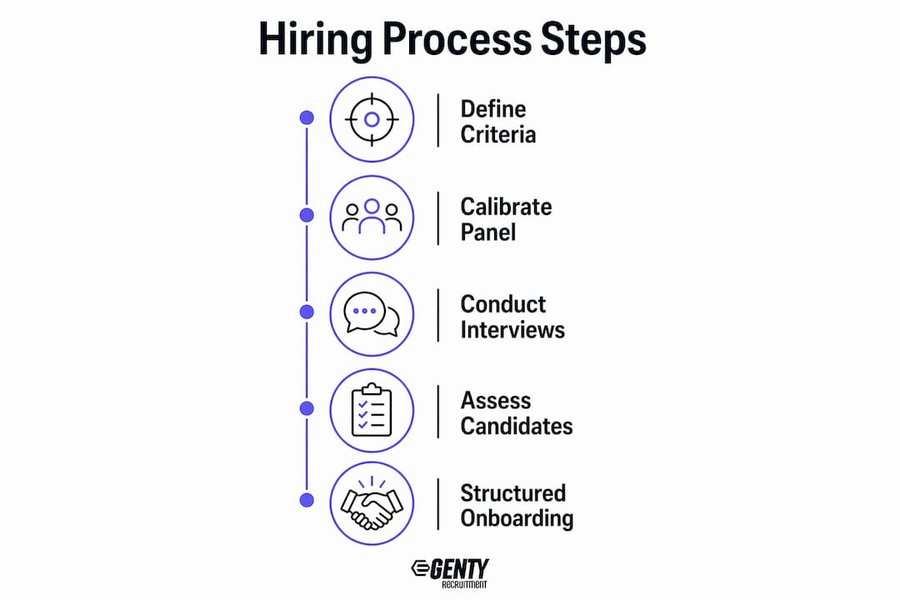
Structured interviews are 2.5 times more predictive of job performance than unstructured conversations. That gap exists because unstructured interviews reward candidates who interview well, not candidates who perform well. Structured interviews fix this by standardizing questions, scoring, and evaluation criteria across every candidate.
The core components of a structured interview process are:
- Consistent question sets: Every candidate for the same role answers the same questions in the same order
- Behavioral questions: “Tell me about a time you had to debug a production issue with no documentation” reveals real experience
- Hypothetical questions: “How would you approach migrating a monolith to microservices with a two-person team?” tests reasoning
- Scorecards: Each interviewer rates responses on a 1–5 scale against predefined criteria before the debrief
Interviewer calibration is the step most hiring managers skip. Before the process starts, the panel should align on what a “3” versus a “5” looks like for each criterion. Without calibration, two interviewers scoring the same candidate will produce wildly different results, and the debrief becomes a negotiation rather than an evaluation.
Bias reduction requires one specific shift in framing. Hiring for culture add over culture fit means asking what the candidate brings that the team currently lacks, not whether they remind you of your best existing employee. For LATAM candidates, this framing also counters unconscious bias related to accent or educational background.
Pro Tip: Record a calibration session where your panel scores the same sample answer independently, then compare. Disagreements above two points signal that your rubric needs sharper definitions.
You can find structured hiring examples for tech startups that show how leading engineering teams apply scorecards and behavioral rubrics in practice.
Does candidate experience affect the quality of your hires?
Yes, directly. 86% of candidates say a negative interview experience changes their perception of the company. That perception shift does not stay private. It spreads through referral networks, and referrals are among the highest-quality hiring channels available to startups.
The five pillars of a strong candidate experience are:
- Fast response: Acknowledge applications within 24 hours and send interview invitations within 3 business days
- Clear timelines: Tell every candidate exactly when they will hear back and at what stage
- Personalized communication: Reference the candidate’s specific background in outreach, not a generic template
- Feedback: Provide brief, honest feedback to final-round candidates who do not receive an offer
- Streamlined applications: Remove any step that does not directly predict job performance
Slow hiring timelines cause top candidates to disengage. Offers should go out within 48 hours of a final decision. For LATAM candidates in Argentina, Brazil, or Colombia, prompt communication also signals that your company respects time zone differences and operates with professionalism across borders.
Top-quartile candidate experience produces twice the referrals and 34% higher offer acceptance. That compounding effect means your hiring pipeline improves with every positive interaction, even with candidates you do not hire.
Pro Tip: Send a brief survey to every candidate who reaches the final round, hired or not. Three questions about communication, clarity, and respect take 90 seconds to complete and give you data to improve the process.
How predictive assessments reduce costly mis-hires
Traditional interviews capture communication skill and preparation, not actual job performance. Predictive hiring frameworks integrate behavioral, cognitive, and motivation assessments to map role fit with far greater accuracy. This matters most for tech roles where the gap between a strong performer and a weak one is measured in product velocity, not just output.
The five-step predictive hiring framework works as follows:
- Role analysis: Define the cognitive demands, behavioral requirements, and motivation drivers the role requires
- Cognitive assessment: Test for reasoning speed, pattern recognition, and problem-solving under time pressure
- Behavioral assessment: Use tools like the Work Personality Index to map traits like conscientiousness, adaptability, and stress tolerance
- Motivation alignment: Confirm the candidate’s career goals match the role’s growth trajectory
- Risk mapping: Score each candidate against role demands and flag mismatches before the offer stage
Aligning behavioral tendencies and cognitive style with role demands reduces both turnover and burnout. A DevOps engineer who scores low on ambiguity tolerance is a poor fit for a pre-Series A startup where requirements change weekly, regardless of their technical credentials.
Applicant volume makes this framework even more necessary. Applications surged 239% by the end of 2025, driven by AI-generated submissions. That volume makes it nearly impossible to rely on resume review alone. Cognitive and behavioral filters cut through noise and surface candidates whose profile actually matches the role.
Pro Tip: Run cognitive assessments before the first interview, not after. You will save panel time and avoid the anchoring bias that comes from liking a candidate before you see their assessment results.
What structured onboarding does for 90-day retention
Hiring the right person and then losing them in the first quarter is a failure of onboarding, not selection. Failing to build a documented 30-60-90 day plan before a hire starts is one of the primary drivers of early turnover. The plan should connect directly to the success criteria you defined before sourcing began.
A strong onboarding structure for remote LATAM hires includes:
- Day 7 check-in: Confirm the hire has access to all tools, understands team communication norms, and has met their key stakeholders
- Day 30 check-in: Review early deliverables against the role’s technical benchmarks and address any gaps in context or expectation
- Day 60 check-in: Assess collaboration quality, identify any behavioral mismatches, and confirm the hire’s motivation remains aligned
- Day 90 check-in: Evaluate performance against the original success criteria and set goals for the next quarter
For LATAM remote hires in countries like Mexico or Colombia, timezone overlap with US Eastern time (typically 1–2 hours difference) makes synchronous check-ins practical. Schedule them during overlapping hours rather than asking the hire to join calls outside their working day.
Reference checks also belong in this phase for any hire where verification was incomplete. Three focused reference questions can prevent $15,000–$50,000 bad hires: what were the candidate’s core responsibilities, how did their performance compare to expectations, and would you rehire them?
Pro Tip: Assign a peer buddy, not just a manager, to every new remote hire. Peer relationships reduce isolation and accelerate context transfer faster than formal onboarding documents.
Key Takeaways
Avoiding bad hires requires defining clear success criteria, applying structured interviews with scorecards, and supporting every hire with a documented 30-60-90 day onboarding plan.
Why gut-feel hiring keeps failing, and what I have seen work instead
After working across dozens of tech hiring cycles, the pattern is consistent. Hiring managers who trust their instincts over structured data make faster decisions and worse hires. The candidate who “felt right” in the room often struggles with the actual role demands within 60 days.
The discipline that actually works is treating hiring as a repeatable process, not a judgment call. That means scorecards filled out before the debrief, not during it. It means cognitive assessments completed before the panel forms an opinion. It means reference checks asked with specific, structured questions rather than a casual “how was she to work with?”
What I have also seen is that LATAM talent pools in Argentina, Brazil, Mexico, and Colombia are consistently underestimated by US hiring managers who have not worked with them before. Engineers from Buenos Aires or Bogotá who go through a proper structured process often outperform US-based candidates at a fraction of the cost, with timezone overlap that makes collaboration genuinely practical. The mistake is applying a loose, gut-feel process to a LATAM search and then attributing poor outcomes to geography rather than process.
The other overlooked variable is retention. Hiring managers spend months on selection and then hand the new hire a Slack invite and a Notion doc. Structured onboarding is not a nice-to-have. It is the last mile of the hiring process, and skipping it wastes everything that came before.
The step-by-step tech hiring process that actually works is not complicated. It is just disciplined. Most teams have the capacity to do it. They just need to stop treating each hire as a one-off and start treating the process as infrastructure.
— Eugene
How GENTY recruitment helps tech startups hire without the guesswork
Tech startups that want to hire pre-vetted LATAM talent without building a full internal recruiting function use GENTY recruitment’s structured process to get there faster.
GENTY recruitment delivers curated shortlists within 7 days, with every candidate pre-screened against your technical, cognitive, and behavioral benchmarks. The agency covers IT recruitment across LATAM, placing software engineers, DevOps specialists, and data professionals from Argentina, Brazil, Mexico, and Colombia. Fixed-fee pricing by seniority level means no surprise costs, and a 3-month replacement guarantee protects your investment if a hire does not work out. Clients consistently save up to 40% compared to US-based hiring while gaining nearshore timezone alignment and strong English proficiency across the candidate pool. If you are ready to build a hiring process that produces better outcomes, explore LATAM tech talent with a team that has already done the vetting.
FAQ
What is the biggest cause of bad hires?
The biggest cause of bad hires is a lack of defined success criteria before sourcing begins. Vague job descriptions attract mismatched candidates and make objective evaluation impossible.
How do structured interviews reduce mis-hires?
Structured interviews use consistent questions and scored rubrics, making them 2.5 times more predictive of job performance than unstructured conversations and reducing mis-hires by 30–40%.
How long should a tech startup’s hiring process take?
Top candidates disengage without feedback within 10 days. Offers should go out within 48 hours of a final decision to prevent drop-off and reduce the risk of losing qualified candidates to faster-moving competitors.
What makes LATAM candidates a strong choice for tech startups?
Engineers from Argentina, Brazil, Mexico, and Colombia typically cost 40–60% less than US-based equivalents, operate in overlapping US time zones, and perform at comparable technical levels when evaluated through a structured hiring process.
Do reference checks actually prevent bad hires?
Yes. Three focused reference questions covering responsibilities, performance versus expectations, and rehire likelihood can prevent bad hires that cost between $15,000 and $50,000 in replacement and productivity loss.