
A Product Manager in Mexico typically earns between MX$700,000 and MX$980,000 a year in total compensation, roughly $38,000 to $54,000 USD at current exchange rates. Mid-level PMs cluster near the median market rate; senior PMs and heads of product earn higher total compensation.
- National median total compensation is estimated near the upper mid-market range.
- Mid to senior range: MX$700,000–1,637,269, per Levels
- Employer add-on rule of thumb: gross salary × 1.25 to 1.30
- GENTY recruitment places vetted Product Managers across Mexico and LATAM with fixed-fee pricing and no upfront cost
Key Takeaways
Primary Sources and Recommended Reading
- Levels — sample-based total compensation figures including equity and bonus.
- SalaryExpert — methodology-based national average base salary and bonus estimates.
- Toku’s Mexico hiring benchmarks — employer-cost breakdowns and nearshore premium data.
- Talentosy — regional and city-level Mexican salary breakdowns by seniority.
Salary Ranges by Seniority and Role Type
Seniority moves the number more than any other single variable, and the jump from mid to senior is steeper in Mexico’s product community than in the US market.
- Junior/Associate PM: MX$300,000–500,000/year ($16,500–$27,500 USD), mostly base salary with minimal bonus
- Product Manager (mid): MX$600,000–900,000/year ($33,000–$49,500 USD)
- Senior Product Manager: MX$900,000–1,300,000/year ($49,500–$71,500 USD), where equity and performance bonuses start appearing
- Head of Product / Director: MX$1,300,000–2,000,000+/year ($71,500–$110,000+ USD), often including profit-sharing and formal equity grants
Equity shows up almost exclusively at Series B+ startups and multinational tech subsidiaries; earlier-stage local companies rarely offer it, leaning on cash instead. Bonuses tend to track company size more than seniority. A senior PM at a 40-person startup may see a smaller bonus than a mid-level PM at a 2,000-person firm with a formal performance-pay structure.
Pro Tip: Anchor your offer to total compensation, not base salary alone. A candidate quoting a Levels.fyi number is thinking in total comp; if your offer letter only shows base, the gap will read as a lowball even when your actual budget is competitive.
Need help hiring?
See the next step after this guide
If this topic is relevant to your team, these are the most useful pages to check next.
City Differences: Mexico City, Guadalajara, and Monterrey
Location still moves the number, even though remote hiring has flattened some of the gap.
Mexico City commands the strongest premium, typically 15% to 25% above the national average, driven by cost of living and the concentration of fintech, e-commerce, and multinational HQs.
- Mexico City: highest premium, largest candidate pool, most competition for senior PMs
- Guadalajara: strong technical talent, slightly lower cost than the capital, growing product community
- Monterrey: closer to national average, strong for B2B and manufacturing-adjacent SaaS
- Smaller markets (Querétaro, Puebla): below-average pay, but fewer senior-level candidates
For a fully remote, US-facing role, city premiums matter less than they would for a local on-site hire. City-level premiums tend to reverse for nearshore roles: employers pay for English fluency, timezone overlap, and domain expertise, not proximity to a specific metro area.
What US Employers Actually Pay: Statutory Contributions in Mexico
Gross salary is never the real cost of hiring in Mexico. Full-time employees trigger a set of statutory obligations that US hiring managers rarely budget for correctly on the first pass.
Add those together and total employer overhead typically lands between 25% and 30% of gross salary, before counting PTU in a profitable year. A senior PM at MX$1,000,000 gross therefore costs the employer closer to MX$1,250,000–1,300,000 once IMSS, INFONAVIT, aguinaldo, and vacation premium are layered on.
Contractors avoid most of these obligations, but Mexico’s labor authorities scrutinize misclassified “contractors” who work full-time, exclusive hours, so the compliance risk of dodging employer costs often outweighs the short-term savings.

Nearshore Premium and the Real Cost Comparison vs US Hiring
US-facing Product Manager roles in Mexico routinely pay above domestic market rate, and that premium is the price of English fluency, US product methodology experience, and real-time collaboration.
Nearshore, US-facing PM roles commonly command a 30% to 50% premium over standard domestic Mexican pay. Even after that premium, the arithmetic still favors nearshore hiring by a wide margin.
- A senior PM total cost in Mexico (salary + statutory add-ons + nearshore premium): roughly $75,000–$95,000 USD/year all-in
- A comparable senior PM total cost in the US: commonly $160,000–$210,000 USD/year including payroll tax and benefits load
- Timezone overlap: Mexico City and Guadalajara run on Central Time, giving 100% overlap with US Central and near-full overlap with EST and PST business hours
- Compliance load: IMSS, INFONAVIT, and labor-law termination rules require either a local entity or an employer-of-record partner
A Budgeting Checklist for US Hiring Managers
- Set your target gross salary using the seniority ranges above, then multiply by 1.25 to 1.30 for statutory add-ons.
- Decide employee vs. contractor status early. Full-time, exclusive work almost always means employee classification under Mexican labor law.
- Build in the nearshore premium if the role is US-facing, English-fluent, and requires real-time overlap.
- Use negotiation levers beyond base pay: flexible hours, professional development budget, and remote-first arrangements often matter more to Mexican PM candidates than modest salary bumps.
- Screen for US-market product fluency during interviews. Prior work with US-based B2B SaaS teams and comfort running standups in English are stronger signals than certifications alone.
Pro Tip: Don’t lead salary negotiations with a number pulled straight from Levels.fyi’s high end. That figure includes equity-heavy multinational packages that most mid-market US companies can’t match; anchor instead to the MX$850,000–950,000 total-comp band and let equity or bonus structure close the gap.
How Salary Grows Across a Product Manager’s Career in Mexico
Career progression in Mexico’s product management market follows a steeper early curve than in the US, then flattens unless a PM moves into a scarce specialization or leadership track.
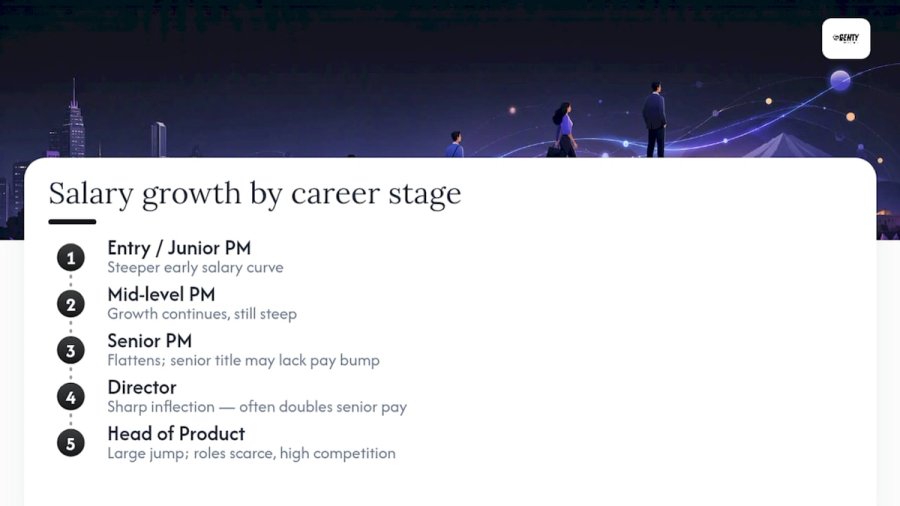
Mexican tech firms promote PMs into “senior” titles readily, but the compensation bump doesn’t always follow the title change, which is why lateral moves to multinational subsidiaries or foreign-funded startups drive the biggest pay jumps in the market.
Head of Product and Director-level roles represent the sharpest inflection point, often doubling senior PM pay, but these roles are scarce. Mexico’s product management talent pool is younger on average than the US market’s, meaning fewer PMs have the 8 to 10 years of experience typically required for director-track roles. That scarcity is exactly why US companies hiring senior and head-of-product talent in Mexico often need to compete on speed and offer clarity rather than just salary, since the strongest candidates field multiple offers within days.
For US hiring managers, the practical implication is straightforward: a candidate who has spent five years at one company, even with a senior title, may be less expensive to hire than someone with three years across two multinational subsidiaries, because the latter has already been recalibrated to global compensation benchmarks.
Do Certifications and Degrees Move the Salary Needle?
Formal credentials matter less in Mexico’s product management market than portfolio evidence and company pedigree, but they aren’t irrelevant.
A bachelor’s degree in engineering, business administration, or computer science remains close to a baseline requirement for PM roles at established tech companies, though it rarely commands a standalone premium once a candidate has two or more years of relevant experience. An MBA from a recognized Mexican or international program (Tec de Monterrey, IPADE, or a foreign MBA) can add measurable weight for head-of-product and director-track candidates, largely because it signals exposure to strategic frameworks that pure operational PM experience doesn’t always build.
Product-specific certifications, Pragmatic Institute, Product School’s PMC, or the AIPMM’s CPM, carry less standalone salary impact in Mexico than in the US market. They function more as a tiebreaker between similarly experienced candidates than as a direct salary lever. What moves the needle more consistently is demonstrable experience with US or European product methodologies, agile frameworks, and English-language stakeholder management, since these are the exact gaps that make US-facing roles pay a premium in the first place.
For US hiring managers screening candidates, weigh a certification as a minor positive signal, not a compensation justification. A candidate’s shipped-product track record and their ability to walk through a real prioritization decision will tell you more than any credential on a resume.
Product Manager Pay vs. Project Managers and Product Owners in Mexico
Title confusion is common in the Mexican tech market, and it affects salary comparisons directly, since companies use “Product Manager,” “Product Owner,” and “Project Manager” inconsistently.
Project Managers, who coordinate delivery timelines and cross-team execution rather than owning product direction, tend to land in a similar or slightly lower band than Product Owners, though PMP-certified Project Managers at large enterprises can close much of that gap.
The practical distinction for US hiring managers: if a Mexican candidate’s resume shows “Product Manager” but the described responsibilities are backlog grooming and sprint coordination without market research, pricing input, or roadmap ownership, you’re likely looking at a Product Owner-level scope, and the salary expectation should reflect that, not the higher PM band described earlier in this article. Getting the role definition right during screening avoids both overpaying for a narrower scope and underpaying a candidate who genuinely owns product strategy.
Where Product Manager Pay in Mexico Is Headed
Product Manager compensation in Mexico has trended upward over the past several years, driven by two forces pulling in the same direction: growing local tech investment and increasing US and European nearshore demand competing for the same talent pool.
The clearest driver is competitive pressure from nearshore hiring itself. As more US companies hire Mexican PMs directly or through staffing partners, domestic Mexican employers have had to raise offers to retain talent, particularly in Mexico City and Guadalajara, where the nearshore premium has effectively become a market floor for experienced, English-fluent candidates rather than a niche add-on. That dynamic shows no sign of reversing, since US tech hiring budgets remain far more compressed than they were several years ago, making nearshore talent increasingly attractive on a pure cost basis.
Expect the gap between “domestic-only” PM roles and “US-facing” PM roles to keep widening rather than closing. Companies hiring purely for the domestic Mexican market will continue competing on the lower end of the ranges outlined earlier, while US-facing and hybrid roles pull further ahead.
The Real Risk in Cross-Border Product Manager Hiring
Most articles on this topic treat salary benchmarking as the hard part. It isn’t. The hard part is that a US hiring manager comparing three data sources, a resume, and a gut feeling has no reliable way to tell whether a “senior Product Manager” candidate in Guadalajara actually owns roadmap decisions or just runs sprint ceremonies with an inflated title.
That gap, between what a title claims and what a candidate has actually done, costs more than any salary miscalculation. Hiring a Product Owner into a strategic PM role because the resume said the right words is a six-month setback with a severance bill attached. Skill-first vetting exists precisely because salary data alone can’t catch that mismatch, and it’s the piece most DIY hiring processes skip under time pressure.
— Eugene
Hire a Vetted Product Manager in Mexico in Under a Week
GENTY recruitment runs skill-first vetting before a single resume reaches your inbox, which is the exact gap most US teams hit when title inflation muddies the salary comparisons above. Curated shortlists arrive within 7 days, priced with a transparent fixed fee per seniority level, no upfront payment required, and every placement carries a 3-month replacement guarantee.
If you’re ready to move past benchmarking spreadsheets, request a salary benchmark or start a Technical Product Manager search from $2,900 with a 5-day curated shortlist, or explore the full IT recruitment service for LATAM hiring to see how the fixed-fee model scales across engineering and product roles.
Sources
Three data sources dominate the search results for Product Manager pay in Mexico, and they don’t agree with each other, because they aren’t measuring the same thing.
Levels.fyi reports average total compensation near MX$979,530, with a range of MX$786,973 to MX$1,637,269, last updated in June 2026. That figure counts stock grants and bonuses, which is why it sits above the other sources. It also skews toward large tech employers and multinational subsidiaries, the companies most likely to have employees self-reporting on a compensation-tracking platform in the first place.
SalaryExpert lists an average base salary of MXN 773,958 a year, plus an average bonus of MXN 34,751, current as of August 2026. That’s a base-only figure built from aggregated survey and government wage data, not self-reported tech-industry compensation, so it lands lower than Levels.fyi almost by design.
A third view from country-level salary trackers puts average PM pay closer to MXN 687,800, reinforcing that methodology, not market shift, explains most of the spread.
The defensible planning number: For budgeting purposes, treat MX$850,000 to MX$950,000 (roughly $47,000 to $52,000 USD) as a realistic median total compensation for a mid-level Mexican Product Manager at a tech company, before employer add-ons.
Glassdoor’s Mexico City listings sit inside that same band once you strip out senior-only samples, which is a useful sanity check when a candidate’s expectations look unusually high or low.
- Product Manager Salary in Mexico
- Product Manager Salary in Mexico (2026) - ERI SalaryExpert
- Product Manager Salaries in Mexico — 2026 Hiring Benchmarks