

Contract developers in Argentina bill US companies in dollars, usually by the month or the hour, and the rate depends far more on seniority, stack and engagement model than on the city a developer lives in. For a senior engineer, a realistic planning range sits well below US salary levels, while the working day overlaps almost completely with US Eastern hours. This guide shows how to build a rate budget, what sits inside a contractor invoice, and where classification risk begins.
TL;DR
- Argentine contractors typically invoice in USD, so your budget does not move with peso inflation. CESSI, the country’s software chamber, points to this stability as a reason the model works for foreign buyers.
- The comparison point is steep: the US Bureau of Labor Statistics reports a median annual wage of $135,980 for software developers in May 2025, before benefits and payroll taxes.
- Rates rise with seniority, specialization (cloud, data, AI) and the length of the engagement. Budget on a monthly retainer for long-term roles, and on hourly rates only for short projects.
- Argentina runs on UTC-3 all year, so it is one hour ahead of US Eastern during daylight time, two hours ahead in winter, and workable for Pacific teams with a shifted start.
- A contractor is not an employee. Getting the classification right matters more than shaving a few dollars off the rate.
What a developer contractor in Argentina actually costs
A contractor rate is a single number that has to cover things an employer normally pays separately: the developer’s own taxes, health coverage, equipment, downtime between contracts and paid time off. That is why contractor hourly rates look higher than the hourly equivalent of an employee’s salary, and why comparing the two directly misleads.
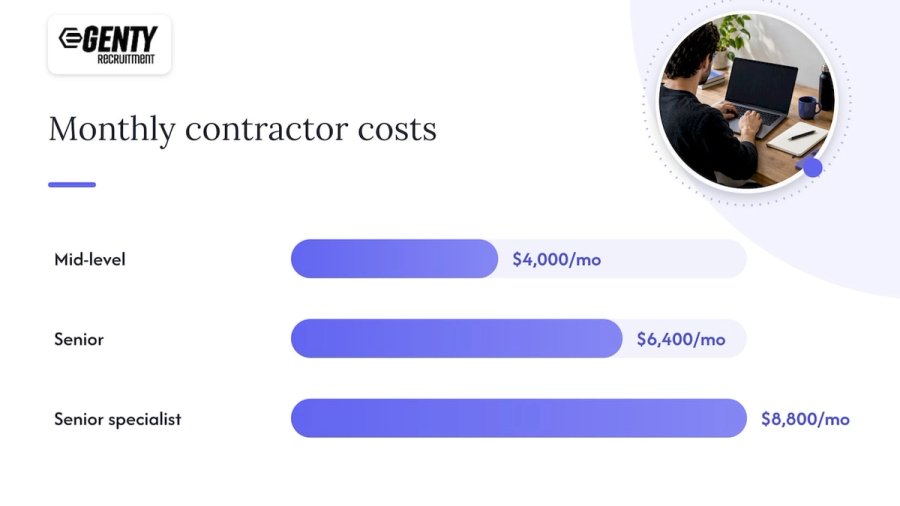
For budgeting, convert everything to a monthly figure. A full-time contractor works roughly 160 billable hours a month, so a rate of $40 an hour becomes $6,400 a month. Most Argentine developers working with foreign clients prefer a flat monthly invoice in dollars, which also gives you a predictable line in your engineering budget.
The numbers below are planning illustrations that show the arithmetic, not a market survey. Replace them with quotes from real candidates once you have a shortlist.
Planning a hire?
Talk through the best hiring option
This article usually leads to one practical question: should you use country guide or it recruitment? We can help you choose quickly.
Simple next step
Start with country guide and we will help you pick the best hiring setup.
Set against the US benchmark, a senior engineer at $76,800 a year is about 43% below the $135,980 median wage the BLS reports for US software developers, and that wage excludes employer benefits and payroll taxes. The gap widens in expensive metro areas and narrows for scarce skills. Treat the savings as a range and verify it for the specific role you are hiring.
What moves the rate up or down
Seniority and scope
The jump from mid-level to senior is the largest step in the ladder. Seniors own architecture decisions, review code and unblock others, so you are paying for fewer meetings and fewer rewrites rather than raw typing speed. Leads and principals who run a team of their own command another premium.
Stack and specialization
Backend engineers in Node.js, Python, Java and .NET are plentiful. Scarcer profiles cost more: DevOps and platform engineers with Kubernetes and Terraform depth, ML engineers, data engineers and security specialists. Argentina has a deep bench here because of its export-oriented software industry, which supports roughly 208,500 formal jobs and reached record exports of $2.651 billion in 2025.
Engagement length
A six-week project costs more per hour than a two-year engagement, because the contractor must price in the gap that follows. If you intend to keep someone for a year or more, say so early and negotiate a monthly retainer.
Currency and payment terms
Developers who bill abroad think in dollars because the peso has been volatile for years. Offering USD payment, on time and by a reliable rail, is worth more to a good candidate than a few extra dollars an hour. CESSI’s analysis notes that local salaries in pesos have climbed quickly with inflation, while USD-billed contractor rates have stayed comparatively stable, which is what lets you plan a budget over several quarters.
Argentina against the rest of LATAM
Argentina is rarely the cheapest country in the region and does not try to be. Its case rests on seniority, English and time overlap. The country scored 575 on the 2025 EF English Proficiency Index, the highest in Latin America according to Global Software Companies’ 2026 market data, and its engineers are used to working in distributed teams for US product companies.
When you compare countries, look at the whole profile:
- Argentina: strong senior backend, mobile and data talent, high English, UTC-3 all year. Best for teams that need real-time collaboration and senior judgment.
- Brazil: the largest talent pool in the region, with Portuguese as the working language outside tech multinationals, so confirm spoken English during screening.
- Mexico: the closest overlap with Central and Pacific US hours, and a natural fit for teams that want daily standups with California. Our Mexico frontend pay breakdown shows how rates there are structured.
- Colombia: a fast-growing market with Eastern-time alignment and competitive pricing. See our Colombia DevOps contractor rates for a role-level view.
For a cross-country cost overview, our guide to hiring costs across Latin America puts the markets side by side.
Timezone overlap with the US
Argentina does not observe daylight saving time and stays on UTC-3. In practice:
- US Eastern (EDT, March to November): Argentina is 1 hour ahead. A 9:00 to 18:00 day in Buenos Aires is 8:00 to 17:00 in New York.
- US Eastern (EST, winter): Argentina is 2 hours ahead, so New York 9:00 is Buenos Aires 11:00. You still share the entire US morning and afternoon.
- US Pacific: the gap is 4 hours in summer and 5 in winter. Most teams settle on a 4 to 5 hour shared window, starting the Argentine day early or ending it late.
For a CTO in New York, that means standups, pairing sessions and incident response happen in normal hours. Compare this with offshore hiring in Asia or Eastern Europe, where overlap often means one party working at the edge of the night.
Contractor or employee: the classification question
The lowest rate is not the lowest cost if the relationship is later reclassified. In Argentina, independent contractors usually register under the Monotributo regime, a simplified scheme run by the tax authority (ARCA, formerly AFIP) that combines income tax, VAT and pension and health contributions into one monthly payment. It suits individuals invoicing foreign clients, but it carries limits on the type and size of activity, so a developer needs to be in the right category or registered under a different regime.
The risk sits on your side. Labor consultancies warn that when a contractor works full time, under direction, for one client, an Argentine court can treat the arrangement as employment, with retroactive severance and social security liabilities. Full-time employment in Argentina is governed by the Ley de Contrato de Trabajo, with its own contribution and severance rules.
A practical way to reduce exposure:
- Put scope, deliverables and payment in a written services agreement.
- Let the contractor choose tools, schedule inside agreed overlap hours and invoice in their own name.
- Avoid managing a contractor like staff: no company title, no mandatory internal hierarchy.
- If you want a full-time, long-term team member, use an employer of record structure instead of stretching the contractor model.
- Ask your US counsel and a local labor lawyer to review the agreement before the first invoice.
That last step is not optional for roles that look and feel like permanent staff.
A checklist for budgeting a contract developer
Use this before you open a requisition:
The last two rows are the ones most budgets miss. A rate that looks 10% cheaper means little if the search takes three months or the hire leaves early without a guarantee. Our cost-to-hire guide breaks those costs down.
Our perspective
We see the same pattern with US and European tech companies hiring in Argentina. The first conversation is about the hourly rate. The second, a month later, is about why the shortlist is thin, the candidate’s expectations are higher than the budget, or the contract needs restructuring.
Our view is that a contractor rate is a fair price for senior judgment, and that the best budget starts with the role, not the number. Before you set a rate, decide what the engineer will own in the first 90 days. Then price the role against the market for that scope, and keep room for the specialist who turns out to be worth 15 to 20% more.
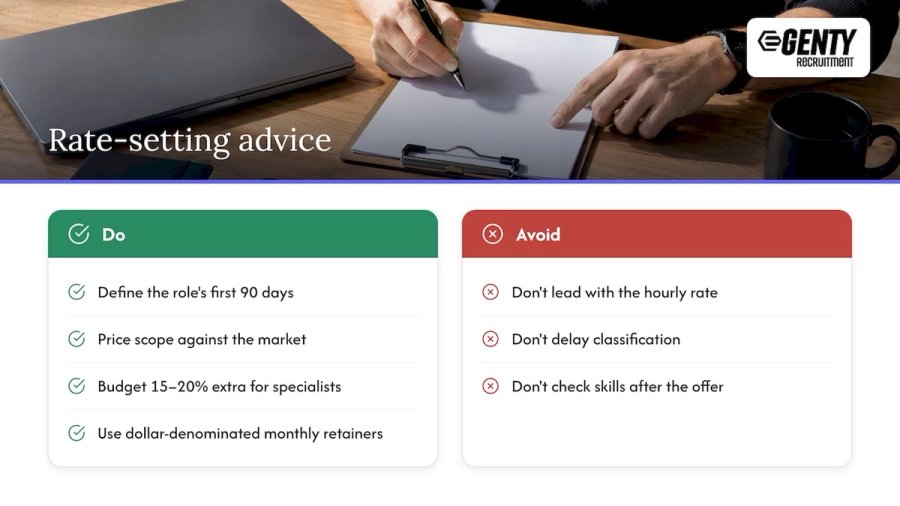
We also think teams underuse dollar-denominated monthly retainers. They are easier to approve in finance, simple for the developer to plan around, and they remove the time-tracking friction that sours a long engagement. And we advise clients to take classification seriously from day one, because it is much cheaper to structure correctly than to repair.
Finally, we recommend triple-checking technical depth, English and availability before an offer, not after. That is how our recruiters work in Argentina, and it is why we publish fixed fees rather than percentages of salary.
— Eugene
Hiring in Argentina with GENTY recruitment
If you have a role open and a budget in mind, our Argentina hiring page outlines how we work. GENTY recruitment runs IT recruitment from 2999 $ one-off per hire, with no upfront payments, a curated shortlist within 7 days and a 3-month replacement guarantee. If you would rather keep a developer on a monthly basis, our remote staffing and EOR service starts from 99 $ per month per employee.
For a deeper look at running distributed teams, read our guides on hiring remote developers from Latin America and remote staffing.
How to turn a rate into an offer
Once you have a shortlist, follow a short sequence:
- Ask candidates for their rate in USD, hourly and monthly, and what it includes (equipment, health coverage, vacation).
- Compare to the scope, not only to the seniority title. A senior who owns infrastructure is not the same as a senior who ships features.
- Test the stack with a paid, scoped exercise or a technical interview run by an engineer from your team.
- Confirm overlap hours in writing, including how you handle public holidays in both countries.
- Agree on payment terms: invoice date, payment rail, late-payment rules and a notice period.
- Plan the first 30 days: access, documentation, a first deliverable that ships within two weeks.
Small details such as invoice dates and holidays are where long contractor relationships succeed or quietly erode.
FAQ
How much do developer contractors in Argentina charge per hour?
It depends on seniority, stack and engagement length. For planning, a mid-level developer may fall in the mid-$20s an hour, a senior around $40, and a cloud, data or AI specialist above that. Treat these as budgeting assumptions and confirm them against actual candidate quotes.
Is it cheaper to hire an Argentine contractor than a US developer?
On salary alone, usually yes: a senior engineer at $76,800 a year is roughly 43% below the US median of $135,980. The US figure excludes benefits and payroll taxes, but the contractor figure excludes recruiting and management time, so compare the full cost for your case.
Do Argentine contractors invoice in dollars?
Most developers who work for foreign clients do. Dollar billing protects them from peso inflation and gives you a stable budget, which is the main reason CESSI describes USD-billed rates as stable next to local salaries.
Can I hire a developer in Argentina as a contractor full time?
You can, but full-time, exclusive, directed work is where reclassification risk grows. Argentine contractors typically register under Monotributo, and a court may treat a disguised employment relationship as real employment. Use a clear services agreement and get local legal advice, or use an employer of record for permanent roles.
What is the timezone overlap with the US?
Argentina is on UTC-3 year-round. It is 1 hour ahead of New York in summer and 2 hours ahead in winter, and 4 to 5 hours ahead of California, so Eastern teams share the full day and Pacific teams share the morning.
Sources
- US Bureau of Labor Statistics: Software Developers, Occupational Outlook Handbook
- Global Software Companies: Argentina Software Outsourcing Statistics, 2026
- CESSI, Argentine software and digital services chamber
- ARCA: Monotributo
- Toku: contractor and employee classification in Argentina