

Most hiring managers assume senior talent recruitment is simply a matter of finding someone with fifteen-plus years of experience and an impressive list of former employers. That assumption is one of the most expensive mistakes a growing tech company can make. True senior talent is defined by strategic impact, the ability to build and lead teams through uncertainty, and the cultural fit to integrate seamlessly into an organization’s mission. For US and European tech firms operating in FinTech, AI, and SaaS, tapping into Latin America’s executive talent pool is no longer a niche strategy. It’s a competitive advantage that forward-thinking companies are actively building around.
Table of Contents
- What is senior talent recruitment?
- Why do tech companies pursue senior LATAM talent?
- The senior recruitment process: Framework and best practices
- Evaluating candidates: Beyond the resume
- What most companies overlook about senior talent recruitment
- Ready to hire top LATAM leaders? Here’s how GENTY recruitment can help
- Frequently asked questions
Key Takeaways
What is senior talent recruitment?
Senior talent recruitment is a specialized discipline focused on identifying, attracting, and securing individuals who can lead organizations, shape strategy, and drive measurable business outcomes. This is fundamentally different from filling mid-level or junior roles, where the emphasis falls heavily on technical skills and immediate task execution.
At the senior level, key leadership competencies extend well beyond technical proficiency. The traits looked for in senior hires encompass strategic vision and proven leadership, meaning a candidate’s track record of building teams, influencing stakeholders, and navigating organizational complexity matters as much as their coding knowledge or product expertise. This is why how top leaders are recruited looks so different from standard hiring workflows.
To make the contrast concrete, here’s how senior recruitment compares to general hiring:
What do you need?
Choose the hiring path that fits
After reading "Senior talent recruitment: How to hire top tech leaders", most teams compare these options before deciding how to hire.
The qualities that separate a true senior leader from a highly experienced individual contributor are worth examining closely:
- Strategic vision: Ability to set direction and align teams to long-term goals
- People development: Consistent track record of mentoring and growing talent
- Change leadership: Proven capacity to lead organizations through transformation
- Stakeholder alignment: Skill in managing expectations across functions and geographies
- Commercial acumen: Understanding of how technology decisions translate to business outcomes
- Resilience under ambiguity: Composure and judgment when data is incomplete
Pro Tip: Don’t confuse years-in-role with capacity for executive impact. Some candidates with eight years of experience have built and scaled global teams. Others with twenty years have never operated outside a single business unit. Evaluate the scope of their decisions, not the length of their tenure.
Why do tech companies pursue senior LATAM talent?
Having defined senior talent recruitment, we can now explore why Latin America has become a prime region for sourcing these leaders.
As LATAM tech talent trends show clearly, LATAM offers a fast-growing pool of experienced technology leaders with global-scale expertise. The region has produced a generation of executives who have built and scaled products for multinational companies, navigated complex regulatory environments in FinTech, and led AI and SaaS organizations through rapid growth phases. This experience now commands serious attention from US and European firms.
The cost differential remains significant. A senior engineering leader or VP of Product in Argentina, Brazil, or Colombia typically commands compensation that is 40 to 60 percent lower than an equivalent hire in San Francisco or London, without any sacrifice in quality or strategic capability. For early-stage companies and growth-stage firms managing burn rate, this creates real financial flexibility without compromising executive horsepower.

According to interview trends in tech hiring, cross-border senior hiring has increased substantially as remote-first organizations normalize distributed leadership. The following data table captures the core comparison:
Beyond cost, time zone alignment is a practical advantage that hiring managers consistently underestimate. LATAM executives operating in EST or CST-adjacent time zones can attend leadership meetings, collaborate in real time, and participate in cross-functional decision-making without the friction that comes with hiring in Asia-Pacific or Eastern Europe.
The top three country choices for senior IT hiring in LATAM each bring distinct strengths:
- Argentina: Strong technical culture, high English proficiency, and a mature startup ecosystem that has produced experienced FinTech and SaaS leaders
- Brazil: Largest talent pool in the region with deep expertise in AI, data engineering, and enterprise software, plus a fast-growing executive class
- Colombia: Rapidly growing tech sector supported by government investment, a strong bilingual workforce, and increasing presence of global tech companies establishing regional hubs
The senior recruitment process: Framework and best practices
Understanding why LATAM talent is in demand, let’s detail the essential steps and smart strategies for recruiting senior leaders.
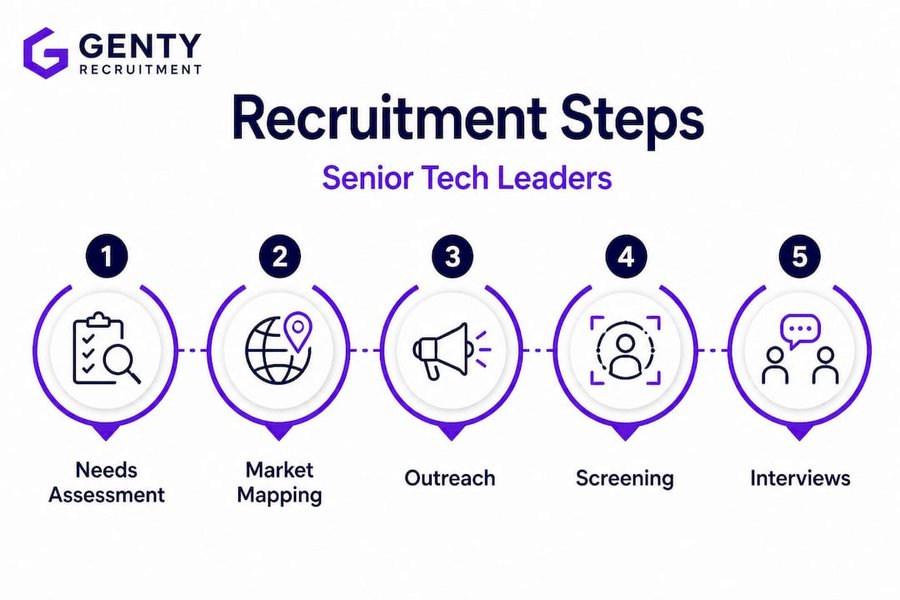
The executive search step-by-step process for senior roles involves several distinct phases, each requiring deliberate effort and specialized expertise. Best practice frameworks help ensure the right fit at the executive level and minimize costly mis-hires, which at the senior level can cost an organization anywhere from 50 to 200 percent of the executive’s annual compensation when factoring in lost productivity, team disruption, and re-hiring costs.
Here is the core senior recruitment framework:
- Needs analysis and role definition: Clarify the strategic mandate, not just the job description. What decision authority will this person have? What outcomes do they own within 90, 180, and 360 days?
- Market mapping: Identify the universe of qualified candidates across active and passive markets, including those not currently seeking new roles.
- Targeted outreach: Personalized, research-driven outreach to high-potential candidates. This is not a job posting. It’s a confidential conversation.
- Structured screening: Competency-based interviews assessing both strategic capabilities and cultural alignment with the hiring organization.
- Executive-level assessment: Panel interviews with C-suite stakeholders, leadership case studies, and scenario-based problem solving.
- Reference verification: Multi-source reference checks focused on leadership impact, not tenure or technical output.
- Offer and negotiation: Compensation benchmarking against LATAM market data to ensure competitive, fair offers that reflect total package value.
- Structured onboarding: A 90-day integration plan that accelerates the executive’s ability to build relationships and deliver early wins.
As technical interview trends indicate, AI and remote processes are reshaping senior talent recruitment in meaningful ways. AI-assisted screening tools now help identify leadership patterns in candidate histories, while asynchronous video assessments allow senior candidates to engage on their schedule rather than fitting into a rigid interview pipeline.
Pro Tip: Personalize every executive touchpoint. Senior leaders receive multiple opportunities simultaneously, and generic outreach signals a lack of organizational seriousness. Address their specific career achievements, reference their public work, and articulate why this role represents a unique opportunity for them specifically.
When hiring CTOs and tech leads in LATAM, the most common mistakes to avoid include:
- Over-indexing on technical certifications while undervaluing management scope
- Moving too slowly between process stages, causing top candidates to accept competing offers
- Failing to involve the hiring executive’s future direct reports in the evaluation
- Neglecting to explain equity structures and remote work policies early in the process
- Conducting generic interviews rather than role-specific leadership assessments
Evaluating candidates: Beyond the resume
With a recruitment framework in mind, the next step is mastering how to identify candidates with both hard and soft leadership skills.
The resume tells you where a person has been. It rarely tells you how they led, what they changed, or whether they’ll thrive inside your specific organization. Evaluating senior candidates effectively requires a structured approach that surfaces impact, judgment, and interpersonal sophistication.
The most effective interviewers focus on these themes when evaluating pre-vetted remote LATAM talent at the senior level:
- Ownership under pressure: How did they handle a product failure, team conflict, or budget cut? What decisions did they own personally?
- Stakeholder navigation: How did they manage alignment across engineering, product, and business leadership in cross-functional environments?
- Hiring and team-building: What frameworks do they use to build high-performing teams? How have they handled performance issues at the manager level?
- Vision articulation: Can they translate technical complexity into business language that resonates with non-technical executives and board members?
- Learning agility: How have they adapted to new technologies, industries, or organizational models within the past three years?
Soft skills evaluation has taken on greater importance in modern senior hiring. Adaptability, cross-cultural communication, and vision are now prioritized as highly as technical acumen, particularly in organizations building globally distributed leadership teams.
“The organizations that consistently hire great senior leaders stop asking what someone knows and start asking what they have built, changed, or saved. The resume is just the starting point of that conversation.” — Perspective shared consistently across executive search practice
Balancing technical and interpersonal assessment requires structure. A useful approach combines a 60-minute leadership case study, a 30-minute stakeholder simulation exercise, and at least three reference conversations with individuals who have reported to or worked alongside the candidate in complex environments. This combination surfaces the patterns that single interviews consistently miss.
What most companies overlook about senior talent recruitment
After the practical guidance, let’s step back and examine what most hiring managers get wrong when recruiting senior talent.
The conventional playbook focuses heavily on pedigree: prestigious university degrees, recognizable company names on the resume, and a long list of technical certifications. These signals are easy to evaluate, which is precisely why they dominate hiring discussions. But they are also frequently misleading at the senior level.
The uncomfortable truth is that a significant share of senior hires fail not because of competence gaps, but because of misaligned values, unclear expectations around ownership, or insufficient cultural integration. A VP of Engineering who thrived inside a highly structured enterprise environment may struggle profoundly in a fast-moving SaaS startup where ambiguity is constant and resources are constrained. The technical skills transfer. The operating model does not.
This pattern is especially pronounced in cross-border hiring. When US or European companies recruit senior leaders from Latin America, the evaluation often stops at English proficiency and technical depth. What gets under-evaluated is the leader’s ability to operate within a specific organizational culture, navigate the company’s particular decision-making style, and build trust with a team they may never meet in person. These are the factors that actually determine whether a senior hire succeeds or fails within the first year.
Organizations that consistently build strong executive teams prioritize mission alignment and adaptability. They ask candidates directly about the work environments where they have struggled, not just where they have succeeded. They involve future peers and direct reports in the evaluation, not just the hiring manager. They invest in structured onboarding that accelerates trust-building rather than assuming a senior hire will figure it out independently.
As firms recruiting through specialized partners have learned, the cost of a misaligned senior hire is rarely just financial. It affects team morale, product velocity, and the organization’s ability to attract the next generation of leadership. Getting it right the first time is always worth the additional investment in evaluation depth and process rigor.
Ready to hire top LATAM leaders? Here’s how GENTY recruitment can help
If you’re ready to put these strategies into action for your organization, here’s how GENTY Recruitment bridges the gap.
GENTY Recruitment specializes in connecting US and European tech companies with senior, pre-vetted leaders from Latin America across FinTech, AI, and SaaS. Our executive search process combines structured market mapping, competency-based assessment, and deep LATAM market knowledge to deliver qualified candidates faster and with greater confidence than traditional agency approaches.
Whether you need IT recruitment in LATAM for your engineering leadership team, a targeted executive search for LATAM leaders at the VP or C-suite level, or flexible remote staffing solutions to scale your team without long-term commitments, GENTY has the infrastructure and regional expertise to deliver results. Our candidates are English-speaking, technically qualified, and ready to integrate into global teams from day one. Reach out to start a search tailored to your organization’s specific leadership needs.
Frequently asked questions
What distinguishes senior talent recruitment from regular tech hiring?
Senior talent recruitment emphasizes leadership potential, strategic impact, and organizational fit rather than just technical skills or years of experience. Where general hiring focuses on task execution, senior recruitment evaluates the capacity to drive organization-wide decisions and lead teams through complexity.
Why is Latin America attractive for hiring senior leaders in tech?
LATAM offers access to globally experienced leaders, competitive compensation relative to US and EU markets, and strong alignment with North American time zones. The region’s fast-growing technology leadership pool includes executives with proven records at multinational organizations.
Which are the key steps in a senior talent recruitment process?
Key steps include needs assessment, market mapping, targeted outreach, structured screening, executive interviews, stakeholder evaluation, offer negotiation, and onboarding. Each phase requires deliberate attention to ensure thorough, multi-stage evaluation at the leadership level.
How do you assess soft skills in senior tech candidates?
Soft skills are evaluated through scenario-based interviews, multi-source reference checks, and cultural fit discussions with future peers and direct reports. Assessing adaptability and cross-cultural communication is as important as verifying technical depth for senior roles.