
A competitive nonexecutive time-to-hire in 2026 sits between 35 and 45 days, tracking closely with the SHRM 2025 Recruiting Benchmarking Report’s 39-day median. Engineering roles run longer, often 60 days or more, once take-home assignments and multi-round panels enter the picture. If your process closes under 30 days, you are outperforming most peer companies. If it runs past 60, something in your pipeline is stuck, and this article, drawing on data from SHRM, Ashby, and Visier, is built to help you find where.
TL;DR:
Companies with a time-to-hire under 30 days outperform most peers, while exceeding 60 days indicates process bottlenecks that need addressing.
Speeding up scheduling and screening processes through automation and parallel interviews can save several days, especially in technical roles with longer timelines.
Industry context significantly impacts benchmarks, with tech and aerospace often taking 45 to 60 days or more, depending on complexity and compliance delays.
Legal requirements like background checks and work authorization can add fixed delays that internal improvements cannot shorten.
Strong employer branding and candidate experience minimize withdrawal rates and reduce overall hiring time by keeping candidates engaged and well-informed.
What Time to Hire Actually Measures (and Why Time to Fill Isn’t the Same Thing)
Time to hire counts the days from when a candidate first enters your pipeline (application, sourced outreach, referral) to the moment they accept your offer. Time to fill starts earlier, at the requisition-approval date, and stretches through the same finish line. Confusing the two is the single most common reason internal numbers look wildly different from published benchmarks, according to Joveo’s analysis of the two metrics.
Three mistakes distort comparisons most often:
- Counting calendar days when a benchmark source counts business days, or vice versa.
- Starting the clock at requisition approval instead of first candidate contact.
- Excluding internal approval delays that happened before the job was ever posted.
Before you benchmark anything, build a short internal mapping table that states which days your applicant tracking system counts for each metric. A five-minute audit here saves weeks of arguing over numbers that were never comparable in the first place.
Planning a hire?
Talk through the best hiring option
This article usually leads to one practical question: should you use salary guide or rpo? We can help you choose quickly.
Simple next step
Start with salary guide and we will help you pick the best hiring setup.
How Do Time to Hire Benchmarks Vary by Industry?
Industry context changes everything about what “competitive” means. A 35-day hire in retail is unremarkable; the same number in aerospace would be a case study. Visier’s time-to-hire data puts the global average near 44 days, but that average hides enormous spread, from under a month in high-volume hourly roles to well past two months in regulated or highly technical fields.
Seniority compounds every row in that table. Entry-level roles routinely close in three to four weeks. Mid-level specialist roles average closer to the industry median shown above. Senior and executive searches, per SHRM, run about 45 days on average, and can push past 70 when a search committee or board sign-off enters the loop.
Where the Time Actually Goes: A Stage-Level Breakdown
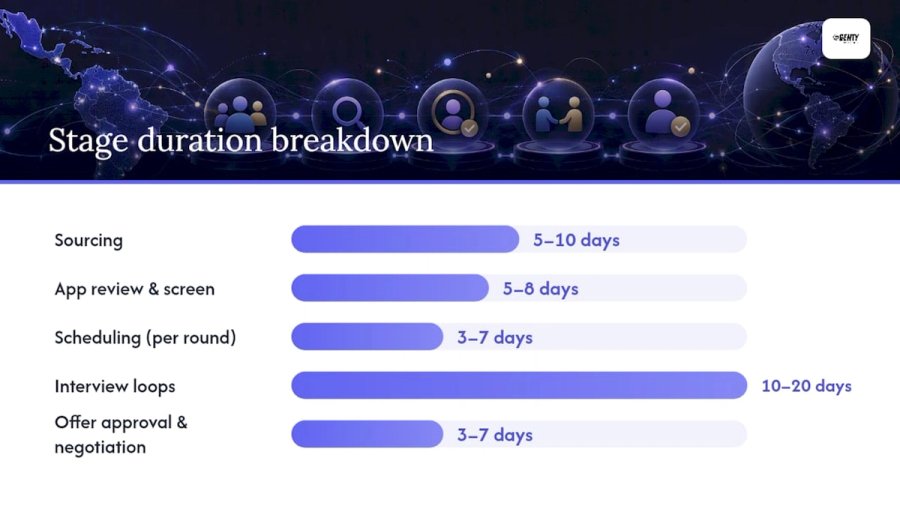
Time to hire is rarely one big delay. It’s the sum of five or six small ones, a pattern Ashby’s recruiting operations research documents across thousands of pipelines. Sourcing and top-of-funnel activity typically consumes 5 to 10 days. Application review and recruiter screening add another 5 to 8. Scheduling, on its own, frequently eats 3 to 7 days per round, largely because it depends on manual back-and-forth. Interview loops themselves run 10 to 20 days across two to four rounds. Offer approval and negotiation close things out with another 3 to 7 days.
Statistic Callout: Ashby’s research found automated scheduling runs about 26% faster than manual coordination, and that gap compounds across every round in a multi-stage loop.
Two questions expose your bottleneck fast:
- Where do candidates wait longest between touchpoints: before a screen, before an interview, or before an offer?
- Which stage requires a human to manually check a calendar before anything moves forward?
How to Turn Benchmarks Into Realistic Internal Targets
Raw benchmarks are a starting point, not a target you paste into a dashboard. Turning them into something your team can act on takes a short, deliberate process:
- Verify definitions first. Confirm your ATS measures the same start and end points as the benchmark source you’re citing.
- Segment by function and seniority. A single company-wide average hides more than it reveals; a high-volume SDR role and a staff engineer search need separate baselines.
- Quantify the gap. If your engineering median is 72 days against a 60-day industry benchmark, that 12-day gap is your improvement budget.
- Set 30/60/90-day targets. Shave a realistic slice off each stage rather than demanding an overnight fix; five days off scheduling in the first 30 days is achievable, cutting 20 days off total time-to-hire in a month usually isn’t.
- Pick the right KPI. Median protects you from being skewed by one nightmare search; 90th percentile tells you how bad your worst cases actually get. Track both.
High-volume sales hiring should target the lower end of your industry range, since screening is largely standardized. Senior engineering searches need a wider, more forgiving target band, because quality checks genuinely take longer.
Practical Tactics That Reliably Shorten Time-to-Hire
Speed and quality don’t have to trade against each other; most of the fastest gains come from removing friction, not lowering the bar.
- Automated scheduling tools cut coordination delays by roughly 26%, and the savings multiply across every interview round in your loop.
- AI-assisted screening can shrink first-contact-to-accepted-offer from a 41-day median down to around 28 days on roles where reviewing applications was the actual bottleneck, though returns shrink for senior technical roles where panel scheduling and take-home projects dominate the timeline instead.
- Video screening pilots can lower cost-per-hire while trimming a full scheduling round, a tactic detailed in FaceCruit’s screening playbook.
- Trimming panel rounds from four interviews to three, with parallel rather than sequential scheduling, is a Talent Acquisition-owned fix with almost no implementation cost.
- Fast-tracking offer approvals by pre-authorizing salary bands with Finance removes a stage that HR Operations usually controls but rarely audits.
- Strengthening referral pipelines shortens sourcing before a requisition even opens, since referred candidates need less vetting time upfront.
Pro Tip: Compress stages, not communication. Send a same-day recap after every interview round even when scheduling the next one takes 48 hours. Candidates rarely complain about a process that takes two weeks; they complain about silence.
What LATAM Hiring Does to Your Time-to-Hire Numbers
Nearshore sourcing changes the sourcing stage more than any tool. Some specialized recruitment agencies deliver curated shortlists within about a week for tech and sales roles, compressing the 5 to 10 day sourcing window most companies experience into a more predictable timeframe.
Legal and Compliance Considerations Affecting Hiring Timelines
Compliance steps rarely show up in a benchmark chart, but they consistently explain why healthcare, financial services, and aerospace hiring runs longer than the general median. Background checks, professional license verification, and security clearance processing each add fixed calendar time that no amount of scheduling automation can shorten, because they depend on third-party government or licensing-body turnaround, not your internal process.
Equal employment opportunity documentation and structured interview scorecards add a small amount of time per candidate but reduce legal exposure meaningfully, which is why most Talent Acquisition leaders treat that time as non-negotiable rather than a target for trimming. Data privacy rules also matter more than most hiring teams assume. Any company processing candidate data across borders, including US companies interviewing candidates in Argentina, Brazil, Mexico, or Colombia, needs a clear data-handling policy for resumes, assessment results, and interview notes.
Work authorization checks add another variable. Domestic hires need I-9 verification before their start date, a fixed step regardless of how fast the interview stages moved. International contractor or nearshore arrangements shift that burden differently. Companies hiring through an employer-of-record or a specialized recruitment partner typically move faster here because the compliance groundwork, contracts, tax classification, and payment structure, is already built rather than assembled from scratch for every hire.
The practical takeaway: build your 30/60/90-day targets around a realistic compliance floor for your industry, not the fastest theoretical timeline your ATS could produce.
How Employer Branding and Candidate Experience Change Your Timeline
A weak employer brand doesn’t just cost you top candidates; it silently adds days to every stage of your pipeline. When candidates aren’t familiar with your company, recruiters spend extra time on qualification and persuasion during the initial screen, time that companies with strong brand recognition skip almost entirely because candidates arrive already sold on the opportunity.
Candidate experience compounds this effect through withdrawal rates. A candidate who waits five days for interview feedback is more likely to accept a competing offer mid-process, forcing you back to the sourcing stage and effectively restarting your clock. Fast, consistent communication, even a short same-day update with no real news, keeps candidates engaged through multi-round loops that would otherwise lose people to silence.
Job description clarity plays a quieter but real role too. Vague requirements produce a flood of underqualified applications, which inflates the application-review stage well beyond its median duration. Specific, accurately scoped postings shrink that same stage because recruiters spend less time filtering noise.
Companies with structured, well-reviewed interview processes also see fewer candidates drop out mid-loop, which matters more than it sounds: every dropped candidate late in a process means restarting sourcing, screening, and scheduling from closer to zero. Employer branding and candidate experience aren’t marketing concerns bolted onto recruiting. They function as a direct multiplier on every stage in the table above, for better or worse.
Team Structure and Collaboration: The Hidden Variable Behind Slow Hiring
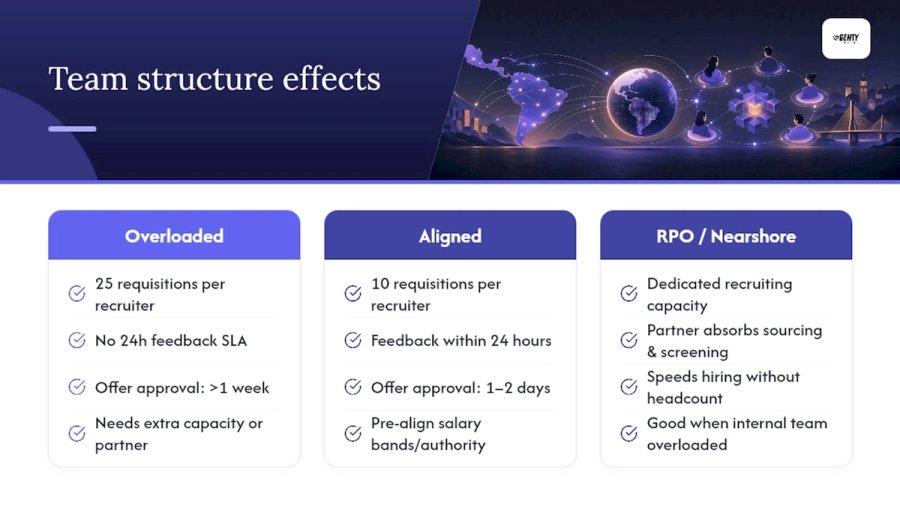
Two companies with identical job requisitions and identical applicant pools can produce wildly different time-to-hire numbers based purely on how their recruiting team is structured. A recruiter juggling 25 open requisitions simply cannot give each pipeline the attention a recruiter managing 10 can provide, and that ratio shows up directly in scheduling delays and screening turnaround.
Hiring manager availability is an underrated bottleneck. When a hiring manager treats interview feedback as a low-priority task squeezed between meetings, that delay ripples through the entire loop, because most companies won’t schedule the next round until the previous one is scored. Building a service-level expectation, feedback within 24 hours of an interview, removes one of the most common invisible delays in the stage-level breakdown covered earlier.
Cross-functional collaboration matters just as much. When Talent Acquisition, hiring managers, and Finance operate as separate silos with separate approval queues, offer approval alone can stretch past a week. Companies that pre-align on salary bands and approval authority before a search even opens routinely cut that stage to one or two days.
Recruitment Process Outsourcing and specialized nearshore recruiting partners solve part of this structural problem by adding dedicated capacity without adding permanent headcount. A team that’s structurally overloaded doesn’t need more benchmarks to study; it needs either more recruiting capacity or a partner who absorbs the sourcing and screening load directly. For companies weighing that option, understanding how to speed up tech hiring without sacrificing quality is a useful next step before restructuring internally.
When Speed Should Win, and When Depth Should
Speed matters most for high-volume, well-defined roles where the skill bar is clear and mistakes are cheap to correct. Depth matters more for senior engineering and leadership hires, where a bad decision costs months of rework. My rule of thumb: if replacing a bad hire costs less than three weeks of lost productivity, optimize for speed; if it costs a quarter or more, slow down and verify.
— Eugene
Faster LATAM Hiring Without the Guesswork
Some recruitment partners specialize in closing sourcing and screening stages more rapidly by focusing on nearshore talent from Latin American countries like Argentina, Brazil, Mexico, and Colombia, avoiding the long time-zone differences faced with Eastern Europe or Asia. These services offer shortlists within about a week, use transparent pricing by seniority, and provide replacement guarantees.
This works best for software engineers, DevOps specialists, data roles, and sales teams, the same categories where the benchmarks table above shows the longest US and European timelines. If your engineering searches are running past that 60-day median discussed earlier, start by reviewing IT recruitment in LATAM and requesting a shortlist for your open role this week.
Sources
- SHRM 2025 Recruiting Benchmarking Report
- Recruiting Operations Benchmarks | 2026 Talent Trends Report | Ashby
- What is time to hire? Importance & Formula (2024)
- Time-to-Hire Benchmarks 2026: 39 Days, Stage by Stage