

Gig economy talent is defined as the segment of the workforce that performs short-term, project-based, or platform-mediated work outside traditional full-time employment. This includes independent contractors, freelancers, temporary employees, and fractional executives who offer specialized skills on demand. An estimated 5–15% of the US population participates in gig work in some form, with platform-based activity accounting for 2–4% of that total. For organizations evaluating workforce flexibility, understanding what is gig economy talent is the first step toward using it as a deliberate strategic asset rather than a reactive hiring measure.
What is gig economy talent and how is it defined?
Gig economy talent refers to workers who engage in short-term, flexible, or digitally mediated work arrangements rather than holding permanent positions with a single employer. The standard industry term for this workforce segment is the contingent workforce, which encompasses independent contractors, freelancers, temporary staff, and on-demand specialists. The gig economy definition, as used in workforce planning, covers everything from app-based delivery drivers to fractional CFOs and senior technology consultants.
Gig work spans broad sectors and skill levels, from platform-based delivery and ride-sharing to short-term software development contracts and executive advisory roles. That breadth is what makes the gig economy workforce so strategically relevant. A company can engage a senior data scientist for a 90-day project through the same structural framework it uses to staff a seasonal customer support team.

The defining characteristics of gig talent are autonomy, project scope, and legal classification. Workers operate under defined deliverables rather than open-ended employment agreements. This distinction shapes everything from tax treatment to benefits eligibility, and organizations that ignore it face real legal and financial exposure.
What do you need?
Choose the hiring path that fits
After reading "What Is Gig Economy Talent? A 2026 Guide", most teams compare these options before deciding how to hire.
What are the main types of gig economy talent?
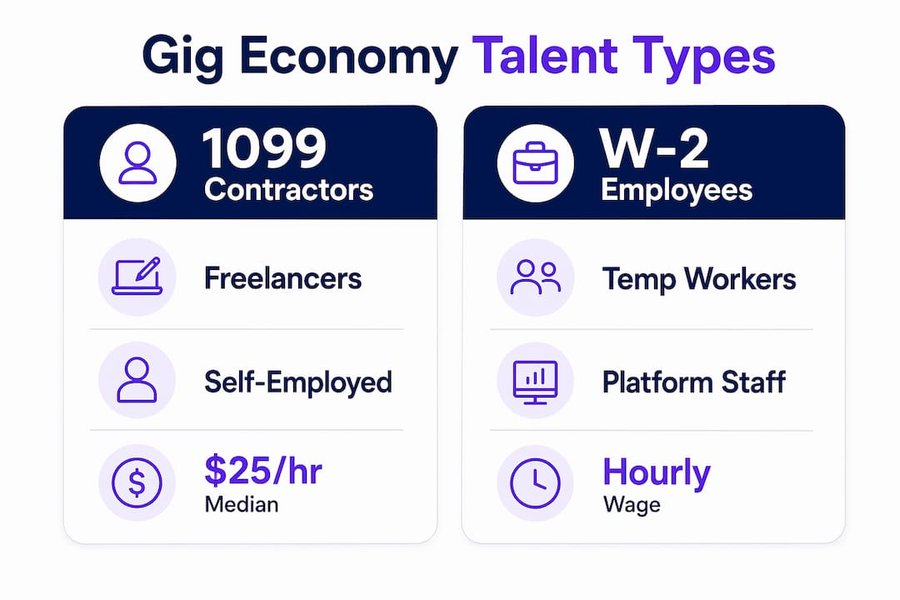
Gig talent splits into two distinct categories: independent contractors classified as 1099 workers and short-term W-2 employees placed through staffing agencies or direct temporary arrangements. These two groups differ significantly in skill level, compensation, autonomy, and the strategic value they deliver.
Independent contractors set their own rates, manage their own taxes, and typically bring specialized expertise that is difficult to source through traditional hiring. Temporary W-2 employees work under closer supervision, receive employer-managed payroll, and fill volume-based or time-sensitive operational needs. The economic divide between these two groups is significant. A $25/hr contractor and a $15/hr temp worker require entirely different hiring strategies, onboarding processes, and performance frameworks.
- Independent contractors are best suited for technical projects, product development, strategic consulting, and roles requiring deep domain expertise.
- Temporary W-2 employees are best suited for operational scale-up, seasonal demand, and roles with defined, repeatable tasks.
- Fractional executives represent a high-value subset of independent contracting, where senior leaders such as CTOs or CMOs engage part-time across multiple organizations.
- Platform-sourced gig workers operate through apps like Uber, DoorDash, or Upwork and are typically classified as independent contractors, though classification disputes remain active in multiple jurisdictions.
Pro Tip: When building a gig talent strategy, map each open role to one of these two categories before sourcing. Misclassifying a contractor as a temp employee, or vice versa, creates legal risk and misaligned compensation expectations from day one.
What are the advantages and challenges of gig economy work?
Gig work benefits organizations and workers in measurable ways, but those benefits come with real structural trade-offs. Understanding both sides is necessary for any workforce planning decision.
The core advantages for organizations include:
- Rapid scaling. Companies can expand or contract their workforce within days rather than months, without the fixed costs of full-time headcount.
- Access to specialized expertise. A FinTech startup can engage a blockchain architect for a 60-day integration project without committing to a full-time salary and benefits package.
- Cost efficiency. Gig workers are not entitled to employer-sponsored health insurance, retirement contributions, or paid leave under most current US classifications, which reduces total compensation costs.
- Geographic flexibility. Organizations can source talent from any market, including high-skill, cost-competitive regions like Latin America, without requiring relocation.
Flexibility in gig work comes with precarity: income volatility, algorithmic management controls, and the absence of standard employment benefits create real risks for workers. A global review of gig work studies from 2018 to 2024 found that autonomy and flexibility were consistently offset by financial instability and limited career progression pathways. This matters to organizations because precarity directly affects worker retention and output quality.
“Although offering flexibility, gig work also intensifies precarity and uneven income among workers, affecting retention and performance.” — Exploring the Work Perceptions and Experiences of Gig Workers Globally, MDPI 2024
Legal classification and engagement structures require discipline for contractor arrangements. Misclassification of workers as independent contractors when their working conditions resemble employment is an active enforcement area for the IRS and Department of Labor. Organizations that engage gig talent without structured contracts, defined deliverables, and clear separation of control expose themselves to back-tax liability and penalties.
The practical takeaway: gig talent delivers maximum value when organizations treat workers fairly, pay competitively, and maintain clean legal frameworks. Cutting corners on classification or compensation increases turnover and legal risk simultaneously.
How can organizations integrate gig talent into workforce planning?
Organizations that treat gig talent only as temporary fillers miss the strategic value in rapid scaling and expert access. The most effective approach treats the contingent workforce as a permanent, data-driven layer of the overall talent strategy, not a reactive patch for headcount gaps.
Practical integration starts with three structural decisions:
- Define the gig talent use cases. Identify which roles in your organization are genuinely project-scoped versus those that require institutional continuity. Engineering sprints, product launches, market research, and compliance audits are natural fits for gig talent. Core infrastructure roles are not.
- Build a pre-vetted talent pipeline. Waiting until a need is urgent means accepting whoever is available. Organizations that maintain relationships with qualified contractors, or work with specialized recruitment partners, can fill critical roles in days rather than weeks. Tools like AI-assisted sourcing have materially reduced the time required to identify and screen qualified gig candidates.
- Establish performance frameworks before engagement. Define deliverables, milestones, and quality standards in writing before a gig worker starts. This protects both parties legally and gives the organization clear criteria for evaluating whether to extend, convert, or end the engagement.
Managing gig talent also requires attention to platform and tool selection. Project management platforms like Jira, Asana, and Linear integrate gig contributors into team workflows without requiring full system access. Payroll and compliance tools like Deel and Remote handle contractor payments across jurisdictions, reducing administrative burden and classification risk.
Pro Tip: Before converting a high-performing gig worker to a full-time role, run a structured 30-day project evaluation. Assess output quality, communication cadence, and cultural fit. This data makes the conversion decision defensible and reduces mis-hires.
AI automation tools are increasingly used to manage gig worker scheduling, performance tracking, and payment processing at scale. For organizations managing more than 20 active contractors simultaneously, automation is not optional. It is the only way to maintain compliance and visibility without dedicated headcount.
What trends are shaping the gig economy workforce in 2026?
The gig economy workforce is growing fastest among younger workers, and that demographic shift is changing how organizations source and retain contingent talent. Daily active users for top gig apps among 17–25 year-olds grew by up to 97.5% year-over-year in Q2 2026. Overall daily active users across the six largest gig apps rose 19.0% year-over-year in the same period. Gen Z is not just using gig platforms. They are building careers on them.
Gig work is often multi-app: workers manage 2–3 platforms simultaneously to maximize income. Cross-app overlap is highest on major services like DoorDash and Uber, where workers treat platform switching as a standard income optimization strategy. This behavior has a direct implication for workforce planning. A gig worker’s availability is not guaranteed simply because they accepted your project. Competing platforms and higher-paying opportunities will pull them away if your engagement terms are not competitive.
For organizations sourcing remote LATAM talent, these trends create a specific opportunity. Latin American markets, particularly Argentina, Brazil, Mexico, and Colombia, have seen rapid growth in English-speaking technical talent willing to engage on project-based terms. Time zone alignment with US teams, competitive compensation relative to North American rates, and strong technical education pipelines make LATAM one of the most productive sources of gig and contract talent for US and European companies.
Key takeaways
Gig economy talent is a permanent, strategically valuable workforce layer that requires deliberate classification, fair compensation, and structured performance management to deliver consistent results.
The gig workforce is a strategic layer, not a safety net
I have spent years watching organizations treat contingent workers as a fallback option, something you reach for when a full-time hire falls through or a project deadline accelerates unexpectedly. That framing is expensive and wrong.
The most effective workforce strategies I have seen treat gig talent as a permanent, planned layer of the organization. They know in advance which roles will always be project-scoped, which skills they will never need full-time, and which markets produce the best contractors for those needs. They do not scramble. They source continuously and maintain relationships with pre-vetted workers who can activate quickly.
The precarity issue is real and deserves honest attention. Workers who face income volatility and algorithmic management do not deliver their best work. Organizations that pay fairly, communicate clearly, and structure projects well get better output and better retention from their gig talent. That is not idealism. It is a practical performance observation.
The demographic data from 2026 confirms what I have observed directly: Gen Z is building careers in the gig economy by choice, not by necessity. That changes the talent relationship. These workers have options, platform alternatives, and a low tolerance for disorganized engagements. Organizations that adapt their management style to meet that reality will win the best contingent talent. Those that do not will cycle through mediocre options indefinitely.
— Eugene
How Gentyrecruitment helps you hire flexible tech talent
Gentyrecruitment specializes in connecting US and European tech companies with pre-vetted, English-speaking talent from Latin America, including contract, project-based, and full-time roles across FinTech, AI, and SaaS. Whether you need a fractional CTO for a product sprint or a full engineering team for a long-term build, Gentyrecruitment’s structured assessment process delivers qualified candidates faster than traditional hiring cycles.
For organizations ready to treat gig and remote talent as a strategic workforce layer, Gentyrecruitment provides IT recruitment in LATAM with a process built for speed, technical depth, and global team integration. You can also explore remote LATAM talent hiring to source contract and flexible workers across Argentina, Brazil, Mexico, and Colombia. Contact Gentyrecruitment to discuss your contingent workforce needs and get matched with candidates who are ready to contribute from day one.
FAQ
What is gig economy talent in simple terms?
Gig economy talent refers to workers who take on short-term, flexible, or project-based work outside traditional full-time employment, including independent contractors, freelancers, and temporary employees. The standard industry term for this group is the contingent workforce.
How does a 1099 contractor differ from a temp employee?
A 1099 independent contractor sets their own rates, manages their own taxes, and earns a median of $25/hr, while a temporary W-2 employee earns a median of $15/hr and works under closer employer supervision. These two categories require distinct hiring strategies and legal frameworks.
What are the biggest risks of using gig workers?
The primary risks are worker misclassification, income volatility affecting performance, and multi-platform availability conflicts. Organizations that misclassify contractors as employees, or vice versa, face IRS penalties and back-tax liability under current US labor law.
Why is gen z driving gig economy growth in 2026?
Daily active users for top gig apps among 17–25 year-olds grew by up to 97.5% year-over-year in Q2 2026, indicating that younger workers are actively choosing platform-based and project-based work as a primary career model rather than a supplement to traditional employment.
How can organizations retain high-quality gig talent?
Organizations retain top contingent workers by offering competitive pay, clear project scopes, and structured communication. Workers active on multiple platforms simultaneously will prioritize engagements that offer the best combination of compensation, clarity, and professional respect.