

White-collar recruitment is the systematic process of sourcing and hiring professionals for office-based, knowledge-driven roles that require specialized education, credentials, and experience. Industries like finance, law, information technology, and marketing rely on this hiring discipline to fill managerial, administrative, and technical positions where cognitive output drives business value. For hiring managers and HR professionals, understanding what white-collar recruitment involves means mastering a distinct set of sourcing strategies, assessment frameworks, and candidate engagement practices that differ substantially from other hiring models. Tools like LinkedIn Recruiter, hireEZ, and Recruitment Process Outsourcing (RPO) models are standard infrastructure in this space.
What is white-collar recruitment and how does it work?
White-collar recruitment covers the full hiring lifecycle for professional roles where the primary output is intellectual rather than physical. This includes positions in corporate finance, software engineering, legal services, executive leadership, sales management, and human resources itself. The term originates from the historical distinction between office workers in dress shirts and manual laborers, but today it maps cleanly onto any role requiring a degree, professional certification, or specialized domain expertise.
The scope of white-collar job recruitment extends well beyond posting a job description on LinkedIn. It includes proactive sourcing of passive candidates who are not actively looking, structured competency-based screening, multi-stage interview processes, and offer negotiation that accounts for total compensation packages including equity, benefits, and remote work terms. Each of these stages demands a different skill set from the recruiter and a different level of engagement from the hiring team.
What distinguishes this model from general hiring is the emphasis on fit at multiple levels: technical competency, leadership behavior, cultural alignment, and long-term growth potential. A financial controller hire at a Series B SaaS company, for example, requires assessing not just accounting credentials but also the candidate’s ability to build reporting infrastructure from scratch and communicate with a non-finance board. That level of scoping demands a structured hiring brief, not a keyword-matched job post.
Before you start hiring
Check location, salary, and hiring fit
If you are moving from research to action, start with the market basics so your hiring plan is clearer.

How does white-collar recruitment differ from blue-collar hiring?
The contrast between white-collar and blue-collar recruitment is not just about job titles. It reflects fundamentally different candidate profiles, sourcing channels, screening criteria, and hiring timelines.
Blue-collar recruitment focuses on manual, trade, and hourly roles in construction, manufacturing, logistics, and skilled trades. Sourcing happens through job boards like Indeed, trade-specific platforms, staffing agencies, and local referral networks. Speed is the primary metric. White-collar hiring, by contrast, prioritizes fit precision over fill speed, uses professional networks and executive search firms, and involves multiple stakeholders in the decision process.
The practical implication for HR teams is that white-collar hiring strategies cannot be borrowed from high-volume blue-collar playbooks. Passive candidate sourcing, structured behavioral interviews, and calibrated salary benchmarking are non-negotiable components of an effective white-collar recruitment process.
Key differences that shape your sourcing approach:
- White-collar candidates are often not actively job searching, requiring outbound discovery and personalized outreach
- Hiring decisions involve multiple stakeholders, extending the interview cycle to four to six rounds in senior roles
- Employer brand and candidate experience directly affect offer acceptance rates in competitive talent markets
- Compensation benchmarking must account for equity, remote work premiums, and total rewards, not just base salary
What are the key stages of the white-collar recruitment process?
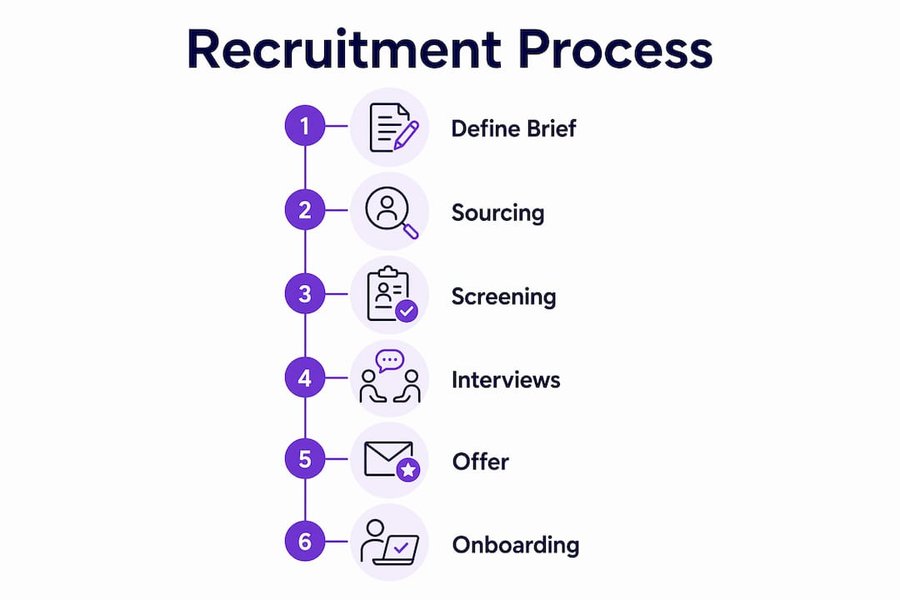
The most effective white-collar hiring process follows a full-cycle recruiting model where a single recruiter or a tightly coordinated team owns every stage from intake through onboarding. This model improves accountability, reduces handoff errors, and creates a more consistent candidate experience.
The stages break down as follows:
<p>Intake and hiring brief. The recruiter meets with the hiring manager to define the role by outcomes, not just responsibilities. What does success look like at 90 days? What leadership behaviors are non-negotiable? What is the calibrated salary range? Scoping hires by outcomes rather than keyword lists prevents wasted sourcing effort and produces a more relevant shortlist.</p>
<p>Sourcing. Active candidates arrive through job boards and referrals. Passive candidates require a research-plus-contact strategy: mapping target employers, identifying relevant profiles on LinkedIn or hireEZ, and crafting individualized first-touch messages. Warm referrals significantly outperform cold outreach in conversion rates, which is why building a referral network is a long-term competitive advantage.</p>
<p>Screening and assessment. Phone screens filter for baseline competency and motivation. Structured competency-based interviews assess leadership behaviors and domain expertise. For technical white-collar roles in engineering or finance, skills assessments or case studies add an objective layer to the evaluation.</p>
<p>Interview coordination. Managing a four-round interview process across multiple stakeholders requires deliberate scheduling, clear evaluation rubrics, and prompt feedback loops. Candidate drop-off at this stage is a direct cost. Every day of delay increases the risk of losing a finalist to a competing offer.</p>
<p>Offer management and close. Offer management in white-collar hiring is a negotiation, not a formality. Recruiters who understand total compensation structures, including equity vesting schedules and remote work stipends, close offers faster and with fewer counteroffers.</p>
Pro Tip: Write the hiring brief before you open the requisition. A one-page document covering the role’s 90-day outcomes, must-have behaviors, salary range, and deal-breakers will cut your sourcing time by a measurable margin and prevent misaligned shortlists.
What are the biggest trends and challenges in white-collar hiring for 2026?
The 2026 market for white-collar job recruitment is defined by selective demand rather than broad growth. Employers are slowing entry-level office and tech hiring while increasing investment in skilled trades and infrastructure roles. This signals a structural shift, not a temporary slowdown, and requires HR teams to adapt their sourcing and positioning strategies accordingly.
The most significant forces reshaping white-collar recruitment right now:
- AI integration in recruiting workflows. Tools like hireEZ, Gem, and Beamery automate candidate discovery, outreach sequencing, and pipeline tracking. Hybrid recruiting models that combine human relationship management with AI-assisted sourcing are becoming the operational standard for high-performing talent teams.
- Increased competition for senior talent. As entry-level hiring slows, competition intensifies for experienced professionals with proven track records. Passive candidate sourcing and warm referral networks become more valuable, not less.
- Remote and nearshore hiring expansion. US and European tech companies are accelerating hiring from Latin America, where English-speaking professionals in FinTech, AI, and SaaS offer strong technical credentials at competitive salary points. This geographic expansion requires recruiters to understand cross-border compensation benchmarking and compliance.
- RPO adoption for capacity management. Recruitment Process Outsourcing can reduce cost-per-hire by about 30% and compress time-to-fill. That figure matters because it means an RPO engagement often pays for itself within the first two or three hires, especially for teams managing multiple simultaneous requisitions.
The core challenge in this environment is quality over volume. Hiring managers who treat white-collar recruitment as a numbers game, sending high volumes of generic outreach and reviewing hundreds of keyword-matched resumes, consistently produce worse outcomes than teams that invest in precise sourcing and structured assessment.
What strategies actually improve white-collar recruitment outcomes?
Improving white-collar hiring outcomes requires changes at the process level, not just the tactical level. The following strategies produce measurable results across sourcing quality, time-to-fill, and offer acceptance rates.
Define roles by outcomes, not job descriptions. The most common failure in white-collar recruitment is a misaligned hiring brief that lists responsibilities without defining success criteria. Replace bullet-point job descriptions with outcome statements: “Build and manage a three-person FP&A team capable of delivering monthly close in five business days within the first quarter.”
Build a systematic sourcing infrastructure. Treating sourcing as a dedicated system means maintaining target employer lists, tracking outreach conversion rates by message type, and segmenting your pipeline by engagement stage. Individualized first-touch messaging and meticulous conversion tracking are the operational backbone of passive candidate sourcing for senior roles.
Use retained executive search for senior hires. For VP-level and above positions, a retained executive search process produces a shortlist of three to five calibrated finalists from a sourcing campaign that typically maps 80 to 100 candidates and generates 15 to 25 exploratory conversations. That funnel math is why retained search outperforms contingency models for senior white-collar roles.
Integrate AI tools for repetitive tasks. AI call coaching platforms like OffBook help recruiters improve their screening and interview conversations in real time, reducing the quality variance that comes from high-volume interview schedules. Pairing AI tools with human judgment produces better candidate assessments than either approach alone.
Partner with an RPO provider when internal capacity is the constraint. When your team is managing five or more open white-collar requisitions simultaneously, recruitment process outsourcing embeds sourcing infrastructure and vetting frameworks directly into your hiring pipeline without the overhead of expanding your internal team.
Pro Tip: Track your sourcing-to-screen conversion rate by channel. If LinkedIn outreach converts at 8% but warm referrals convert at 35%, that data tells you exactly where to invest more recruiter time.
Key takeaways
White-collar recruitment produces better outcomes when hiring teams invest in precise briefing, systematic sourcing, and structured assessment rather than high-volume, keyword-driven processes.
Why most white-collar hiring problems start at the brief
After working across hundreds of white-collar hiring engagements, the pattern is consistent: the roles that stall, produce weak shortlists, or end in declined offers almost always trace back to a poorly scoped intake conversation. Hiring managers describe the role in terms of what the last person did, not what the next person needs to accomplish. Recruiters build sourcing strategies around keyword lists instead of behavioral profiles. The result is a pipeline full of technically qualified candidates who are wrong for the actual job.
The second pattern I see repeatedly is over-reliance on inbound applications for roles that genuinely require outbound sourcing. A senior product manager with a track record of shipping B2B SaaS features is not browsing job boards. Reaching that person requires employer mapping, a warm introduction through a mutual connection, and a first message that speaks directly to their career trajectory. Recruiters who wait for the right candidate to apply are waiting for something that will not happen.
AI tools are changing the mechanics of sourcing, but they are not changing the underlying logic. You still need a precise brief, a targeted sourcing strategy, and a candidate experience that respects the professional’s time. What AI does is remove the administrative friction from those steps, freeing recruiters to spend more time on the conversations that actually move candidates through the funnel. The recruiters who will win in 2026 are the ones who use AI to do more of the right work, not more of the wrong work faster.
For niche white-collar roles, particularly in FinTech, AI infrastructure, and executive leadership, partnering with a specialist agency is often the most efficient path. Internal teams rarely maintain the market maps, referral networks, and sector-specific assessment frameworks that a focused recruitment partner builds over years of working in a single domain.
— Eugene
How Gentyrecruitment supports white-collar hiring for tech companies
Gentyrecruitment specializes in white-collar recruitment for US and European tech companies hiring across FinTech, AI, SaaS, and adjacent sectors. The team delivers pre-vetted, English-speaking professionals from Latin America, covering IT recruitment, sales hiring, and LATAM executive search for senior leadership roles. Every engagement combines structured assessment, AI-assisted sourcing, and hands-on recruiting to produce qualified shortlists faster than most internal teams can manage alone.
If your team is managing multiple open white-collar requisitions or needs a specialist partner for a senior hire, Gentyrecruitment provides full-cycle support from intake through offer close. Reach out at gentyrecruitment.io to discuss your current hiring priorities.
FAQ
What is white-collar recruitment?
White-collar recruitment is the process of sourcing and hiring professionals for office-based, knowledge-driven roles that require specialized education and experience, including positions in finance, law, IT, and management.
How does white-collar recruitment differ from blue-collar recruitment?
White-collar recruitment focuses on salaried professional roles using sourcing channels like LinkedIn and executive search, while blue-collar recruitment targets manual and trade roles using high-volume, speed-focused methods through platforms like Indeed.
What does full-cycle white-collar recruiting involve?
Full-cycle recruiting covers every stage from intake and hiring brief through sourcing, screening, interviews, and offer management, with a single recruiter or coordinated team owning the entire process for consistency and accountability.
When should a company use retained executive search?
Retained executive search is the right model for VP-level and above white-collar roles, where a structured sourcing campaign of 80 to 100 candidates produces a calibrated shortlist of three to five finalists with detailed assessment dossiers.
What is RPO and how does it help white-collar hiring teams?
Recruitment Process Outsourcing embeds an external team’s sourcing infrastructure and vetting frameworks into your hiring pipeline, reducing cost-per-hire by about 30% and compressing time-to-fill when internal capacity is the primary constraint.