

Interim staffing is defined as a hiring model where organizations bring in skilled professionals to temporarily fill critical roles for a defined period, whether to cover a leave of absence, manage a project surge, or maintain continuity during a leadership transition. Unlike open-ended employment, interim roles are structured around a clear window of need, giving hiring managers a precise, controlled way to address talent gaps without committing to permanent headcount. Companies like BDO use interim staffing in finance and accounting to match the right skills to special projects, while organizations like Loring Sternberg apply it in the nonprofit sector to preserve operational momentum. Forbes has noted that interim leadership, a related model, is increasingly expected to drive immediate results rather than simply hold the line.
What is interim staffing and why does it matter?
Interim staffing is the practice of engaging temporary, pre-vetted professionals to fill specific roles for a defined duration, typically ranging from a few weeks to over a year. The model sits between traditional temporary staffing and permanent hiring, occupying a middle ground that prioritizes both skill specificity and schedule flexibility. It is not a stopgap measure. It is a deliberate workforce strategy.
The distinction matters because hiring managers often conflate interim staffing with general temp work. Temporary staffing typically addresses operational, lower-skill roles without management responsibility. Interim staffing, by contrast, fills more critical roles that often require specialized expertise and, in some cases, a degree of strategic involvement. A company bringing in a senior financial analyst to manage a regulatory audit is using interim staffing. A company hiring a warehouse worker for peak season is using temporary staffing.
For business leaders, the practical implication is significant. Interim staffing gives you access to professionals who are ready to contribute from day one, without the months-long recruitment cycle that permanent hiring requires. That speed, combined with role-specific expertise, is what makes the model worth understanding in depth.
Planning a hire?
Talk through the best hiring option
This article usually leads to one practical question: should you use staffing or salary guide? We can help you choose quickly.
Simple next step
Start with staffing and we will help you pick the best hiring setup.

Key benefits of interim staffing solutions
The benefits of interim staffing extend well beyond filling a seat. When applied correctly, the model delivers measurable advantages across cost, capability, and continuity.
- Workforce flexibility. You scale your team up or down based on actual project demands rather than projected headcount. BDO highlights this as a core advantage in finance and accounting, where fluctuating workloads make permanent overstaffing inefficient and costly.
- Access to specialized skills. Interim professionals are typically brought in precisely because they have expertise your current team lacks. This is especially relevant in technology, where a specific stack or compliance requirement may demand a specialist for a defined sprint or integration cycle.
- Cost efficiency. Interim staffing allows payment only for project-related work, eliminating recruitment costs, benefits overhead, and long-term retention expenses associated with permanent hires. For short-term needs, this model consistently outperforms full-time hiring on a cost-per-output basis.
- Operational continuity. When a key team member departs unexpectedly or a critical project demands additional capacity, interim staffing prevents the productivity loss that typically follows. The organization keeps moving while a permanent solution is identified.
- Relationship building with staffing partners. Organizations that work repeatedly with the same interim staffing providers develop faster, more accurate placements over time. The provider learns your culture, technical requirements, and team dynamics, which reduces onboarding friction with each successive engagement.
Pro Tip: Before engaging an interim staffing provider, document the specific skills, tools, and deliverables the role requires. Providers who receive a precise brief return candidates who are genuinely ready to contribute, not just broadly qualified.
How does interim staffing work in practice?
Understanding how interim staffing works operationally helps hiring managers set realistic expectations and get the most from each engagement. The process follows a clear sequence, though the specifics vary by industry and role complexity.
- Define the need. Identify the gap: what role needs to be filled, what skills are required, and how long the engagement will last. Interim staffing is not just adding headcount. It is targeted capacity aligned with specific project demands and skill gaps.
- Engage a staffing partner. Work with a provider who specializes in your industry or function. Share a detailed brief covering technical requirements, team context, and expected deliverables. Providers with deep candidate networks can return a shortlist within days.
- Vet and select the candidate. Interim professionals are typically assessed for both technical competency and their ability to integrate quickly into unfamiliar environments. Reviewing a candidate’s prior interim experience is a reliable signal of their adaptability. You can learn more about structured vetting approaches in Gentyrecruitment’s guide on assessing technical and soft skills.
- Onboard with intention. Structured onboarding accelerates interim staff integration and productivity. Provide system access, policy documentation, and clear role expectations on day one. The faster an interim professional understands the environment, the faster they deliver value.
- Manage the engagement actively. Set milestones, schedule regular check-ins, and clarify how success will be measured. Interim engagements in the nonprofit sector, for example, typically last 3 to 4 months initially, sometimes extending to a year or more, depending on how the organization’s needs evolve.
- Transition and close. Plan the handoff before the engagement ends. Interim staff who are well-integrated often document processes, train successors, or assist in hiring their permanent replacement, preserving institutional knowledge.
Pro Tip: Assign a dedicated internal contact to each interim professional. This single point of coordination reduces confusion, accelerates problem-solving, and signals to the interim hire that the organization is invested in their success.
Interim staffing vs temporary staffing: what’s the real difference?
Hiring managers frequently use these terms interchangeably, but the distinctions carry real consequences for how you structure an engagement and what you can expect from it.
Temporary staffing fills operational roles without management responsibility. Interim staffing fills critical roles that require specific expertise and, in some cases, cross-functional coordination. Interim leadership goes further: experienced managers take full operational and strategic responsibility on a temporary basis, with loyalty to the organization’s mission and direct accountability for staff outcomes.
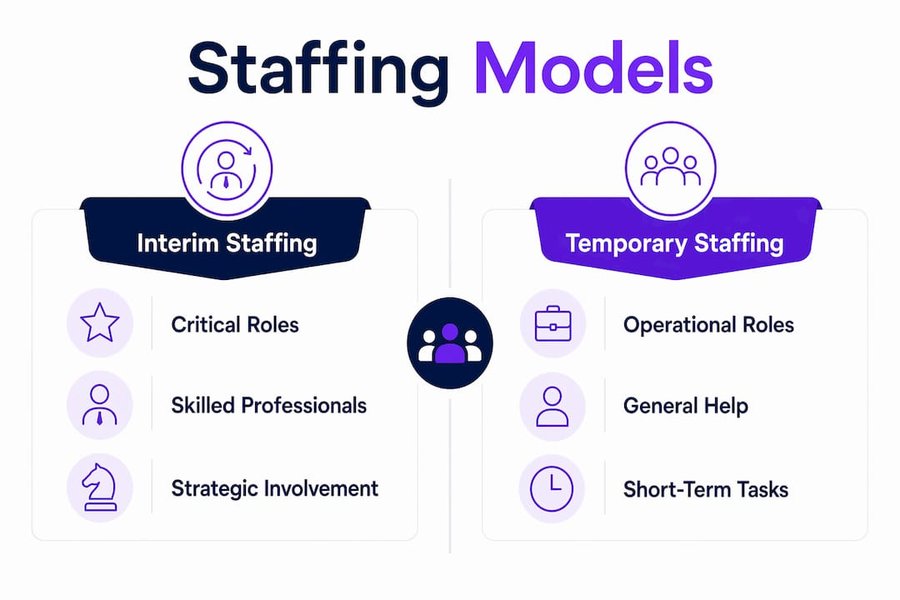
The practical test is straightforward. If the role requires someone to execute tasks within an existing structure, that is temporary staffing. If it requires someone to apply specialized judgment, manage deliverables independently, or interface with senior stakeholders, that is interim staffing. If it requires someone to run a function or drive organizational change, that is interim leadership.
The interim and fractional leadership market is evolving toward execution-focused placements that deliver immediate impact rather than just stability. This shift means the bar for interim professionals at every level is rising, and hiring managers should select accordingly.
Industries and real-world examples of interim staffing
Interim staffing applies across sectors, but certain industries have developed particularly mature and well-documented use cases.
- Finance and accounting. BDO uses interim staffing to address fluctuating project demands, placing curated talent for regulatory audits, system implementations, and financial close cycles. The model prevents overstaffing during quiet periods while maintaining full capacity when workloads spike.
- Nonprofit organizations. Loring Sternberg documents interim engagements that run 3 to 4 months initially, often extending as the organization works through leadership transitions. Interim staff in this context strengthen internal systems, support remaining employees, and assist in recruiting permanent replacements. The dual function of operational support and institutional continuity makes interim staffing especially valuable in resource-constrained environments.
- Technology and startups. Fast-growing tech companies face a recurring challenge: they need specialized engineers, product managers, or data analysts immediately, but the permanent hiring process takes months. Interim staffing fills that gap while the permanent search runs in parallel. Gentyrecruitment’s guide on speeding up tech hiring outlines how startups use this approach to maintain development velocity without sacrificing quality. For enterprise environments, cybersecurity and data analytics roles are increasingly filled through interim arrangements as the talent market for these specializations remains tight.
- Executive and functional leadership gaps. When a CFO, CTO, or VP of Sales departs unexpectedly, organizations cannot afford to leave the function unled for six months while a search runs. Interim executives step in with the mandate to move businesses forward immediately, not simply maintain stability. TrueBridge and similar firms have built entire practices around placing vetted interim leaders who accelerate transformation rather than pause it.
- Organizational change and transformation. Mergers, restructurings, and technology migrations all create temporary spikes in specialized demand. Interim staffing provides the capacity to execute these initiatives without permanently expanding the organization’s cost base.
Key takeaways
Interim staffing delivers the most value when organizations treat it as a deliberate workforce strategy, not a reactive fix, matching skilled professionals to defined needs with clear timelines and structured onboarding.
What I’ve learned about making interim staffing actually work
Most hiring managers approach interim staffing as a procurement exercise. They define a role, engage a provider, and wait for a candidate. That mindset produces mediocre results, and I’ve seen it play out repeatedly across technology and finance engagements.
The organizations that get the most from interim staffing treat the engagement as a leadership challenge, not a logistics task. The interim professional arrives with no institutional history, no established relationships, and no political capital. Interim leaders face the challenge of managing transitions with incomplete histories and shifting expectations, and this human reality applies to interim staff at every level, not just executives.
The single most underrated factor is prior interim experience. A candidate who has successfully completed three or four interim engagements has already learned how to build credibility fast, ask the right questions early, and deliver without the safety net of organizational familiarity. That track record is more predictive of success than technical credentials alone.
My honest recommendation: before you sign an engagement, ask the provider how they assess a candidate’s adaptability and speed to contribution, not just their domain expertise. The best interim staffing partners have a structured answer to that question. If they don’t, find a provider who does. The staffing strategy you build around remote and distributed teams requires the same rigor applied to interim placements, because the cost of a slow-starting interim hire is measured in weeks you cannot recover.
— Eugene
How Gentyrecruitment supports your interim staffing needs
Gentyrecruitment specializes in placing pre-vetted, English-speaking professionals from Latin America into technology and non-technology roles for US and European companies. When your organization needs skilled interim talent fast, whether for a FinTech project, a SaaS integration, or a sales function gap, Gentyrecruitment’s structured assessment process returns qualified candidates in days, not months. Explore IT recruitment in LATAM for technology roles, or review hiring across LATAM for broader interim placement needs across 14 countries. Contact Gentyrecruitment to discuss your specific requirements and receive a shortlist within five business days.
FAQ
What is interim staffing in simple terms?
Interim staffing is a hiring model where organizations bring in skilled professionals to fill a critical role for a defined period. It differs from general temp work because the roles require specific expertise and the engagements are structured around clear deliverables.
How long does an interim staffing engagement typically last?
Engagements commonly run 3 to 4 months initially, with extensions possible up to a year or more depending on organizational need. The duration is defined at the outset and adjusted based on project progress or transition timelines.
Is interim staffing more cost-effective than permanent hiring?
For short-term needs, interim staffing is consistently more cost-effective because organizations pay only for project-related work and avoid recruitment, benefits, and long-term retention costs associated with permanent employees.
What is the difference between interim staffing and interim leadership?
Interim staffing fills operational or specialized roles without formal management responsibility. Interim leadership places experienced executives or managers who take full strategic and operational ownership of a function on a temporary basis.
Which industries use interim staffing most often?
Finance and accounting, nonprofit organizations, technology companies, and executive functions all rely heavily on interim staffing. BDO and Loring Sternberg are documented examples of organizations that apply the model to manage project surges and leadership transitions.