

Talent pipelining is defined as the proactive process of identifying, engaging, and nurturing qualified candidates well before a role opens, so hiring teams always have a ready pool to draw from. Unlike reactive hiring, which starts from zero when a seat goes vacant, a talent pipeline treats recruitment as a continuous relationship-building system. Companies with mature talent pipelines fill open roles 38% faster and achieve 25% higher quality-of-hire scores compared to reactive hiring. That gap is widening as tech talent shortages push US and European companies to source engineers and sales professionals from Latin America, where Argentina, Brazil, Mexico, and Colombia offer deep talent pools with strong timezone alignment.
What is talent pipelining and how does it differ from reactive hiring?
Talent pipelining, also called candidate pipelining in some recruiting frameworks, is a structured workflow that runs parallel to day-to-day operations rather than activating only when a role opens. Reactive hiring waits for a vacancy, then posts a job, screens applicants, and hopes the right person applies within a tight window. A talent pipeline inverts that sequence entirely.
The industry standard, as defined by SHRM and widely adopted across enterprise talent acquisition teams, separates three distinct concepts that recruiters often conflate:
- Talent pool: A broad, loosely organized database of candidates who have expressed interest or been sourced at some point. No active relationship management is required.
- Talent pipeline: A curated, actively managed subset of that pool. Each candidate is segmented by role family, seniority level, and readiness. A recruiter owns each relationship and documents progress in a CRM.
- ATS applicant database: A record of people who applied to a specific job posting. This is reactive by design and does not constitute a pipeline.
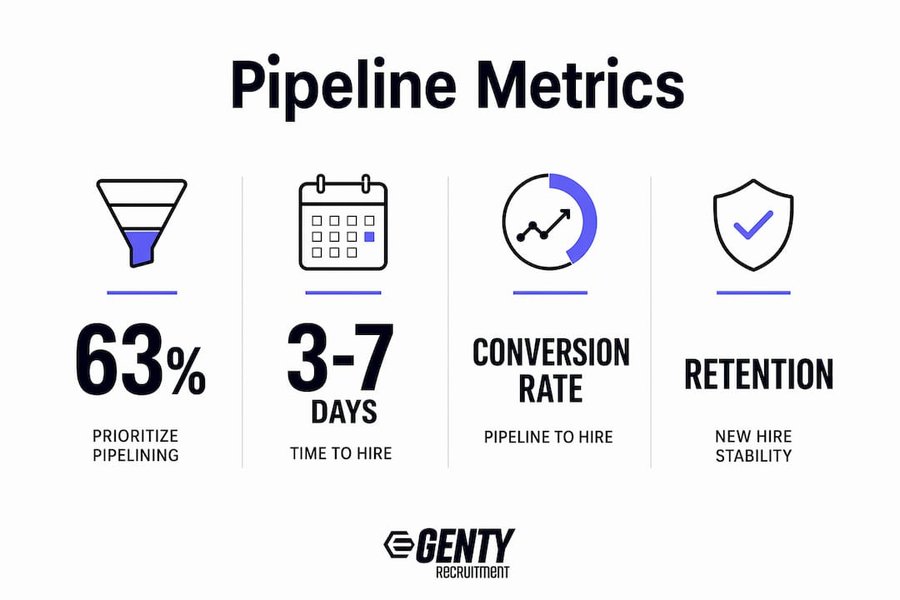
The distinction matters because pipeline candidates advance in 3–7 days from first contact to offer, compared to 14–30 days for candidates sourced reactively. That speed comes from prior qualification, established rapport, and mutual fit assessment completed before urgency sets in.
Planning a hire?
Talk through the best hiring option
This article usually leads to one practical question: should you use it recruitment or staffing? We can help you choose quickly.
Simple next step
Start with it recruitment and we will help you pick the best hiring setup.
Effective pipelining also requires starting candidate identification and engagement 6–18 months before anticipated openings. That lead time feels counterintuitive, but it reflects how long it takes to build genuine trust with passive candidates, especially senior engineers or specialized roles in FinTech and AI.

Pro Tip: Segment your pipeline by candidate readiness: “open to opportunities now,” “open in 3–6 months,” and “long-term relationship.” Tailor your outreach cadence to each group to avoid burning out candidates who are not ready to move yet.
How does talent pipelining improve hiring efficiency and quality?
The evidence for pipelining is concrete and measurable. 63% of recruiting organizations now prioritize building sustainable pipelines, and 48% name it their top hiring priority in 2026. That consensus reflects real performance data, not trend-following.
The metrics that matter most in a pipeline-enabled talent acquisition model are:
For US and European tech companies hiring in LATAM, these gains compound. LATAM’s timezone alignment with US EST/PST means pipeline candidates in Argentina or Colombia can participate in real-time interviews and onboarding without scheduling friction. Senior software engineers in Brazil and Mexico command salaries that are significantly lower than equivalent US-based roles, often saving companies up to 40% in total compensation cost, without sacrificing technical depth.
“The shift from transactional recruiting to relationship-driven pipelines is the single most impactful change a talent acquisition team can make. Warm candidates require fewer interviews, self-select out of bad fits, and accept offers faster because trust is already established.”
The key metrics to track in your own pipeline include pipeline-to-hire conversion rate, time from first contact to accepted offer, and new hire retention and promotion rates. These three data points tell you whether your pipeline is producing hires who stay and grow, which is the real measure of quality.
How to build a talent pipeline for LATAM tech recruitment
Building a talent pipeline for Latin American tech roles requires more precision than generic sourcing. The process starts with workforce planning aligned to your business roadmap, not just open headcount.
Define candidate personas before sourcing
A candidate persona for a senior DevOps engineer in Colombia looks different from one for a mid-level data scientist in Argentina. Map each persona by technical skills, years of experience, English proficiency level, preferred work arrangement, and salary expectations. LATAM tech professionals in FinTech and SaaS typically expect compensation in USD, which simplifies negotiation for US-based employers.
Build proactive sourcing channels
- Passive candidate outreach: Use LinkedIn, GitHub, and regional tech communities to identify engineers who are not actively job-seeking. These candidates make up the highest-value segment of any pipeline.
- Tech events and meetups: Communities in Buenos Aires, São Paulo, Mexico City, and Bogotá host regular developer events. Consistent presence builds brand recognition before you have an open role.
- Content and newsletters: Sharing genuine industry insights, not just job postings, keeps your brand visible to candidates who are months away from being ready to move.
- Referral networks: Engineers in LATAM refer within tight professional circles. One strong hire in Medellín can open access to a network of five more qualified candidates.
Document everything in a CRM
Recruiter ownership documented in a CRM is the operational backbone of any pipeline. Each candidate record should include the date of first contact, the role family they fit, their readiness status, and the name of the recruiter who owns the relationship. Without this structure, pipeline knowledge walks out the door when a recruiter leaves.
Pro Tip: Focus pipeline investment on senior, specialized, or scarce roles first. Reactive hiring works adequately for high-volume, entry-level positions. Your pipeline budget delivers the highest return on roles where the candidate market is thin and time-to-fill pain is acute.
Common challenges in talent pipelining and how to overcome them
Talent pipelining fails in predictable ways. Recognizing these patterns early prevents wasted effort and candidate attrition.
- Pipeline decay: Candidates go cold when outreach stops. A pipeline with no engagement cadence is just a spreadsheet. Set calendar-based touchpoints for every candidate, even if the message is simply sharing a relevant article or congratulating them on a career milestone.
- Recruiter turnover impact: When a recruiter leaves and takes their candidate relationships with them, the pipeline collapses. Clear CRM documentation and defined handoff protocols prevent this. Every relationship must live in the system, not in someone’s inbox.
- Generic outreach fatigue: Mass emails with job descriptions destroy pipeline credibility. Personalized communication, including role-specific context and genuine interest in the candidate’s career trajectory, outperforms templated blasts by a significant margin.
- Misaligned pipeline scope: Trying to pipeline every role type simultaneously spreads resources too thin. Strategic-priority mapping focuses pipeline effort on roles where reactive hiring consistently fails, typically senior engineers, niche specialists, and leadership positions.
- Over-engagement: Contacting candidates too frequently signals desperation and erodes trust. A quarterly touchpoint for long-horizon candidates is sufficient to maintain warmth without creating pressure.
Pro Tip: Segment your pipeline communication by candidate readiness tier. Candidates who are 6+ months from a move need value-driven content, not job alerts. Save direct role conversations for candidates who have signaled active interest.
Key Takeaways
Talent pipelining is the most reliable method for reducing time-to-fill, improving hire quality, and building a hiring advantage that compounds over time.
Why I think most companies pipeline the wrong way
The most common mistake I see is treating a talent pipeline as a sourcing list rather than a relationship system. Companies build a spreadsheet of 200 names, send one LinkedIn message, and call it a pipeline. Six months later, none of those candidates respond because no real relationship was ever established.
Visible leadership engagement is the factor most teams underestimate. When a VP of Engineering or a CTO personally reaches out to a senior candidate, the response rate and quality of conversation changes immediately. High-tier candidates, especially passive ones in competitive LATAM markets, respond to genuine peer-level interest, not recruiter templates.
The LATAM market has a specific dynamic worth understanding. Engineers in Argentina and Colombia are increasingly sophisticated about their options. They receive multiple inbound messages weekly from US companies. What cuts through is specificity: knowing their tech stack, referencing their actual work, and being honest about the role’s challenges. Generic outreach fails faster here than anywhere else I have worked.
The transition from transactional to relationship-focused recruiting is the hardest part of building a real pipeline. It requires patience, consistent effort, and a willingness to invest in candidates who will not be ready to hire for months. The companies that commit to that investment consistently outperform those that do not, both in speed and in the caliber of people they ultimately hire.
— Eugene
GENTY recruitment’s approach to talent pipelining in LATAM
GENTY recruitment operates a pre-vetted candidate network across Argentina, Brazil, Mexico, Colombia, and Chile, built specifically for US and European tech companies that need to hire fast without sacrificing quality.
The GENTY recruitment process is designed around the same principles that make talent pipelining work: proactive sourcing, skill-first qualification, and relationship-driven candidate management. Clients receive curated shortlists within 7 days, with fixed-fee pricing per seniority level and a 3-month replacement guarantee. For companies ready to access IT recruitment in LATAM at a fraction of US hiring costs, GENTY recruitment provides the pipeline infrastructure without the overhead of building it internally. Timezone overlap with US EST and PST means your new hire is available during your core working hours from day one.
FAQ
What is talent pipelining in simple terms?
Talent pipelining is the practice of building and maintaining relationships with qualified candidates before a job opening exists. It replaces reactive, post-vacancy sourcing with a continuous engagement system that produces faster, higher-quality hires.
How early should you start building a talent pipeline?
Candidate identification and engagement should begin 6–18 months before an anticipated opening. That lead time allows recruiters to qualify candidates, build trust, and assess fit without the pressure of an urgent vacancy.
What is the difference between a talent pool and a talent pipeline?
A talent pool is a broad database of potential candidates with no active management. A talent pipeline is a curated subset with defined recruiter ownership, CRM documentation, candidate segmentation, and a regular engagement cadence.
What metrics measure talent pipeline success?
The three core metrics are pipeline-to-hire conversion rate, time from first contact to accepted offer, and new hire retention rate at 6 and 12 months. Together, they show whether the pipeline produces hires who are both fast to place and durable in role.
Why is LATAM a strong region for talent pipelining?
LATAM offers a deep pool of English-proficient tech professionals in countries like Argentina, Brazil, Mexico, and Colombia, with timezone overlap matching US EST and PST hours. Salary ranges are significantly lower than US equivalents, making pipeline investment in the region highly cost-efficient for US and European tech companies.