

Talent retention is defined as the strategic process of keeping high-performing, high-potential, and critical employees engaged, motivated, and committed to an organization over the long term. For tech startups, where institutional knowledge and specialized skills are concentrated in small teams, losing a single senior engineer or product lead can set a roadmap back by months. Voluntary turnover costs U.S. businesses roughly $1 trillion annually, a figure that reflects not just recruitment fees but lost productivity, team disruption, and eroded morale. Gallup, Mercer, and the Work Institute all confirm that most of this loss is preventable. The organizations that retain talent most effectively treat it as a continuous management discipline, not a one-time HR initiative.
What is talent retention vs. general employee retention?
Talent retention and employee retention are related but not interchangeable. Employee retention refers to keeping the overall workforce stable, measuring aggregate turnover rates across all roles and levels. Talent retention is more surgical. It focuses on high-potential employees and critical roles, directing resources toward the people whose departure would cause disproportionate damage to the business.

In a 50-person SaaS startup, this distinction matters enormously. Losing a junior QA analyst is manageable. Losing your lead ML engineer or VP of Engineering triggers a cascade of delays, knowledge gaps, and team instability that no amount of rapid hiring fully repairs. Talent retention strategy, as defined by Greenhouse, demands that HR leaders identify which roles are scarce, which employees are high-impact, and which individuals are flight risks before they resign.
The metrics differ as well. General employee retention tracks overall headcount stability and voluntary turnover rates. Talent retention programs measure:
Planning a hire?
Talk through the best hiring option
This article usually leads to one practical question: should you use it recruitment or staffing? We can help you choose quickly.
Simple next step
Start with it recruitment and we will help you pick the best hiring setup.
- Retention rate of high performers (typically the top 20% by performance review)
- Critical role vacancy duration after departure
- Regrettable turnover rate, which counts only the departures the organization genuinely wanted to prevent
- Engagement scores for identified high-potential employees, tracked separately from company-wide averages
Asanify’s research draws a further distinction worth noting: retention and engagement are separate constructs. An employee can remain on payroll while quietly disengaging, delivering minimum effort, and planning an exit. Talent retention programs that focus only on keeping people from leaving, without addressing why they stay, produce a workforce that is present but not productive.
What factors most influence talent retention in tech startups?
Understanding why top performers leave is the foundation of any effective retention program. The causes are more predictable than most startup leaders assume.
<p>Burnout from unsustainable workloads. DDI’s research confirms that burnout drives top talent out faster than almost any other factor, and that leadership behavior is the primary lever. Managers who pile on scope without adjusting timelines or resources create the conditions for departure, regardless of salary.</p>
<p>Career development deficits. This is the most consistent finding in retention research. Career growth ranks as the top reason employees leave, outranking compensation and management quality. For tech professionals, this means visible promotion pathways, access to new technologies, and opportunities to build skills that remain marketable.</p>
<p>Weak or unclear leadership. Engineers and product managers in startups frequently cite poor communication from leadership as a reason for leaving. When strategic direction shifts without explanation, or when managers fail to advocate for their teams, trust erodes quickly.</p>
<p>Compensation that falls behind the market. Base salary matters, but total compensation, including equity, bonuses, and benefits, determines whether a tech professional sees a long-term financial case for staying. Startups that do not benchmark salaries regularly against LATAM and North American market rates lose talent to competitors who do.</p>
<p>Absence of recognition and belonging. Wellhub’s 2026 research shows that effective retention integrates wellbeing into business objectives rather than relying on surface-level perks like ping-pong tables or free lunches. Employees who feel seen, valued, and connected to a mission stay longer than those who receive only transactional rewards.</p>
Pro Tip: Run a quarterly “stay interview” with your top 10% of performers. Ask directly: what would make you consider leaving, and what would make you stay? The answers will surface retention risks months before a resignation letter arrives.
The data from Pin confirms that 75% of departures are preventable, which means the majority of tech startup attrition is a management and culture problem, not an inevitable market reality. That reframing changes what HR leaders should prioritize.
Which retention strategies actually reduce turnover in tech startups?
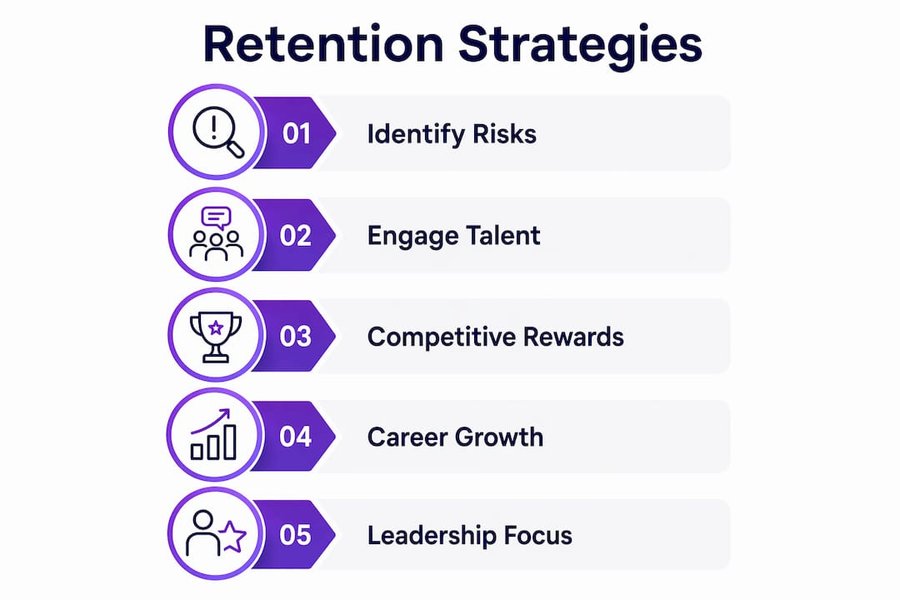
Evidence-based retention strategies for tech startups fall into five categories, each targeting a different driver of departure.
<p>Competitive total rewards packages. Salary alone no longer closes the gap. Startups that combine base pay with equity, performance bonuses, and flexible benefits retain engineers at higher rates than those offering salary alone. Benchmarking against current IT recruitment trends in LATAM and North American markets keeps compensation competitive without overspending.</p>
<p>Structured onboarding that extends beyond day one. A strong onboarding process improves new hire retention by 82% and productivity by over 70%. Most startups treat onboarding as a two-week administrative exercise. The organizations with the lowest early attrition run structured integration programs through the first 90 days, assigning mentors, setting clear 30/60/90-day goals, and conducting formal check-ins at each milestone.</p>
<p>Manager training on coaching and workload management. DDI’s research is direct: retention is a leadership behavior. Investing in manager development, specifically in how to give feedback, manage scope, and communicate strategic context, produces measurable retention gains. This is one of the highest-ROI investments a startup can make.</p>
<p>Visible career development pathways. Startups that publish internal promotion criteria, create technical career ladders (distinguishing individual contributor tracks from management tracks), and fund external learning through platforms like Coursera, Pluralsight, or internal hackathons give employees a reason to stay and grow.</p>
<p>AI-powered hiring that improves role fit from day one. AI sourcing tools that match candidates on deeper criteria reduce early attrition significantly. When candidates are assessed for cultural alignment, communication style, and technical depth before an offer is made, the probability of a strong long-term fit increases. Data-backed retention initiatives can reduce voluntary turnover by up to 9% in competitive labor markets.</p>
Pro Tip: Build a “talent risk register” updated quarterly. List your top 15 employees, their estimated flight risk (low/medium/high), and the specific retention action assigned to each. This turns retention from a reactive process into a managed discipline.
How can tech startups build a proactive retention program?
Most startups address retention reactively, launching initiatives only after turnover spikes. A proactive retention program identifies risk early and intervenes before the decision to leave is made.
<p>Conduct regular stay interviews. Unlike exit interviews, which collect data after the damage is done, stay interviews surface concerns while there is still time to act. Ask employees what they enjoy, what frustrates them, and what would cause them to look elsewhere. Schedule these quarterly for high-performers and semi-annually for the broader team.</p>
<p>Integrate retention metrics into HR analytics. Track regrettable turnover, high-performer retention rates, and engagement scores for critical roles on a monthly dashboard. Tools like Lattice, Leapsome, or Workday provide the infrastructure to monitor these signals at scale. When a metric moves in the wrong direction, the response should be immediate and specific, not a company-wide survey six months later.</p>
<p>Prioritize the first 90 days as a retention phase. Neglecting the critical first 90 days produces higher churn regardless of later retention efforts. Assign each new hire a dedicated buddy, schedule weekly one-on-ones with their manager, and conduct a formal 90-day review that addresses both performance and satisfaction. This period sets the trajectory for the entire employment relationship.</p>
<p>Develop scalable leadership programs. As startups scale from 20 to 100 employees, management quality becomes the single biggest variable in retention outcomes. Invest in leadership development early, before poor management practices become embedded in the culture. Programs from DDI, BetterUp, or internal coaching frameworks all produce measurable improvements in manager effectiveness.</p>
<p>Avoid the perks trap. Free lunches, gym memberships, and team offsites improve satisfaction temporarily but do not address the structural reasons employees leave. Wellhub’s 2026 research confirms that sustainable retention requires integrating employee wellbeing into business objectives, not layering benefits on top of a dysfunctional work environment.</p>
Building a strong talent pool in parallel with your retention program reduces the pressure that comes from unexpected departures. When you have pre-vetted candidates ready to engage, the urgency of a single resignation does not force a rushed hire that restarts the attrition cycle.
Pro Tip: Set a retention KPI at the executive level, not just in HR. When the CEO and CTO track regrettable turnover in quarterly business reviews, managers treat retention as a business priority rather than an HR metric.
Key takeaways
Talent retention is the most cost-effective growth strategy available to tech startups, requiring leadership investment, career development infrastructure, and data-driven early intervention to produce lasting results.
Why leadership is the real retention variable
The most common mistake I see tech startup leaders make is treating retention as a compensation problem. They benchmark salaries, add equity, and introduce a wellness stipend, then express genuine confusion when attrition continues. The data from DDI is unambiguous: retention is a leadership behavior. Managers who communicate clearly, manage workloads sustainably, and advocate for their teams produce retention outcomes that no perks package can replicate.
What makes this particularly challenging in tech startups is the pace of growth. A team of 15 engineers scales to 60 in 18 months, and the technical leads who were excellent individual contributors become managers overnight, without training, without frameworks, and without time to develop the skills the role demands. The result is a layer of well-intentioned but undertrained managers who inadvertently create the burnout and disengagement that drive departure.
The startups I have observed with the strongest retention cultures share one characteristic: they treat manager development as a product investment, not an HR expense. They allocate budget, time, and executive attention to building leadership capability at every level. They also distinguish clearly between retention and engagement, recognizing that an employee who stays without intrinsic motivation is a quiet quitter waiting to happen.
My recommendation to HR leaders in early-stage tech companies is to start with the 90-day onboarding window and the stay interview cadence. Both are low-cost, high-signal interventions that produce immediate data and demonstrate to employees that the organization is paying attention. From there, build the career ladder, train the managers, and benchmark the compensation. In that order.
— Eugene
How Gentyrecruitment helps tech startups retain talent from day one
Retention problems often begin before an employee’s first day. When a hire is a poor fit for the role, the team, or the working style of the organization, early attrition is almost guaranteed regardless of how strong the retention program is.
Gentyrecruitment addresses this at the source. By combining AI-powered sourcing with structured technical and cultural assessments, Gentyrecruitment delivers pre-vetted LATAM engineers, product managers, and tech leaders who are qualified, English-speaking, and ready to integrate into distributed teams from day one. The result is a higher-quality match that reduces early attrition and supports long-term retention goals. For startups scaling their engineering or product teams, LATAM tech hiring through Gentyrecruitment cuts time-to-hire while improving the fit quality that makes retention possible. For senior leadership roles that shape culture and retention strategy, Gentyrecruitment’s executive search services provide access to proven tech leaders across Argentina, Brazil, Mexico, and Colombia.
FAQ
What is talent retention in simple terms?
Talent retention is the deliberate effort to keep high-performing and critical employees engaged and committed to an organization over time. It differs from general employee retention by focusing specifically on the people whose departure would most damage the business.
Why does talent retention matter for tech startups?
Voluntary turnover costs U.S. businesses $1 trillion annually, and the impact is amplified in small tech teams where a single departure can disrupt an entire product roadmap. Retaining key engineers and leaders protects both productivity and institutional knowledge.
What is the most effective talent retention strategy?
Career development is the single most powerful retention driver, ranking as the top reason employees leave for over a decade. Combining visible promotion pathways with competitive compensation and strong manager coaching produces the highest retention outcomes.
How do stay interviews improve retention?
Stay interviews identify flight risks before employees decide to resign, making them more effective than exit interviews. Conducted quarterly with high-performers, they surface specific concerns that HR and managers can address while there is still time to act.
How does hiring quality affect talent retention?
AI-powered sourcing tools that match candidates on deeper criteria, including cultural alignment and communication style, reduce early attrition significantly. Better role fit from the start means employees are more likely to stay, engage, and grow within the organization.