

Volume hiring is defined as the process of filling many similar roles simultaneously within a compressed timeframe, often hundreds of positions across weeks rather than months. Tech startups scaling into Latin America rely on this model to build engineering, DevOps, and sales teams without the slow, one-role-at-a-time pace of traditional recruitment. Companies using automation in volume hiring recruit 26% faster than those relying on manual processes. That speed advantage is the difference between capturing a market window and missing it. The industry also calls this approach high-volume recruiting, and both terms describe the same discipline: process-driven, technology-supported hiring at scale.
What is volume hiring, and how does it differ from traditional recruitment?
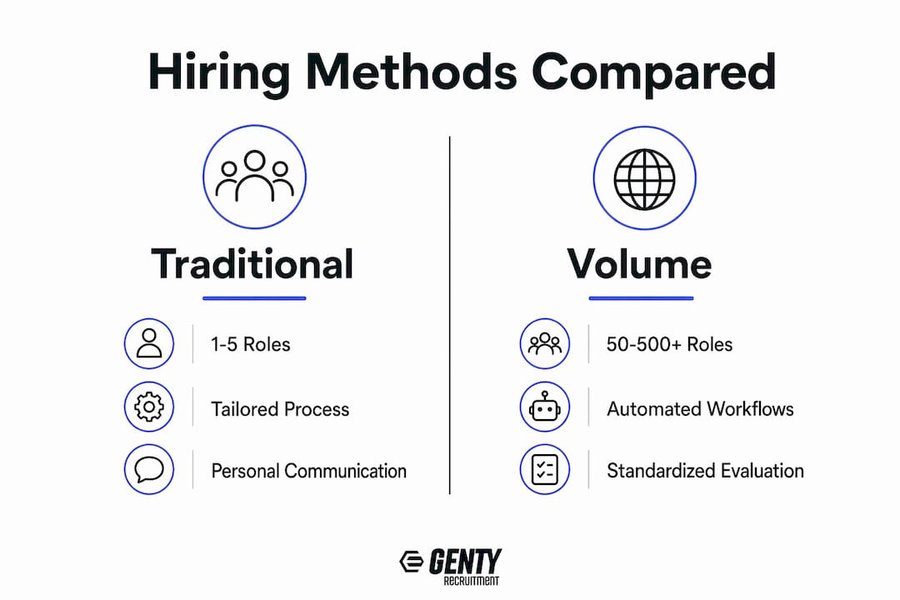
Volume hiring and traditional recruitment solve different problems. Traditional recruitment fills one or a few specialized roles with high-touch, individualized attention. Volume hiring fills dozens or hundreds of similar positions, often entry-level or frontline roles, using standardized workflows and automated candidate funnels.

The operational differences are significant. Traditional hiring gives each candidate a tailored experience and each recruiter a manageable workload. Volume hiring replaces manual coordination with process-driven automation and treats the funnel as a production system. Recruiter workload shifts from individual relationship management to funnel monitoring and process improvement.
The candidate experience also changes. In traditional hiring, candidates receive personal communication at each step. In volume hiring, candidates move through automated touchpoints, asynchronous assessments, and self-scheduled interviews. Done well, this feels efficient. Done poorly, it feels impersonal and drives drop-off.
What do you need?
Choose the hiring path that fits
After reading "What Is Volume Hiring? A 2026 Guide for Tech Startups", most teams compare these options before deciding how to hire.
What technologies power efficient volume hiring in 2026?
The standard volume hiring tech stack includes five core components, and removing any one of them creates a bottleneck that manual effort cannot fix at scale.
- Applicant Tracking System (ATS) with automation: Routes candidates, triggers communications, and tracks funnel stages without recruiter intervention. An ATS without automation rules is just a database.
- AI-assisted screening and resume parsing: Filters large applicant pools against defined criteria before a human reviews a single profile. This is where AI in recruitment delivers its clearest efficiency gain.
- Digital skill assessments: Replace resume-first filtering with task-based evidence of capability. Coding challenges, situational judgment tests, and role-specific simulations surface qualified candidates faster.
- Asynchronous interview platforms: Allow candidates to record video or voice responses on their own schedule. This eliminates scheduling bottlenecks and gives hiring teams a consistent artifact to review.
- Automated scheduling software: Coordinates interview slots across hiring managers and candidates without back-and-forth emails. Manual coordination is impossible at scale.
- Centralized analytics dashboards: Track funnel conversion rates, time-to-hire, offer acceptance rates, and drop-off points by stage. Without this data, you cannot identify where the process breaks.
Pro Tip: Build compliance and auditability into your automated workflows from day one. AI screening tools must meet equal employment opportunity standards, and every automated decision should generate a log that your legal team can review. Retrofitting compliance after launch is far more expensive than building it in upfront.
How to implement a volume hiring strategy: a phased 90-day framework
The recommended phased approach runs 90 days and divides implementation into three distinct operational phases. Each phase builds on the last, preventing the common startup mistake of launching full-scale hiring before the process is proven.
Days 1–30: Process mapping and SLA definition
- Map your current hiring funnel end-to-end and identify every manual step that creates delay.
- Define operational SLAs: how quickly hiring managers must review candidates, provide feedback, and commit to interview slots.
- Select and configure your ATS and screening tools. Write standardized job ads for each role family.
- Establish baseline metrics: current time-to-hire, offer acceptance rate, and funnel conversion by stage.
Days 31–60: Pilot role testing
- Run the new process on one role or one location before scaling.
- Collect data on funnel conversion, candidate drop-off, and hiring manager compliance with SLAs.
- Identify the top two or three bottlenecks and fix them before expanding.
- Conduct the first interviewer calibration session to align scoring rubrics across your hiring team.
Days 61–90: Training and scale
- Train hiring managers in short, focused sessions covering SLA expectations, assessment interpretation, and feedback standards.
- Expand the process to all target roles and locations.
- Activate your analytics dashboard and set weekly review cadences.
- Build an iterative feedback loop: review funnel data weekly and adjust screening criteria, job ad copy, or SLAs based on what the data shows.
Pro Tip: For LATAM hiring, build timezone alignment into your SLA design from the start. Engineering teams in Argentina, Brazil, Mexico, and Colombia overlap with US EST by 1–5 hours and with PST by 3–5 hours. Schedule live interview slots during that overlap window and you eliminate the scheduling friction that kills candidate engagement.
What are the biggest challenges in volume hiring?
High-volume recruiting is fundamentally a signal problem, not just a volume problem. The challenge is not attracting thousands of applicants. The challenge is identifying the qualified ones before your team wastes time on interviews that should never have happened.
- Low-intent candidate noise: Large applicant pools contain many candidates who apply broadly without genuine interest. Asynchronous voice screens and job-related task filters remove these candidates early. They require effort to complete, which self-selects for motivated applicants.
- Quality drift: When multiple hiring managers assess candidates independently, scoring criteria drift over time. Calibration sessions where teams review recorded interviews together and align on rubrics prevent this. Run them monthly during active hiring campaigns.
- Hiring manager SLA violations: Slow feedback is the single most common cause of candidate drop-off in volume hiring. SLA enforcement reduces time-to-hire and gets offers out before candidates accept elsewhere. Treat hiring manager response time as a KPI, not a courtesy.
- Compliance risk in automated screening: AI tools can introduce bias if not properly configured and audited. Every automated screening decision should be logged, and your criteria should be reviewed against equal employment opportunity standards before launch.
- Inconsistent job ads: Variation in how roles are described across locations produces inconsistent applicant pools. Standardized job ad templates for each role family fix this at the source.
Pro Tip: Use standardized evaluation rubrics for every role, and share them with hiring managers before the first interview. A rubric that defines what “strong” looks like for a mid-level software engineer in Buenos Aires should be identical to the one used for the same role in Bogotá. Consistency across locations is what makes volume hiring defensible.
What are the benefits of volume hiring for LATAM tech startups?
Volume hiring delivers measurable advantages when the process is built correctly, and LATAM amplifies those advantages through cost, talent depth, and timezone alignment.
Hiring costs in LATAM run significantly below US and European benchmarks. A software engineer in Colombia or Mexico costs a fraction of the equivalent role in San Francisco or Berlin, without sacrificing technical quality. For a startup running a volume hiring campaign across 20 or 30 roles, that cost differential compounds quickly.
Timezone alignment with US EST and PST means LATAM engineers work synchronously with US teams during core business hours. This matters for volume hiring because it allows live technical interviews, real-time onboarding, and daily standups without the friction of asynchronous-only collaboration.
The recruitment automation examples that deliver the fastest results in LATAM combine ATS automation with asynchronous video screening and structured skill assessments. This combination cuts the time between application and offer without reducing the rigor of the evaluation.
Key Takeaways
Volume hiring succeeds when it treats recruitment as an operational discipline, not an ad-hoc activity, with standardized processes, SLA enforcement, and the right technology stack applied consistently across every role.
Why startups get volume hiring wrong more often than they should
Most startups I work with treat their first volume hiring campaign like a bigger version of their normal hiring process. They use the same job ads, the same interview loops, and the same informal feedback culture. Then they wonder why the funnel collapses at the offer stage.
The uncomfortable truth is that volume hiring requires a different operating model, not just more recruiters. Manufacturing-style operational rigor applied to hiring, standardizing job ads, communications, and screening steps, is what separates campaigns that scale from campaigns that stall. Startups that “wing it” on SLAs and skip calibration sessions pay for it in quality drift and candidate drop-off.
LATAM adds a layer of complexity that most US-based HR teams underestimate. Hiring markets in Argentina, Brazil, Mexico, and Colombia each have distinct salary expectations, candidate behavior patterns, and labor law considerations. A process built without that regional context produces inconsistent results even when the technology is right.
The teams that get this right treat hiring KPIs the same way they treat product metrics: weekly reviews, clear owners, and fast iteration when the data shows a problem. That discipline is not glamorous, but it is what makes volume hiring work at the speed a scaling startup actually needs.
— Eugene
GENTY recruitment’s approach to volume hiring in LATAM
Tech startups running volume hiring campaigns in Latin America need more than job board access. They need a partner who understands regional hiring markets, compliance requirements, and the operational rigor that keeps quality high at scale.
GENTY recruitment specializes in IT recruitment across LATAM, placing pre-vetted software engineers, DevOps specialists, and data professionals in Argentina, Brazil, Mexico, Colombia, and Chile. Curated shortlists arrive within 7 days, with fixed-fee pricing per seniority level and a 3-month replacement guarantee. For startups that need to staff a talent acquisition function quickly, GENTY recruitment also places talent acquisition specialists in LATAM from $2,900. Contact GENTY recruitment to discuss your volume hiring campaign and get a shortlist within the week.
FAQ
What is volume hiring in simple terms?
Volume hiring is the process of filling many similar roles at the same time, using automated workflows and standardized screening to maintain speed and quality across a large candidate pool.
How does automation help in volume hiring?
Automation handles resume parsing, candidate communications, interview scheduling, and funnel tracking. Companies using automation in volume hiring recruit 26% faster than those relying on manual processes.
What is the biggest risk in high-volume recruiting?
The biggest risk is quality drift, where assessment standards become inconsistent across hiring managers and locations. Monthly calibration sessions and standardized evaluation rubrics prevent this.
Why is LATAM a strong market for volume hiring campaigns?
LATAM offers deep tech talent pools in countries like Argentina, Brazil, Mexico, and Colombia, with salary benchmarks significantly below US rates and timezone overlap with US EST and PST that supports synchronous collaboration.
How long does it take to implement a volume hiring process?
A phased 90-day implementation covers process mapping and SLA definition in the first 30 days, pilot testing in days 31–60, and full-scale training and rollout in days 61–90.