
Prioritizing technical skills produces measurable, near-term impact on hireability, time-to-impact, and promotion potential — and for engineering leaders, it determines how fast a new hire ships. Employers increasingly rely on verifiable signals — digital credentials, skill assessments, and demonstrable work samples — rather than resume claims alone, because those signals predict on-the-job performance far more reliably. Upskilling programs tied to retention show that a large majority of learning leaders say effective training directly contributes to keeping employees longer.
TL;DR — act on these now:
- Candidates: Map every job posting’s “Required Qualifications” to specific tools and platforms, then close the gaps with verifiable credentials before you apply.
- Candidates: Build a project portfolio with measurable outcomes (rows processed, uptime achieved, deployment frequency) and link it from your resume and LinkedIn profile.
- Hiring leaders: Replace unverified resume screening with skill assessments or take-home tasks before the first interview to cut screening time.
- Hiring leaders: Fill critical technical gaps faster by sourcing pre-vetted nearshore talent from Argentina, Colombia, Brazil, or Mexico, where timezone overlap with US EST and PST keeps real-time collaboration intact.
Why prioritize technical skills? What they are and how they differ from soft skills
Technical skills are measurable, tool- or task-specific capabilities — the kind you gain through education, training, or deliberate practice and can demonstrate through a test, a portfolio, or a certification. Soft skills like communication and adaptability are real and valuable, but they resist direct verification; technical skills do not. A candidate either knows how to write a Terraform module or they do not, and that distinction matters when a team needs to ship infrastructure changes on day one.

The practical difference for hiring: soft skills require behavioral interviews and reference checks to approximate; technical skills can be confirmed with a timed assessment, a GitHub repository, or a digital credential in under an hour.
To map a job posting to the exact skills you need, read the “Required Qualifications” and “Education and Experience” sections first, then cross-reference with the tools listed in the day-to-day responsibilities. Those two sections together tell you what the employer will test for.
Before you start hiring
Check location, salary, and hiring fit
If you are moving from research to action, start with the market basics so your hiring plan is clearer.
Why investing in technical skills pays off for employers and employees
Technical skills shorten onboarding because a hire who already knows the stack does not need weeks of ramp-up before contributing to production. That compression matters: a mid-level engineer who can open a meaningful pull request in week one versus week six represents a real productivity delta for a team running a two-week sprint cycle.
Stat: 92% of learning leaders say effective training and development programs directly contribute to higher employee retention — making technical upskilling one of the clearest levers for reducing churn.
SHRM research confirms that many HR professionals report difficulty recruiting qualified applicants because of skills shortages, which means candidates with verified, role-specific technical evidence stand out in a compressed pool. For employees, ongoing certifications unlock higher-paying opportunities and serve as promotion signals that managers can point to in compensation reviews.
The downstream effects compound quickly. Fewer errors from technically proficient engineers mean fewer production incidents. Faster deployment cycles from a team fluent in CI/CD tooling mean shorter time-to-market. Both outcomes show up in metrics that executives track.
For hiring leaders — treat technical skills as a hiring KPI:
- Track time-to-first-PR (or equivalent first contribution) as a proxy for onboarding efficiency.
- Use skill-assessment pass rate during screening to calibrate job description accuracy.
- Monitor certification completion rate in upskilling programs as a leading retention indicator.
- Compare error rates and incident frequency before and after targeted technical training cohorts.
Employers who invest in skills development see measurable retention and engagement outcomes, which means the ROI case for upskilling is not just anecdotal — it shows up in churn data.
What technical skills do employers want most right now?
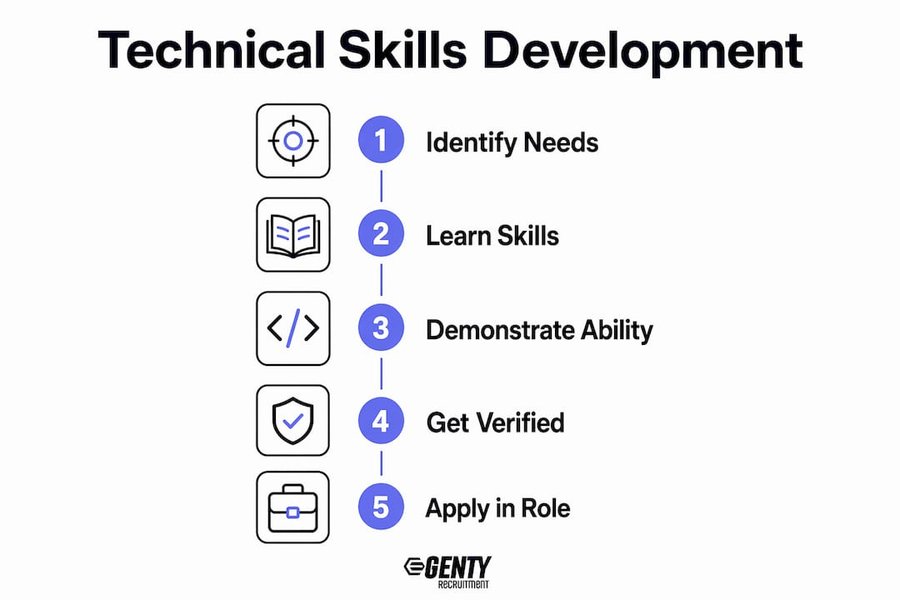
The core demand clusters in 2026 are: data and analytics, cloud infrastructure, cybersecurity, ML/AI tooling, DevOps and platform engineering, and web and mobile development. Each cluster has sector-specific depth, but the underlying pattern is consistent: employers want candidates who can apply tools to domain problems, not just list them on a resume.

As generative AI lowers the barrier to raw coding, domain-centric expertise combined with tool fluency becomes the differentiator. A data engineer who understands financial data modeling and can apply dbt and Snowflake to that domain is more valuable than one who knows the tools in isolation.
US and EU engineering teams running on AWS, GCP, or Azure expect LATAM candidates to be fluent in those platforms specifically, not just cloud concepts in the abstract. For AI-adjacent roles, familiarity with OpenAI APIs, LangChain, and prompt engineering patterns is increasingly a baseline expectation, not a differentiator. The types of AI content tools now embedded in marketing and product workflows mean that even non-engineering roles benefit from tool fluency at a working level.
How do you decide which technical skills to learn first?
Prioritize by three criteria in this order: role-to-skill fit (does this skill appear in the job postings you are targeting?), near-term verifiability (can you prove it within 90 days?), and compensation delta (does adding this skill move you into a higher salary band?). Everything else is secondary.
Prioritization checklist — run through this before committing to a learning path:
- Pull 10–15 real job postings for your target role and list every technical requirement that appears in at least 60% of them.
- Identify which of those skills you can verify quickly (certification, take-home project, assessment score) versus which require months of practice.
- Check salary data on Glassdoor, Levels.fyi, or LinkedIn Salary for your target role with and without each skill to estimate the compensation delta.
- Map team dependencies: if your current or target team runs on a specific stack (e.g., Kafka for event streaming, dbt for data transformation), that stack takes priority over general-purpose learning.
- Estimate time-to-competency honestly: SQL and basic Python are achievable in 3–6 months of focused study; Kubernetes administration or ML engineering realistically takes 6–12 months to reach a hirable level.
Pro Tip: When hiring across LATAM, prioritize skills that require real-time collaboration — backend infrastructure, event-driven systems, real-time data pipelines — because Colombia (UTC-5), Argentina (UTC-3), and Mexico (UTC-6 to UTC-5) all maintain meaningful overlap with US EST and PST working hours, which reduces coordination friction on time-sensitive work.
How to develop and demonstrate technical skills in a realistic timeframe
The fastest verifiable routes are project-based portfolios, digital credentials from recognized platforms, and timed assessments. They work because they produce artifacts an employer can inspect directly, rather than claims they have to take on faith.
For portfolio projects, specificity is what passes ATS filters and recruiter screens. “Built a data pipeline” is invisible. “Built an ETL pipeline in Python and Apache Airflow processing 2M rows/day from three source APIs into Snowflake, with automated dbt tests and a Tableau dashboard — GitHub repo linked” is not. Every project description should name the tool, the scale, and the outcome.
For hiring leaders deciding between internal upskilling and external hiring: upskilling is cost-effective for skills that are 3–6 months away and adjacent to what the team already knows. When the gap is 12+ months or the role requires a fundamentally different stack, hiring is almost always faster and cheaper than training from scratch.
How do employers assess technical skills, and how should you show them?
Employers now rely on verifiable signals — skill tests, work samples, and digital credentials — more than resume claims alone, because digital credentials improve hiring outcomes and trust for both sides of the hiring process. Hiring teams increasingly reject unsourced resume claims and require verifiable artifacts before on-site interviews to reduce screening time.
Common assessment methods and how to prepare:
- Skill tests (HackerRank, Codility, TestGorilla): practice under timed conditions; the format itself is a skill.
- Take-home tasks: treat these as portfolio pieces — document your reasoning, not just your solution.
- GitHub / code repositories: keep repos clean, add README files with context, and pin the most relevant projects.
- Digital badges and credentials: attach them to your LinkedIn profile and link them directly in your resume header.
- Work samples: for data or analytics roles, a public Tableau dashboard or a Jupyter notebook with real data beats any bullet point.
For assessing technical and soft skills of developers, the most reliable approach combines a short async assessment with a structured technical interview focused on problem-solving process, not just correct answers.
Resume bullet examples that pass modern screening:
- “Migrated monolithic API to microservices on AWS ECS, reducing p95 latency from 800ms to 120ms — architecture diagram and Terraform code in linked repo.”
- “Built ETL pipeline (Python, Airflow, Snowflake) processing 2M rows/day; added dbt tests that caught 3 data quality issues before production.”
- “Achieved AWS Solutions Architect Associate certification (scored 890/1000); applied skills to reduce monthly cloud spend by 22% through Reserved Instance optimization.”
LinkedIn checklist for technical professionals:
- Attach digital credential badges directly to the Licenses and Certifications section with verification links.
- Add GitHub, portfolio, or project links in the Featured section, not just the contact info.
- List assessment outcomes (e.g., “Top 10% in SQL on LinkedIn Skill Assessments”) in the Skills section.
- Write project summaries in the Experience section using the same specificity standard as resume bullets.
What GENTY recruitment sees in LATAM hiring: trends and cost data for 2025–2026
LATAM hires close technical skill gaps fast and cost-effectively while preserving timezone overlap with US teams — that is the core hiring case, and the data supports it. LATAM is becoming the top region for remote tech hiring precisely because the combination of technical depth, English proficiency, and timezone alignment is difficult to replicate elsewhere at comparable cost.
A growing share of HR leaders now look for digital badges and verified credentials when screening candidates, and LATAM engineers increasingly hold AWS, GCP, and Azure certifications alongside strong GitHub portfolios — which means they arrive with the verifiable signals employers want.
Compensation comparison: mid-level and senior engineers, LATAM vs. US (annual, USD)
Ranges reflect market data from GENTY recruitment placements and publicly available salary reports. Actual compensation varies by stack, seniority, and company stage.
Clients working with GENTY recruitment typically save up to 40% compared to equivalent US or European hires, without sacrificing technical depth or timezone compatibility.
Timezone alignment by country:
- Colombia (UTC-5): aligns directly with US EST year-round, making it ideal for real-time collaboration.
- Mexico (UTC-6 to UTC-5): overlaps with both EST and PST, covering the widest US working-hours window.
- Argentina (UTC-3): overlaps with EST mornings; works well for async-heavy teams with defined sync windows.
- Brazil (UTC-3 to UTC-2): similar to Argentina; São Paulo-based engineers align well with EST morning standups.
For specific skill concentrations: Colombia and Argentina produce strong senior backend and cloud infrastructure engineers; Brazil has a deep pool of Java and Scala specialists, particularly for FinTech and data engineering roles; Mexico is a strong source for full-stack and DevOps talent serving US product companies.
Stat: SHRM research confirms that skills shortages are tightening the US job market, with many HR professionals reporting difficulty recruiting qualified applicants — a gap that nearshore LATAM hiring directly addresses.
Key Takeaways
Technical skills are the single most verifiable predictor of on-the-job impact, and hiring leaders who treat them as a primary screening signal — not a secondary filter — fill roles faster and retain engineers longer.
The case for verified skills over credential theater
There is a version of this conversation that gets stuck on certifications as the end goal — and that framing misses the point. Certifications matter because they are verifiable, not because they guarantee competence. The teams that onboard fastest are the ones where the hiring process required candidates to demonstrate work, not just list credentials. A take-home task, a live architecture discussion, or a linked GitHub repository tells you more in 90 minutes than a two-hour behavioral interview.
What GENTY recruitment consistently observes in LATAM placements is that engineers from Argentina and Colombia who arrive with both a cloud certification and a portfolio of real infrastructure projects cut onboarding time significantly compared to hires whose resumes list the same tools without evidence. The credential signals intent; the portfolio signals execution. Hiring leaders who require both before extending an offer make better decisions faster.
The 7-day shortlist model works because the vetting happens before the client sees a candidate, not during the client’s interview process. That shift in where the screening effort lands is what compresses hiring timelines without compressing quality. For CTOs running lean engineering teams, that distinction is worth understanding before the next role opens.
GENTY recruitment: pre-vetted LATAM technical talent in 7 days
When upskilling your current team is not fast enough and a US-market search is running over budget, nearshore LATAM hiring through GENTY recruitment is the direct alternative. The agency places pre-vetted software engineers, DevOps specialists, and data professionals from Argentina, Brazil, Mexico, and Colombia, matched to your specific technical stack and seniority requirements.
The model is straightforward: fixed-fee pricing per seniority level, no upfront payment, curated shortlists delivered within 7 days, and a 3-month replacement guarantee. Clients typically save up to 40% compared to equivalent US hires while gaining engineers who overlap with US EST and PST working hours from day one. For teams that need verified technical skills filled quickly, the IT recruitment service is the fastest path from open role to first pull request. Contact GENTY recruitment to receive your first shortlist within a week.
Useful sources and further reading
- SHRM — Skills shortage tightens job market: HR research on employer difficulty recruiting qualified applicants due to skills shortages.
- HR Dive — Skills development disconnect: Data on how training programs affect retention; source of the 92% learning-leader statistic.
- Accredible — Why technical skills matter for job seekers: Covers digital credentials, hiring outcomes, and the growing role of verified badges in screening.
- Workable — Technical skills: examples and definitions: Operational definitions and role-based examples across departments.
- D2L — Invest in upskilling: survey findings: Research on employer-driven upskilling and measurable retention outcomes.
- QuickStart — Importance of technical skills in the workplace: Covers salary and career-advancement impacts of certifications and ongoing training.
- Inc. — Jensen Huang on coding and AI: Industry perspective on how generative AI shifts the value of domain expertise over raw coding speed.
- Certifier — Technical skills: benefits and examples: Covers the digital skills gap and how up-to-date skills affect employability.
- GENTY recruitment — IT recruitment in LATAM: Service page for technical hiring from Latin America, including fixed-fee model and shortlist timelines.
- GENTY recruitment — Why LATAM for remote tech hiring: Market analysis of LATAM developer pools, salary data, and country-specific hiring advantages.