

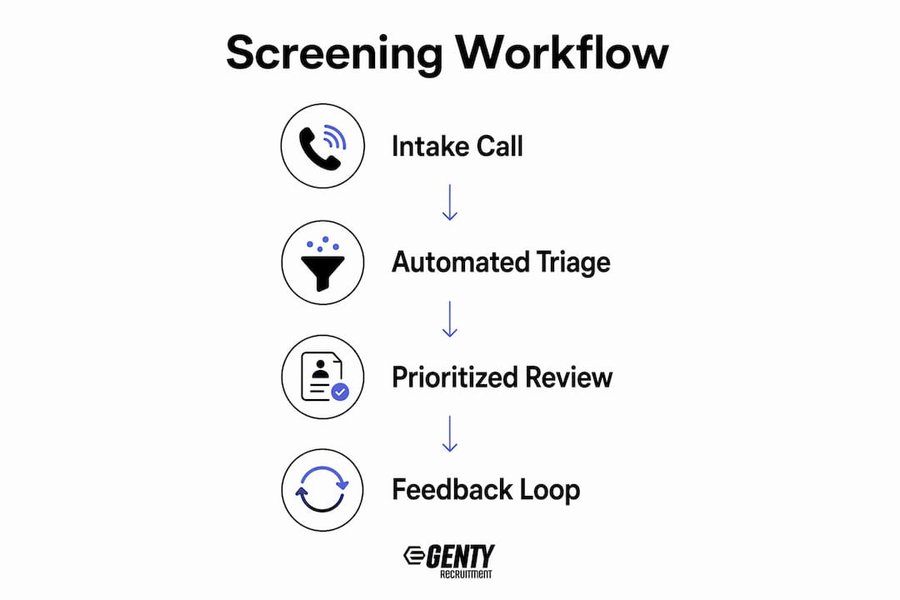
A reproducible, four-stage applicant screening workflow — define must-haves → automated triage → prioritized recruiter review → closed-loop feedback — cuts time-to-hire and improves hire quality for US and European tech teams hiring pre-vetted LATAM engineers and salespeople. When applied to Latin American talent markets, this workflow also captures significant cost savings versus equivalent US or EU hires, with GENTY recruitment delivering curated shortlists within about a week under a fixed-fee model.
Start today with these five actions:
- Run a short intake call and lock in several non-negotiable must-haves before any application lands
- Configure 3 elimination rules in your ATS (right-to-work, minimum experience, English proficiency)
- Build a 1–5 weighted scorecard for the role before reviewing a single resume
- Set KPI tracking for time-to-first-contact to enable faster candidate engagement
- Review the hiring manager checklist to align your team before the req goes live
What does a four-stage screening workflow look like in practice?
A structured candidate evaluation process — defined criteria, a scoring rubric, and a repeatable workflow — let teams assess every applicant consistently and scale without adding headcount. The four stages below map ownership, inputs, outputs, and realistic SLAs.

Launch checklist:
- Conduct a 30–45 minute intake call; document must-haves in writing before the req is posted
- Configure ATS elimination questions to auto-disposition candidates who miss any must-have
- Route only the strong-match bucket to the recruiter queue; pool the rest with a reason attached
- Set KPI dashboards tracking time-to-first-contact, shortlist-to-offer rate, and 90-day retention
The intake call is the highest-leverage step. Without a written, agreed list of must-haves, reviewers default to subjective “good but not right” evaluations that waste hours and produce inconsistent shortlists.
How do you build a scorecard that actually holds up across reviewers?
Start with role outcomes, not job description bullet points. Convert 3–5 outcomes into weighted criteria, then define scoring anchors before any application is reviewed. Candidate evaluation is most effective when it includes structured scoring applied consistently at every stage, not just during interviews.
Before you start hiring
Check location, salary, and hiring fit
If you are moving from research to action, start with the market basics so your hiring plan is clearer.
Engineering scorecard (sample):
Sales scorecard (sample):
Store scores directly in your ATS or HRIS so the system can compute weighted totals and auto-generate a ranked shortlist. This removes the manual aggregation step that typically delays decisions by a day or more.
Pro Tip: Draft scoring anchors for all five levels before your first application arrives, then run one calibration round on two sample candidate profiles. Disagreements in that session reveal ambiguous anchors — fix them before they cost you a real candidate.
How does automated triage cut recruiter hours without losing strong candidates?
Automated, rule-based screening removes manual triage tasks and instantly dispositions unqualified candidates, freeing recruiters to focus exclusively on the top of the funnel. The key is configuring rules that eliminate clear mismatches without creating false negatives for borderline-strong candidates.
High-impact rule types to configure:
- Elimination questions: right-to-work status, required certifications, minimum years of experience in a specific stack
- Keyword/boolean filters: must-have technologies (e.g., Kubernetes, dbt, Salesforce) flagged at the resume-parse stage
- Automated coding assessments: HackerRank or Codility challenges triggered immediately post-application for engineering roles
- Language screening: async video or written response to assess English proficiency before any recruiter time is spent
- Availability and salary gating: confirm timezone overlap and compensation expectations upfront to prevent late-stage drop-off
Place elimination questions on the ATS pre-application form so unqualified candidates are dispositioned before a resume is ever parsed. Server-side rule engines handle keyword and boolean logic at scale. Integrated assessment vendors handle coding and language screens asynchronously.
The false-negative risk is real. Strict keyword filters can reject candidates who describe the same skill with different terminology. Mitigate this by adding a “soft filter” queue for candidates who pass must-haves but miss nice-to-haves, and route that queue to a weekly recruiter review rather than auto-rejection. Understanding how candidates navigate ATS filters helps you design questions that surface intent rather than penalize formatting choices.
How do you keep scoring consistent when multiple reviewers are involved?
Structured interviewing requires the same vetted questions, standardized scoring rubrics, and interviewer training to maintain consistent, reliable hiring decisions. Without calibration, different reviewers interpret the same anchor differently, and scoring drifts within weeks.
Run a calibration session before the first candidate is reviewed: walk through each rubric anchor, grade 2–3 shared sample answers independently, then reconcile differences as a group. Disagreements are the data. After reconciliation, save the agreed examples as written grading guides in the ATS so new interviewers inherit the same baseline.
Pro Tip: Require every interviewer to submit their scorecard independently before any panel discussion. Group discussion before scoring anchors individual judgment to whoever speaks first, which is a reliable path to groupthink and inflated consensus scores.
Calibration cadence: run a session for every new role type and after every 10 hires on an existing role. Assign a calibration facilitator (usually the recruiter or hiring ops lead) and log outcomes to a shared hiring ops document.
Which KPIs should you track, and how do you use them to improve screening?
High-performance screening workflows treat criteria as living artifacts. Feed hire and reject outcomes back into scoring weights and automated rules quarterly to tighten signal over time.
Instrument your ATS to capture disposition reasons at every stage. You need at least 20–30 hires per role type before statistical patterns in the data are reliable enough to adjust weights. Quarterly, review which must-haves predicted 90-day retention and which turned out to be nice-to-haves in practice, then adjust elimination rules accordingly.
LATAM hiring: country-level benchmarks and operational notes
Hiring pre-vetted talent from Argentina, Brazil, Mexico, and Colombia delivers meaningful cost advantages alongside strong technical depth and genuine timezone alignment with US EST and PST teams.
These ranges represent savings of up to 40% versus comparable US-based hires without sacrificing seniority or English proficiency.
Operational checklist for LATAM hiring:
- Schedule technical interviews between 9 AM–1 PM EST to capture full overlap across all four countries
- Use contractor-of-record (COR) or employer-of-record (EOR) services for compliant payroll in each country
- Conduct background checks through a provider with LATAM coverage (criminal, employment history, education)
- Confirm English proficiency at the screening stage via async video or written assessment, not just resume claims
- For remote tech roles, verify home office setup and internet reliability as part of pre-vetting
Argentina produces particularly strong backend and data engineering talent, especially in FinTech and AI. Mexico’s timezone alignment with CST/PST makes it the default choice when real-time collaboration with West Coast teams is a hard requirement.
When does it make sense to outsource screening to a specialist?
In-house screening works well when your team has LATAM sourcing experience, a calibrated rubric, and the recruiter capacity to review 50–100 applications per role within 48 hours. When those conditions aren’t met, a specialist partner typically delivers a faster, higher-quality shortlist at lower total cost.
Signals that outsourcing is the right move:
- Time-to-fill has exceeded 45 days on two or more consecutive requisitions
- Your team has no established sourcing network in Argentina, Brazil, Mexico, or Colombia
- You need a pre-vetted shortlist within 7 days to stay competitive for senior talent
- The role requires niche skills (e.g., Rust, Solidity, or enterprise SaaS sales) where your internal pipeline is thin
- You want fixed-fee pricing with a replacement guarantee rather than variable agency costs
What a high-quality specialist must deliver: role-specific pre-vetting (not just resume forwarding), English proficiency and timezone confirmation at the screening stage, a written SLA for shortlist delivery, a 3-month replacement guarantee, and integration support with your existing ATS. Pre-vetting practices that include skills verification and structured scoring reduce your team’s review burden to a final hiring decision rather than a full evaluation cycle.
Key Takeaways
A four-stage applicant screening workflow — intake, automated triage, prioritized review, and a closed feedback loop — is the single most reliable system for improving hire quality and cutting time-to-fill when hiring pre-vetted LATAM tech and sales talent.
The part of screening most teams get wrong
Most hiring teams treat the intake call as a formality. They spend 10 minutes confirming the job title and level, then send the recruiter off to source against a vague brief. The result is predictable: reviewers fall back on subjective signals, shortlists are inconsistent, and the hiring manager rejects three rounds of candidates before anyone revisits the criteria.
The workflow described here is not complicated. The intake call, the rubric, the calibration session, the KPI dashboard — none of these require expensive tooling or a large recruiting team. What they require is discipline applied before the first application arrives, not after the third round of rejections.
One pattern that consistently improves outcomes in LATAM hiring specifically: narrowing must-haves during the intake call to the two or three criteria that actually predict 90-day performance, rather than listing every preferred qualification from the job description. Broader must-have lists eliminate strong candidates who would have succeeded, and they slow automated triage because the rule engine has more conditions to evaluate. Tighter criteria produce faster, more accurate shortlists.
GENTY recruitment’s screening process, and how it can work for your team
GENTY recruitment applies this exact four-stage workflow to every LATAM placement, with one concrete difference: your team receives a pre-vetted, scored shortlist within 7 days rather than managing the triage and review stages internally.
For IT and sales hiring across LATAM, GENTY recruitment handles intake alignment, automated pre-screening, English proficiency verification, timezone confirmation, and structured scoring before a single profile reaches your desk. Fixed-fee pricing per seniority level means no variable agency costs, and a 3-month replacement guarantee covers you if a placement doesn’t work out.
What clients receive in the first 30 days:
- Intake call and must-haves documentation within 48 hours of engagement
- Pre-vetted shortlist of 3–5 candidates delivered within 7 days
- Scored profiles with English proficiency and timezone overlap confirmed
- ATS integration support so candidate data flows directly into your existing system
- Replacement guarantee active from day one of placement
Teams hiring engineers in Argentina or sales talent in Colombia regularly report faster hiring times and cost savings compared to US-based hiring. To see how the workflow applies to your open roles, contact GENTY recruitment and request a shortlist for your next requisition.
Useful sources for building your screening workflow
- Applicant screening: the signal-vs-noise framework (Metaview) — the most detailed public breakdown of the four-stage framework; reinforces the intake call and top-decile focus recommendations in Sections 2 and 3.
- Structured interviewing guide (Google re:Work) — primary reference for rubric design, calibration sessions, and interviewer training in Sections 3 and 5.
- Candidate evaluation process (SeekOut) — practical guidance on applying structured criteria consistently across all applicants; supports the scorecard and workflow sections.
- Candidate evaluation methods (Jobylon) — covers the distinction between screening and evaluation, and when to apply each method in the funnel.
- Prescreening and screening candidates (ApplicantStack) — specific guidance on ATS elimination questions and pre-application form configuration; reinforces Section 4.
- Candidate evaluation best practices (Recruitee) — covers application questionnaires, scoring rubrics, and bias reduction; supports Sections 3 and 5.
- What is an ATS? (Greenhouse) — foundational reference for ATS workflow configuration, scorecard storage, and pipeline reporting in Sections 2 and 6.
- Candidate screening workflow (US Tech Automations) — benchmarking source for automated triage time savings; cited in Section 4.
- Recruitment automation examples (GENTY recruitment) — practical automation patterns for fast-growth tech teams; extends the automation section with implementation examples.
- Effective candidate screening steps (GENTY recruitment) — operational guide aligned with the four-stage workflow; useful companion to Sections 2 and 3.