

Talent vetting is the process of rigorously evaluating candidates beyond their resumes to confirm they possess the technical skills, cultural alignment, and professional reliability your startup needs to scale. Why talent vetting matters becomes clear fast: 46% of new hires fail within their first 18 months due to inadequate screening. That number represents wasted salaries, lost productivity, and team disruption that early-stage companies cannot afford. The industry term for this discipline is candidate screening, though founders increasingly use “talent vetting” to describe the more rigorous, multi-layered evaluation frameworks that go well beyond a phone call and a resume review. Structured vetting processes, when applied consistently, reduce time-to-hire by 50% to 70% while cutting manual evaluation workload by up to 40%.
Why talent vetting matters for team performance
Structured vetting directly predicts whether a new hire will perform, stay, and contribute to team cohesion. The mechanism is straightforward: when you replace gut-feel interviews with scored technical assessments and behavioral frameworks, you collect comparable data on every candidate instead of impressions shaped by interview nerves or personal rapport.
Structured interviews and assessments double the predictive power of unstructured interviews for hiring success. That means a startup using a defined scoring rubric for a senior backend engineer role is twice as likely to hire someone who actually performs at that level six months in. For a 15-person team where one underperformer can slow an entire sprint cycle, that predictive accuracy is worth more than any single feature shipped.

Cultural fit compounds the effect. 91% of managers say cultural fit is as important as technical skills, yet most still rely on unstructured conversations to assess it. The fix is not a personality quiz. It is a defined set of behavioral questions tied to your team’s actual working norms, such as how candidates handle ambiguous requirements, disagreement with a tech lead, or a missed deadline.
Before you start hiring
Check location, salary, and hiring fit
If you are moving from research to action, start with the market basics so your hiring plan is clearer.
Key performance benefits of structured candidate screening include:
- Higher retention rates because candidates understand the role’s real demands before accepting
- Faster onboarding because vetted hires arrive with verified skills and need less remedial training
- Stronger team morale because top engineers stay engaged when surrounded by equally capable peers
- Reduced management overhead because fewer performance conversations are needed in the first 90 days
Pro Tip: Combine a timed coding assessment using platforms like HackerRank or Codility with a 30-minute behavioral interview scored against a rubric. The technical test filters for skill; the behavioral rubric filters for fit. Running both in parallel cuts your screening time without sacrificing signal quality.
What risks does talent vetting mitigate for startup hiring?
Skipping rigorous screening does not save time. It defers costs to a much more expensive moment. The importance of talent vetting becomes most visible when you map the specific risks that surface from poor hiring decisions.
“Failing to vet talent is like gambling. Bad hires demoralize top employees and harm company culture in ways that outlast the individual’s tenure.” — Mike Voories, Business Resources One
The risks fall into four distinct categories:
- Financial exposure. A mis-hire at the senior engineer level costs an estimated one to two times the annual salary when you account for recruiting fees, onboarding time, lost productivity, and the cost of restarting the search. For a $120,000 role, that is a six-figure write-off.
- Reputational damage. A toxic or dishonest hire who interacts with clients, partners, or open-source communities can damage relationships that took years to build. In FinTech and SaaS, where trust is a product feature, this risk is not theoretical.
- Legal and compliance failures. Hiring someone with falsified credentials or an undisclosed conflict of interest can expose your startup to liability, especially in regulated sectors like AI or financial services. Background checks and credential verification are not bureaucratic formalities. They are legal protection.
- Cultural disruption. Bad hires drain energy and frustrate top employees far beyond the direct financial costs. A single disruptive hire on a 10-person engineering team can trigger voluntary attrition among your best performers, which is the most expensive outcome of all.
Experienced recruiters use backdoor references to uncover hidden red flags that official reference calls miss. A backdoor reference means contacting someone in your network who has worked with the candidate, rather than only speaking to the references the candidate selected. This technique surfaces behavioral patterns that polished candidates know to conceal in formal conversations.
How does a multi-stage vetting process work for startups?
A multi-stage vetting framework filters candidates progressively, so your most time-intensive evaluation steps are reserved for the smallest, most qualified pool. Platforms using rigorous multi-stage vetting reject up to 98% of applicants to surface the top 2%. That ratio reflects how much noise exists in a typical applicant pool and why a single-stage screening process consistently produces poor outcomes.
Here is how a well-designed multi-stage process works in practice:
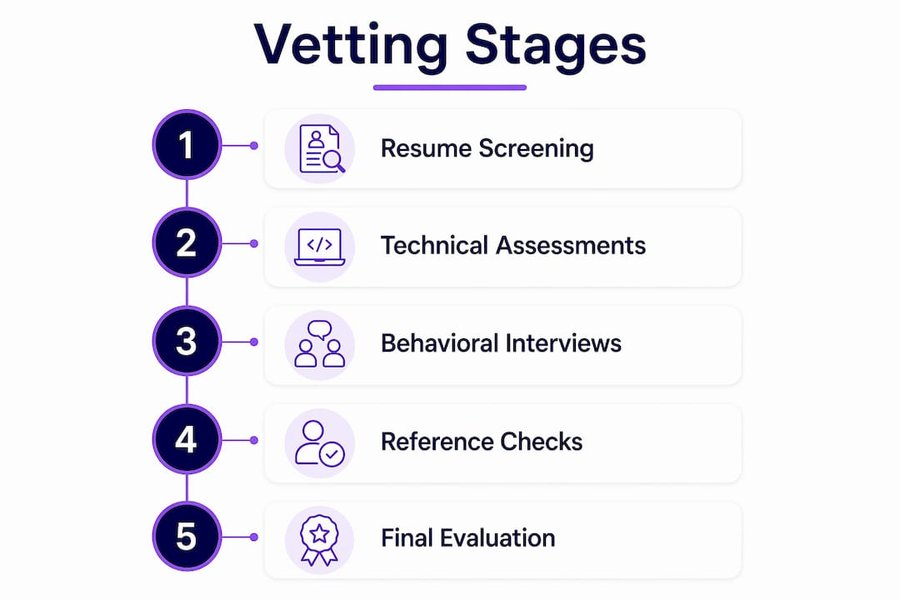
The gap between “basic screening” and comprehensive vetting is significant. Basic screening typically means reviewing a resume and conducting one unstructured interview. Comprehensive vetting means running every stage above with documented criteria and consistent scoring. The latter takes more time upfront but produces candidates who assess technical and soft skills at a verified level rather than a self-reported one.
One practical note: the definition of “pre-vetted” varies widely across hiring platforms and agencies. Pre-vetted can mean a simple resume review or a comprehensive multi-stage assessment. When evaluating any external hiring partner, demand a written breakdown of exactly which stages they run and what criteria they use at each one.
What tools and best practices optimize talent vetting in tech startups?
Modern candidate screening combines purpose-built software with disciplined process design. The tools accelerate execution; the process design determines quality. Neither works well without the other.
Effective vetting technology for tech startups includes:
- Technical assessment platforms like HackerRank, Codility, and TestGorilla for role-specific coding and problem-solving tests
- Applicant tracking systems like Greenhouse, Lever, or Workable to centralize candidate data and enforce consistent evaluation stages
- Background check services like Checkr or Sterling for automated credential and identity verification
- Behavioral assessment tools like Predictive Index or Culture Amp for structured personality and culture-fit scoring
- Recruitment assessment tools that combine technical and behavioral signals into a single candidate profile
Beyond tooling, the most important practice shift is treating vetting as an ongoing governance function rather than a one-time hiring task. Vetting must move from a one-off activity to ongoing governance with regular checks and accountability at the leadership level. This means periodic re-verification of credentials for sensitive roles, structured 90-day performance reviews tied to original assessment criteria, and board-level visibility into hiring quality metrics.
Leveraging external hiring partners adds another layer of risk management. Recruiters who specialize in a specific talent market, such as LATAM tech talent or FinTech engineers, act as risk managers by identifying candidates who speak in results and take ownership rather than deflecting accountability. That behavioral signal is difficult to detect without experience in the specific candidate pool.
Pro Tip: When speed is a competitive constraint, do not compress your vetting stages. Instead, run stages in parallel where possible. Send the technical assessment the same day as the initial screen, and schedule the behavioral interview before the coding results are back. You maintain thoroughness while cutting total elapsed time by 30% to 40%.
When hiring remote engineers, the impact of recruitment validation extends to time zone compatibility, async communication skills, and remote work discipline. These factors require dedicated assessment criteria that most generic vetting frameworks do not include by default.
Key takeaways
Rigorous talent vetting reduces hiring failure rates, protects team culture, and cuts time-to-hire when structured screening replaces unstructured interviews across every stage of the process.
Why I think most startups underinvest in vetting until it’s too late
After working with dozens of tech startups across the US and Europe, the pattern is consistent. Founders move fast on hiring when momentum is high, compress the screening process to close candidates before a competitor does, and then spend the next six months managing the consequences. The financial cost is visible on a spreadsheet. The cultural cost is not, and that is the one that actually slows companies down.
The startups that hire well treat vetting as a leadership responsibility, not a recruiter task. When a CTO reviews assessment scores alongside resumes, when founders conduct at least one behavioral interview for every senior hire, and when reference checks are treated as intelligence gathering rather than a formality, the quality of the team compounds over time. The teams that skip these steps do not fail immediately. They accumulate technical debt in human form, and it surfaces at the worst possible moment, usually during a funding round or a product launch.
The uncomfortable truth about the benefits of candidate screening is that it requires discipline when you are least inclined to apply it. The best time to vet rigorously is when you are under pressure to hire fast. That is also when most founders cut corners. Building the process before you need it urgently is the only way to protect your team from the costs of a bad hire.
— Eugene
How Gentyrecruitment helps tech startups hire pre-vetted LATAM talent
Gentyrecruitment runs a multi-stage vetting process across technical assessment, behavioral evaluation, English proficiency testing, and background verification before a candidate ever reaches your desk.
For US and European tech startups hiring engineers, FinTech specialists, or AI developers from Latin America, Gentyrecruitment’s pre-vetted LATAM talent pools deliver candidates who are technically qualified, English-speaking, and ready to integrate into global teams. The process is built to move fast without sacrificing screening depth, giving founders access to IT recruitment that is up to 5X faster than traditional hiring. If your next hire needs to be the right hire, Gentyrecruitment is built for that standard.
FAQ
Why does talent vetting matter more for startups than large companies?
Startups operate with smaller teams where one bad hire has an outsized impact on productivity and culture. A single mis-hire on a 10-person engineering team can disrupt delivery timelines and trigger attrition among top performers.
What is the difference between candidate screening and talent vetting?
Candidate screening typically refers to early-stage filtering by resume and basic qualifications. Talent vetting is the broader, multi-stage process that includes technical assessments, behavioral interviews, reference checks, and compliance verification.
How much does a bad hire actually cost a tech startup?
A bad hire at the senior engineer level costs an estimated one to two times the annual salary when accounting for recruiting fees, lost productivity, onboarding time, and the cost of restarting the search.
Does rigorous vetting slow down the hiring process?
Structured vetting reduces time-to-hire by 50% to 70% when implemented correctly, because it filters unqualified candidates earlier and reduces the number of late-stage interviews that end in rejection.
What does “pre-vetted” actually mean when working with a hiring agency?
Pre-vetted varies widely by agency. It can mean a simple resume review or a full multi-stage assessment. Always request a written breakdown of the specific screening stages and criteria used before engaging any external hiring partner.