
Your requisition is approved, the compensation band is set, and three agency proposals are sitting in your inbox. One charges a percentage of salary, another wants a retainer, and the third promises a fixed fee that looks dramatically cheaper. The question isn't "Which invoice is smallest?" It's what will one successful hire cost after exclusions, internal effort, and replacement risk are counted?
A fixed fee recruitment agency agrees a predetermined price for a role or seniority band before sourcing begins. That price is separated from the candidate's eventual salary, unlike contingency recruitment, which usually charges a percentage of first-year compensation. The model can improve budget control, but only when the contract defines delivery, inclusions, and failure protection precisely. Use the analysis below to compare proposals against your GENTY recruitment pricing, not against a headline number alone.
What a Fixed Fee Recruitment Agency Actually Charges
A CTO at a Series B company has just opened a senior backend role. Finance approved the hiring budget, engineering has agreed on the technical profile, and the leadership team wants interviews moving quickly. The three proposals look different: one takes a percentage if someone starts, one asks for an upfront retainer, and one quotes a flat amount for the campaign.
The flat-fee provider is offering a predetermined price per role or seniority band, regardless of the successful candidate's salary. That's the defining commercial feature. The agency's charge doesn't automatically rise because the selected engineer negotiates a higher compensation package.
Need help hiring?
See the next step after this guide
If this topic is relevant to your team, these are the most useful pages to check next.
A UK contingency agency commonly charges around 15% to 25% of annual salary, while specialist, technical, senior, or difficult-to-fill roles can reach 20% to 30% or more, according to UK recruitment agency fee benchmarks. A candidate hired on £40,000 could therefore create an agency fee of roughly £6,000 to £10,000 under a 15% to 25% model. The sourcing workload may be broadly similar across salary bands, but the invoice follows compensation.
The question finance should ask
Fixed pricing changes that relationship. You agree the cost before the search starts, then evaluate whether the service delivers enough qualified candidates and hiring support to justify it. That predictability helps when your company compares domestic hiring with nearshore options, where salary levels and currencies can differ.
The model isn't automatically superior. A low quote can exclude assessments, advertising, verification, or replacement support. A high quote may be reasonable if it includes technical screening, structured interviews, and a meaningful guarantee.
Practical rule: Compare the fee against the cost of a candidate who actually starts and remains productive, not against the price printed at the top of the proposal.
Ask for a line-item scope before approving the search. If your company also needs a broader employee engagement budget, separate that decision from recruitment and review resources such as plans for frontline teams. Recruitment pricing should remain tied to sourcing, assessment, hiring, and replacement obligations.
How Fixed Fee Pricing Differs From Contingency and Retained
The three models change different parts of the transaction. Contingency changes the payment trigger. Retained search changes the commitment and timing of payment. Fixed fee changes the basis used to calculate the amount.
Consider two technical hires under a 20% contingency fee. A £50,000 hire creates a £10,000 fee. A £100,000 hire creates a £20,000 fee. The search effort may involve one intake, one shortlist, and one successful placement in both cases, but the client's cost doubles.
A published UK flat-fee schedule illustrates a different design: £1,500 for roles up to £30,000, £2,000 for £30,000 to £44,999, £3,000 for £45,000 to £59,999, and £4,000 for £60,000 to £79,999, as described in UK recruitment fee guidance. This isn't a single price for every search. It's a bounded price within an agreed category.
Choose the model by search economics
Contingency works when you want no placement invoice unless the agency succeeds, and when the role is relatively straightforward to market. Retained search makes more sense for confidential leadership hiring, scarce profiles, or assignments requiring dedicated and exclusive attention. A fixed fee fits a well-defined role where the finance team values a known acquisition cost.
For a deeper explanation of the contingency model, see this contingent hiring guide for technical HR teams. The important distinction is simple: fixed doesn't mean all-inclusive, and retained doesn't mean unlimited. The agreement determines what each label is worth.
Reading a Fixed Fee Proposal Beyond the Headline Number
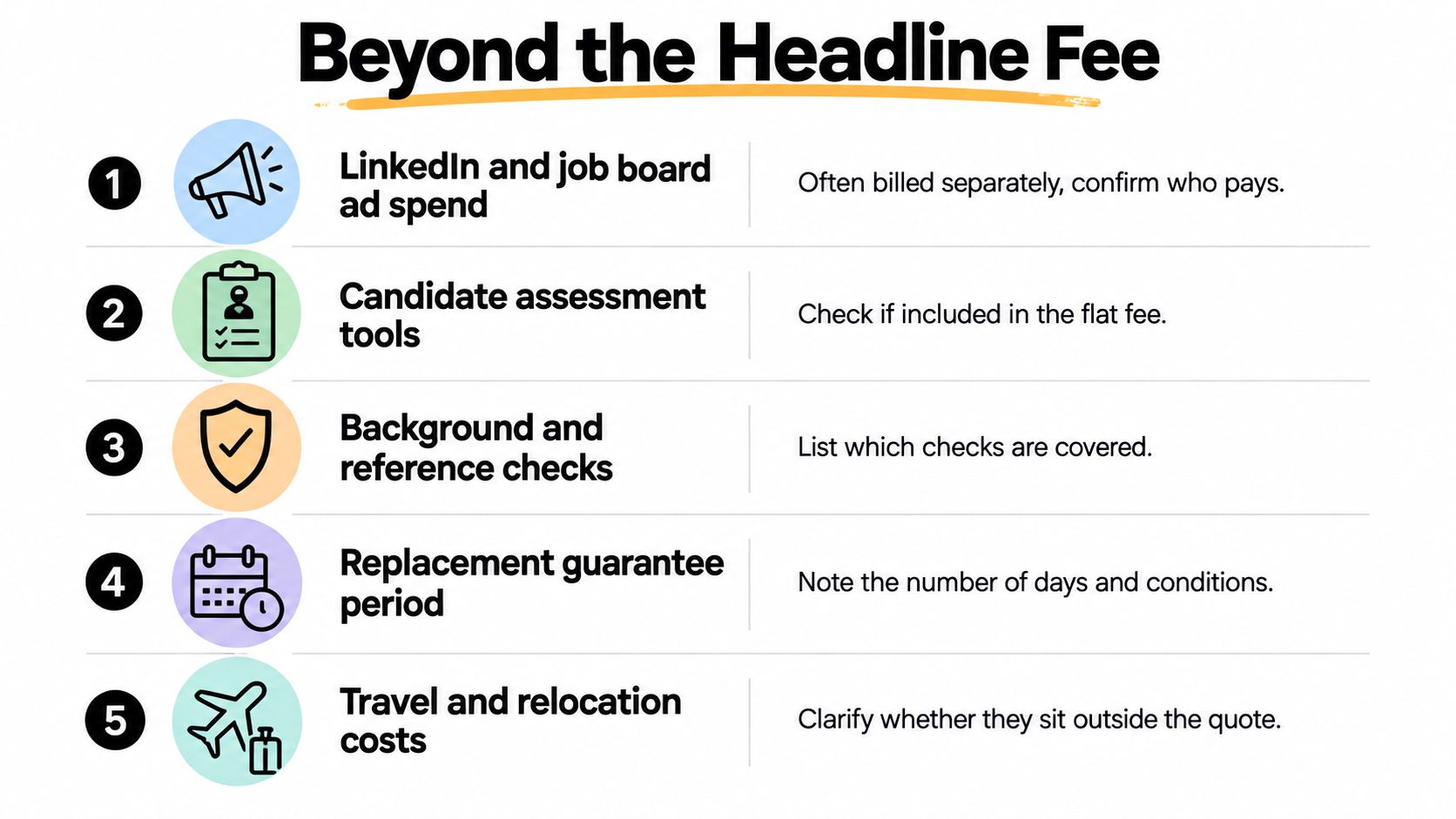
A fixed-fee proposal becomes useful only when you can turn it into a cost map. Start with the quoted amount, then list every activity needed to produce a candidate who starts, including the items the agency has excluded.
The fully loaded view matters because internal recruiting isn't free. SHRM's 2025 benchmark reports an average US cost per hire of $5,475 for nonexecutive roles and $35,879 for executive roles, according to its 2025 recruiting benchmark. Those figures frame the comparison, but your own model should include recruiting labor, interview coordination, sourcing tools, advertising, assessments, background checks, agency fees, and allocated overhead.
Calculate the number that matters
Use this formula:
Effective cost per successful hire = (fixed fee + excluded expenses) ÷ hires that start
If a provider charges a modest fee but sends poorly screened candidates, your engineering team absorbs unnecessary interviews and scheduling work. If the selected hire leaves early and the agreement offers no meaningful replacement, the original fee doesn't represent the final recruiting cost.
Salary assumptions can distort the comparison too. Before approving a role, use a documented salary benchmarking service to separate compensation accuracy from agency pricing. Then ask whether the fee is based on base salary, total compensation, seniority, country, or a fixed role category.
Service Levels That Turn a Fixed Fee Into a Managed Outcome
A fixed fee becomes defensible when the statement of work defines an operating result. “We'll source candidates” isn't a service level. The contract should specify what the agency delivers, by when, and how both sides measure quality.
Write the operating terms precisely
At minimum, define:
Role definition: title, responsibilities, required technologies, and essential skills.
Seniority classification: level, experience band, and decision rights.
Geographic scope: approved countries, remote terms, time-zone overlap, and employment constraints.
Shortlist deadline: the date for the initial candidate pool, not a vague promise to begin sourcing.
Candidate-quality criteria: validated skills, communication ability, salary expectations, availability, and location.
Interview ownership: who schedules, who collects feedback, and who manages offer discussions.
Replacement period: duration, eligibility conditions, and credit or replacement mechanics.
Taxes and unusual costs: whether assessments, travel, relocation, and local taxes are included.</li>
Track the funnel with time-to-first-shortlist, shortlist-to-interview ratio, interview-to-offer ratio, offer acceptance rate, time-to-fill, and 90-day retention. SHRM defines time-to-fill as the period from opening a requisition to offer acceptance, and its 2025 data places median time-to-fill for executive and nonexecutive positions at roughly a month and a half, according to SHRM's recruiting insights.
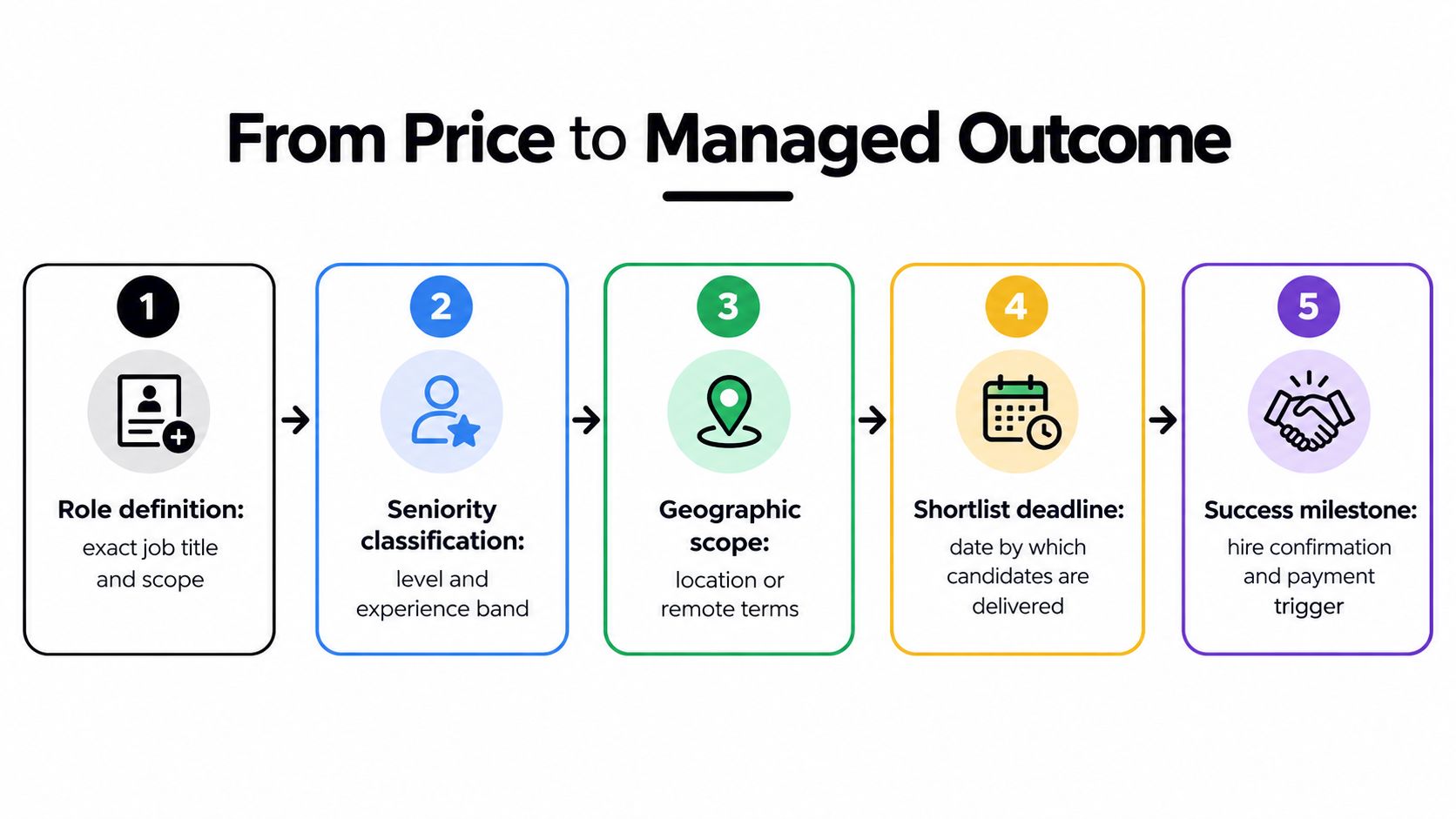
A promise to deliver an initial pool in three to seven days addresses the front end of the funnel. It doesn't guarantee offer acceptance or a completed hire. Your contract should distinguish sourcing speed from final hiring speed.
This short process overview can help teams comparing a fixed-fee search with recruitment process outsourcing:
A flat invoice without measurable delivery obligations is not a managed recruiting service. It's simply a different billing format.
When Fixed Fee Is the Wrong Economic Model
Flat pricing can be the wrong answer. The strongest objection is economic, not philosophical: hiring volume, role difficulty, and compensation spread determine value.
A startup hiring one scarce infrastructure engineer may benefit from external expertise, but it should compare the fixed fee with the fully loaded cost of internal sourcing and the cost of a failed search. A scale-up hiring repeatedly into the same market may get better economics from an internal recruiter who amortizes tools, market knowledge, and relationships across multiple openings. An RPO model can also outperform a per-role fee when hiring cadence is sustained and the client needs embedded recruiting capacity.
A single fee can also hide major differences between role families. 2026 estimates place mid-level full-stack developers in LATAM around $2,700 to $4,000 per month, DevOps and SRE talent around $3,100 to $4,500, and AI/ML engineers around $3,500 to $5,000, according to the LATAM tech talent report. These salary ranges don't prove that one search is harder than another, but they show why “LATAM engineer” is too broad a category for a serious rate card.

Match the model to the hiring pattern
SHRM's 2025 benchmark reports recruiting at an average of 26% of total HR budget, with organizations at the 25th percentile allocating 10%, the median allocating 20%, and the 75th percentile allocating 39%, as reported in its HR benchmarking release. Those figures don't prescribe a model. They reinforce that recruiting economics vary by organization.
Use fixed fee cautiously when:
You hire repeatedly into one talent pool: Internal recruiting or RPO may spread costs more efficiently.
Role complexity varies sharply: One price can overcharge routine roles or underfund difficult searches.
The provider rewards submissions: Candidate volume can rise while interview quality falls.
Compensation bands are unclear: The agency may classify every search into an unsuitable tier.
You need executive confidentiality: Retained search may provide stronger exclusivity and market coverage.</li>
Fixed fee wins when the role is clearly defined, the delivery scope is measurable, and the agency's price remains sensible after excluded expenses and internal time are included.
Legal and Guarantee Considerations Before You Sign
Pricing doesn't remove employment risk. A recruitment agreement may define what the agency invoices, but it doesn't determine whether a worker is legally an employee or an independent contractor.
For US hiring, the Department of Labor's rule published on January 10, 2024, and effective March 11, 2024, uses a multifactor economic-reality analysis. The six factors are the worker's opportunity for profit or loss, investments by the worker and employer, permanence of the relationship, the nature and degree of employer control, whether the work is integral to the business, and the worker's specialized skills and business initiative, as explained by the US Department of Labor classification guidance.
Don't confuse contract language with legal status
The federal rule doesn't use an ABC test. It evaluates the totality of the relationship, with economic dependence as a central concern. A company that controls a developer's schedule, tools, methods, and ongoing work may create employee-status facts even if the contract calls the person a contractor.
Before signing, ask whether the provider is introducing candidates, employing the worker, or supplying a managed service. Those structures allocate payroll, classification, supervision, benefits, and replacement responsibilities differently.
Guarantee language deserves the same scrutiny. Confirm:
Duration: How long does the replacement guarantee last?
Trigger: Does it apply to resignation, termination for performance, redundancy, or every departure?
Remedy: Is the client entitled to a replacement, a prorated refund, a full credit, or a new search?
Clock: Does a replacement search start a new guarantee period?
Conditions: Must invoices be paid, feedback supplied, or termination procedures followed?</li>
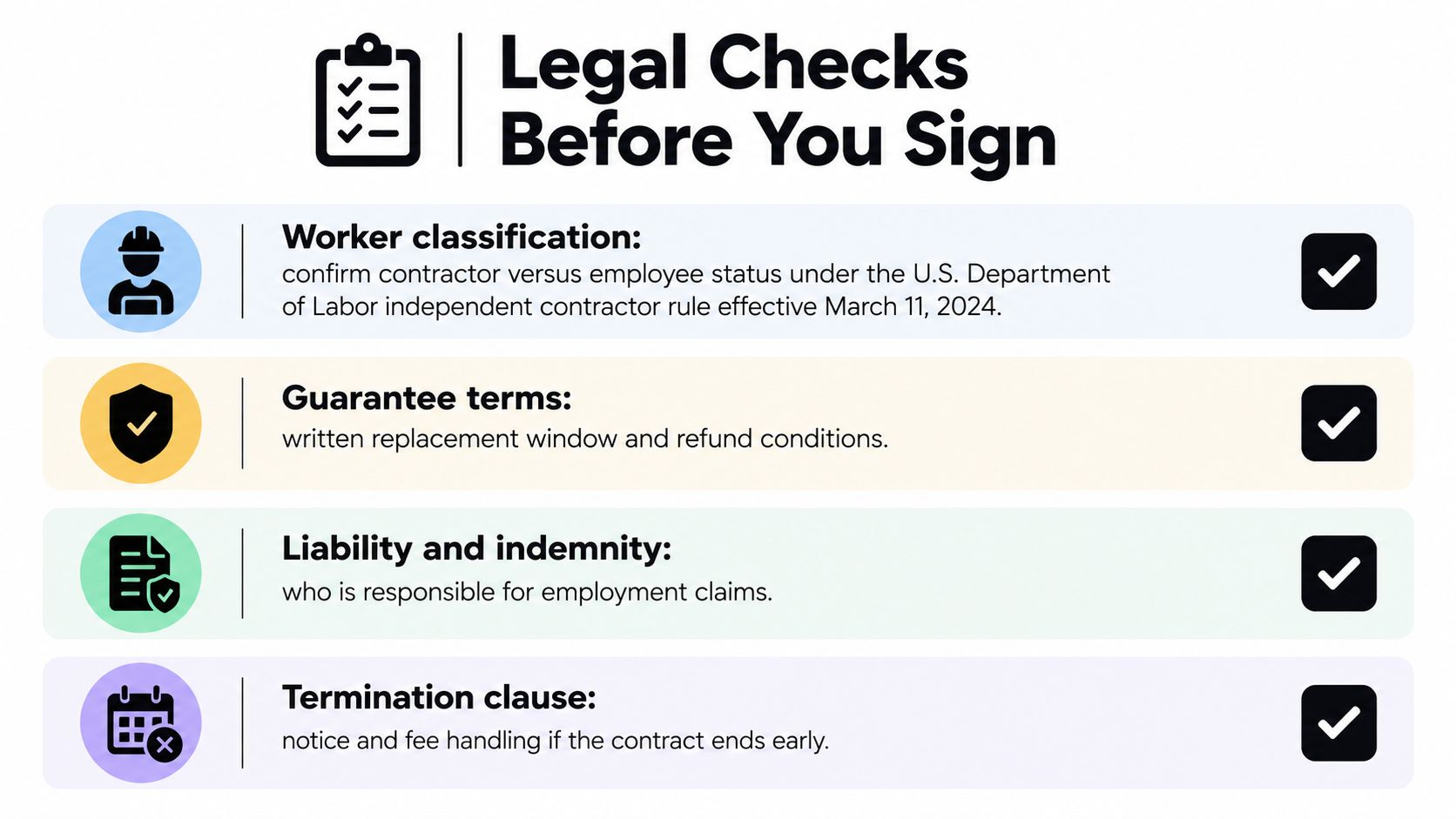
Have counsel review the classification, indemnity, data handling, payment timing, exclusions, and termination language. Teams that need help drafting solid service agreements should ensure the commercial promise and legal remedy say the same thing. A clear recruitment replacement guarantee is far more useful than a vague statement that the agency “stands behind” its placements.
Choosing a Fixed Fee Agency With Confidence
The decision comes down to four checks. Fail one, and the advertised fee isn't enough information to approve the search.
Check the hiring cadence first
If you need one difficult hire, a fixed-fee agency can be efficient because it gives you specialist sourcing without adding permanent recruiting capacity. If you expect recurring hiring across the same roles, compare the fee with an internal recruiter and RPO. The relevant question is not whether the agency is cheaper per transaction. It's whether the model produces the lowest fully loaded cost across your expected hiring pattern.
Check role difficulty and seniority
A fee should reflect the work. A routine role with a wide candidate pool shouldn't be priced like a confidential executive search, while a scarce DevOps, security, or AI profile may require deeper sourcing and technical validation. Ask the agency to define its seniority bands and explain how country, scarcity, urgency, and volume affect the quote.
Check every line item
Require a written inclusion matrix before procurement approves the agreement. Mark each item as included, excluded, or conditional:
Sourcing: Which markets, databases, referrals, and outreach channels are covered?
Screening: Who validates technical ability, communication, availability, and compensation expectations?
Assessment: Are coding tests, systems exercises, and external tools included?
Verification: Who pays for references, background checks, and right-to-work checks?
Coordination: Does the agency schedule interviews and manage feedback?
Taxes and expenses: Are VAT, sales taxes, travel, relocation, or integrations separate?
Failure protection: What credit, refund, or replacement applies if no candidate starts or the hire leaves?</li>
Check the service levels
The contract should state the shortlist deadline, quality threshold, client feedback obligations, interview ownership, offer support, payment trigger, and replacement terms. A promise of fast candidate delivery is useful only when the agreement also tracks interview conversion, offer acceptance, time-to-fill, and retention.
For companies evaluating fixed-fee IT and sales recruitment across Latin America, GENTY recruitment is one example of a provider using seniority-based flat pricing and a skill-first shortlist process. Other agencies, internal teams, and RPO providers may be a better fit when hiring volume or operational complexity justifies embedded capacity.
Buyer's standard: Reject any proposal that makes you calculate the real price yourself.
The final decision should use effective cost per successful hire. Add the quoted fee, excluded expenses, internal recruiting time, interview burden, and expected replacement exposure. Divide by candidates who actually start, then compare that figure with contingency, retained search, internal recruiting, and RPO. The winning proposal isn't the one with the lowest headline. It's the one that produces a qualified, retained hire at a cost your finance team can defend.
GENTY recruitment provides fixed-fee IT and sales recruitment for companies building technical and commercial teams across Latin America, with structured sourcing, screening, and replacement terms. Visit GENTY recruitment to compare its approach with your current agency proposals and request a hiring model based on your roles, markets, and volume.