
Aguinaldo is Mexico’s mandatory year-end bonus: at least 15 days’ pay, due no later than December 20, under Article 87 of the Ley Federal del Trabajo. It applies to nearly every worker on a Mexican payroll, including remote employees hired by U.S. companies, and workers can enforce it through PROFEDET or the local labor board if an employer misses the deadline.
TL;DR:
Employers must pay at least 15 days’ salary as aguinaldo by December 20, with no statutory grace period or extension allowed.
The law applies broadly to all subordinate employment relationships, including remote workers, while independent contractors might be reclassified as employees if the relationship is closely supervised.
The aguinaldo is calculated on the full year’s salary or prorated for employees hired mid-year, with variable pay averaged based on actual days worked.
A portion of the aguinaldo up to MXN 3,519.30 in 2026 is tax-exempt, but employers must correctly withhold taxes on the taxable part.
Payment must be in cash or bank transfer, and late or in-kind payments are subject to heavy fines, with claims possible up to one year after December 20.
What Article 87 of the LFT Actually Requires
Article 87 of the Ley Federal del Trabajo sets the floor: every employer must pay an annual aguinaldo equal to at least 15 days of the employee’s salary, and that payment must land in the worker’s hands no later than December 20 each year. PROFEDET, the federal agency tasked with defending worker rights, treats this deadline as absolute. There’s no statutory grace period, no allowance for “processing delays,” and no carve-out for companies that run payroll from outside Mexico.
The law covers anyone in a subordinate employment relationship, meaning the employer directs the work, sets the schedule, and controls the how and when. That standard matters more than the contract’s label.
Workers who believe they were shortchanged have two main paths:
Need help hiring?
See the next step after this guide
If this topic is relevant to your team, these are the most useful pages to check next.
- File a complaint with PROFEDET, which offers free legal representation to employees pursuing wage claims.
- Escalate to the local labor board (Junta de Conciliación y Arbitraje or the newer labor courts, depending on the state) if PROFEDET mediation fails.
Employees have one year from December 20 to bring a claim, so exposure for a missed or short payment doesn’t disappear on January 1. Mexico’s Congress periodically floats proposals to raise the statutory minimum above 15 days, but as of 2026 none has passed into law, so the 15-day floor still governs.
Who Qualifies for Aguinaldo (and Who Doesn’t)
Coverage is broad by design. The law protects the employment relationship itself, not the job title or the pay structure sitting on top of it.
- Full-time employees on indefinite contracts
- Part-time staff, prorated by days actually worked
- Temporary and seasonal workers, including those on short fixed-term contracts
- Commission-based sales staff, calculated on averaged variable pay
- Domestic workers, who gained explicit aguinaldo protection under reforms to Mexico’s labor code
Independent contractors are excluded, but only on paper. If a U.S. company hires someone in Mexico as a “contractor” while dictating their hours, requiring exclusive availability, and supervising their daily output, Mexican labor authorities can reclassify that relationship as subordinate employment retroactively. That reclassification exposes the employer to back aguinaldo, social security contributions, and penalties. This is one of the most common compliance traps for U.S. tech companies that try to hire in Mexico without a local entity or an employer-of-record arrangement, and it’s worth reviewing before you assume a contractor label protects you.
The 15-Day Minimum, the Dec 20 Deadline, and Sector Exceptions
Fifteen days is the legal floor, not a target. Nothing stops an employer from paying more, and plenty do: aguinaldo equal to 20 or even 30 days’ salary is common among companies competing for talent in Mexico’s tighter labor markets, according to LegalClarity. If a collective bargaining agreement or individual contract promises more than 15 days, that higher number becomes the enforceable minimum.
Public-sector rules sometimes diverge from the private-sector floor. Certain federal pension-related payments, for instance, are calculated at 40 days rather than 15, reflecting decades-old decrees specific to government employment, per Infobae. Private employers don’t get that variance without a contract that says so.
December 20 is fixed regardless of weekends, holidays, or internal payroll cycles. If it falls on a weekend, smart employers move payment earlier, never later.
How to Calculate Aguinaldo: Formulas and Worked Examples
The math is simpler than most payroll teams expect once you separate full-year employees from mid-year hires.
For an employee who worked the entire calendar year, the formula is:
- Divide the monthly salary by 30 to get the daily rate.
- Multiply the daily rate by 15 to get the gross aguinaldo.
For someone who joined partway through the year, LegalClarity’s pro rata formula applies:
- Take the daily salary rate.
- Multiply by 15.
- Multiply that result by (days worked ÷ 365).
Here’s how those formulas play out across common salary bands for a Mexican tech hire:
A software engineer earning MXN 70,000 a month who worked the full year is owed MXN 35,000 gross in December. The same engineer hired in July owes roughly MXN 17,260, prorated for the days actually on payroll. Budget for this line item the same way you budget for payroll taxes; it isn’t optional, and it isn’t negotiable at deadline time.
What Counts as “Salary” When You Calculate the Base
Fixed-salary employees use their standard daily quota, no adjustment needed. Variable-income earners are where payroll teams most often get it wrong.
- Fixed salary employees: use the regular daily rate derived from monthly pay.
- Commission or piecework earners: average the actual daily income from the last 30 days worked, or the full prior year for heavily commission-driven roles, per NOVACARD’s calculation guide.
- Days on legally protected leave (maternity, paternity, sick leave under IMSS coverage) still count as days worked toward the aguinaldo period.
- One-time bonuses, expense reimbursements, and non-recurring payments are typically excluded from the base calculation.
Pro Tip: When averaging variable income, count only the days the employee actually worked, not calendar days. Dividing total commission earnings by 30 calendar days instead of actual working days quietly understates the aguinaldo base, and it’s the single most common payroll error in commission-heavy sales teams.
Tax Treatment: The UMA Exemption Explained
Aguinaldo isn’t fully tax-free, but a meaningful slice of it is. Mexico exempts the equivalent of 30 days of the UMA (Unidad de Medida y Actualización), the index INEGI publishes and updates annually, from income tax (ISR).
At the 2026 daily UMA value of MXN 117.31, that works out to a tax-exempt threshold of MXN 3,519.30 on the aguinaldo payment, according to LegalClarity. Anything above that amount gets taxed as ordinary income, with the employer responsible for withholding ISR before disbursement, the same way payroll withholds on regular salary.
Employers should confirm the current UMA figure with INEGI and cross-check withholding treatment with SAT, Mexico’s tax authority, every year rather than assuming last year’s numbers still apply. For U.S. companies running payroll through an entity in Mexico, or through an employer-of-record partner, this withholding step happens locally. It’s not something a U.S.-based payroll system will calculate correctly on its own, and getting it wrong creates a filing headache for both the company and the employee come tax season.
Payment Rules: Cash Only, No Shortcuts After Dec 20
Mexican law is specific about how aguinaldo has to be paid, not just when.
- Payment must be in legal tender, meaning cash or a bank/electronic deposit.
- Vouchers, merchandise, gift cards, or any in-kind substitute are explicitly forbidden, per PROFEDET.
- There’s no legal path to installment payments after December 20; the full amount is due by that date.
- Fines for non-payment or late payment range from 50 to 5,000 times the daily UMA, according to Infobae.
- Workers have one year from the December 20 deadline to file a claim through PROFEDET or a labor board.
At a 2026 UMA of MXN 117.31, that penalty range spans roughly MXN 5,866 to MXN 586,550 per violation, a spread wide enough that regulators clearly intend for repeat or willful offenders to feel it.
Aguinaldo When an Employee Leaves Before December 20
Separation doesn’t erase the obligation. Anyone who resigns, gets terminated, or otherwise leaves before the December payout date is still entitled to a proportional aguinaldo, and it has to be included in their finiquito, the final settlement Mexican law requires at separation.
The formula mirrors the mid-year pro rata calculation: daily salary × 15 × (days worked in the calendar year ÷ 365). An employee earning MXN 45,000 a month who leaves at the end of September, having worked 273 days that year, is owed roughly MXN 16,808 in proportional aguinaldo as part of their final pay. Employers who skip this line item in a finiquito are just as exposed to a PROFEDET claim as one who misses the December 20 deadline entirely, and the one-year claim window applies here too.
Employer Compliance Checklist Before December 20
Payroll teams that treat aguinaldo as a routine calendar item, not a scramble, avoid nearly every dispute that ends up at PROFEDET. Here’s the sequence that works:
- Confirm every worker’s classification, since misclassified contractors carry hidden aguinaldo liability.
- Calculate pro rata amounts for anyone hired mid-year.
- Recalculate averages for commission or variable-pay employees using actual days worked.
- Confirm the current UMA value with INEGI before applying the tax exemption.
- Withhold ISR correctly on the taxable portion above the exemption.
- Schedule bank transfers to land before December 20, not on the deadline itself.
- Issue pay stubs documenting the aguinaldo calculation separately from regular salary.
- Retain records for at least the one-year claim window, ideally longer.
Companies without a Mexican entity typically lean on an employer-of-record or a local payroll partner to execute these steps, since a U.S.-based HR system usually has no native way to apply UMA-based tax exemptions or file the required documentation, making workforce management software a valuable tool for HR pros.
What U.S. Tech Employers Hiring in LATAM Should Budget For
Aguinaldo isn’t a rounding error in your total cost of hire. Budget it as a fixed 15th line item, minimum, on top of base salary.
- A mid-level software engineer in Mexico City earning around MXN 70,000/month (roughly $4,100 USD) carries a minimum aguinaldo liability near MXN 35,000, over $2,000 USD, that lands entirely in December.
- Senior engineers and specialized roles in FinTech or AI often see salaries 40 to 60% higher, scaling the aguinaldo obligation proportionally.
- Companies competing for talent in Guadalajara or Monterrey tech hubs often pay 20 to 30 days rather than the 15-day floor, which raises the December liability further.
Mexico’s timezone alignment with U.S. Central and Eastern time zones means daily standups, sprint planning, and real-time collaboration happen without the scheduling gymnastics that Eastern European or Asian teams require, an advantage that shows up in delivery speed, not just cost. For companies planning headcount across the region, salary benchmarks for Mexican software engineers help translate these liabilities into a real annual budget line rather than a December surprise.
Where Aguinaldo Came From and Why It Still Exists
Aguinaldo predates Mexico’s modern labor code by decades, rooted in a Catholic tradition of year-end gift-giving that eventually migrated from informal employer generosity into codified law. The Ley Federal del Trabajo formalized it as a mandatory benefit in the 1970s, converting what had been a discretionary gesture in many workplaces into an enforceable right tied to the employment relationship itself.
The policy logic behind that shift wasn’t sentimental. Mexico’s Congress designed aguinaldo partly to address a structural gap in the country’s wage system: unlike many countries where cost-of-living adjustments or built-in holiday pay smooth out December expenses, Mexican workers historically faced a sharp seasonal cash crunch around the holidays with no statutory cushion. Aguinaldo closed that gap by law, guaranteeing a predictable lump sum precisely when household costs spike.
That history explains why aguinaldo functions so differently from a discretionary year-end bonus in the U.S. sense. It isn’t a reward tied to performance or company profit. It’s closer to a deferred wage the law requires employers to release once a year, regardless of how the business performed. For U.S. companies used to bonus pools that flex with revenue, that distinction is worth sitting with: aguinaldo doesn’t flex. It’s owed whether the company had a record year or a rough one, and the labor authorities treat it accordingly.
Where Employers and Employees Get Aguinaldo Wrong
A surprising number of disputes trace back to a handful of recurring misunderstandings, on both sides of the employment relationship.
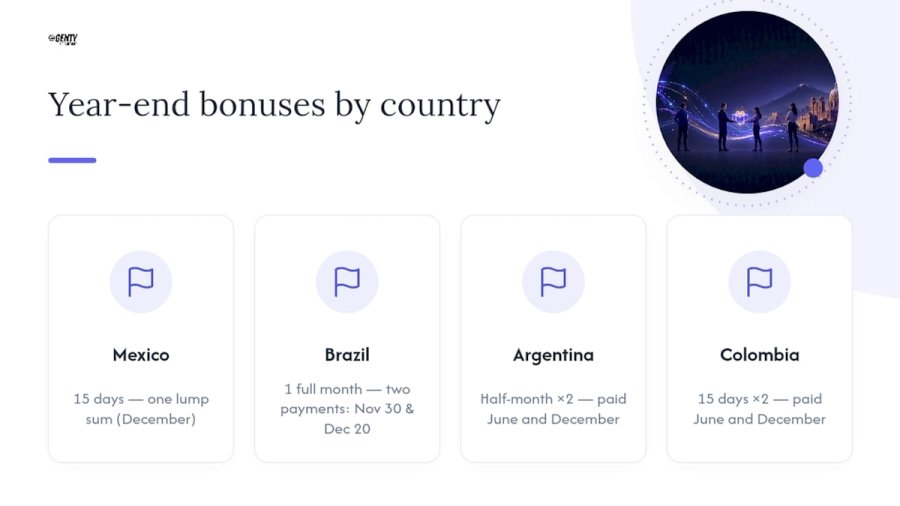
Some employers assume aguinaldo can be folded into an annual salary and paid out monthly instead of as a lump sum in December. That’s not how the law treats it. Even if the total annual compensation is identical, restructuring aguinaldo into monthly installments doesn’t satisfy Article 87, because the statute requires a discrete December payment.
Employees sometimes assume aguinaldo is taxed in full, and either overestimate what they’ll receive or fail to notice an incorrect withholding calculation. The UMA-based exemption means a meaningful portion, MXN 3,519.30 in 2026, arrives untaxed, and any ISR applied to that exempt slice is a withholding error worth flagging.
Another common misconception cuts the other way: some workers believe aguinaldo is a “gift” the employer can skip in a bad year. It isn’t discretionary, and it isn’t tied to company performance or profitability. The company’s financial health doesn’t change the legal obligation.
Finally, remote workers hired by foreign companies sometimes assume aguinaldo doesn’t apply to them because their employer sits outside Mexico. If the working relationship meets Mexico’s subordinate-employment test, geography of the employer’s headquarters is irrelevant. The obligation follows the employment relationship, not the company’s mailing address.
How Aguinaldo Compares to Year-End Bonuses Elsewhere in Latin America
Aguinaldo isn’t unique to Mexico, but the mechanics vary enough across the region that treating them as interchangeable is a budgeting mistake.
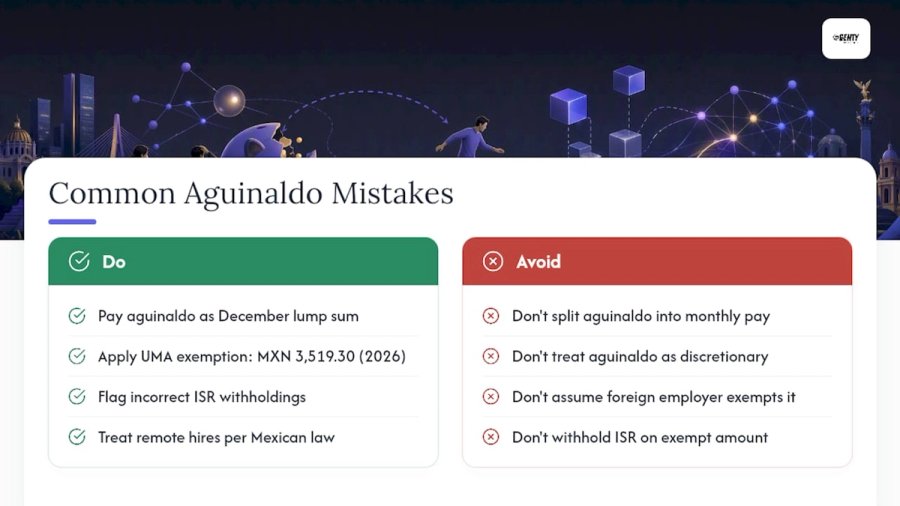
Brazil’s version, the 13th salary, splits payment into two installments rather than one lump sum: roughly half by November 30 and the remainder by December 20, and it applies to essentially the same subordinate-employment standard Mexico uses. The 13th month salary in Brazil is calculated on a full month’s pay, not 15 days, making it considerably larger than Mexico’s statutory floor.
Argentina’s equivalent, the Sueldo Anual Complementario (SAC), also pays out in two installments, in June and December, each equal to half a month’s salary, again exceeding Mexico’s 15-day minimum in total value.
Colombia mandates a prima de servicios paid twice yearly, in June and December, each installment equal to 15 days’ salary, putting its annual total closer to Mexico’s aguinaldo in raw days owed, even though the payment schedule differs.
For a U.S. company staffing teams across the region, this means the “Christmas bonus” line item on a Mexico payroll budget doesn’t translate directly to Brazil or Argentina without adjusting both the formula and the payment calendar. A team split between Mexico City and São Paulo carries two entirely different statutory bonus structures, and treating them as one budget line is how finance teams get blindsided in Q4.
A hiring manager’s lesson on catching an aguinaldo error before December 20
The most common failure isn’t malice, it’s a stale UMA figure or a commission average calculated on calendar days instead of worked days. Catching that requires a payroll QA step: before finalizing December transfers, recalculate one variable-pay employee’s aguinaldo manually and compare it against the payroll system’s output. If they diverge, audit every commission-based calculation before release, not after.
— Eugene
How GENTY recruitment Helps You Budget for LATAM Payroll Obligations
Aguinaldo is exactly the kind of line item that catches U.S. finance teams off guard when they’re building a hiring plan for Mexico, Argentina, Colombia, or Brazil for the first time. GENTY recruitment is the alternative to guessing at total cost of hire: instead of estimating salary alone and getting blindsided by a mandatory December payout, you get accurate, current salary benchmarks across LATAM markets built into the hiring plan from day one.
The agency places pre-vetted software engineers, DevOps specialists, data professionals, and sales talent across Argentina, Brazil, Mexico, and Colombia, with curated shortlists delivered within a week and transparent fixed-fee pricing per seniority level. There is no upfront payment, and placements can include a replacement guarantee. Hiring nearshore also provides timezone overlap with U.S. Eastern and Pacific hours to facilitate daily standups and real-time collaboration.
If you’re planning a hire in Mexico and want the aguinaldo liability built into your budget from the start rather than discovered in December, GENTY recruitment’s IT recruitment services can help you scope total compensation, including statutory obligations, before you extend an offer.
Primary sources to consult
- PROFEDET — Aguinaldo FAQ
- LegalClarity — Calculation, taxes, deadlines
- Infobae — Aguinaldo 2026 explainer
- Mexico News Daily — Aguinaldo guide
Sources
- PROFEDET — Preguntas frecuentes: Aguinaldo
- LegalClarity — Aguinaldo: Christmas bonus calculation, taxes, and deadlines
- Infobae — Aguinaldo 2026: quiénes lo reciben, cuánto les toca y cuándo se paga
- NOVACARD — Calculadora de aguinaldo 2026: fórmula, ISR y ejemplos
- Mexico News Daily — The aguinaldo holiday bonus: Everything you need to know