
77% of surveyed organizations were developing or had developed pay-transparency strategies, but only 14% had fully implemented them, according to Mercer's 2025 Global Pay Transparency Report. Publishing pay is easier than explaining it. So, what is compensation benchmarking? It's the structured comparison of your company's pay for a defined job against external labor-market data and internal job requirements, producing a defensible pay range rather than a guess.
For a CTO or HR Director at a growing tech company, the difficult part isn't finding salary figures. It's deciding which figures describe the people you need to hire.
Compensation Benchmarking Explained in Plain Terms
Say you're hiring a backend engineer. A salary search returns figures for application developers, infrastructure specialists, and technical leaders. All look relevant until you compare their actual responsibilities.
Benchmarking is like checking a home's price against recent sales on the same street, not just the same postcode. Similar labels don't establish comparable value. You need to inspect what's inside.
Need help hiring?
See the next step after this guide
If this topic is relevant to your team, these are the most useful pages to check next.
A useful comparison accounts for job scope, skills, experience, location, industry, company size, and total rewards. A developer maintaining a mature service isn't necessarily comparable to someone designing your platform and owning production incidents.
The analysis starts with a shared understanding of the role.

Define the comparison before collecting salaries
The U.S. Bureau of Labor Statistics percentile guide defines a wage percentile as the value below which a specified percentage of workers fall. That lets you examine a distribution instead of treating one average as the answer.
Before searching, record these inputs:
Scope and level: Decisions owned, operational responsibility, and expected autonomy.
Required capabilities: Essential skills and relevant experience, not a wishlist.
Hiring geography: Where candidates work and which employers compete for them.
Company peer group: Industry, organizational size, and comparable operating complexity.
Compensation components: Base salary, variable pay, equity, and benefits.</li>
The output should describe the market for that role. A benchmark is a distribution of matched work, not an average of unrelated salaries.
Percentile Targets and What Each One Costs
BLS example wage percentiles and what each target means
The wage figures below reproduce the BLS guide's illustrative distribution. The employer-target column describes possible policy choices, not occupational recommendations from BLS.
These are illustrative wages, not engineering salary recommendations. An entry-level role still needs its own matched distribution; choosing a lower percentile doesn't establish a job's seniority.
Choose a position before calculating a budget
A percentile tells you where a pay point sits among comparable observations. It doesn't tell you what your company ought to pay. That's a policy decision involving hiring difficulty, affordability, and your broader rewards package.
For a mid-level backend engineer, selecting an upper-market target instead of the median raises the intended midpoint. Finance must then budget for that higher recurring salary and any employer costs linked to it. Apply the decision across planned headcount, rather than assessing only the next offer.
Practical rule: Set the target before reviewing a preferred candidate's salary expectations. Otherwise, you're documenting a negotiation rather than establishing a pay policy.
Equity or flexibility may support a lower cash position, but don't assume candidates value those benefits as you do. Test the package during recruitment and record why it's competitive.
Use the BLS program's occupational and geographic breakdowns to check location assumptions, then seek more specific technical-role evidence. For nearshore hiring, a country-specific salary reference can help frame the relevant market without turning a regional headline into your final budget.
Methodologies and Data Sources for Each Role
Data sources compared for compensation benchmarking
Triangulate rather than vote. A WorldatWork market-pricing study found that 80% to 90% of responding organizations used at least two survey sources. Treat that as historical evidence of quality-control practice, not a current adoption estimate.
Match the method to the decision
Market-survey pricing matches your role to an appropriate survey segment and selected market position. It's useful when you need a repeatable salary structure.
Internal relativities compare jobs by scope, skills, and responsibility. Use them to avoid placing an engineering manager and a staff engineer inconsistently because their external datasets differ.
Skill-first pricing examines capability clusters such as Kubernetes, data engineering, or LLM tooling when conventional titles don't describe the work adequately. Don't add a premium for every technology listed in a job description.
WTW's compensation-data selection guidance emphasizes source fitness and comparability. Check whether a dataset captures remote premiums, employment status, currency, tax burden, benefits, and the distinction between an employee's home market and your headquarters market.
Compare independent sources, investigate disagreement, and check results against recruitment outcomes. Don't force incompatible datasets to agree by averaging them.
A comparison of salary benchmarking tools is useful only after you've defined the decision the tool must support. More observations won't repair a poor role match.
How to Run a Benchmark Step by Step
Create a benchmarking worksheet that HR, engineering, and finance can review together. Keep the job-match notes beside the pay figures so reviewers can challenge assumptions without reconstructing your analysis.
Use this process overview to organize the work.
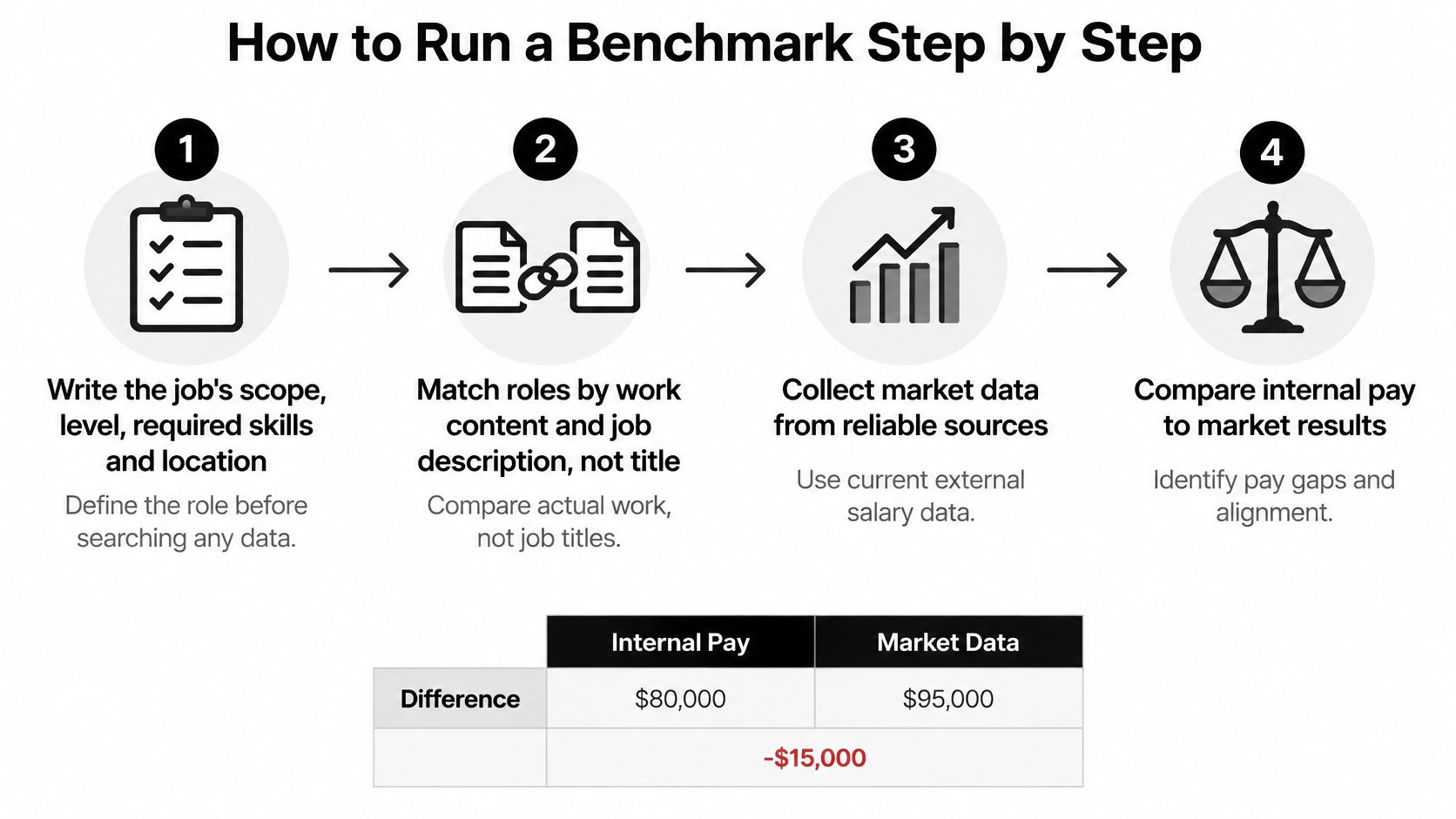
Build an auditable worksheet
Write the role specification. Capture scope, level, required skills, and location before opening a salary database. Include concrete outcomes, such as owning service reliability or leading architectural decisions.
Match work content rather than titles. WorldatWork's benchmarking guidance recommends examining job descriptions and responsibilities because titles can mislead. Record where the survey description fits and where your role differs.
Select independent evidence. Choose sources with suitable technical-role and geographic coverage. Check their underlying origins so you don't mistake repackaged versions of the same dataset for independent confirmation.
Extract the lower-quartile, median, and upper-quartile observations. Keep each source's results separate while checking definitions. Don't compare base salary in one column with total cash compensation in another.
Confirm the labor market. For a senior technical leader recruited nationally, a neighborhood-level comparison may be too narrow. For locally recruited operational roles, a broad international dataset may be irrelevant.
Construct the range. Place the midpoint near your selected market position, then define minimum and maximum using role scope and progression criteria. Explain what distinguishes someone developing into the role from someone consistently operating at its full scope.
Preserve the evidence. Record sample size, effective date, currency-conversion method, inclusion rules, and quality limitations. Assign an owner to approve the benchmark and identify when it needs review.
Test whether the range works
Compare the proposed range with recent offers and acceptance patterns. When candidates decline, distinguish compensation concerns from interview delays, role ambiguity, or competing opportunities.
Also inspect incumbent placements before approving a recruiting exception. A range that attracts candidates but creates unexplained internal differences isn't ready for routine use.
Use the accompanying video as a discussion aid while your hiring team reviews its worksheet.
Pitfalls That Distort a Compensation Benchmark
Most benchmarking mistakes happen before anyone approves a salary band. Catch them in the worksheet rather than trying to explain them after an offer.
Averaging percentiles across different roles. Build a comparable peer group and calculate its distribution rather than averaging frontend, backend, and infrastructure percentile figures.
Treating a title as a job description. Compare deliverables and decision authority; for coordination-heavy positions, HireArchitects' project coordination guidance for architecture studios offers a useful adjacent resource for thinking about actual responsibilities rather than labels.
Trusting one convenient source. Challenge a loosely matched survey result with independent evidence instead of treating a recognizable publisher as sufficient validation.
Ignoring the effective date. Check whether the observations still describe the candidates you're approaching, particularly for evolving AI or security responsibilities.
Missing internal compression. Review a proposed new hire's placement against established employees doing comparable work, and resolve unjustified differences before final approval.
Don't mix compensation designs
A sales benchmark can be distorted even when the job match looks correct. Separate base pay from target incentives and performance conditions; an SDR compensation-plan reference helps frame that distinction.
Keep the job-match explanation, observation date, and compensation definition beside every result. A polished chart without those details is difficult to defend.
What a Benchmark Must Include Beyond Base Salary
Base salary isn't employer cost. The BLS compensation-percentile factsheet reports that wages and salaries represent approximately 70% of average employer compensation costs, with benefits accounting for the remaining 30%. Those benefits include paid leave, supplemental pay, insurance, retirement and savings, and legally required benefits.
That's an aggregate U.S. measure, not a loading factor to apply automatically to every international hire. Build the actual cost components for your arrangement.
Compare packages without disguising trade-offs
Say your backend engineer offer sits at the market median for base salary. A guaranteed bonus, employer-funded health coverage, and retirement contributions can produce a higher employer cost than another median-base offer.
Keep equity separate from guaranteed cash. Describe the grant and valuation assumptions clearly rather than presenting uncertain future value as salary equivalent. For distributed roles, include equipment and recurring work expenses; an equipment-stipend framework for remote teams can help define that budget line.
Check equal value as well as market value
The OECD's pay-transparency guidance identifies gender-neutral job evaluation using skills, effort, responsibility, and working conditions as central to equal pay for work of equal value.
External competitiveness alone doesn't establish fairness. Examine whether differences reflect documented factors such as location, relevant experience, or scope, rather than inconsistent negotiation outcomes.
Before approval, complete these checks:
Total cost: Include cash, benefits, contributions, and separately identified equity assumptions.
Internal positioning: Inspect comparable employees for compression or unexplained gaps.
Placement rationale: Document why this person belongs at this point within the band.</li>
Benchmarking LATAM Hires Across Hiring Models
LATAM hiring models and the cost each benchmark must include
The hiring model belongs in the comparison definition, not in a footnote added after salary negotiations. Local employment, employer-of-record arrangements, and contracting produce different obligations and cost structures.
The BLS occupational wage methodology organizes estimates by standardized occupation and geography, applies weights, and warns that averaging percentile wages across detailed occupations generally doesn't produce the correct combined percentile. Apply the same discipline here: don't merge countries, levels, or engagement models into an apparently precise market figure.
A Mexico-based full-stack developer
Suppose you're comparing local employment with a contractor engagement for the same developer. For employment, build the budget from salary, applicable statutory benefits, employer contributions, and any bonus or additional benefits.
For contracting, assess the agreed service rate, equipment obligations, invoicing currency, and relevant tax treatment. Don't assume that a higher contractor payment means higher comparable earnings or that a lower invoice necessarily creates a lower-risk arrangement. Confirm classification and local requirements with qualified counsel.
Keep both budgets on a consistent time basis and document the exchange-rate assumption. Use country-specific developer contractor-rate guidance for its intended engagement type, not as a substitute for employee salary evidence.
Test the market country by country
Talent Intelligence means checking country-and-role benchmarks against candidate availability, relevant shortlists, and offer acceptance. Nearshore time-zone overlap and English proficiency can support the hiring decision, but they don't change the benchmarking method.
Compare like-for-like compensation first. Compare the business advantages of each hiring arrangement separately.
Publish a Defensible Range Under Pay Transparency Rules
Pay transparency makes the quality of your benchmark visible to candidates and employees. A published range needs an explanation of both its boundaries and individual placement.
Under Directive (EU) 2023/970, as explained by the European Commission, member states must transpose the directive by 7 June 2026; jobseekers must receive initial pay or range information in the vacancy notice or before the interview, and workers gain rights to request average pay information for women and men in the same pay category. Check the applicable national implementation before recruiting.
Approve the explanation with the range
State the policy: Record the target market position and its business rationale.
Validate the evidence: Reconcile independent sources with recent offers.
Confirm affordability: Check total employer cost under the chosen hiring model.</li>
At GENTY recruitment, our Salary Benchmarking uses real country- and role-specific data for Latin American markets, percentile bands, benefits and equity comparisons, market insights, and a custom PDF report. It can save up to 25% on compensation without losing top talent; teams applying the benchmark to an active search can discuss their hiring requirements.
This week, write down the target percentile and rationale for your next open role.
GENTY recruitment offers salary benchmarking and technical recruitment to connect defensible pay ranges with a live candidate search. Bring your role scope, hiring location, and proposed package to GENTY recruitment to discuss the evidence you need before approving your next offer.