

Write nearshore as one word for outsourcing and hiring; near shore is the literal phrase for physical closeness to the coast. But does correcting the spelling tell you whether the hiring model will improve delivery?
For a CTO or HR director, that's the more expensive question. A nearby engineer can still spend the day waiting for decisions, and a lower hourly rate can still produce a higher delivery cost. Choose the spelling by context. Choose the hiring model by usable overlap, capability, and fully loaded cost.
Which Form of Nearshore Is Correct
Nearshore is the standard choice in business, technology, and hiring copy. Use it consistently in job descriptions, recruitment briefs, vendor agreements, and engineering plans.
A working definition is straightforward: nearshore means hiring or outsourcing delivery to a country close enough to share a substantial part of your working day. Latin America is a common option for US companies. European employers need to assess the actual shared window rather than assume the same geography provides the same benefit.
Planning a hire?
Talk through the best hiring option
This article usually leads to one practical question: should you use staffing or it recruitment? We can help you choose quickly.
Simple next step
Start with staffing and we will help you pick the best hiring setup.
Nearshore spellings and when each one fits
The word works most naturally as an adjective, as in a nearshore team, or as an adverb, as in we deliver nearshore. You may encounter it used as a noun, but “a nearshore delivery location” is clearer than “a nearshore.”
Nearshoring names the practice, not the people. Write “we're considering nearshoring” when discussing the sourcing strategy and “we're hiring nearshore engineers” when discussing the team.
Keep terminology separate from the contract
Nearshore doesn't tell you who employs the engineer, who manages delivery, or who owns the work product. A direct employee, contractor, staffing placement, and outsourced delivery team can all operate nearshore.
Writing rule: If the sentence concerns outsourcing, hiring, or delivery, use nearshore. If it describes physical distance from the coast, use near shore.
When someone asks “nearshore or near shore,” the editorial answer is simple. The procurement decision still needs a separate definition of responsibilities, employment structure, and expected outcomes.
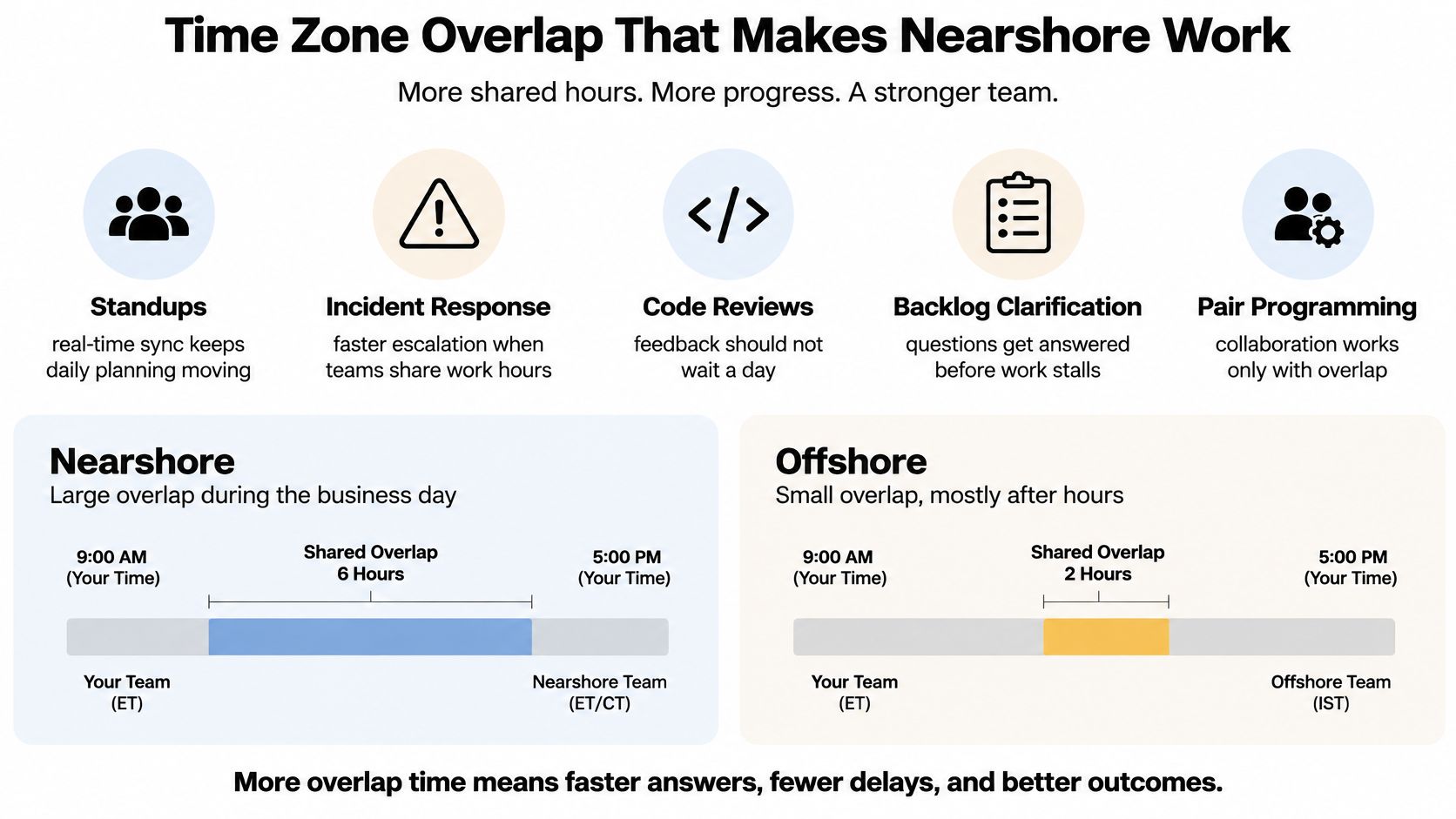
Time Zone Overlap That Makes Nearshore Work
Working-hour overlap with US Eastern Time by country
The planning table assumes both teams work 9am to 6pm locally. Shared hours are calculated from the listed offsets, not a promise about an individual candidate's availability.
The Auxis regional comparison places Mexico typically 1–2 hours behind US Eastern, Colombia on the same time or an hour behind, and Brazil and Argentina 1–2 hours ahead. Treat the table as a scheduling model and verify each candidate's city, working hours, and seasonal changes.
The practical advantage is faster interaction, not shorter distance.
Reserve overlap for decisions
A broad shared window supports standups, incident escalation, code reviews, backlog clarification, and pair programming. But overlap doesn't help if the engineering manager fills it with unrelated meetings or leaves pull requests unanswered.
Protect a shared decision window in the calendar. Name a reviewer and an escalation owner so an engineer can resolve a blocker without waiting for the next ceremony.
The comparison of developer salaries, time zones, and productivity is useful when assessing those trade-offs together rather than treating availability as an afterthought.
European teams need a different calculation
For an illustrative winter schedule, a Mexico City workday overlaps Central European Time by roughly 2 hours, Colombia by 3 hours, and São Paulo or Buenos Aires by 5 hours. Under the same local-workday assumption, European summer time reduces those windows to roughly 1, 2, and 4 hours, respectively.
That makes Brazil and Argentina more practical starting points for European collaboration. Mexico or Colombia may require an agreed early start locally or a later availability window in Europe.
Seasonal clock changes can alter the arrangement, and Mexico's largely discontinued daylight-saving practice makes city-level verification important. Write the required overlap window into the job specification before shortlisting.
What Nearshore Savings Look Like After Loaded Costs
Outsourced hourly rates for LATAM developers in 2026
The Abark nearshore market comparison lists $33–45 per hour for junior outsourced developers and $60–75 for senior developers in its 2026 comparison, alongside an industry estimate of costs 20–30% below comparable US developer costs.
Those are budgeting inputs, not your savings calculation. A senior-heavy team, a scarce infrastructure stack, or a delivery arrangement with substantial management included can produce a very different commercial proposal.
Build the loaded model
Calculate the cost of acquiring and sustaining productive capacity, not just paying for access to a person.
Recruiting: Include search fees and the internal time spent screening and interviewing.
Employment administration: Add payroll, contractor-management, or employer-of-record charges.
Working setup: Include equipment, software access, and security provisioning.
Benefits and compliance: Account for the obligations attached to the selected employment model.
Replacement risk: Budget for interrupted delivery, renewed search effort, and another onboarding cycle.</li>
For a practical cost worksheet, use the guide to the cost of hiring regional talent. Keep recurring expenses separate from acquisition and transition costs so you can compare arrangements fairly.
Measure output after access
Track time to productivity in weeks, first-interview pass rate, delivery throughput per sprint, and retention at six and twelve months. Define productivity as independent delivery of work at the role's expected complexity, not completion of onboarding videos.
A cheaper engineer who needs substantially more mentoring may consume the capacity you intended to add. Conversely, an expensive specialist can be economical when they remove a bottleneck that blocks the wider team.
Compare the cost of an independently delivered outcome, not the price of an available hour.
Don't confuse regional employee-wage averages with outsourced developer rates. The former describes pay; the latter can include a provider's delivery and commercial costs. Structured technical screening and skill-based matching make the cost advantage useful. A low rate alone doesn't.
Language and Working Style Benefits in Practice
A résumé's English label isn't evidence that a candidate can explain a production incident or challenge an ambiguous requirement. Test the communication the job requires.
For QA, ask for a written bug report with reproduction steps, expected behavior, actual behavior, and severity reasoning. For engineering, request a short design note explaining a proposed approach and its trade-offs.
Score the work, not the accent
Use a rubric covering clarity, completeness, and tone. Can the reviewer act without another meeting? Does the candidate state uncertainty and distinguish a recommendation from an established requirement?
The guide to English proficiency in distributed hiring provides context, but the hiring decision should rest on the candidate's work sample and stakeholder discussion. Ask about experience writing for international product, engineering, or customer teams.
Working-style fit also requires explicit expectations. Define how reviewers disagree in GitHub, where blockers belong in Slack, and when an asynchronous discussion should become a call. Translate AI's international business etiquette strategies can help managers make those expectations clear without treating nationality as a personality profile.
Test sales roles against the buyer
An SDR prospecting US buyers from Mexico needs calling availability inside the buyer's business day. An SDR targeting Europe needs an explicitly agreed European calling window, not merely overlap with an internal manager.
Spanish supports Spanish-speaking accounts, while Brazilian accounts require Portuguese. A Mexico-based account executive may serve Spanish-speaking buyers natively, but location alone doesn't establish language ability.
Buyer-facing test: Request a short written or recorded pitch in the buyer's language.
Ramp assessment: Ask the candidate to estimate quota-ramp time in months and explain the assumptions.
Role scorecard: Weight communication and language above years of experience for distributed roles.</li>
Which LATAM Markets Fit Your Hiring Goal
The region isn't a single labor market. CBRE's tech-talent market analysis identifies Mexico City, São Paulo, and Santiago as its three largest tech-talent markets, with Monterrey the fastest-growing; it also places average regional technology wages at approximately 39% of US levels, a pay comparison rather than an outsourced-rate quote.
Map each search against the capability you need.

Match the market to the role
Mexico City and Monterrey are sensible starting points for US-aligned product and backend searches. Don't interpret Monterrey's growth as proof that every specialist stack has deep availability.
São Paulo deserves consideration for hiring at scale, Portuguese-speaking roles, and European overlap. Santiago belongs on the shortlist for Spanish-speaking technical teams.
Within every market, check backend, DevOps, cybersecurity, and data-engineering depth separately. The multi-country hiring guide for HR leaders can help structure a search that doesn't depend on a single city.
Use the video alongside your market discussion.
Shortlist two markets for each critical role before posting, then validate candidate depth rather than relying on city reputation.
Nearshore Fit Checklist for US and EU Teams
Run this checklist with the hiring manager and technical lead before opening the requisition. Treat the answers as operating commitments, not recruitment preferences.
Use this visual as a discussion prompt.
Test the operating model
Does the work require real-time collaboration for at least four hours a day? Use that as a proposed decision threshold, not a universal rule. A yes supports paying for alignment; a no means a broader offshore search may serve the work equally well.
Will the team own decisions without long approval chains? Specify which technical decisions engineers can make independently. If they only execute tickets while approvals remain elsewhere, proximity won't remove the bottleneck.
Is the required capability available in the target market? Validate specialist depth through qualified candidates, not total developer counts. If the shortlist lacks credible DevOps, cybersecurity, or data-engineering experience, broaden the search or budget for development.
Have you defined the seniority mix? Separate tasks requiring specialist judgment from work a developing engineer can own. Otherwise, you may budget for generalists while assessing everyone against a specialist bar.
Can the process run asynchronously? Written specifications, architecture decisions, and handoffs should remain usable when colleagues are offline. A no means the team needs process preparation before additional hiring.
Have you selected the employment model? Decide between direct employment, contracting, and an employer of record. Assign responsibility for local employment advice, intellectual-property terms, data access, and termination obligations before an offer.
Have you defined measurable outcomes? Agree on ramp expectations, throughput, and retention ownership. Without a baseline, you won't know whether the model improved delivery or merely expanded headcount.
Interpret the result honestly
Mostly affirmative answers indicate a workable setup. Negative answers on overlap need and decision rights weaken the case for nearshore, even when candidates are excellent.
Geographic alignment cannot substitute for a manager who has time to onboard, delegate, and review.
Nearshore may be the wrong choice for work with no real-time dependency. It's also a poor immediate choice when nobody has the capacity to manage distributed contributors.
Decide Your Nearshore Hiring Model This Quarter
Pick one critical role, one target market, and an explicit overlap window. Put them into the job specification alongside the loaded-cost assumptions before interviewing.
Build the screen around a realistic work sample and review the shortlist against a written scorecard. For distributed positions, prioritize communication and demonstrated judgment over tenure alone.
Make the first hire measurable
Use the guide to global hiring models for technical recruiting to settle the engagement structure. For an end-to-end technical search, consider IT recruitment; for growing hiring volumes, RPO supports an outsourced recruitment process.
At GENTY recruitment, we verify candidates' C1/C2 English level and remote-work readiness. Those checks complement, rather than replace, your role-specific assessment.
If the search fails the overlap or capability-depth test, change the market or model before posting. After the hire starts, report time to productivity at 30, 60, and 90 days, then review throughput and retention at six months as your chosen evaluation cadence.
GENTY recruitment helps US and EU startups hire vetted nearshore talent in under 2 weeks. Visit GENTY recruitment with your priority role, required working window, and budget assumptions to discuss a skill-first search built around your delivery needs.