

A Series A engineering team has a release blocked by an unanswered product question. Its offshore vendor has finished work for the day, the product manager has logged off, and the issue now waits in a queue until the next morning. For a CTO or VP Engineering, the true nearshore outsourcing advantages are shared working hours, access to a substantial technical labor market, and a cost position that can beat US and European salaries when the full employment model is priced candidly. A lower rate isn't automatic savings.
The decision is whether closer collaboration and the available talent justify the fully loaded cost for the specific role and hiring model. That means testing how proximity affects delivery, where salary savings survive, how talent differs by country, what risks erase the advantage, and whether to hire in-house, through an agency, or with RPO.
Nearshore Outsourcing Advantages in Plain Terms
Nearshore outsourcing is useful when your team needs external capacity without turning every product question into an overnight handoff. For a company with a growing backlog and a thin local hiring market, the practical case is straightforward: a nearshore team can work alongside internal engineers during a shared business day, bring skills that are difficult to hire locally, and cost less than comparable US or European staff under the right arrangement.
That's the advantage, not a promise that any vendor will deliver more cheaply or more effectively. A team with weak communication, unclear ownership, or insufficient overlap can recreate the same delays as a distant offshore team. And a competitive hourly rate can disappear once you add recruitment fees, benefits, management effort, and replacement risk.
Before you start hiring
Check location, salary, and hiring fit
If you are moving from research to action, start with the market basics so your hiring plan is clearer.
For US companies considering Latin America, the opportunity is to buy a way of working, not just a lower-cost location. Define the work first. Is the bottleneck implementation capacity, a specialist skill, or the ability to get design decisions made while both teams are online? Those are different problems, and they need different staffing models.
A useful outside perspective is this guide to nearshore engineering teams for US companies, which frames proximity as part of the operating model rather than a rate card. Apply that distinction before you compare vendors. A team that can join a live review and resolve a blocker today may create more value than a nominally cheaper team whose schedule makes rapid feedback difficult.
The sections ahead put each claim under pressure. First, separate nearshore delivery from local employment and far-offshore handoffs. Then set a concrete collaboration window, test the loaded cost by hiring model, and match the role to a country's strengths. Finally, check the risks and choose a recruiting path that fits your company's hiring cadence.
What Nearshore Means for a Software Team
Nearshore describes an outsourced team located close enough to the client for practical same-day collaboration. It's still distributed delivery: the engineers may work for a vendor or another employer, and they aren't local employees sitting in the same office. The distinction from far-offshore work is less about a label than about whether the teams can routinely make decisions together during working hours.
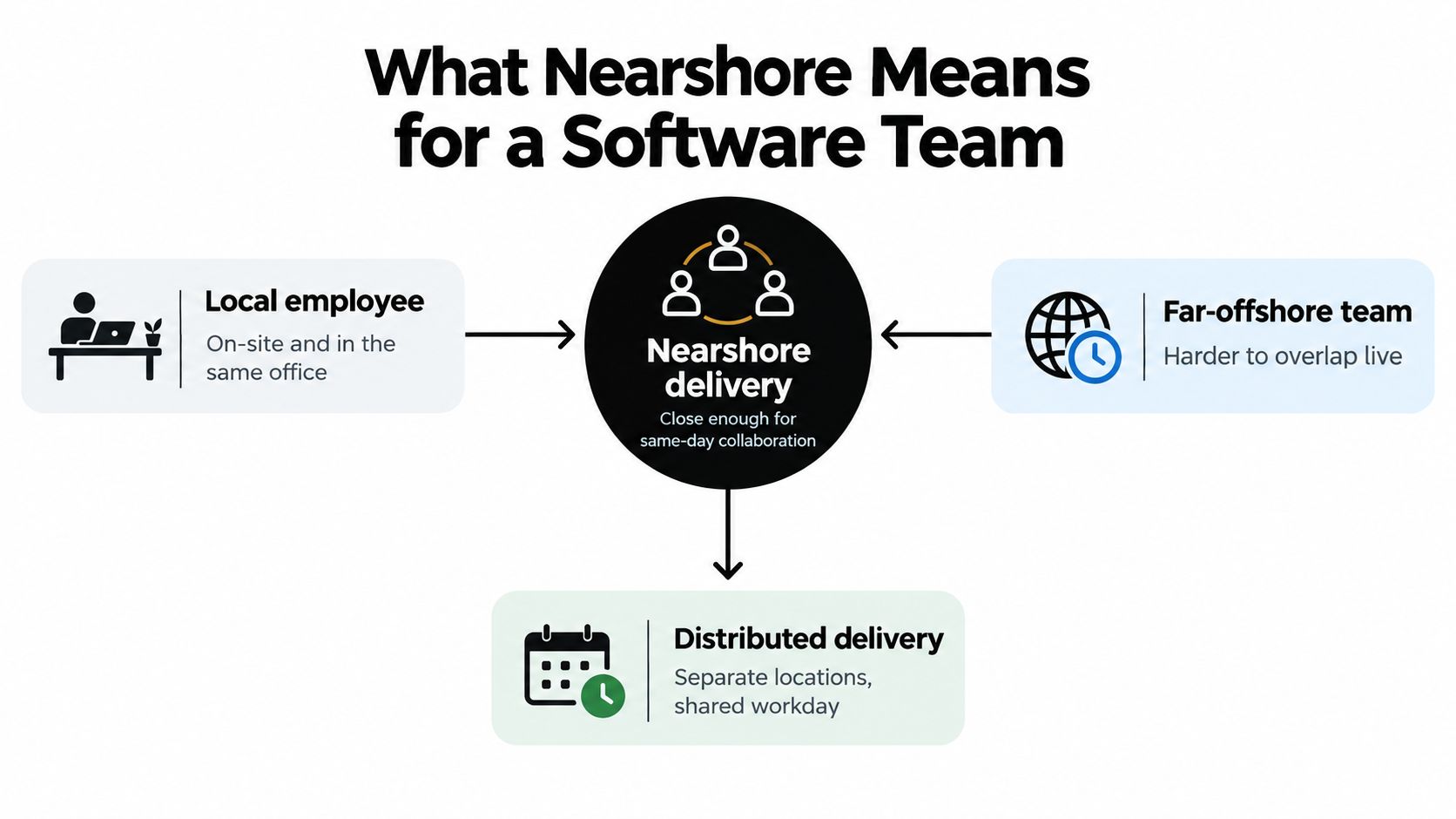
The distinction matters because companies buy different things under each model. A local employee is embedded in the company's employment structure and day-to-day environment. A nearshore team is a separate delivery or staffing arrangement with enough working-hour overlap to support regular coordination. A far-offshore team can still be effective, especially for work built around planned handoffs, but live interaction is harder when the schedules barely meet.
The regional market has a substantial export record behind it. World Bank data on digitally delivered services shows that Latin America and the Caribbean's exports of these services rose from $18.5 billion in 2005 to $87.7 billion in 2024. The sector represented about one-third of commercial services exports in 2024, while the region still accounted for about 2% of global digitally delivered service exports.
Specialization also varies across economies. Digitally delivered services made up 62% of Brazil's services exports, 54% of Costa Rica's, and 27% of Mexico's in 2024; the World Bank also reported 53% for Uruguay and 48% for Argentina. That's evidence of an established export ecosystem, not proof that talent is unlimited or evenly distributed. Capacity exists, but buyers still need to match a role to the relevant market and test actual candidates.
Three distinct hiring jobs often sit behind a nearshore search:
Add implementation capacity: Extend an existing team's ability to deliver planned work.
Cover a scarce skill: Bring in a specialist, such as a DevOps engineer or QA automation specialist, for work the current team can't absorb.
Build a first remote engineering pod: Establish a distributed group that can own a defined product area with clear client-side direction.</li>
Proximity is an operating condition, not a slogan. Define the work, ownership, and overlap before evaluating a vendor's location.
If you're weighing delivery models, this comparison of offshore and nearshore approaches can help frame the operating differences. For a view of how external development support can work in practice, explore development support from Wisely. The key is to decide what you're buying before judging the price.
How Overlapping Hours Speed Up Delivery
A shared workday reduces the time a team spends waiting for answers. When an engineer can ask a product manager to clarify a requirement, or an incident lead can reach the person who owns a service, the team can resolve ambiguity while everyone is available. Without that overlap, a small question can sit idle until the next working day.
An IEEE case study of distributed software projects found that teams in closer time zones communicated more frequently than teams separated by larger time differences, and it examined email reply delays associated with time-zone distance. The finding supports a practical mechanism: time-zone proximity makes synchronous communication easier. It doesn't guarantee good communication, but it gives a team more opportunity to resolve questions in real time.
For companies hiring in the Americas, reported developer schedules typically fall within roughly 0–3 hours of US time zones. Colombia matches New York year-round, and Mexico is generally one to two hours behind the US East Coast. These patterns can support live design reviews, incident escalation, pair debugging, and same-day product feedback, provided the supplier staffs the hours your team needs.
Set the window before selecting the location
Start with the client team's core collaboration hours. Require the nearshore team to staff that window, then confirm it against the specific city and the client's office calendar. A practical target is at least four scheduled hours of overlap for core collaboration, with written handoffs covering work outside that window.
For a European buyer, map the company's own working day rather than borrowing a US East Coast assumption. The right overlap depends on when the people making product, technical, and incident decisions are available. Country names alone aren't enough: time-zone rules and daylight-saving changes can shift calendars, so check the actual hiring location and plan the schedule explicitly.
Use overlap for decisions, not just meetings
Reserve shared hours for work that benefits from immediate interaction. Put design decisions, production escalations, pairing, and product feedback there. Use written tickets and handoffs to carry decisions across the remaining hours, with clear owners and enough detail for the next person to act without reconstructing context.
Measure overlap as scheduled working hours, not as a supplier's description of its geography. If a vendor claims the teams are in the same time zone, verify that claim against your office location and calendar, then confirm named team members will be available during the agreed window. That turns proximity into an operating requirement rather than a marketing line.
Where Cost Savings Hold and Where They Fail
Senior engineers in Latin America are benchmarked at roughly $53,000–$63,000 annually, compared with about $130,000–$180,000 in the US, or approximately 60–65% less in direct salary. On that benchmark, a five-person senior engineering team could yield more than $400,000 in direct annual salary savings before benefits and overhead. Those figures come from market benchmarks for Latin American engineering, not a guarantee for a specific role or offer.
The same benchmarks put senior hourly rates at about $45–$85, overlapping with roughly $50–$90 in Eastern Europe. So the useful question isn't whether nearshore is cheaper in general. It's whether the fully loaded cost for this role, country, seniority, and employment model beats the alternatives while delivering the capacity your team needs.
Compare the whole employment model
A proper comparison includes recruiting or vendor fees, benefits, payroll compliance, equipment, currency movement, management time, travel, turnover, and the cost of delayed delivery. A salary or hourly rate alone leaves too much out. Also, a contractor, dedicated team, managed service, and direct employee don't carry the same responsibilities or overhead.
Loaded Cost by Hiring Model
Don't treat “included” as “free.” A vendor may administer payroll or provide equipment, but those costs still sit in the commercial arrangement. Get the responsibilities and charges written down, then compare alternatives using cost per productive engineer-month or cost per completed sprint objective rather than rate alone.
Keep architecture, security, and delivery governance with the client unless there's a clear reason to transfer them. The vendor can supply implementation capacity, but your company should name who approves designs, controls production access, and accepts delivery. For further perspective on balancing development speed, quality and control, focus on what the delivery model lets your team control and what it asks the vendor to own.
GENTY's stated positioning is up to 40% versus US or European markets, but that's not a substitute for a role-specific benchmark. DevOps, data, and software engineering can have different pay ranges and hiring conditions. Use a US versus LATAM developer salary comparison to frame the comparison, then validate the actual role, seniority, employment model, and delivery expectations before claiming savings.
Talent Depth English and Country Tradeoffs
A regional shortlist isn't a strategy. The countries differ in candidate volume, English indicators, and practical time alignment, so the right sourcing market depends on the job you need done.

Consider three hiring briefs:
The scale brief: A team needs candidate volume for full-stack development and QA automation. Cited estimates place developer supply at about 759,000 in Brazil and 563,000 in Mexico, compared with 167,000 in Argentina, 85,000 in Colombia, and 59,000 in Chile. Across those principal markets, the estimates total roughly two million developers. The priority here is candidate volume, not an assumption that one country is best for every role.
The English-intensive brief: A platform team needs engineers who can explain technical trade-offs and participate actively in sprint discussions. In the cited EF English Proficiency Index, Argentina scored 575 and ranked 26 globally, compared with Brazil at 482 and rank 75, Colombia at rank 76, and Mexico at rank 103. A separate sample found that 65% of Argentine developer postings explicitly required English. That points to employer demand, not a guarantee that every candidate is fluent.
The East Coast product brief: A squad puts a premium on working-hour alignment. In this case, choose the market and the actual working schedule that satisfy the collaboration window, rather than assuming the largest developer pool is the best fit. That can matter for product, BI, DevOps, or QA automation roles with frequent stakeholder interaction.</li>
These figures are market estimates and indicators, not a substitute for interviewing candidates. The developer-supply and English-index data can help narrow the search, but the hiring team still needs to evaluate each person against the role.
Test English through the work the candidate will do. Ask them to explain a system-design choice, describe how they'd communicate during an incident, write or improve a ticket, and participate in a sprint discussion. Don't infer communication skill from nationality, university, or a résumé keyword; use a live assessment that resembles the role's real collaboration.
For more practical screening ideas, see these ways to find English-speaking technical talent. The objective isn't to select a country based on a single ranking. It's to align the role mix with the market's available supply, the team's language needs, and the collaboration schedule.
The accompanying video offers another perspective on evaluating talent depth and hiring strategy.
Risks That Erase a Nearshore Edge
A geographically close team can still perform like a distant vendor if the operating agreement is weak. The common failures aren't mysterious: the promised overlap isn't staffed, the proposed seniority doesn't match the work, communication breaks down under pressure, or the client gives up control of decisions that should stay internal.
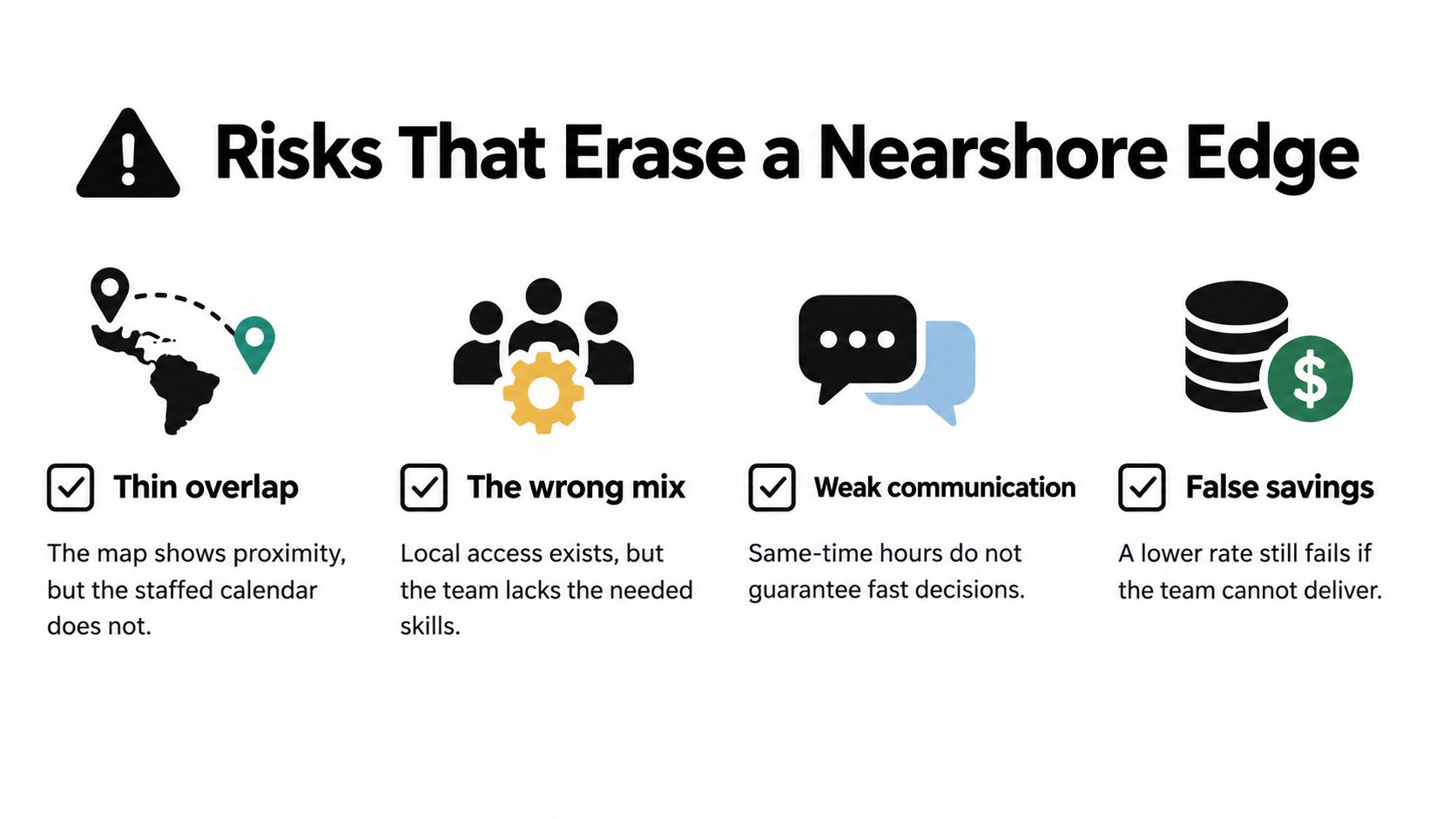
Thin overlap on a map can mean little overlap on the calendar. If the team isn't staffed during the client's decision window, a live incident or design question still waits. Seniority inflation creates a different failure: a mid-level engineer presented as senior may need more direction than the client budgeted for, slowing delivery instead of increasing capacity.
Communication can fail even when working hours line up. A candidate may list English proficiency but struggle to explain a production issue clearly, write actionable tickets, or participate in a design review. Meanwhile, if the vendor owns architecture decisions by default, security requirements and technical standards can drift away from the client's expectations.
Currency and payroll arrangements can also distort the business case. A rate quoted in one currency may shift against the budget, while management overhead, travel, or replacement time can be overlooked. Treating a role as a commodity can increase turnover risk if the work needs continuity and institutional knowledge.
Run this check before signing
Confirm scheduled overlap. Require four hours of staffed overlap, including daylight-saving weeks, and verify the actual team schedule. If that window doesn't exist, expect delays on decisions and incident response.
Run live communication and technical screens. Ask candidates to explain a system design, discuss an incident, and produce clear ticket notes. A weak result can leave the client reworking unclear requirements during a sprint.
Benchmark the specific role. Compare the offer with the correct country, seniority, skill, and employment model. A mismatched benchmark can make a mid-level profile look like a bargain senior hire.
Name production decision owners. Specify who approves architecture, security, and production changes on the client side. If no one owns those decisions, the vendor may make choices that don't fit the product or security model.
Define replacement terms. Put expectations in the agreement if a team member leaves early. Without a clear replacement path, the client can lose delivery continuity and spend time restarting the search.</li>
Treat this as a go-or-no-go test for the specific pod, not a verdict on remote work. Check the contract and working practices for intellectual-property assignment for remote contractors, and confirm that ownership, access, and delivery responsibilities are explicit before work begins.
How to Staff Nearshore Without Guesswork
Choose the hiring route based on how often you'll hire and which parts of recruiting your company can manage. In-house recruiting makes sense when your team already knows the market, can handle payroll or an employer-of-record arrangement, and has time to screen candidates. It offers direct control, but the company must supply the sourcing capacity and process.
A specialized agency fits a defined search for named roles. The agency builds a shortlist, while your engineering and HR teams retain ownership of interviews, selection, and offers. RPO is a better fit when hiring is continuous and the company wants sourcing, process management, and pipeline activity organized against an ongoing plan rather than a single requisition.
To compare those options with your own remote hiring requirements, use this guide to hiring remote developers. The right model depends on whether you need one curated shortlist or an ongoing recruiting function. Don't buy process you won't use, and don't expect a one-off search to provide continuous pipeline management.
For a specialist tech and sales recruiting option, GENTY recruitment offers skill-first shortlists, end-to-end IT and sales recruitment, RPO, and salary benchmarking through Talent Intelligence. Its stated operating reach covers Argentina, Mexico, Brazil, Chile, Colombia, Peru, and Uruguay, with searches for roles such as full-stack, DevOps, QA automation, BI, and product. The firm lists fixed fees by seniority, no upfront payment, a three-month replacement guarantee, and initial candidate pools often delivered in three to seven days.
Use RPO when hiring is ongoing and you need a recruiting process built around a continuing plan. Use IT recruitment when you need a defined technical search. In either case, agree on role criteria, seniority, communication requirements, and who makes the hiring decision before sourcing starts.
Your next step is specific: pick the role, seniority, and required overlap hours, then request a role-level salary benchmark and a shortlist against that brief.
GENTY recruitment provides skill-first tech and sales recruitment, RPO, and role-level salary benchmarking for companies assessing nearshore hiring. Visit GENTY recruitment to discuss a defined role, the seniority you need, and the working-hour overlap your team requires.