

Direct hire means the hiring company becomes the worker's legal employer from day one, taking responsibility for payroll, tax, benefits, and employment obligations. The deciding question is whose payroll and legal employment relationship begin on day one.
A strong developer in Argentina is ready to join your engineering team, and someone asks whether to hire directly or use a contractor arrangement. Don't decide based on who found the candidate or what the contract calls them. Decide who employs the person, then confirm that arrangement works under the laws where they'll work.
That distinction matters for a Series A–C company choosing how to build a team across borders. Direct hire can be supported by an outside recruiter, and it doesn't automatically mean full-time employment or guaranteed work for life. It also doesn't remove the need to check local employment rules. Use the comparisons and checks below to determine who carries the obligations, where an intermediary fits, and what to settle before making an offer. For another practical overview of the placement model, see nexus IT group's guide to direct placement.
A Plain-English Definition for Busy Hiring Leaders
The relationship matters more than the recruiting channel
Direct hire is an employment relationship, not a promise about how the candidate was sourced. Your company may find the candidate through its own team, or a recruiting partner may source and screen them. Either way, it's a direct hire if your company becomes the employer, rather than an agency employing the person and assigning them to you.
Planning a hire?
Talk through the best hiring option
This article usually leads to one practical question: should you use staffing or country guide? We can help you choose quickly.
Simple next step
Start with staffing and we will help you pick the best hiring setup.
That's why “Did we use a recruiter?” is the wrong test. Ask: whose payroll and legal employment relationship begin on day one? If the answer is your company, it's a direct employment relationship, subject to the employment structure and rules that apply in the worker's location.
The label doesn't settle cross-border compliance
For a developer in another country, direct hire doesn't tell you whether your company can employ them there through an existing entity, needs a local entity, or should use an employer of record (EOR). Those are separate legal and operational questions. The OECD distinguishes temporary work, where a job has a predetermined end date, from permanent work of unlimited duration, but the employment arrangement still needs to be understood in its local context (OECD employment-duration definitions.
Keep the decision practical: identify the legal employer, establish which entity or provider will handle employment obligations, and confirm the worker's classification and contract terms before making an offer. The comparison below helps separate recruiting support from the actual employment model. The later checklist turns that distinction into actions for a cross-border hire.
The Four Building Blocks of a Direct-Hire Relationship
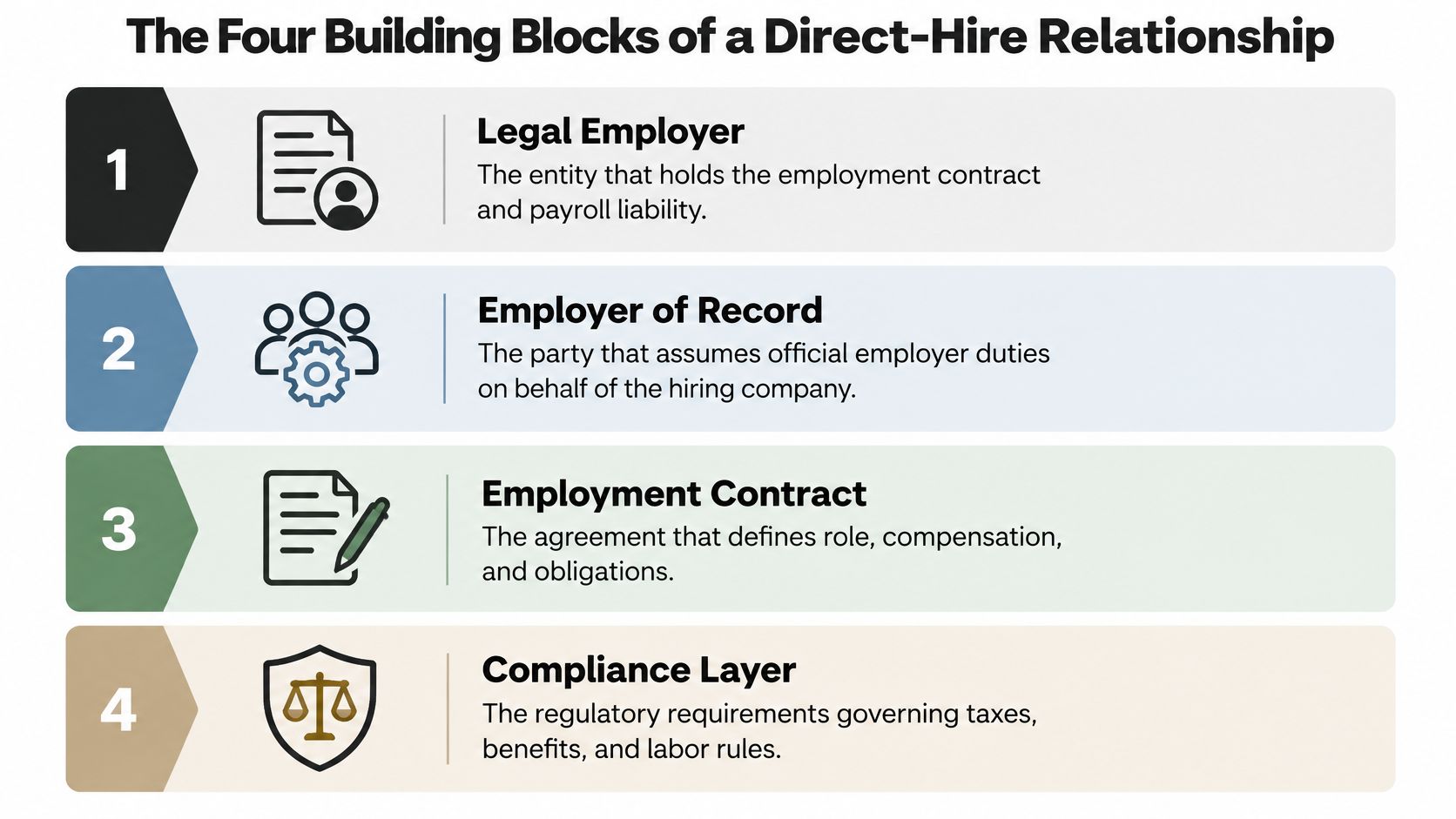
Direct hire becomes easier to assess when you break it into four questions: who employs, who handles official employer duties, what the agreement says, and which local rules apply. Consider a SaaS company hiring a senior backend developer in Argentina. The candidate's role may look like an ordinary engineering hire, but the company still has to work out which entity can employ them and manage applicable obligations.
Who employs and who pays
Legal employer means the company or authorized local provider that holds the employment relationship. In a direct hire through the company's own eligible entity, the company employs the worker. If an EOR is involved, that provider may carry the formal employment relationship under the arrangement, even while the worker performs work for your business. Confirm exactly which entity appears in the employment agreement and on payroll.
Employer of record describes the party handling official employer responsibilities under the applicable structure. Don't treat this as a label that resolves every compliance question. Confirm what the provider handles, what remains your company's responsibility, and whether the structure is lawful in the worker's jurisdiction.
What the agreement covers, and how long it lasts
The employment contract should make the role, compensation, and obligations clear. The company also needs to define who handles payroll, tax withholding, benefits eligibility, onboarding, performance management, and termination compliance. The IRS emphasizes that employment classification depends on the working relationship, not just the agreement's wording (IRS worker-classification guidance).
Direct hire doesn't necessarily mean full-time work or employment for life. A direct employee can be part-time, or employed for a fixed term where local law permits. “Permanent” means there's no predetermined end date, not that employment can never end. Before offering a role, determine whether your company can employ the developer in Argentina directly or needs a lawful local structure or EOR arrangement.
Direct Hire vs Temporary Staffing vs EOR
These models differ most in who employs the worker and who owns the employment obligations. A recruiter can source and screen someone for direct hire without employing them. Temporary staffing is different: an agency employs the worker and assigns them to a client. EOR and contractor arrangements need separate scrutiny because using either label doesn't, by itself, establish the right employment classification.
Pick a model by asking who carries the risk
For direct hire, ask: Will our company or its local entity employ the person and own employment compliance? For temporary staffing, ask: Is the worker employed by the agency and assigned to us? For an EOR or contractor arrangement, ask: Which party has the legal employment relationship, and does the actual working arrangement match its classification?
Don't confuse agency-assisted recruiting with agency employment. A recruiter can identify candidates while the client hires the selected person directly. That's distinct from temporary staffing, where the agency employs the worker. If your team is weighing recruiting support against staffing, this comparison of staffing and recruiting can help frame the sourcing decision. For a related view of employment-model costs, consult this comparison of virtual assistant and employee costs.
How the IRS and EU Test the Employment Relationship
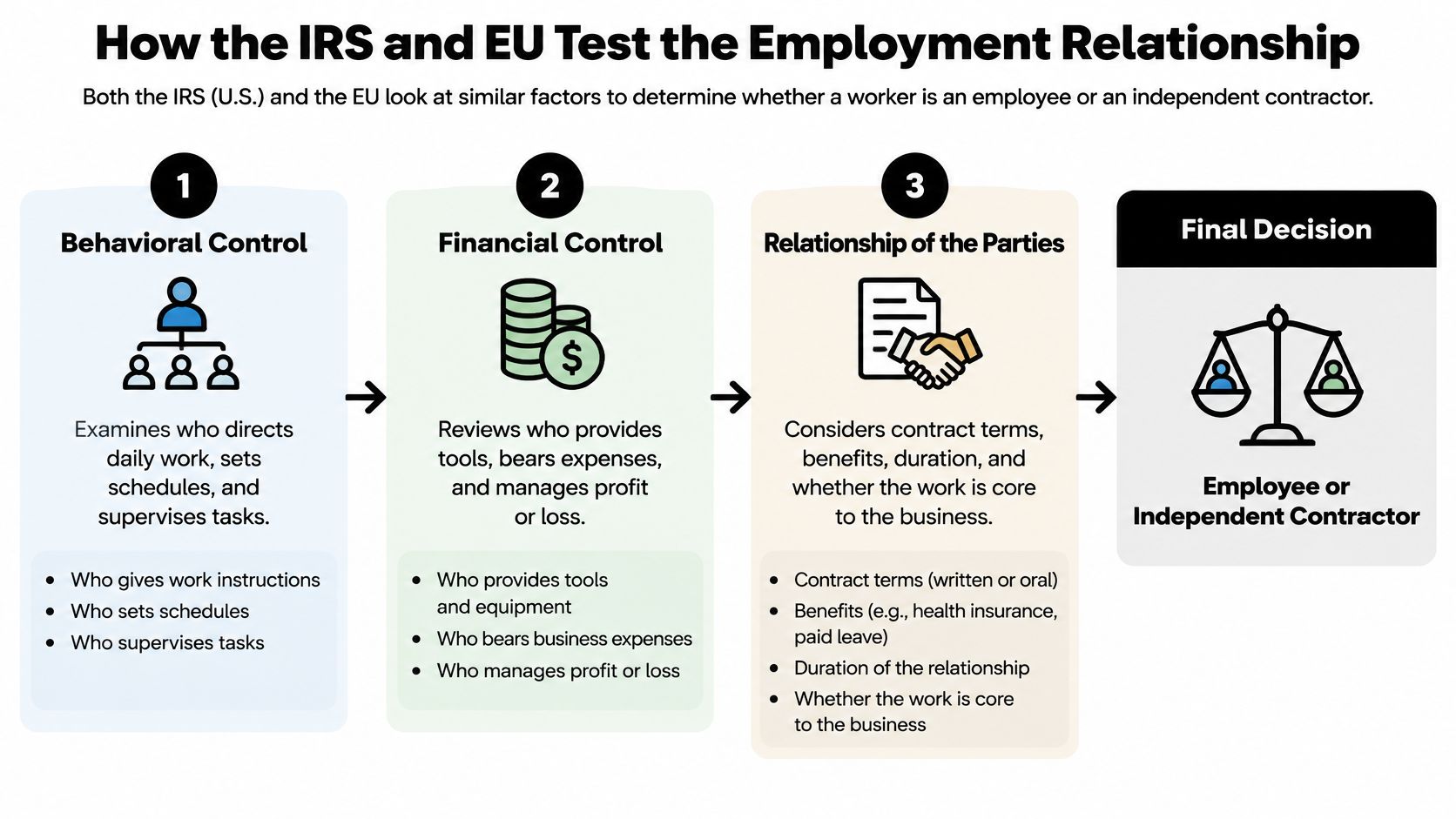
Contract labels don't override how the work is organized. In the United States, the IRS considers behavioral control, financial control, and the relationship between the parties when assessing whether someone is an employee or an independent contractor. Instructions and training can indicate behavioral control. Payment practices and expense reimbursement can inform financial control. Benefits and the expected permanence of the relationship can help show how the parties operate. A written contract is relevant, but it doesn't decide classification by itself.
Apply the tests to the work, not just the paperwork
Take a developer working with company-provided equipment, a fixed schedule, regular performance reviews, and close integration into the engineering team. Those details are important to assess; they aren't an automatic legal verdict. Review the whole working relationship under the relevant jurisdiction's rules before deciding whether employee or contractor status fits. For cross-border engagements, this guide to 1099 arrangements for foreign contractors is a useful prompt to examine classification rather than relying on a contract label.
EU temporary-agency work involves a different structure. Under Directive 2008/104/EC, the worker is employed by a temporary-work agency and assigned to a user company under that company's supervision and direction. The directive provides for basic working and employment conditions at least as favorable as those that would apply if the user company had recruited the worker directly, including pay, working time, rest periods, and holidays.
The EU also requires temporary agency workers to be informed about vacancies at the user undertaking so they have the opportunity to seek permanent employment. The Court of Justice of the European Union has addressed successive assignments that, taken together, exceed a duration reasonably considered temporary and don't correspond to a permanent employment relationship with the agency. If an assignment keeps being extended, review whether the structure still fits the work and the applicable rules. The operational test remains: identify which party carries payroll, withholding, benefits, and termination responsibilities.
A Pre-Offer Checklist for Cross-Border Tech Hires
Run these checks before you send the offer, not after the candidate signs. They help expose situations where a company has selected a worker but hasn't yet determined who can legally employ them or administer the relationship.
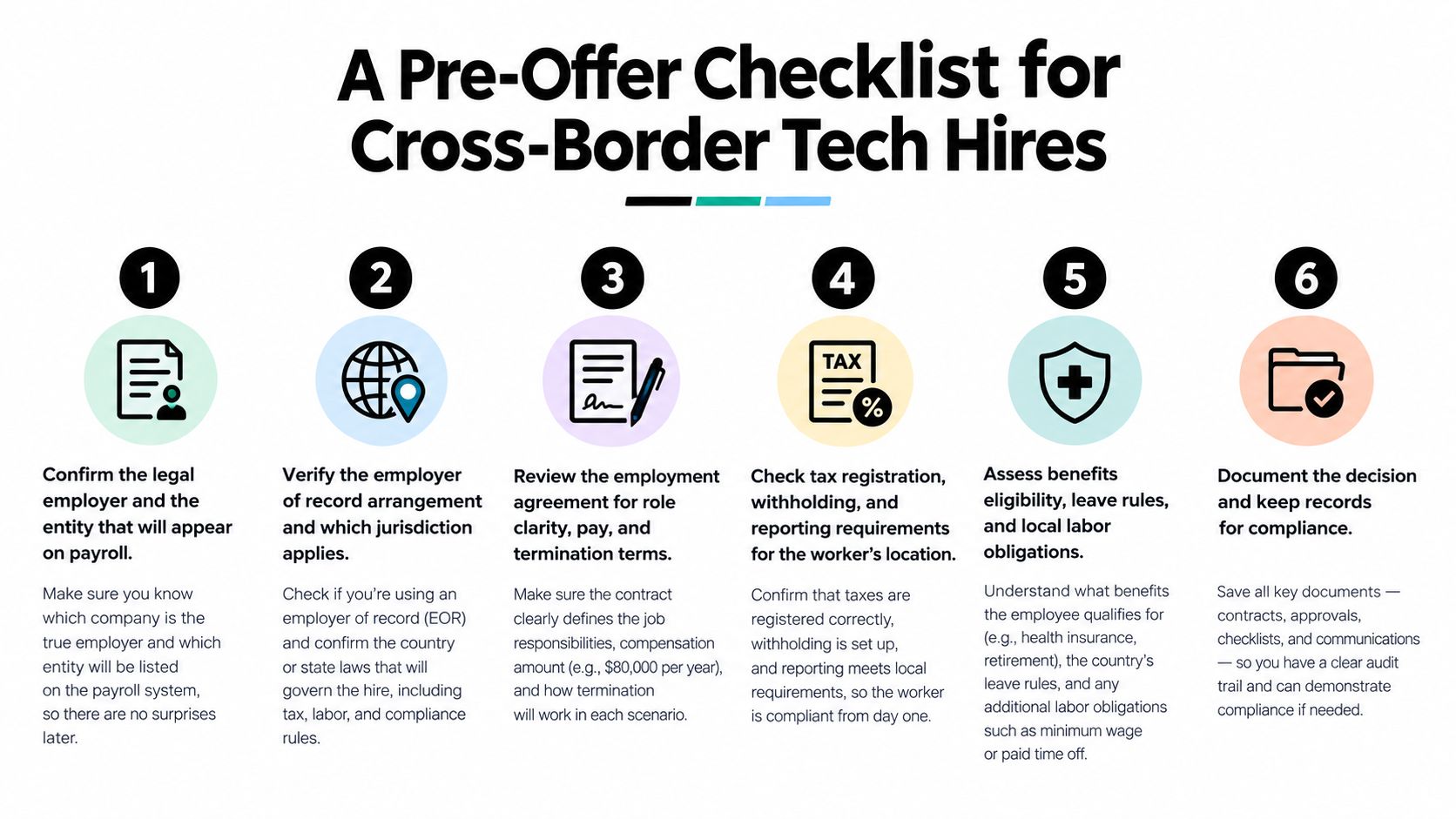
Name the legal employer. Confirm which entity will sign the agreement and appear on payroll. Don't issue an offer with the employer identity still undecided.
Validate the arrangement and location. Determine whether your company can employ the worker directly or needs a local entity or EOR. Confirm which jurisdiction's rules apply.
Check worker classification. Assess the proposed duties and actual working relationship against local requirements. Don't assume a contractor agreement is a substitute for direct employment.
Calculate total compensation and obligations. Review salary, applicable statutory benefits, leave, payroll administration, and other employment costs. Make sure the offer matches the structure you can support.
Set the terms and controls. Document the role, working hours, currency and payment mechanics, probation where applicable, and termination provisions. Address IP ownership, confidentiality, equipment, security controls, and cross-border data access.
Keep a record of the decision. Document who reviewed the employer structure, classification, and applicable requirements. Add that review to the existing offer-approval workflow so hiring managers and HR can verify it before work begins.</li>
Two errors deserve particular attention. Skipping the local-entity question can leave the company uncertain about who is permitted to employ and pay the person. Treating a contractor agreement as equivalent to direct employment can create a mismatch between the paperwork and the actual working relationship. For a broader compliance framework, use this guide to hiring compliance alongside advice specific to the worker's location.
Fees Replacement Guarantees and Pricing Models
A recruiting fee covers the search. The employment costs are yours. In a direct-hire arrangement the candidate joins your payroll from the start, so salary, taxes, and benefits sit with you while the agency invoice is a separate line item for the sourcing work. In the US market, a commonly reported direct-hire model charges approximately 20%–30% of the new employee's first-year salary (staffing agency fee overview). Treat that range as a reference point, since a contingent search means you owe the fee only if you hire a candidate the agency presented.
A fixed fee is the option I'd push for when finance needs a predictable recruiting budget. GENTY recruitment offers fixed-fee pricing by seniority level, no upfront payments, and a three-month replacement guarantee, as described on its fixed-fee recruitment agency page. For an agency-assisted search, GENTY's IT recruitment service describes the sourcing side separately from the client's direct employment relationship.
Put the commercial terms in writing
Before signing with any recruiter, confirm what the fee applies to, when it's due, whether multiple agencies can submit the same candidate, and what happens if the hire leaves. Ask whether the remedy is a replacement search or a refund, what conditions apply, and how long it lasts. A breakdown of agency fee percentages gives you market benchmarks to pressure-test any quote.
Two cautions. A replacement guarantee does not mean the hire is guaranteed to succeed, and not every departure qualifies; the written agreement controls the remedy. And if the hire is cross-border, the fee is the smaller risk. The agency's obligation ends at placement, while your classification and employer obligations continue for as long as the person works for you.
Fixed pricing is easier to approve when budgets are tight. A percentage fee works when the fee basis and trigger are clearly defined. Compare the written terms, not the headline price.
Choosing the Right Model for Your Hiring Stage
Choose the model based on hiring stage, role type, and cross-border complexity. If the role is central to your product and the country is a long-term hiring market, direct employment through a suitable local entity may be the clearest default. For an initial hire where the company doesn't have its own local structure, assess whether an EOR can support the employment arrangement. For work that is independent and project-based, contracting may fit, provided the actual relationship and local rules support that classification.
For an early team that needs sourcing help but wants the candidate to join the company directly, agency-assisted direct hire separates recruiting from employment. When your hiring volume becomes ongoing rather than a set of isolated searches, an RPO service is another model to evaluate. It can provide recruiting-process support without changing the central question of who employs each person.

For a broader view of the employment structures available to companies building teams in the region, see this overview of global hiring models for Latin America tech recruiting. Then compare the practical trade-offs: your existing entity and compliance capacity, the role's expected duration, and whether the work is integrated into your operating team.
For US and European companies hiring across LATAM, a nearshore team can work well when the role requires regular collaboration with the core team. Make the decision on the employment structure before treating location or recruiter involvement as the deciding factor. The final test is whose payroll and legal employment relationship begin on day one.
GENTY recruitment supports tech and sales hiring across Latin America through candidate sourcing, screening, and direct-hire placements, with fixed-fee pricing and replacement terms. If you're deciding how to structure a cross-border search, visit GENTY recruitment to discuss the hiring model and recruitment support that fit your team.