

The popular advice is simple: move recruiting offshore, pay less, and fill roles faster. That framing is incomplete. Offshore recruitment process outsourcing works best as a capacity-and-speed model, not as a substitute for hiring judgment. A provider can run sourcing, talent mapping, screening, interview coordination, reporting, and pipeline management from another country, while your engineering or business leaders retain technical assessment, offers, and final hiring authority. The key question is whether you can design that division of labor without losing control of candidate data, standards, or accountability.
For a Series A to Series C technology company, the model becomes valuable when internal recruiters and hiring managers are overwhelmed by repeatable execution. The provider removes bottlenecks, extends sourcing capacity, and keeps candidates moving. It doesn't remove the need for a clear intake process, measurable service levels, or disciplined governance.
Rethinking Offshore Recruitment Process Outsourcing
Cost matters, but it shouldn't be the operating thesis. If a provider sends more resumes without improving qualified interview flow, the company hasn't created capacity. It has created more review work for engineers and managers.
A better definition is delegating repeatable recruitment execution to an external team while keeping employment decisions inside the business. The offshore team may identify full-stack developers, build talent maps, conduct initial screens, coordinate interviews, and maintain the pipeline. Your technical leaders still decide whether a candidate can design systems, debug production issues, collaborate with the team, and meet the role's actual requirements.
Planning a hire?
Talk through the best hiring option
This article usually leads to one practical question: should you use rpo or it recruitment? We can help you choose quickly.
The global RPO market was valued at USD 7.33 billion in 2022 and projected to reach USD 24.32 billion by 2030, implying a 16.1% CAGR from 2023 to 2030, according to the market figures compiled by World Metrics. A separate estimate placed the market at USD 9.7 billion in 2024 and forecast USD 22.9 billion by 2030, with a 15.4% CAGR from the cited source. The exact market boundary varies by report, but both estimates point to sustained adoption rather than a temporary staffing experiment.
The bottleneck is usually execution
Technical hiring slows down in predictable places. A hiring manager writes an underspecified brief, sourcing starts before the role is calibrated, recruiters submit candidates against keywords, interviewers respond late, and strong candidates leave the process before a decision is made.
Offshore RPO can address the execution layer, but only when the workflow is explicit. The provider needs a usable role profile, decision rules for screening, access to approved systems, and a defined escalation path. Without those inputs, the vendor guesses. Guessing produces volume, not quality.
Practical rule: Outsource the work that is repeatable. Keep the decisions that carry technical, employment, and reputational risk close to the business.
Companies evaluating the model should distinguish between offshore delivery and offshore decision-making. A provider can accelerate a search without owning the hiring standard. A useful primer on how organizations scale hiring with RPO can help leaders understand the broader model, but technical teams still need to tailor responsibilities to their own engineering process.
The strongest use cases involve recurring demand, stable role definitions, and enough hiring activity to justify a dedicated operating rhythm. Full-stack engineering, QA automation, DevOps, sales development, and other repeatable searches often fit better than a single confidential executive search or a role whose requirements change every few days.
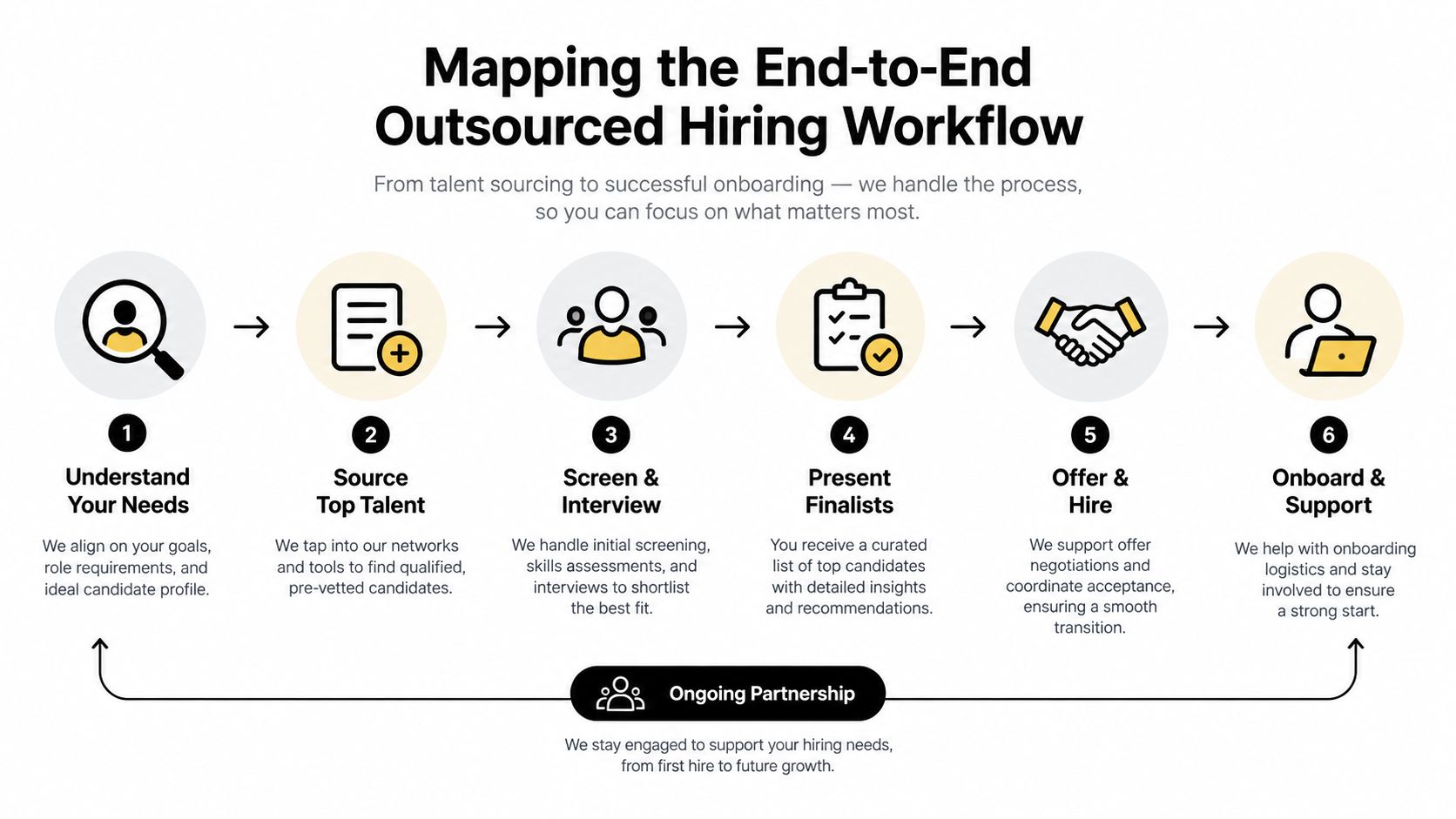
Mapping the End-to-End Outsourced Hiring Workflow
An offshore hiring program should be mapped before the contract is signed. The provider's responsibilities must end at a deliberate point, not wherever communication becomes difficult.
Start with a controlled intake
The workflow begins with consultation and role planning. The intake should capture the role's mission, must-have skills, salary range, time zone, language needs, reporting line, interview stages, and evidence of success. The WiseMonk offshore recruitment guide describes this progression from planning through sourcing, screening, interviews, offers, onboarding, and ongoing support.
For a technical role, add the information recruiters usually miss: the production environment, expected on-call responsibilities, seniority signals, acceptable adjacent experience, and the reasons previous candidates failed. A provider can't screen accurately against an abstract phrase such as “strong backend engineer.” It needs observable evidence, such as experience operating distributed services or making trade-offs under load.
The split should look something like this:
Candidate information should be segmented by role. Candidate PII, compensation details, interview notes, and client IP shouldn't sit in one undifferentiated vendor workspace. Define who can see each category, where it can be stored, how long it remains available, and who deletes it when the engagement ends.
A recruiting coordination tool can reduce calendar friction, but it won't solve ownership ambiguity. Teams considering automation can review the SyncThemCalendars recruiting use case, while leaders building the broader operating model can use GENTY's RPO recruitment process guide as a reference point for pipeline stages and coordination responsibilities.
Keep the decision boundary visible
The provider should accelerate throughput up to a defined handoff. For example, it can qualify a candidate against the approved intake and arrange the technical interview. The engineering panel then owns assessment, feedback, and the final recommendation. HR or the hiring manager owns compensation approval and the employment decision.
That boundary protects quality because the people closest to the work remain accountable for judgment. It also gives the vendor a clear operating target, which is far easier to manage than a vague requirement to “own hiring.”
Cost Benchmarks and Engagement Models Compared
The financial case for offshore RPO rests on two mechanisms: labor arbitrage and process standardization. Lower-cost delivery markets can support sourcing, screening, and scheduling capacity at a different cost structure, while repeatable workflows reduce the effort required for each search.
Benchmark data cited by Recruitment Process Outsourcing Media places offshore RPO for volume recruitment commonly around USD 1,000 to 3,500 per hire. The same source places onshore US RPO for professional and specialist roles at USD 3,000 to well over 10,000 per hire. These figures are benchmarks, not a promise. Role complexity, market scarcity, service scope, replacement terms, and hiring volume can change the commercial outcome.
The same source attributes mature offshore delivery with potential time-to-fill reductions of roughly 25% to 40%, driven by extended-hour sourcing, pre-screening, scheduling, and standardized processes. A finance leader should still test what “time-to-fill” includes, whether the measure ends at acceptance or starts at vacancy demand, and whether quality is being protected.
RPO engagement model comparison
An engagement can be structured around a dedicated team, a project, a recurring requisition volume, or a fixed fee per hire. The right choice depends on demand predictability. A dedicated model can make sense when the company has a steady stream of similar roles. A project model limits commitment during a hiring spike. A fixed-fee arrangement creates cost visibility, but the agreement must define what counts as a completed search, what happens when requirements change, and whether replacement support is included.
Pricing structure deserves the same scrutiny as sourcing capability. A fixed-fee recruiting model can be easier to budget than contingency pricing, but transparency alone doesn't guarantee performance. Ask for the expected workflow, decision rights, reporting cadence, and quality controls alongside the fee.
Hidden cost changes the calculation
A cheap submission is expensive if engineers spend hours rejecting irrelevant profiles. Miscommunication creates rework. Weak intake produces poor targeting. Slow feedback extends candidate exposure to competing employers. Data-handling failures can create legal and operational costs that aren't visible in the original proposal.
Offshore RPO therefore needs a broader business case than cost per hire. Compare qualified interview conversion, hiring manager time, time-to-hire, offer acceptance, candidate experience, and early performance. If the vendor optimizes only submissions, the program may look productive while the engineering organization absorbs the waste.
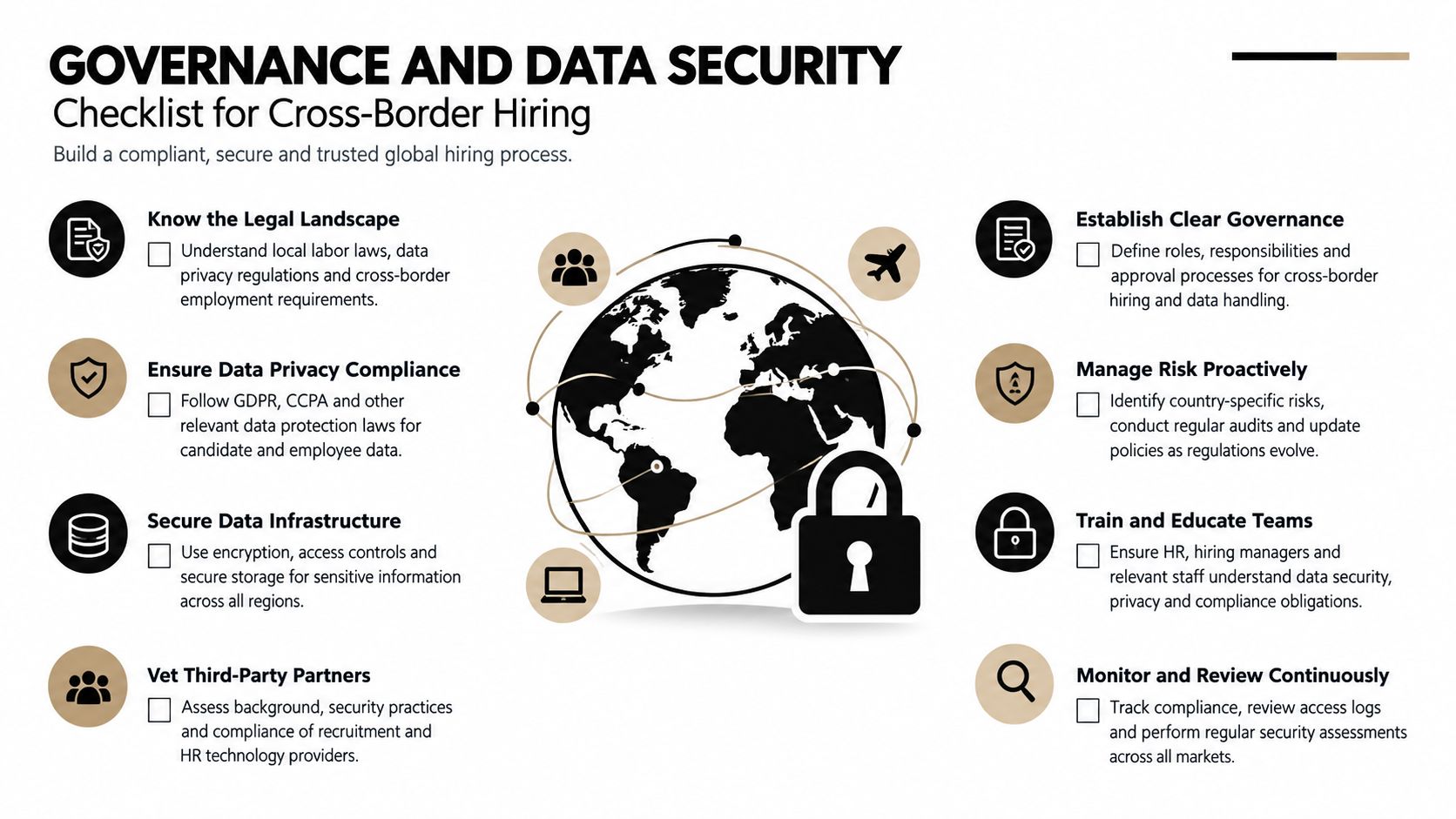
Governance and Data Security in Cross-Border Hiring
Cross-border recruiting is a vendor-design problem. The company must know which provider role can access which data, in which system, from which location, for how long, and under whose authority.
Candidate records may include identity details, contact information, compensation expectations, interview notes, work authorization information, and other sensitive employment data. The Qualigence guidance on overseas recruiting risks emphasizes the need to map candidate PII, compensation details, interview notes, and client IP by vendor role, then define storage region, transfer, retention, deletion, and breach ownership contractually.
Put ownership in writing
A RACI framework is a practical starting point. Assign who is responsible for execution, accountable for the outcome, consulted before a decision, and informed after it. Apply it to role approval, candidate access, screening exceptions, technical interviews, compensation, offers, data deletion, and incident response.
The contract should also define:
Access boundaries: Use role-based access and limit vendor permissions to the systems and records required for the assigned work.
Data location: Specify permitted storage regions and cross-border transfer requirements.
Subprocessors: Require disclosure and approval rules for any third party that can access candidate or client information.
Retention and deletion: Define retention periods, deletion requests, offboarding actions, and evidence that deletion occurred.
Incident response: Assign breach notification duties, escalation contacts, investigation responsibilities, and remediation ownership.
Audit artifacts: Require logs, access records, screening documentation, and service reports that allow the client to verify performance.</li>
The operating cadence matters as much as the legal language. Hold weekly pipeline reviews with a fixed agenda: open roles, stage movement, blocked decisions, slate quality, aging candidates, feedback latency, and escalations. Define escalation triggers in advance, such as repeated rejection for the same calibration issue, a missing hiring manager decision, an unauthorized data-access event, or a material change to role requirements.
A practical overview of hiring compliance for HR leaders can help teams build the internal checklist, but compliance ownership shouldn't be outsourced by default. The client remains responsible for deciding what the organization is willing to accept and how employment risk is controlled.
Governance principle: If nobody can explain who owns a candidate record, a hiring decision, or a breach notification, the operating model isn't ready.
Use the following video as a supplementary visual prompt for discussing cross-border controls with stakeholders:
The Strategic Shift to LATAM Nearshore Tech Talent
Traditional offshore delivery can reduce cost, but technical hiring depends on more than lower labor rates. Engineers need live clarification on architecture, product context, interview expectations, and team practices. When the provider and client work in sharply different working hours, every unanswered question waits for another day.
LATAM nearshore RPO offers a different trade-off. US and European companies can work with recruiting teams that are closer to their operating hours, which makes intake calibration, technical interviews, pair-programming discussions, and hiring-manager feedback easier to run synchronously. Strong English proficiency and cultural familiarity can also reduce the translation burden, although those qualities still need to be assessed role by role.

Optimize for collaboration, not geography alone
A nearshore model doesn't automatically produce better candidates. It creates a better environment for rapid calibration and collaboration when the provider has regional knowledge and the client participates consistently.
For engineering teams, that means the recruiter can ask a hiring manager about a borderline profile while the role is still active. The provider can prepare a candidate for a live technical discussion without relying on a long chain of asynchronous messages. Interview panels can surface a concern and request clarification before the candidate disappears from the process.
The advantage becomes especially clear for roles such as full-stack development, DevOps, QA automation, and product engineering. These searches often require nuanced evaluation of systems experience, production ownership, communication, and practical trade-offs. A recruiter who understands the regional talent market can distinguish between a keyword match and a credible technical profile.
Nearshore still needs discipline
Time-zone alignment won't repair a weak brief or an inconsistent interview panel. The client must still define the role mission, approve the screening rubric, provide timely feedback, and keep compensation expectations realistic for the target market.
A useful decision framework is to compare the cost of coordination with the value of synchronous work. If a role requires frequent stakeholder interaction and rapid technical clarification, nearshore may justify a higher delivery cost than a distant offshore model. If the work involves repeatable sourcing and tightly standardized screening, a more distributed offshore setup may remain practical.
The offshore versus nearshore comparison from GENTY offers a useful lens for making that distinction. The answer isn't that one geography always wins. The answer depends on where the process needs speed, where the data can be handled safely, and where the business must retain direct control.
Vendor Selection and Performance Metrics
A vendor's sales presentation tells you less than its operating evidence. Ask to see a sample intake form, screening scorecard, anonymized pipeline report, escalation policy, and technical-role calibration process. A provider that can't explain how it rejects weak profiles before they reach an engineer is likely selling activity rather than outcomes.
Test the operating system
Evaluate the partner against four practical questions:
Can it understand technical requirements? Ask how the team screens for architecture ownership, cloud operations, testing depth, and production responsibility rather than matching job-title keywords.
Can it show its work? Require stage definitions, candidate notes, source tracking, feedback records, and clear reporting.
Can it price the engagement clearly? Review fixed fees, payment timing, scope changes, replacement terms, and any charges for additional services.
Can it protect information? Confirm role-based access, data residency, subprocessors, retention, deletion, and breach obligations before sharing candidate records.</li>
A contingency agency can be useful for a rare search, but an RPO partner should operate as an integrated extension of the hiring function. That means participating in calibration, maintaining a consistent pipeline, coordinating stakeholders, and accepting measurement beyond resume delivery.
Measure conversion and quality
The CollarSearch service-level glossary identifies time-to-hire, quality of hire, candidate satisfaction, and hiring manager satisfaction as common RPO metrics. Time-to-hire can run from vacancy demand to the candidate's first day, while quality of hire is often assessed through retention or performance reviews.
Track the funnel with enough detail to diagnose failure:
Time-to-shortlist: Measures provider execution after an approved intake.
Slate quality: Records how many submitted candidates meet the agreed must-have criteria.
Interview conversion: Shows whether the shortlist survives technical evaluation.
Feedback latency: Identifies internal delays that the provider can't solve alone.
Offer acceptance: Tests alignment between role, compensation, candidate expectations, and process communication.
Quality of hire: Connects recruitment activity to subsequent performance and retention signals.
Candidate satisfaction: Exposes communication failures that may damage the employer brand.
Hiring manager satisfaction: Tests whether the team receives useful candidates and timely support.</li>
Don't use submissions as the primary success metric. A smaller slate with strong interview conversion is more valuable than a large queue that forces engineers to repeat screening work.
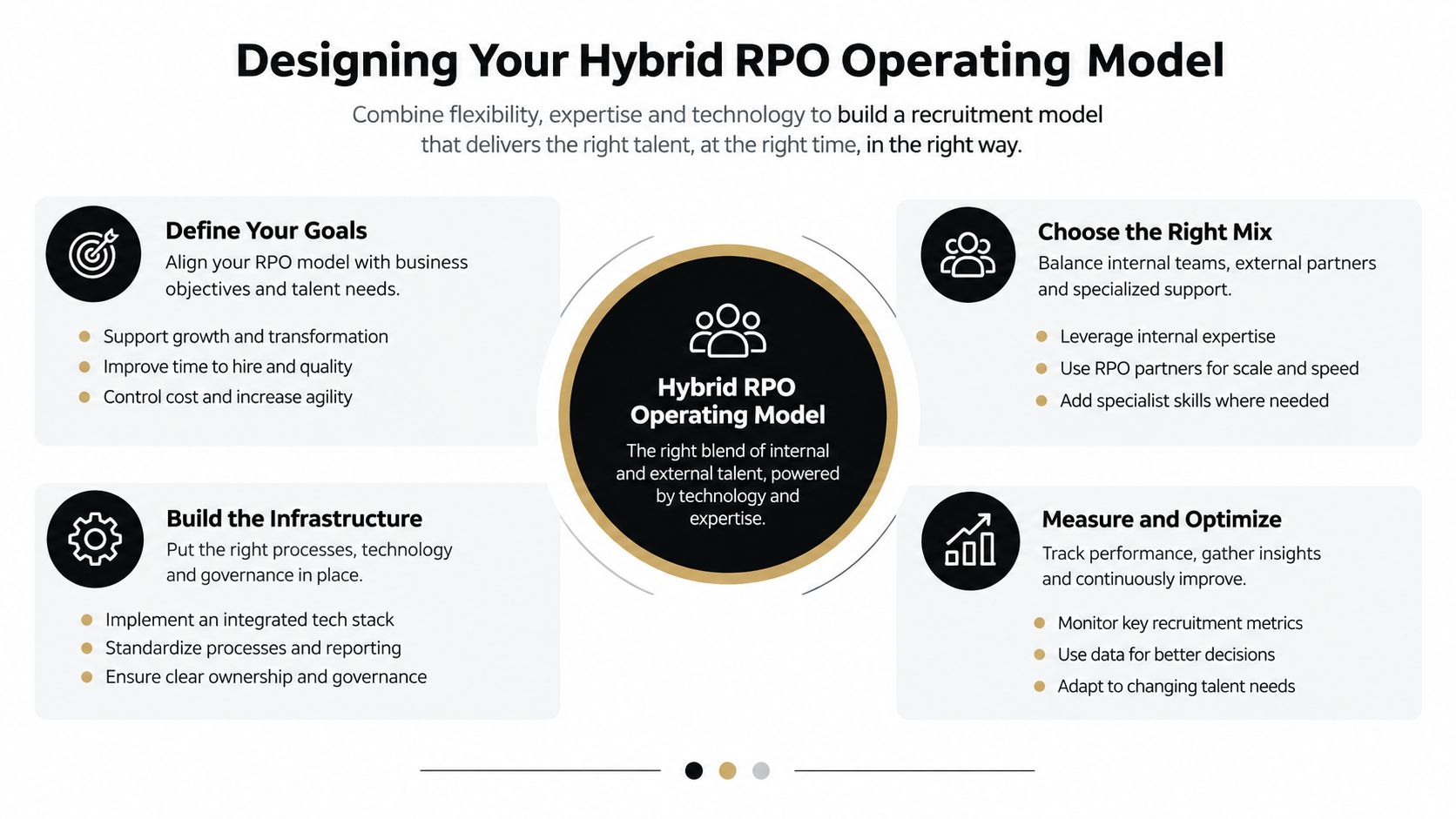
Designing Your Hybrid RPO Operating Model
A hybrid model gives the company a deliberate way to combine external execution with internal judgment. Start with roles that have repeatable requirements and visible demand. Keep role approval, technical assessment, compensation, offers, and final decisions inside the company.
A practical rollout sequence
Choose a bounded pilot. Select a defined group of recurring roles, an accountable internal owner, and a short list of approved systems.
Calibrate before scaling. Review early profiles with engineering leaders, document rejection reasons, and update the scorecard before increasing sourcing volume.
Run the weekly control loop. Review pipeline movement, slate quality, interview conversion, candidate experience, and unresolved decisions.
Expand by evidence. Add niche roles only after the provider demonstrates consistent understanding of the existing hiring standard and reliable data handling.</li>
The model should feel like an operating system, not a black box. The external team handles orchestration and workforce intelligence around the pipeline. Internal leaders retain the authority that affects architecture, team composition, compensation, and employment risk.
For a CTO or HR Director, the decision is straightforward: outsource execution where it creates capacity, keep judgment where it protects quality, and make every handoff measurable. That approach turns offshore RPO from a generic cost initiative into a controlled hiring capability.
GENTY recruitment provides RPO, IT and sales recruitment, salary benchmarking, and talent intelligence for companies building technical teams across Latin America. Visit GENTY recruitment to discuss a governed nearshore or hybrid hiring model for your next engineering or sales hiring phase.