

U.S. employers are projected to have approximately 19 million job openings annually across all occupations from 2024 through 2034, according to the Bureau of Labor Statistics. But filling seats isn't the same as adding revenue capacity. For a growth-stage technology company, sales and recruitment should operate from one calendar: decide when sellers must become productive, work backward through ramp and hiring, and assess candidates against the work that produces qualified pipeline and closed revenue.
Sales Roles to Hire and What Each Takes to Ramp
A sales hiring plan is a capacity plan, not a list of approved positions. A new rep may contribute during onboarding, but you shouldn't budget full production before they can execute your sales motion independently.
Sales roles by function, ramp and projected growth
The BLS occupational projections project sales engineer employment growing from 56,800 in 2024 to 59,900 in 2034, an increase of 5.5%, and approximately 1.7 million sales-occupation openings annually during 2025–35, primarily to replace workers who leave. Expansion isn't your only hiring requirement. Replacement searches need room in the calendar too.
Hire against the bottleneck
If sellers have capacity but insufficient qualified conversations, define the prospecting ownership and qualification standard before opening an SDR or BDR search. If opportunities stall at technical validation, another closer won't remove the obstacle.
What do you need?
Choose the hiring path that fits
After reading "Sales and Recruitment: How to Hire Sales Teams That Scale", most teams compare these options before deciding how to hire.
When you haven't validated an outbound motion, compare the management commitment with an alternative to an in-house SDR from Ever Outbound Inc. Use that comparison to decide whether you need permanent internal capability or a bounded prospecting test.
Hiring rule: Choose the role that closes the largest gap between pipeline created and pipeline closed, not the most visible title.
How to Build a Sales Hiring Pipeline Step by Step
Give every opening an owner, a required productive month and a documented decision standard. Otherwise, recruiters optimize for available candidates while sales leaders expect a different profile.
Set the capacity model. Specify ramped reps needed by quarter, expected ramp length and expected attainment. The common slip is approving a start date without checking whether the seller can contribute before the revenue deadline.
Write the role scorecard. Choose five to seven observable competencies, such as discovery quality, qualification accuracy, prospecting discipline and CRM hygiene. Sourcing before this exists produces candidates the hiring manager rejects for reasons nobody wrote down.
Source by channel. Tag referrals, outbound prospects and job-board applicants separately in your applicant tracking system. Don't judge channels by application volume when the useful measure is qualified candidates who advance.
Run a short skills screen. Use a written qualification exercise based on a realistic prospect response. Keep it brief and job-relevant, rather than turning an initial screen into unpaid account research.
Interview against the scorecard. Advance shortlisted candidates through consistent exercises and independent scoring. Don't add an informal executive conversation that can overturn evidence without a documented reason.
Make the offer and schedule the review. Write down ramp expectations, manager support and a 90-day review before the candidate joins. Skipping that review hides whether weak progress comes from selection, onboarding or missing sales infrastructure.
The workflow should make ownership and advancement criteria visible.
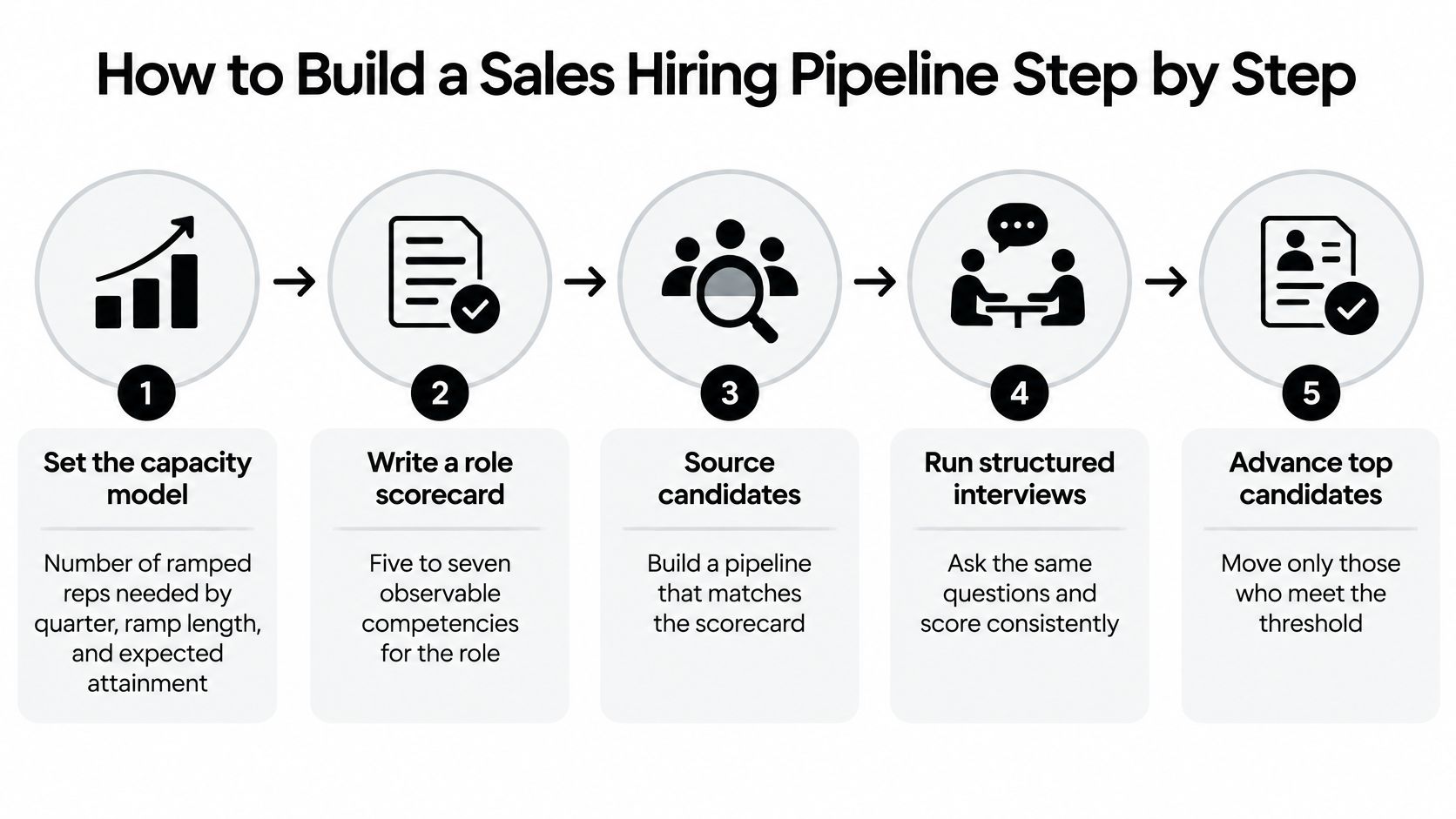
Stage conversions to monitor in the sales hiring pipeline
Track offers issued per finalist separately from offers accepted per offer issued. Combining them makes an internal approval problem look like candidate rejection.
Assess Sales Candidates on Demonstrable Skills
Structured interviews predict job performance substantially better than unstructured conversations. That gap matters for more than accuracy. A scored exercise also tells you how quickly a candidate is likely to carry quota, which is the variable a ramp-adjusted capacity plan prices.
Identical questions, predefined rubrics and documented evidence reduce interviewer discretion. Run the interview as a rehearsal of the work the hire will do in their first ramp months, and score it against the same standard every time.

Turn each competency into an exercise
Give an SDR a live cold-call role-play. Score the opener, the response to an objection and the ability to secure a clear next step. Confidence and accent tell you nothing about whether they will book meetings once they start.
Give an AE a realistic account brief and run discovery. Look for qualification accuracy, the buying-process questions left unanswered and whether the proposed next step follows from the buyer's situation.
Ask a sales engineer to explain a technical concept to a mixed audience. Score accuracy and clarity separately, since polished delivery can hide incorrect claims.
For question design, Captiwate's guide to sales interview questions works as a prompt library. Convert each useful question into a scored competency before using it, and anchor the rubric to the qualities that distinguish strong salespeople over vague personality preferences.
Make evidence mandatory
OECD research on technology talent shortages found that 74% of surveyed organisations had heard of skills-first approaches and 62% used them, while only 17% applied them specifically to hiring and recruitment. Recognition isn't implementation, and the gap shows up as hires who interview well and ramp slowly.
Use this rubric checklist:
Definition: Describe the behavior the competency measures.
Scoring anchors: Define observable performance at scores of 1, 3 and 5.
Evidence note: Require a specific answer or action supporting each score.
Independent judgment: Have panelists score before discussing candidates.</li>
GENTY recruitment evaluates candidates on this basis, combining structured assessment with hands-on recruiting expertise to reduce time-to-hire without sacrificing quality.
Treat each exercise result as a ramp forecast. A candidate who scores 5 on discovery but 2 on process discipline may still miss the month your plan assigns quota, so weigh the score against where the role becomes productive.
Sales Recruiting Metrics That Show Real Capacity
Headcount is the wrong unit for revenue planning. Model productive capacity as hires multiplied by expected production for each month of tenure, rather than assigning full quota to everyone on payroll.
The Haus Advisors benchmark summary reports 66% AE quota attainment and an average AE ramp of 5.3 months in one cited dataset. Treat those figures as reference points, not promises about your segment, territory or onboarding program.
Sales recruiting metrics, formulas and reference points
Don't confuse the share of reps reaching quota with average quota attainment. Use actual production distributions to forecast revenue, including partial attainment, rather than treating every seller below quota as producing nothing.
Apply the calendar to the economics
Suppose an AE joins in March with a hypothetical five-month ramp. Plan for limited contribution before roughly August, with explicit intermediate milestones for account planning, qualified pipeline and independently managed deals.
Budget salary, commissions, recruiting fees, enablement and manager time across that gap. To assess payback, compare cumulative contribution margin from the hire's sales with cumulative hiring and employment costs, not bookings alone.
Separate ramping employees from steady-state sellers, then segment by cohort, manager, channel and territory. Review sales hiring timelines against the required start date rather than treating an accepted offer as the finish line.
A seller who misses target in an unworkable territory doesn't automatically prove that recruitment failed.
Each quarter, compare interview scores with early ramp progress. Remove criteria that don't distinguish stronger outcomes, while checking whether managers delivered the promised onboarding.
Where LATAM Nearshore Sales Teams Fit
Nearshore hiring can provide overlap with U.S. business hours, making it practical to cover morning prospecting and afternoon buyer conversations within the same working day. Confirm the actual schedule, including daylight-saving changes, rather than assuming a country name guarantees coverage.
Mexico, Brazil, Colombia, Argentina, Chile and Uruguay are sourcing options. Start with customer language, working hours and selling experience, then choose the market, not the reverse.
Assess collaboration requirements alongside customer-facing coverage.

Price the role, not the region
Cost advantage isn't a fixed discount. Interfell's review of regional technology recruitment trends describes declines of as much as 16% in some senior-engineer salaries, while demand for AI, cybersecurity and cloud specialists remained strong.
That is engineering compensation evidence, not an SDR or AE salary benchmark. Price those roles separately, and distinguish a technically fluent seller from an engineer moving into presales.
A nearshore hiring assessment should include these checks:
Refresh compensation. Confirm the country-specific salary band for the role this quarter, including base pay and realistic variable earnings.
Verify coverage. Establish availability for the customer's first call and the team's internal handoffs.
Test customer language. Use a discovery exercise and written follow-up in the language buyers use.
Budget total exposure. Include currency movements, benefits, equipment, payroll arrangements and replacement risk.</li>
Refresh salary benchmarks at least quarterly as an operating discipline. A cheaper accepted offer isn't a saving if the compensation structure makes retention or quota execution unrealistic.
Classify Remote Sales Hires Correctly From the Start
A contractor label or a 1099-style payment doesn't settle worker status. The U.S. Department of Labor warns that working from home, signing an independent-contractor agreement or following industry practice doesn't automatically establish contractor status, as explained by USA.gov's worker misclassification guidance; employers may owe unpaid wages, liquidated damages equal to back wages and civil money penalties.
The Department's classification rule guidance describes an economic-reality analysis covering opportunity for profit or loss, control, permanence, investment, skill and initiative, and whether the work is integral to the business. It identifies the rule published on January 10, 2024, with an effective date of March 11, 2024; confirm current rule text and enforcement posture with counsel before relying on it.
Review the actual working relationship
Daily control: Who sets call targets, scripts, schedules and required methods?
Exclusivity: Can the person serve other clients in practice?
Continuity: Is this an ongoing sales position or a defined project?
Business integration: Is the person performing core work within your sales operation?
Independent business: Does the worker make meaningful commercial decisions and investments?</li>
These are review prompts, not a classification test you can resolve by counting answers. For work performed abroad, counsel must also determine which laws apply; U.S. guidance alone doesn't resolve foreign employment obligations.
Separate selection from classification
Complete candidate selection, then obtain jurisdiction-specific legal and payroll advice before setting the contract type. European employers should apply the same discipline under relevant local rules.
Use a foreign-contractor classification review to prepare questions, not replace legal advice. Put payroll readiness on the hiring calendar so the candidate can start under a workable arrangement.
Choose Your Sales Hiring Model for Next Quarter
For a growth-stage company with an expanding hiring plan but limited recruiter capacity, I would consider RPO when several connected roles require coordinated sourcing and assessment. Use an agency for an occasional senior search. Keep recruiting in-house when your existing team can sustain the workload without delaying the productive-start calendar.
Sales hiring models compared
Retain final approval over candidate selection unless you explicitly delegate it. Outsourcing coordination doesn't mean giving up ownership of the revenue assumptions, role requirements or assessment threshold.
Compare delivery models by the work you need someone else to own.
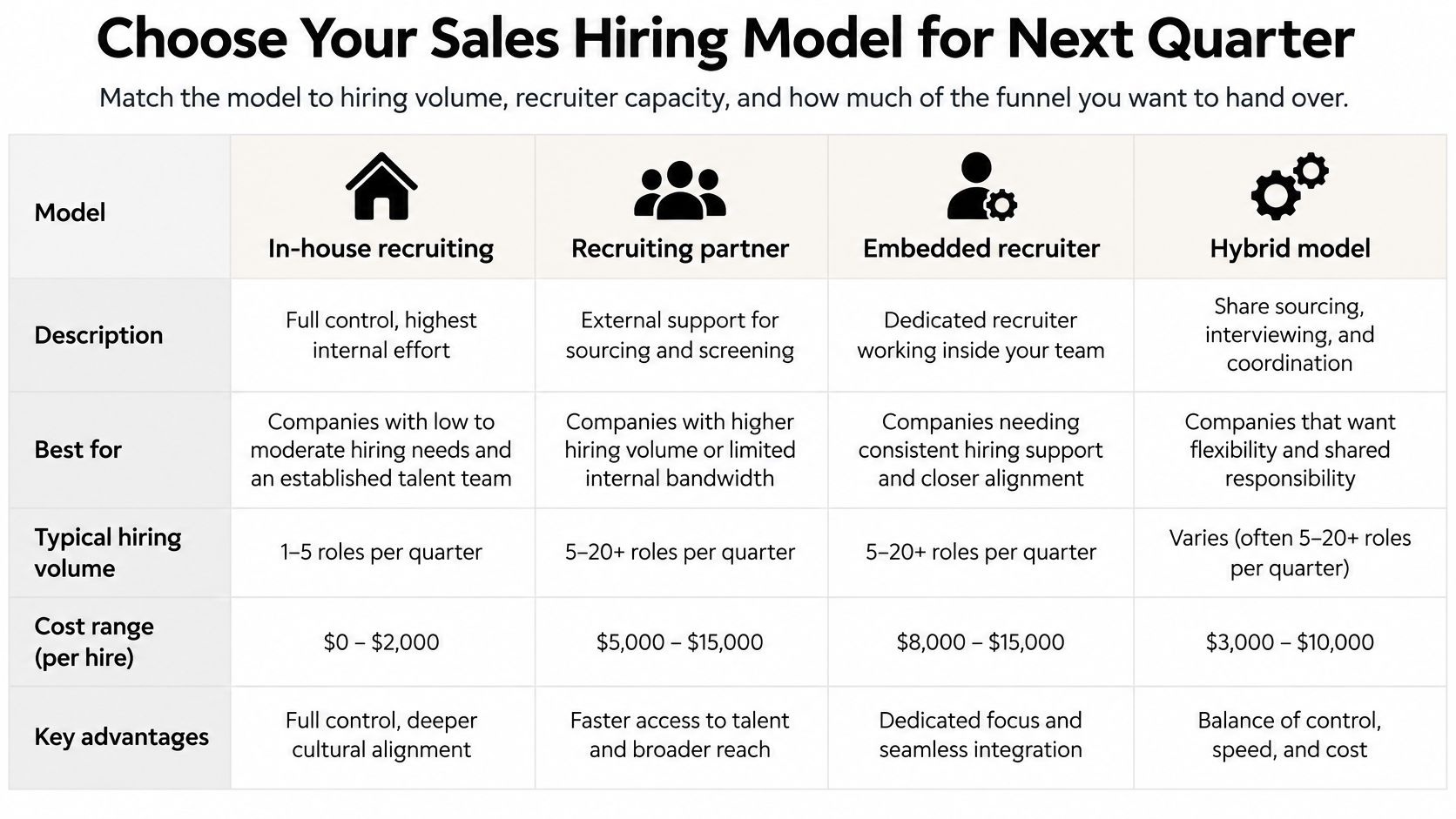
Match commercial terms to delivery risk
A fast shortlist has little value if nobody can explain why candidates passed. Request anonymized scorecards, exercise outputs and the proposed reporting cadence, then assess whether the provider can distinguish prospecting skill from closing skill.
At GENTY recruitment, our RPO service covers the full hiring process with an expert team, while our staffing service includes hiring, onboarding and managing professionals. Either arrangement can support this pipeline, with the client owning the capacity model and defining the required outcomes.
Each Recruitment service includes a dedicated recruiter assigned to the client. We have no upfront payments, clients pay on results, and our sales recruitment includes a replacement guarantee.
Payment on results reduces early financial exposure, but it doesn't eliminate your management responsibilities. Agree how decisions will be made, who supplies interview feedback and what evidence establishes satisfactory ramp progress.
Commercial discipline: Treat recruiter allocation, payment triggers and replacement terms as operating commitments, not sales language.
Before approving the next search, take three actions:
Write the role scorecard. Define the work, assessment evidence and minimum acceptable performance.
Set the capacity calendar. Model the next two quarters, including vacancy time, onboarding and expected production.
Compare delivery evidence. Send both documents to two providers and ask them to show how their interviews would test the requirements.</li>
GENTY recruitment offers skill-first sales hiring, RPO and staffing to help you build a team against a productive-capacity plan rather than a headcount target. Visit GENTY recruitment with your role scorecard and required productive-start dates to discuss sourcing, assessment and delivery ownership.